President Donald Trump has sharply raised the stakes in the preparations for the United States’ 250th anniversary by publicly sharing detailed renderings of a proposed triumphal arch he wants erected in Washington, D.C. The structure, informally known as the “Arc de Trump,” would be a new architectural landmark intended to commemorate the 250th Anniversary celebration of American independence.
A Monumental Vision With Historical Echoes
Architect Nicolas Leo Charbonneau, a partner at Harrison Design, posted a watercolor-style rendering showing a massive stone monument with carved wreaths, two large eagles facing east, and atop it, a gilded winged figure holding a scepter, giving the proposal a ceremonial, even martial, visual signature. The president reposted that rendering on his official Truth Social account.
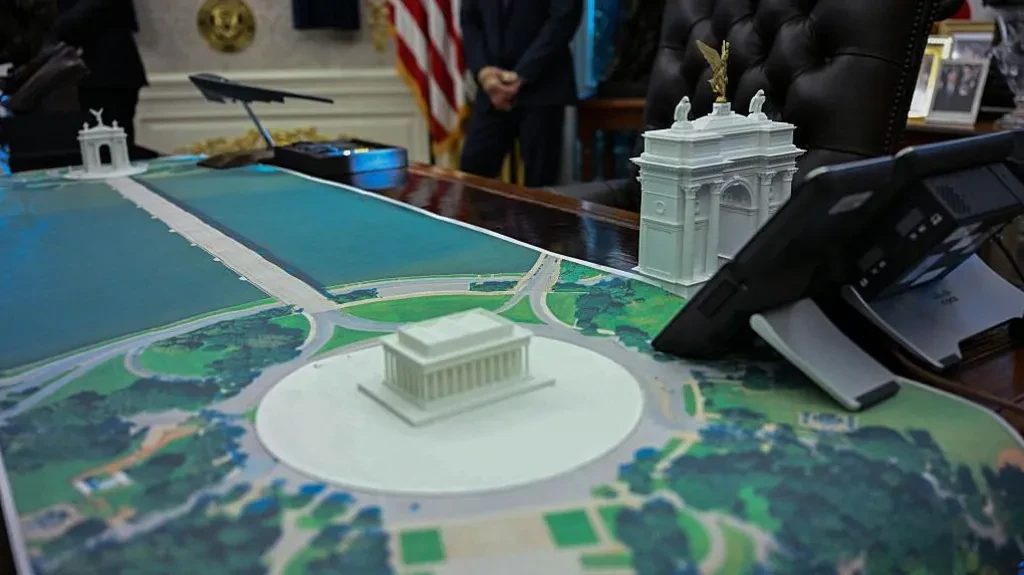
At an October fundraising dinner, Trump presented three scale models of the proposed arch, small, medium, and large, and indicated his preference for the largest version. Journalists at the event reported the structure would dwarf the nearby Lincoln Memorial if built at full scale. When asked by a reporter whom the arch would honor, Trump pointed to himself and said simply, “Me.”
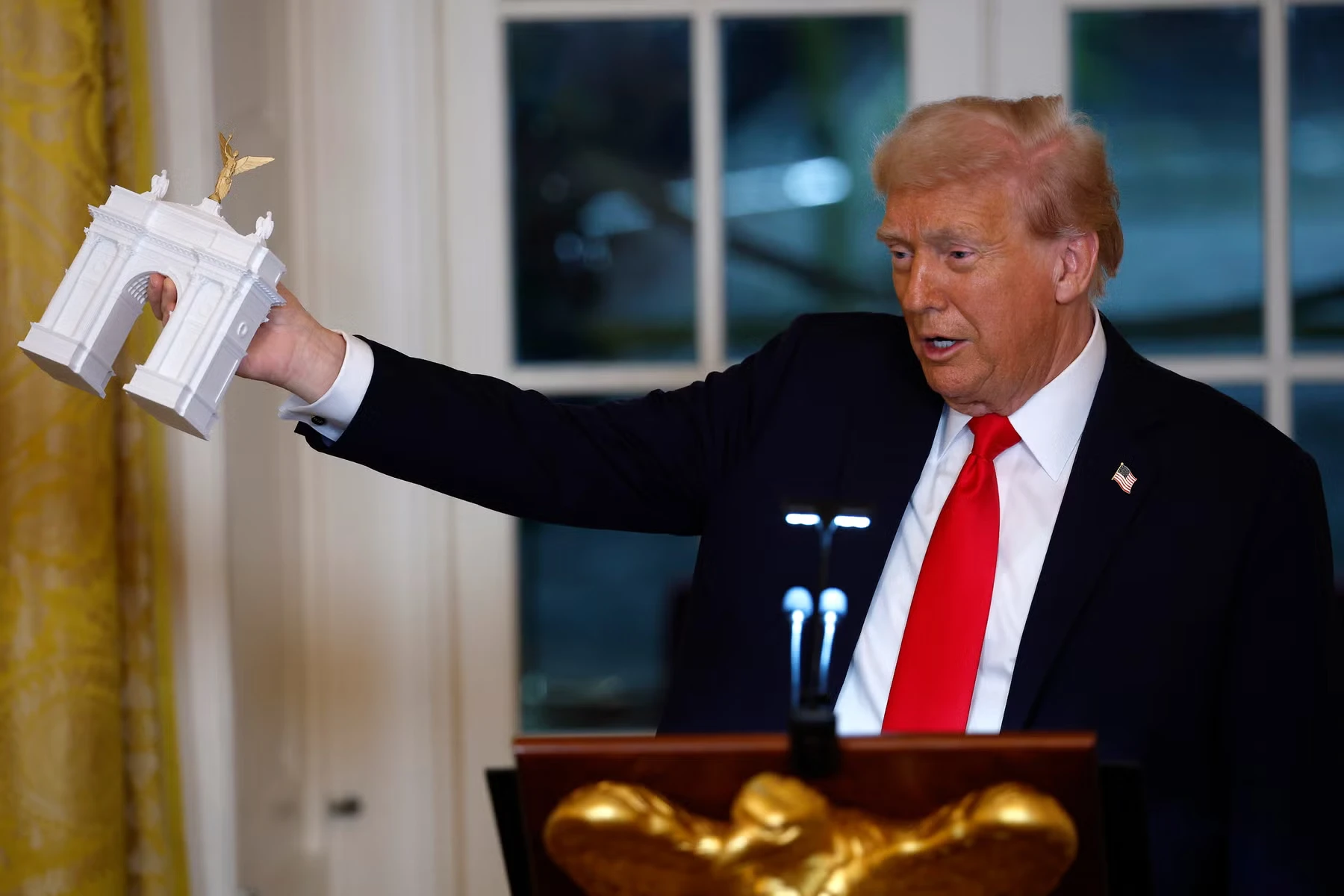
The design clearly draws on neoclassical elements shared with historic triumphal arches from ancient Rome and later European monuments. Such arches traditionally celebrate military victories or national pride. This connection is acknowledged by observers, who note that the Paris Arc de Triomphe, the most direct ancestor, was commissioned in the early 19th century by Napoleon to honor his army after victory at the Battle of Austerlitz.
250th Anniversary Design Sparks Debate Over Legacy and Space in the Capital
The choice of Memorial Circle as the setting places the proposed arch in direct visual dialogue with some of Washington’s most revered landmarks. Planners and historians have pointed out that this site has been considered for monumental design in the past, including in early 20th-century plans that were never realized.
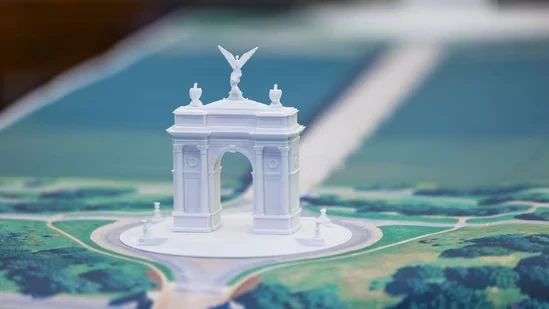
The designs, shared by Trump on social media and displayed at multiple public events, depict a towering stone arch modeled strikingly on Paris’s Arc de Triomphe. It would stand at Memorial Circle, a large traffic roundabout on Columbia Island just across the Potomac River from the Lincoln Memorial and adjacent to Arlington National Cemetery.
- Supporters describe it as a bold, patriotic addition to the capital that would dramatically commemorate a landmark anniversary.
- Architectural critics and preservationists question whether a new, oversized structure belongs in a landscape carefully composed over centuries, especially given its proximity to solemn memorials and established sightlines.
There is also public scrutiny around funding and approvals. While Trump and his allies have linked the arch to broader semiquincentennial celebrations, including events such as a proposed national state fair and other anniversary programming, there remains little clarity on cost estimates, the construction timeline, or whether regulatory bodies, including federal design commissions and Congress, will formally approve the project.
A Monument Tied to Legacy
For Trump, the arch project is part of a larger effort to leave a lasting physical imprint on the capital. In recent years, he has overseen several controversial changes at the White House, including major renovations and redecorations that have drawn public attention. The triumphal arch, if built, would be among the most visible of these changes.
As the country approaches July 4, 2026, the proposal has become a focal point in broader debates about how the United States should commemorate its history, how public monuments shape national identity, and how political legacies are translated into stone and space.