

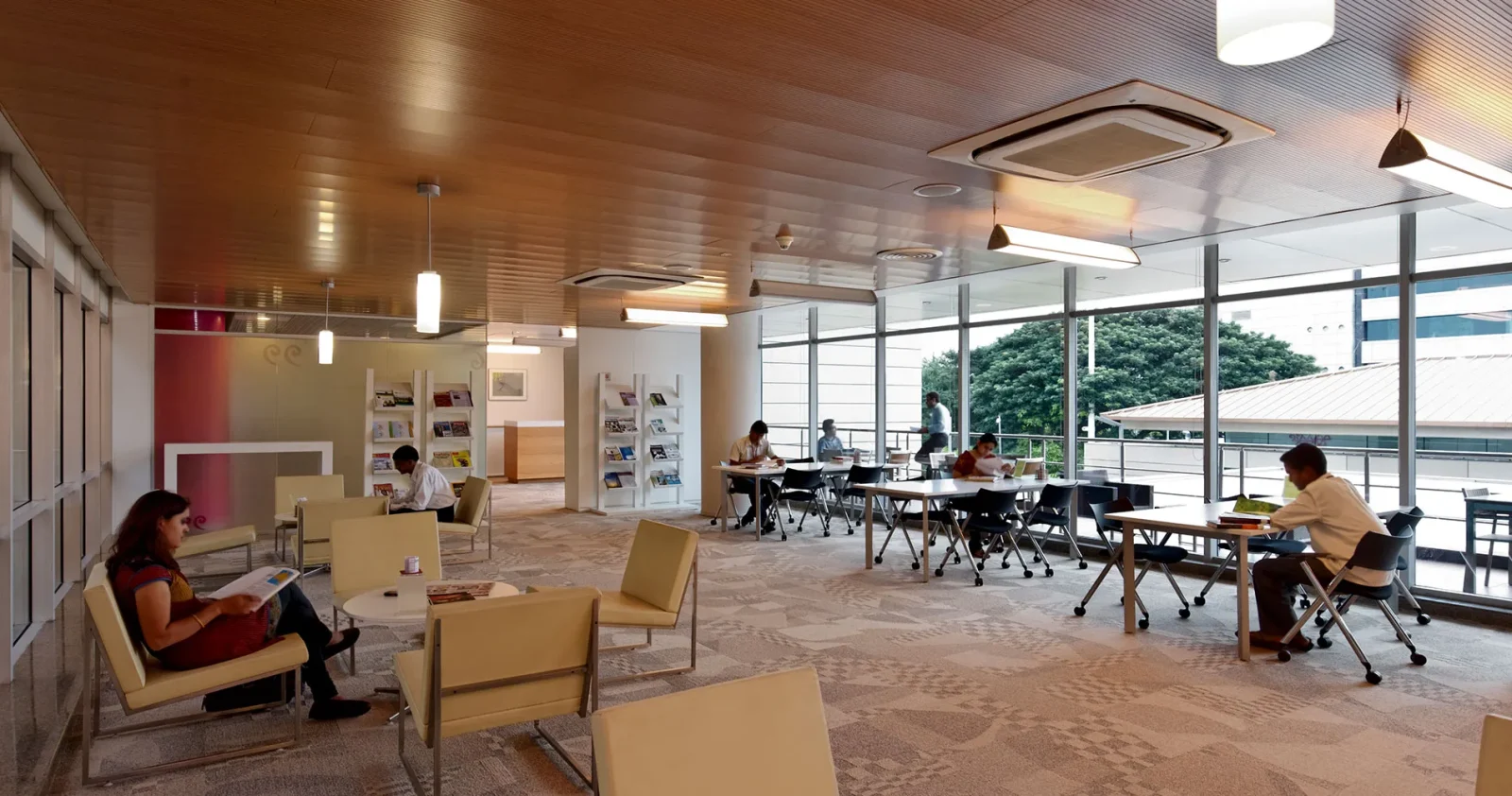
Suzlon is a multinational pioneer company that focuses on wind energy and the manufacturing of machines related to harnessing the renewable resource. As a green power solution provider, their values embody sustainable living, and their office campus, Suzlon One Earth, located in Pune, India, is a testament to that belief. Designed by CCBA Designs and completed in 2009, the structure is the greenest office in India and a model for how zero-energy projects are designed, constructed, and operated.
Ancient architecture is a gold mine for sustainability lessons, and Suzlon One Earth is a perfect example of how traditional campuses spanning the length of the country have inspired not just its form and aesthetics, but also how the spaces function.
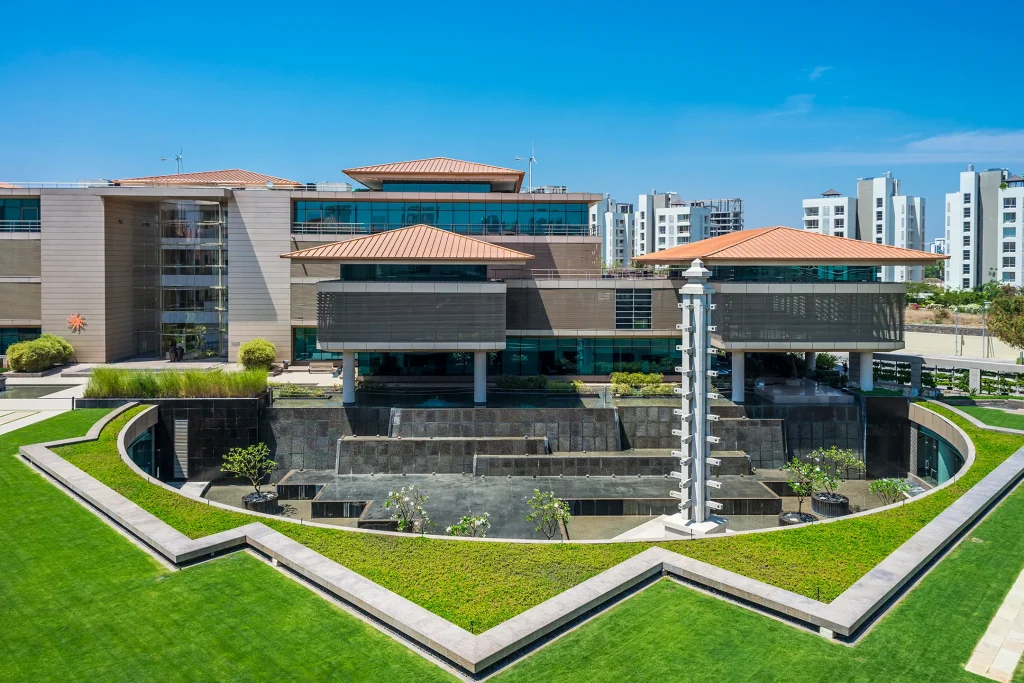
Be it the authority of the modular construction in highlighting the scale and proportion, like the Panch Mahal of Fatehpur Sikri in North India, or the interlocking of complexes to elevate features like the gopuram of the Meenakshi Sundareshwarar Temple in South India. Both these historical campuses, albeit from different eras, balance their closed and open spaces using horizontal elements, a feature that is prevalent on this campus. It is what made the structure a landscraper using locally sourced materials instead of a skyscraper or a glass box, which is a widespread style today.
Contemporary design with a sustainability focus
The client brief required a high-technology campus built to global standards and mirroring Suzlon’s vision as one of the largest sustainable energy patrons, but with local elements that gave its visitors the feel and experience of India. CCBA Designs, under the expert guidance of Christopher Benninger, blended traditional elements with modern needs that highlighted both the architect’s and the client’s commitment to energy efficiency and sustainability.
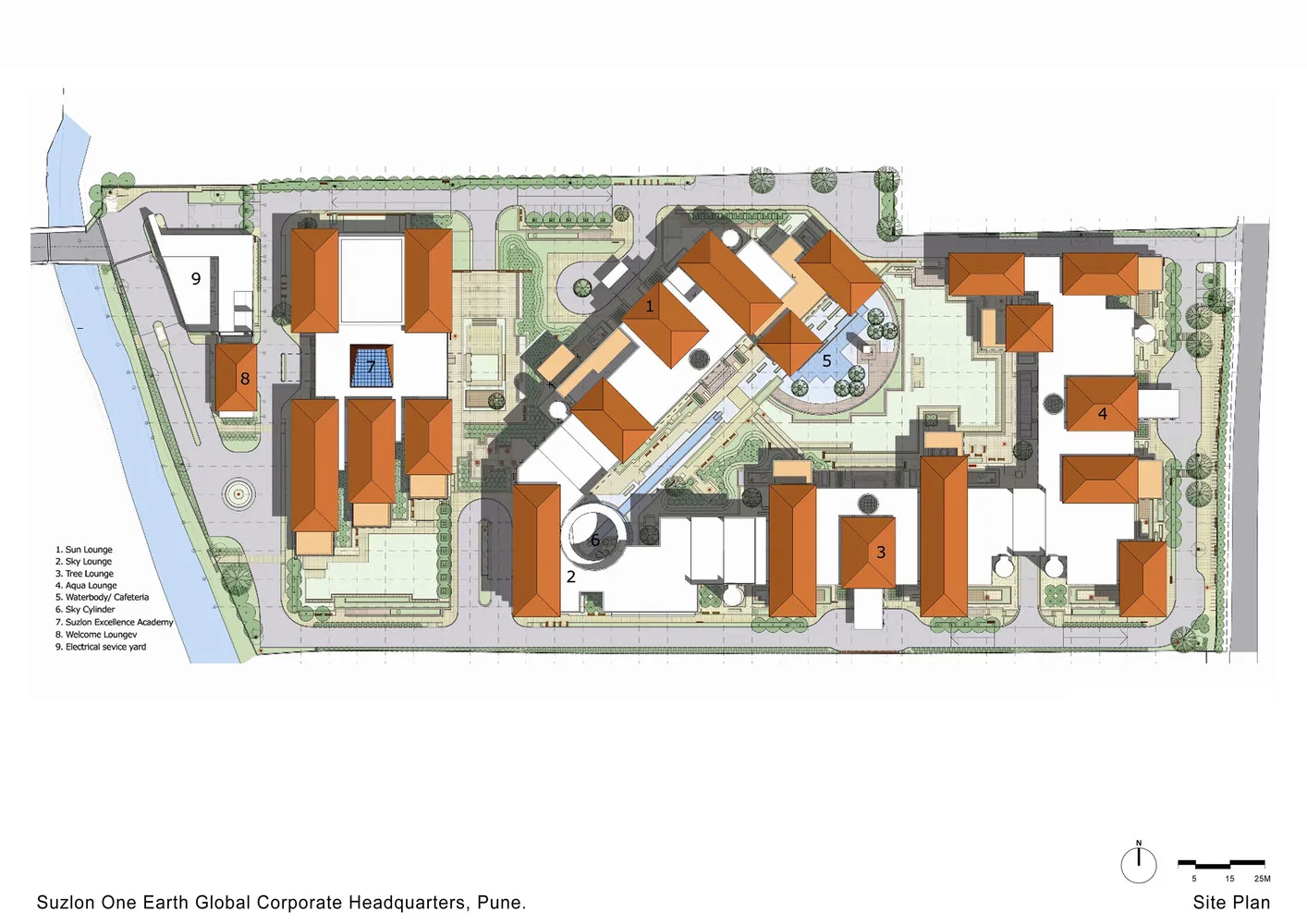
With 10.4 acres of land at their disposal, the structure was designed to spread horizontally, banking on its design and sustainable features to earn the name of an architectural icon rather than its height and shape. The design itself follows the neighborhood’s built fabric with reference to its height and construction material, even going a level below to accommodate the required spaces of this office campus.
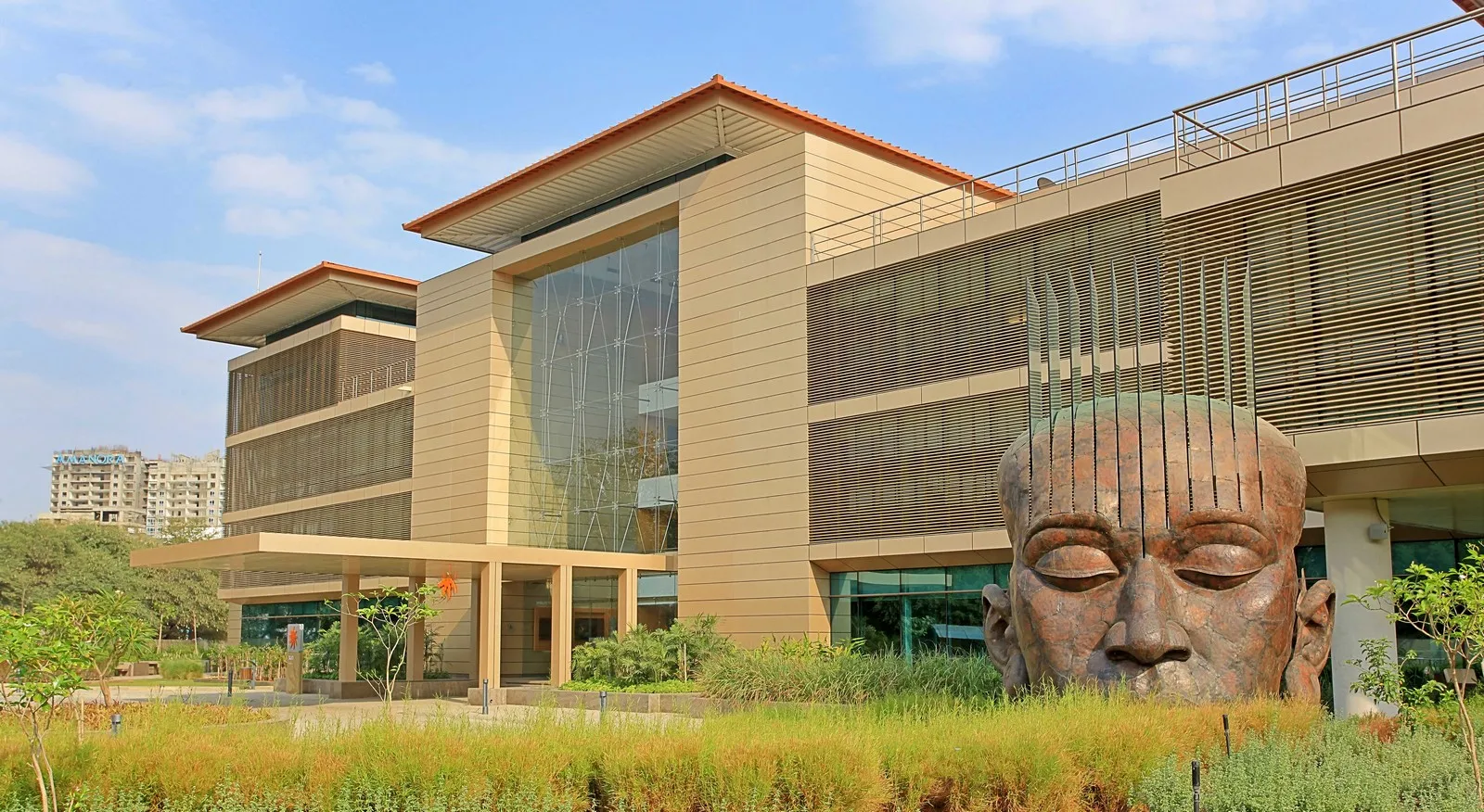
As a company that promotes renewable energy sources, the design had to live by example. The built structure uses the local conditions to supply the energy required by the project. It leverages the wind and solar power to generate 92% of the energy consumption, qualifying it as a Zero Energy Project.
The architect found that a module of 8.4 x 8.4 m was suitable to allow natural light, ventilation, and views of the surrounding green without any hindrance. Modules can be arranged in various combinations to form external and internal spaces, with elements that tie them together. In this project, silo fire stairs and glass cylinders functioned as cohesive components along the façade of the built fabric and provided visual relief. Incorporating modules had the added advantage of reinventing the spaces as the needs change and the business evolves, making the structure timeless and adding another sustainability feature.
The spaces were also fitted as served and server spaces. The served areas accommodate the working spaces where people spend the most time, are adjacent to intermediary interactive spaces, and are fitted with flexible modular walls and furniture systems.
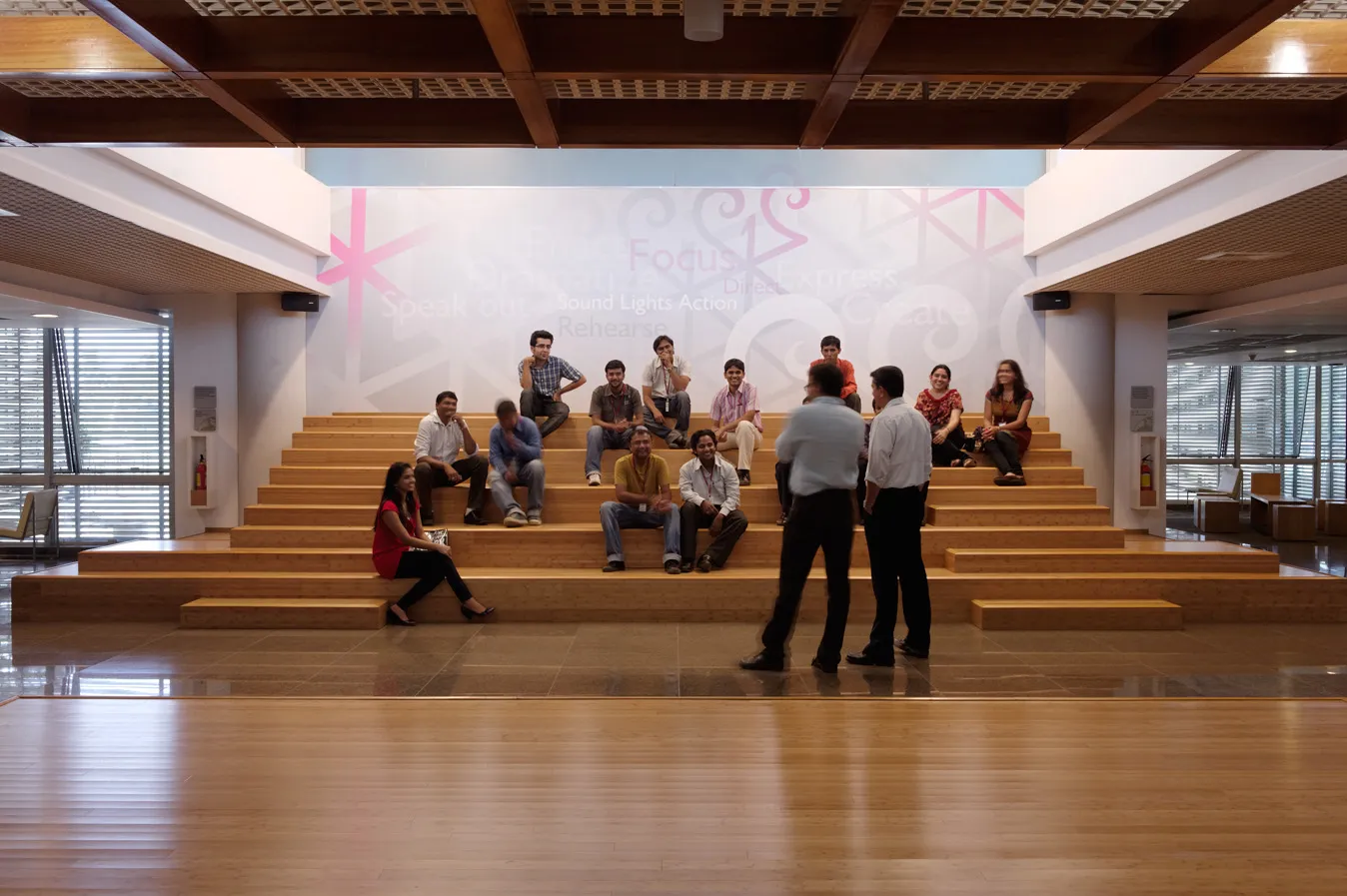
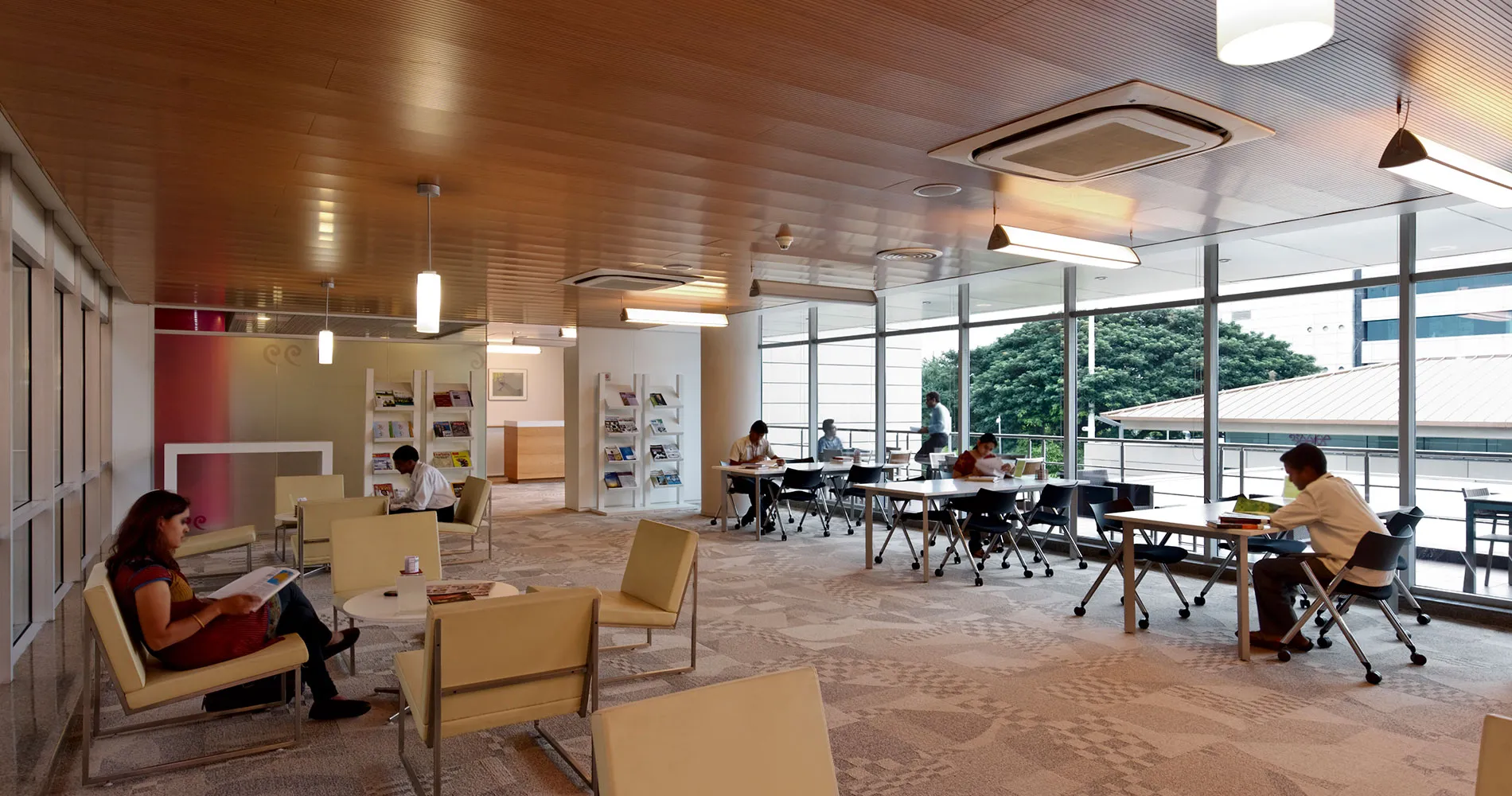
These can be adapted to different sizes and shapes with the changing needs, emphasizing that adaptability is an important aspect in architectural design, which is also cost- and energy-efficient. The server spaces house utility areas like ducts, fire stairs, wet areas, elevators, reception, and entry areas, which are not susceptible to change. There are a total of five lounges that form the server spaces—Aqua, Wind, Sky, Sun, and Entrance.
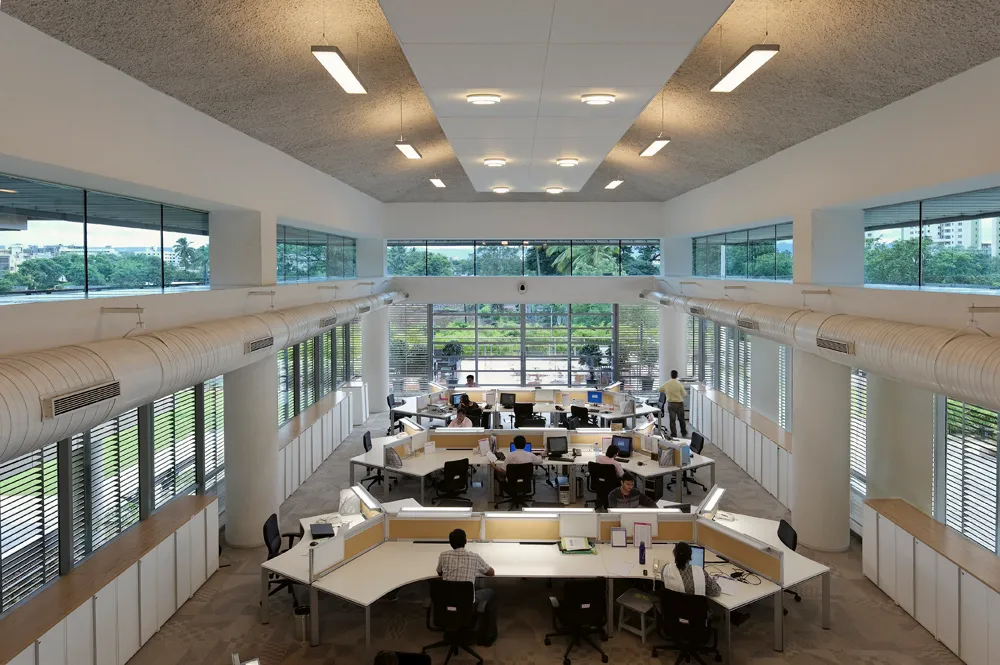
Moreover, the design is a balance of open and closed spaces that help to naturally ventilate and brighten the workspaces. The structure was visualized by the architect as a journey from one space to another, how it interlocks and integrates with its adjacent spaces, the indoor comfort levels, and how man can always be connected to nature as he navigates through the building. The interaction with other occupants and the surrounding natural environment was given top priority, as this ensured a healthy environment, which is one of the most significant aspects of sustainable architecture.
Traditional elements with modern technology
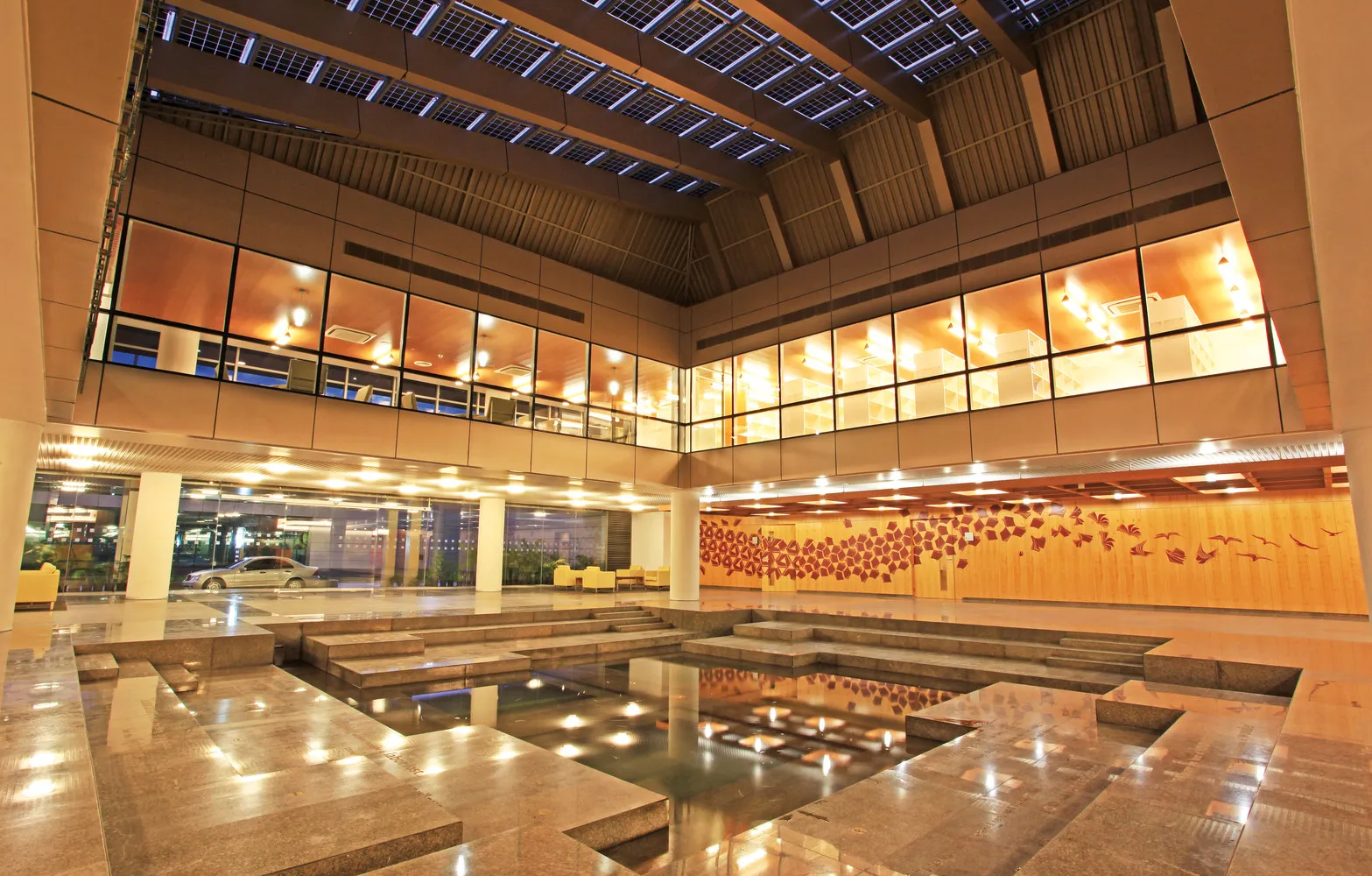
The design started with a central gathering space that was open to the sky, where all spaces and people converged, which in itself was a traditional form of thought. The landscape that seamlessly flows into the interiors, the water bodies cascading along the length of the building, the central atrium that brings light into the basement spaces and doubles as a community gathering space, the long obelisk-like Deepastambh that houses lamps and illuminates the central atrium, and the stepped garden courtyards that also work as punctures in the modules are all traditional elements in a modern setting.
They also aim to keep sustainability at the core of the project and facilitate renewable energy to support the structure’s needs, both of which are part of Suzlon’s deep-rooted principles. Every design decision and element implementation focused on making the project energy-efficient and was an opportunity to connect humans with nature in what the architect calls ‘earth design,’ where people were the top priority and placed close to nature. The sustainability elements and features that drove the design to perform at optimum energy are:
Natural Light and Ventilation – The size of the modules is chosen to allow daylight and continuous cross ventilation across workspaces through operable aluminum louvers, ensuring the need for artificial lighting and cooling is minimized. These fenestrations are equipped with sensors to optimize comfort for users while promoting sensitivity to different environmental conditions outdoors. Using LED systems has helped reduce energy consumption by 65% compared to conventional systems. The water bodies designed as part of the glass cylinders help to create a microclimate that improves the air quality of the interior spaces through evaporative cooling.
Renewable Energy – As a company that endorses renewable energy and is involved in harnessing it, Suzlon’s offices in Pune aimed to lead by example, promoting their products and using the architect’s vision for a sustainable design that leveraged renewable energy sources. The site incorporates both wind and solar energy, which contribute to 8% of the annual electrical energy consumption, which has ensured a total incremental cost efficiency of about 11%. The project uses renewable sources for 92% of its energy. Photovoltaic panels are designed as a part of the ceiling, generating green power and forming a jaali that allows filtered light into the space.
Water and Waste Management – All systems involving water, trash, sewerage, air, and energy are sustainably managed on-site. Wastewater, trash, and sewage are recycled for further use. Rainwater is harvested, and 100% of it is used on-site; sewage greywater is filtered, treated, and used for landscaping, air cooling systems, and flushing. Additionally, solar power is employed for 100% of water heating needs.
Building Management – The whole project implements a comprehensive building management system to facilitate the efficient functioning of the various systems by monitoring aspects like energy, lighting, temperature, and occupancy. This helps reduce energy consumption and makes the project cost-effective.
Construction Materials – The materials were of the non-toxic and recycled variety and sourced within 500 miles of the catchment area to reduce embodied carbon on the site. The architects also followed a mandate of a 3% wastage ceiling for materials and construction to reduce waste production by following standard sizes. This also helped to reduce costs without compromising on aesthetics.
A model for ‘powering a greener tomorrow’
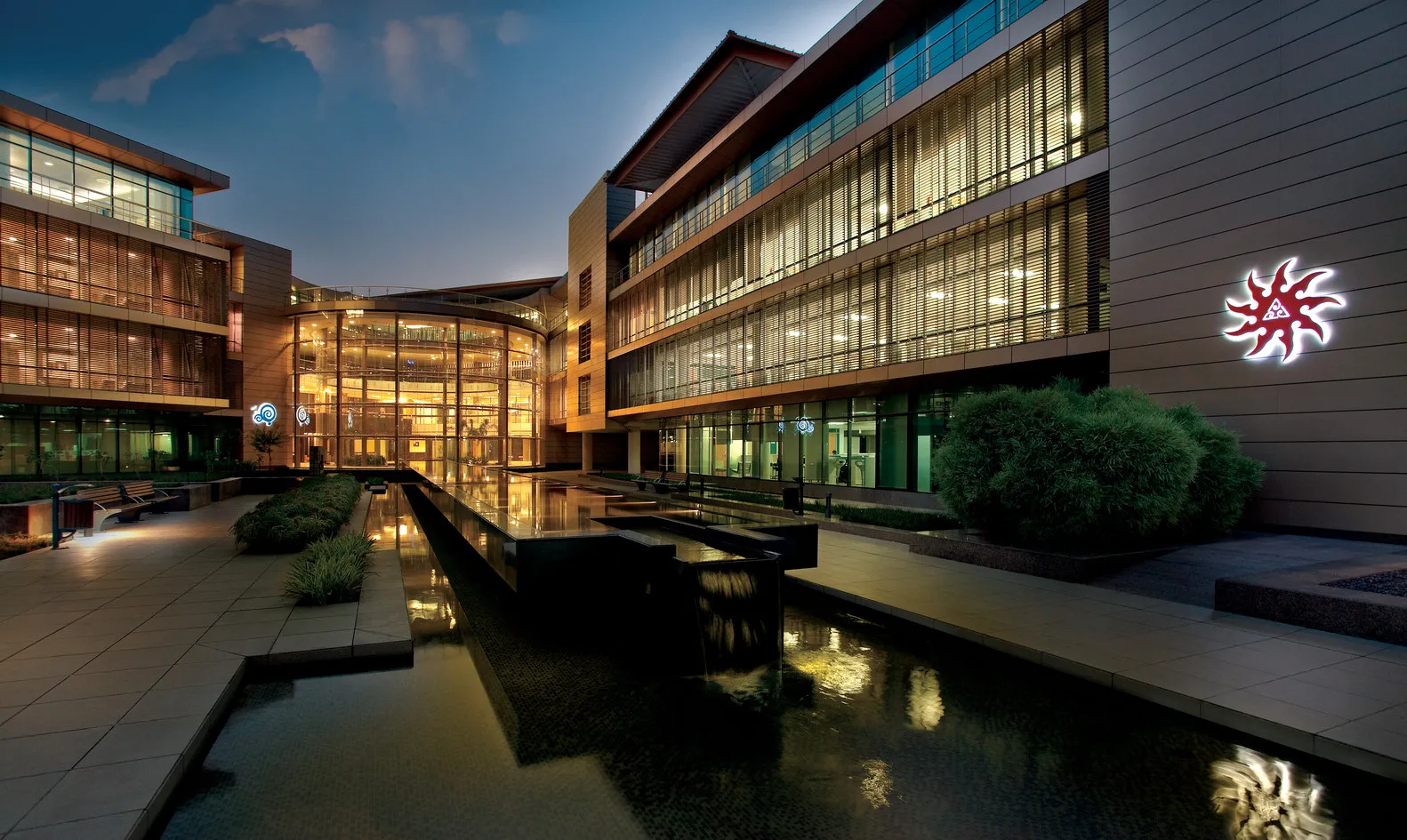
The motto of Suzlon One Earth is ‘powering for a greener tomorrow,’ and both the client and architect believed that this began with creating spaces that allowed man to interact uninterrupted with nature, which would ultimately lead to increased productivity.
This was achieved by implementing modern systems and infusing traditional elements in spaces that encouraged creative and fruitful communication. The project definitely opens avenues for discussion on corporate campuses and their responsibility to become models for sustainable architecture with an environmentally friendly approach in urban settings.
Recognition and certification
The project achieved LEED Platinum certification and TERI GRIHA 5-star certification. This is a rare achievement that showcases its commitment to sustainability. The project also won the Asia Pacific Property Awards for Best Office Interiors in 2011 and the GIREM Leadership Awards for Overall Excellence in Architecture and Interiors.
Explore Courses
.jpg "Ondrej Chybik - Rethinking Architecture")