
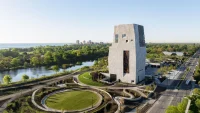
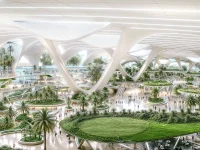
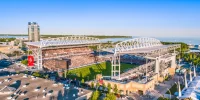

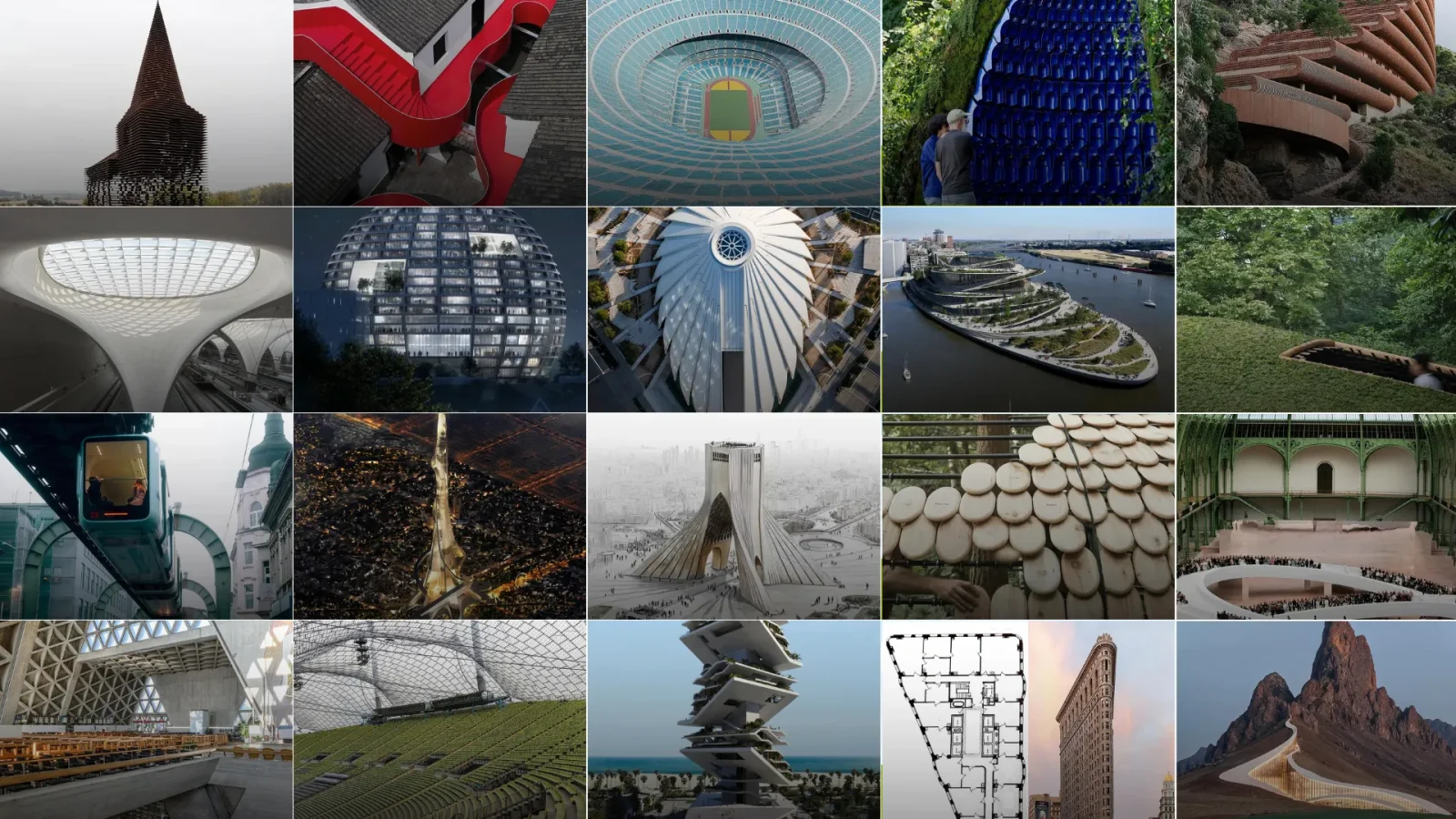
In 2025, architecture continues to push boundaries, shaping the spaces we inhabit and how we experience them. These standout projects of 2025, featured on Parametric Architecture, each offer a fresh perspective. Scroll on to discover the year’s most remarkable designs.
1. Reading Between the Lines by Gijs Van Vaerenbergh
Reading Between the Lines is a permanent, site-specific artwork by Belgian duo Gijs Van Vaerenbergh, completed in 2011 near Borgloon, Belgium. Made from around 2,000 steel columns forming layered cross-sections of a church, the 30-ton structure appears solid or transparent depending on the viewer’s position. It reinterprets the local parish church through perception, scale, and spatial integration of architecture with landscape and art.
2. Big Red Crayfish by Dayi Design
Big Red Crayfish is a 2,500-square-meter dining and commercial complex along the Qinhuai River in Nanjing, completed in 2024 by Dayi Design. It transforms a 300-year-old residence linked to Eastern Jin official Xie An into a crayfish-themed destination. Traditional courtyards, pavilions, and terraces are combined with glass and metal to connect history with modern use. A red steel staircase, inspired by a guardian dragon, links four buildings while serving safety, circulation, and delivery needs. Reused materials, adaptive landscaping, and LED lighting support sustainability and create a lively public space rooted in local culture.
3. 1 Million Seat Stadium
1 Million Seat Stadium by Paul Pfeiffer is a conceptual artwork that imagines a sports stadium designed to hold one million spectators. First shown at the Museum of Contemporary Art, the model stands 10 feet tall but represents a structure equivalent to a 14-story building. The design exaggerates familiar stadium forms, drawing references from venues like Pyongyang’s Rungrado First of May Stadium and Sydney’s 2000 Olympic Stadium. The project uses architectural scale to question the limits and meaning of human gathering in contemporary culture.
4. The Muqarnas Pavilion
Located on the terrace of CIVA in Brussels, the Muqarnas Pavilion by New South reinterprets a traditional Islamic architectural element through contemporary design. Developed with Radhika Bhanot and Gorbon Ceramics, it transforms the muqarnas from a decorative ceiling into a self-supporting structure made of interlocking ceramic pieces. The 20 m² pavilion was designed using parametric computational tools to explore form, structure, and craft. The installation serves as a platform for dialogue, education, and cultural exchange.
5. The Northern Apartments
The Northern Apartments, designed by Studio Precht in collaboration with W10 Architects, are located at the northern tip of Shengjin, Albania. The project features terraced brick forms, curved edges, and earthy tones that make the building appear carved from the mountain, with layered outdoor spaces offering panoramic ocean views. A winding mountain road leads to the site, reinforcing the connection between architecture and landscape. Renderings by mir.no and concepts by Studio Precht show green façades, timber elements, and bold forms rooted in Albania’s coastal setting.
6. The Stuttgart Main Station by Christoph Ingenhoven
Stuttgart Main Station (S21), designed by Christoph Ingenhoven, is one of Germany’s largest infrastructure projects. Planned between 2009 and 2023 and under construction since 2014, it reimagines Stuttgart’s historic rail hub as a future-focused transport center. The station is defined by petal-shaped concrete roofs supported by slender, chalice-like columns that bring daylight to the underground platforms. Developed using parametric modeling and structural simulations, the design balances engineering performance with architectural expression. Scheduled to open in 2026, Stuttgart 21 sets a new contemporary public infrastructure.
7. The Grand Ballroom by MVRDV
MVRDV’s Grand Ballroom has won the competition for a new sports and cultural hub in Tirana, Albania, set on the former Asllan Rusi Sports Palace site. The project is designed as a 100-meter-wide spherical mixed-use complex housing a 6,000-seat arena at its core, with a hotel above and apartments wrapping the upper shell. Its rounded form eliminates back façades, expands public plazas, and integrates green terraces and shared courtyards to strengthen community life. The project draws inspiration from visionary spherical architecture.
8. The Falcon Pavilion
The UAE Pavilion at Expo 2020 Dubai, designed by Santiago Calatrava, takes the form of a giant falcon in flight. Its operable roof wings, inspired by the UAE’s national bird, create a dynamic structure that also provides shade.
9. Hamburg State Opera
BIG wins the international competition to design the new Hamburg State Opera, replacing the 1950s venue with a 45,000 m² contemporary home for the State Opera and Ballet. The design features concentric terraced “soundwaves,” creating a 3D public park with multiple entry points from the quay, park, or opera street.
10. Chicken Hero Pavilion
The Chicken Hero Pavilion by RAD Architects in Urban Forest Jakarta is a 900 m² public space tackling food waste through backyard poultry farming. Nicknamed “The Chicken Coop,” its tunnel-like structure educates and entertains while turning organic waste into compost, chicken bedding, and fresh eggs. Built with reclaimed bamboo and passive design, it operated for four weeks, producing compost every three days and 40 eggs daily for local restaurants. The pavilion reconnects communities with local food systems, reducing reliance on centralized sustainability models.
11. Wuppertal Schwebebahn by Eugen Langen
The Wuppertal Schwebebahn, opened in 1901, is the world’s oldest electric elevated railway with hanging cars. Designed by Eugen Langen, it was initially planned for Berlin but built in Wuppertal, Germany. Stretching 13.3 km along the Wupper River, it glides silently above the city. A century-old engineering marvel, it still carries over 25 million passengers annually.
12. The Rise Tower by HKS Architects
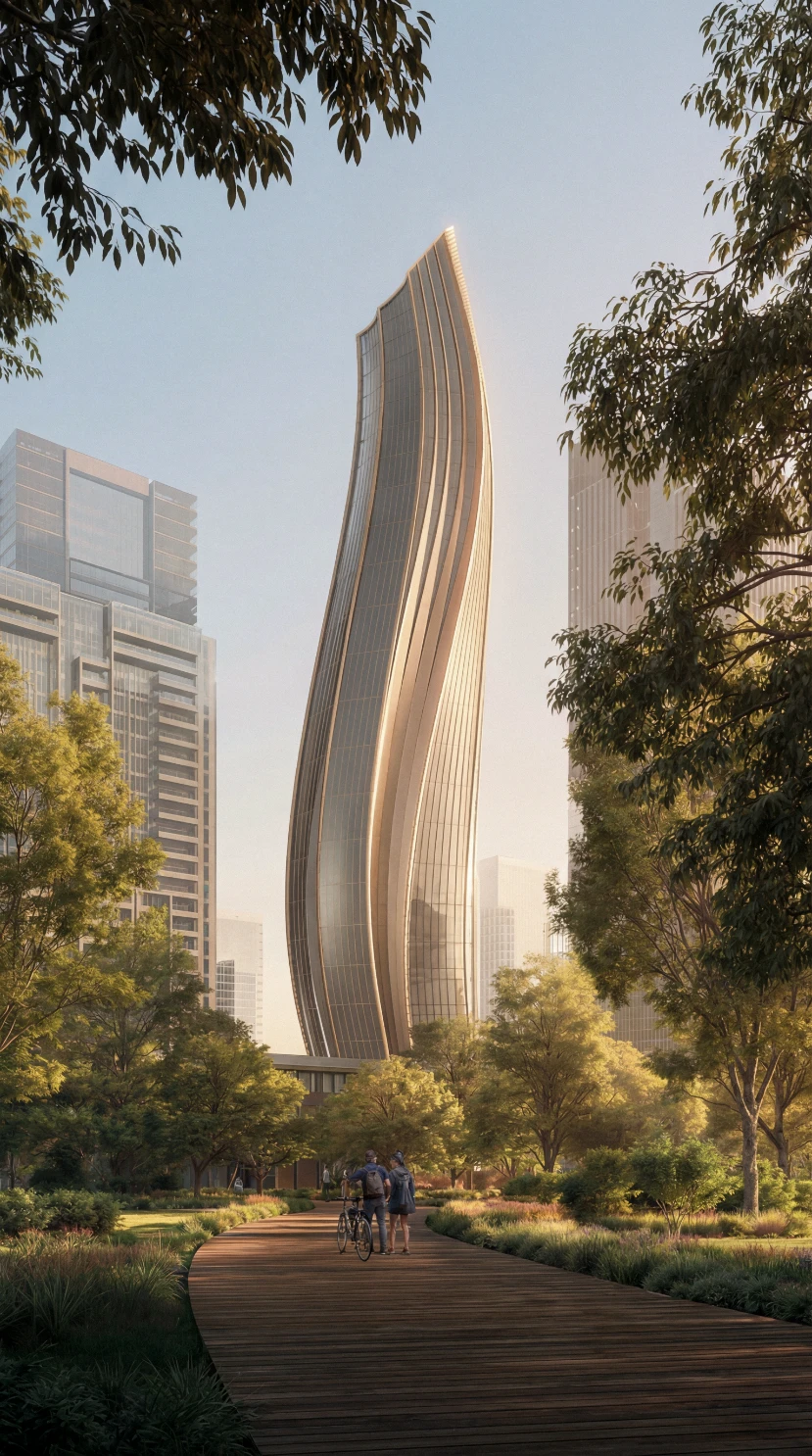
The Rise Tower by HKS Architects is a proposed 2-kilometer “vertical city” in Riyadh, set to be the centerpiece of the 306 km² North Pole development aligned with Vision 2030. Planned for living, work, leisure, and aerial parks, it will more than double the height of the Burj Khalifa, redefining the city’s skyline. Winner of the 2025 WAFX Prize for Climate & Energy Innovation, the Rise Tower frames super-tall architecture as both a landmark and a model for future urban living.
13. Living Sketches – Iranian Monuments
Living Sketches – Iranian Monuments by Tim Fu & Studio Tim Fu explores Persian architectural memory.
14. Perspectives Pavilion
The Perspectives Pavilion, located in Surrey Hills, UK, offers a serene space for rest and contemplation along a walking route. Clad in overlapping cedar shingles, its organic, tapering form opens toward the valley, framing landscape views.
15. Chanel Spring-Summer 2025 Set Design
Chanel’s Spring-Summer 2025 collection was showcased at the Grand Palais in Paris with a set designed by Willo Perron. The runway featured two large, interlocking white ‘C’s at the center, creating a structured path for models. Lightweight fabrics were used throughout, emphasizing elegance and movement. The show celebrated 110 years of Chanel’s history, blending heritage with contemporary design.
16. The Temple of Monte Grisa
The Temple of Monte Grisa, located 300 meters above Trieste on the Karst Plateau, was designed by Antonio Guacci and Sergio Musmeci between 1959 and 1965. Built with reinforced concrete, its triangular geometry symbolizes the letter M in devotion to the Virgin Mary. The façade features glass triangles supported by concrete ribs, forming the letters A and M for “Ave Maria.” The upper church is open to natural light, while the lower church uses hexagonal patterns symbolizing divine illumination.
17. The Munich Olympic Stadium
The Munich Olympic Stadium, designed by Behnisch and Partners with Frei Otto for the 1972 Olympics, symbolized West Germany’s democratic renewal. Partially sunken into the Bavarian landscape, it embraced transparency and openness, breaking from the monumental style of 1936 Berlin. Frei Otto’s innovative tensile roof spans 75,000 m², made of 436 km of steel cables supporting translucent Plexiglass panels.
18. Shoupé Tower
Shoupé Tower, designed by @kanlan.studio, is an 18-story, 22,000 m² mixed-use high-rise planned for the Babolsar coastline in Mazandaran, Iran. Inspired by traditional “Shoupé” night guards, it integrates residential units with shared amenities, markets, and public spaces. Its two-story podium links the city to the beach, and the unbuilt project won the 2024 World Architecture Festival award for mixed-use innovation.
19. The Flatiron Building by Daniel Burnham
The Flatiron Building in New York, designed by Daniel Burnham and completed in 1902, features a bold triangular form. Rising 22 stories at the intersection of Broadway and Fifth Avenue, it transforms an awkward plot into a landmark.
20. Orogenesis Land Art
Orogenesis Land Art by AI Architecture, instructor of this weekend’s AI-Driven Architectural Design 2.0 workshop at the Paacademy.
Explore Courses
.jpg%202.jpg "Building Performance with Forma & Opossum")
.jpg "Ondrej Chybik - Rethinking Architecture")