

Set along the Someș River in Cluj-Napoca, the former Carbochim industrial site is being transformed into RIVUS, a large-scale mixed-use district, with construction now officially underway. Commissioned by Rivus Investments S.R.L for IULIUS and Atterbury Europe, the masterplan has been designed by UNStudio together with Felixx Landscape Architects and Planners. The proposal introduces a mixed-use district where public space, landscape, and urban life are organized around renewed access to the Someș River.
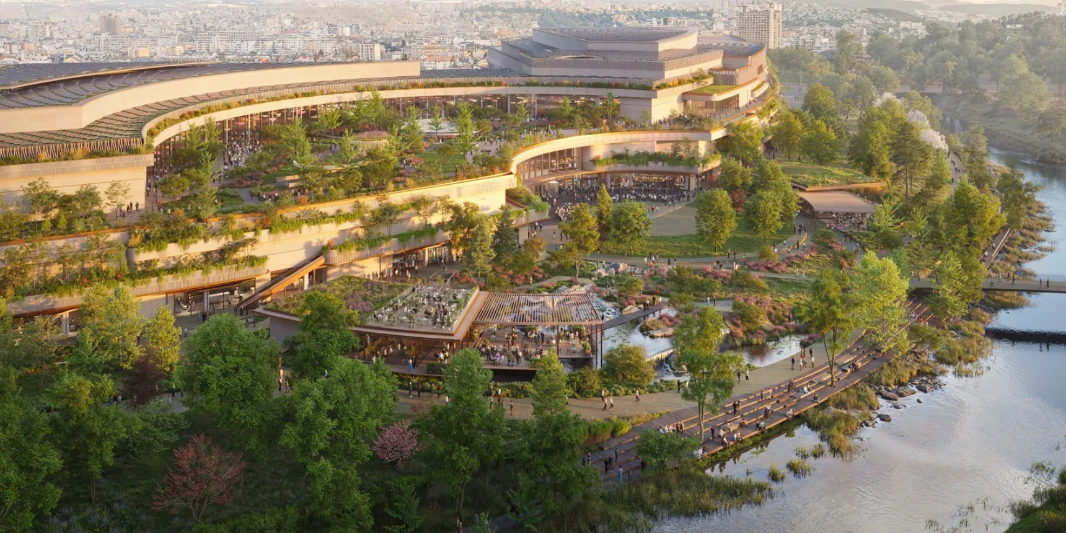
Long before the site became an industrial center, the area was known as the “Meadowland Garden.” Over time, factory development transformed the riverfront into a restricted and inaccessible zone despite its importance to the city’s growth. RIVUS seeks to reverse this condition by opening the waterfront back to residents and creating stronger physical and social connections between the river and the surrounding neighborhoods.
Through adaptive reuse, new public infrastructure, and landscape-led planning, the project brings together cultural spaces, retail, workplaces, and recreational areas within one interconnected urban environment. The development positions the riverfront as an active extension of everyday life in the city.
Architecture That Extends the Landscape
Spanning more than 14 hectares, RIVUS is designed as a layered riverside environment where architecture, landscape, and infrastructure merge into a continuous public experience.
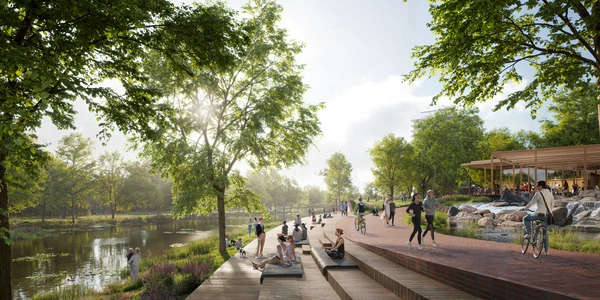
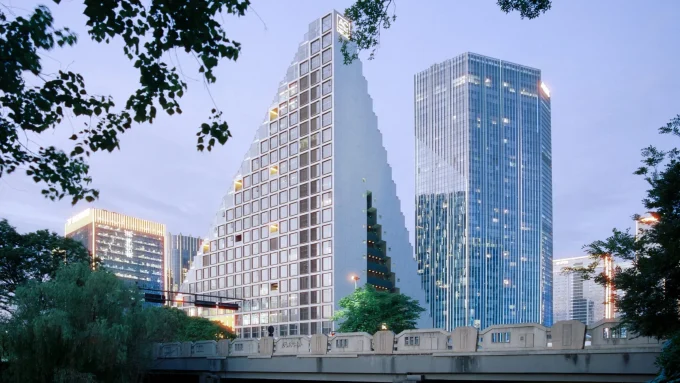
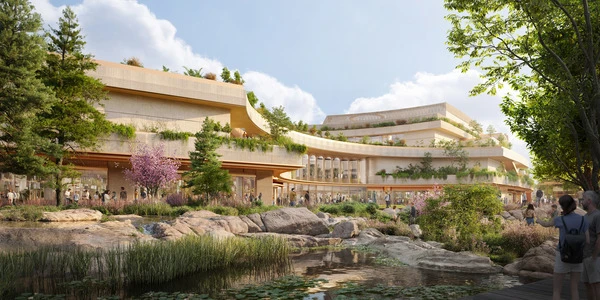
The project’s terraced building form gradually steps down towards the Someș River, visually and physically extending the riverside park into the development. Public squares, pathways, planted spaces, and bridges connect the retained industrial buildings with new urban spaces, encouraging movement between the city and the waterfront.
Inspired directly by the movement of water, the development’s geometry is defined by concentric circular forms and fluid river-like lines. These patterns influence both the masterplan and the façade design, creating a visual identity linked closely to the surrounding landscape.
Natural materials such as wood and stone reinforce this relationship with the site while softening the transition between indoor and outdoor spaces.
New Public Infrastructure Along the Riverfront
The project introduces extensive pedestrian, cycling, and transportation infrastructure aimed at improving accessibility throughout the district.
Key interventions include:
- Two new pedestrian bridges across the Someș River
- Modernisation of surrounding streets
- Construction of two roundabouts
- Dedicated bicycle lanes along the site perimeter and riverfront
- Integrated pedestrian pathways and public plazas
These infrastructural additions are designed as part of the architectural concept itself, where surrounding streets and bridges continue into the development as interior urban corridors.
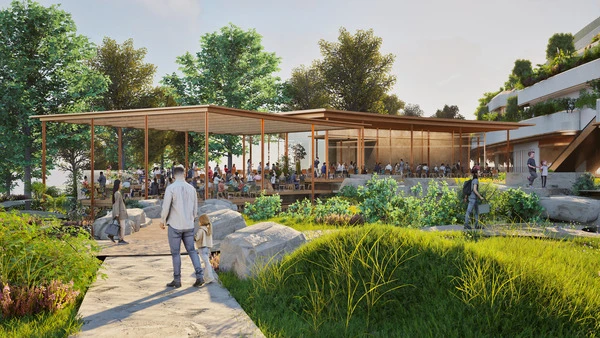
A large public park will also be integrated into the site, featuring:
- Riverside terraces
- A public amphitheatre
- A riverfront boardwalk
- Landscaped open spaces for leisure and events
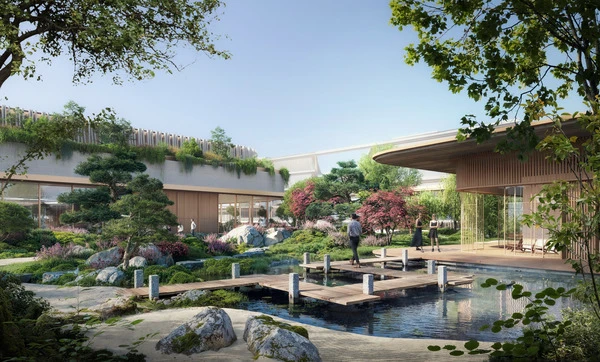
- A rooftop terrace with a Japanese garden
Together, these spaces create a layered public landscape that supports recreation, social interaction, and year-round activity.
Preserving Industrial Heritage Through Adaptive Reuse
The project incorporates parts of the former Carbochim factory into the new masterplan.
Established in 1949, Carbochim became Romania’s largest producer of professional abrasives, and several of its industrial buildings remain important markers of the city’s manufacturing heritage.
Two preserved structures will be adaptively reused:
- The former administrative brick building will become coworking and entrepreneurial spaces
- The arcade hall will be transformed into a cultural and entertainment venue
This adaptive reuse strategy allows the industrial memory of the site to remain part of the district’s future identity.
UNStudio Designs a Riverfront Mixed-Use District
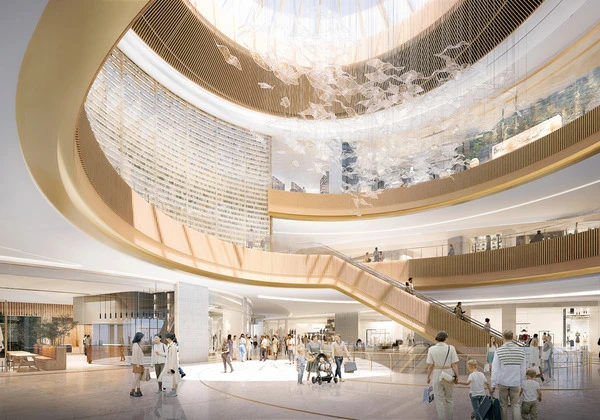
RIVUS is planned as a mixed-use district. The program is arranged to activate public space throughout the day while supporting both social and economic activity.
The development will include:
- Over 400 retail stores
- More than 30 restaurants and cafés
- Coworking and office spaces
- Platforms for local producers and entrepreneurs
- Cultural and entertainment venues
- Public gathering areas and event spaces
By combining commerce, workspaces, hospitality, and culture within a landscape-led framework, the project creates a new public destination connected directly to the riverfront.
Landscape-Led Sustainability Strategies
RIVUS targets LEED Platinum and EDGE Advanced certifications while complying with NZEB standards.
The sustainability strategy at RIVUS integrates architecture with ecological systems through a landscape-driven approach. Green façades and roofscapes are combined with native, climate-responsive planting to create natural habitats that support local biodiversity throughout the site. Water management is addressed through rainwater storage and cascading irrigation systems that help reduce stormwater runoff into the Someș River while maintaining the surrounding green spaces. Together, these environmental strategies reinforce the project’s vision of a riverfront district shaped by both urban activity and ecological balance.
More than 700 trees and over 100,000 plants will shape the site’s evolving landscape, creating seasonal variation while supporting local biodiversity.
In 2025, the project achieved a major milestone with the approval of the zonal urban plan. Demolition works for non-preserved industrial structures have been completed, and excavation is currently underway.
Preservation works on the former administrative building are also in progress, while the official building permit for the development was obtained in March 2026.
RIVUS Project Details
Project Name: RIVUS
Location: Cluj-Napoca
Client: Rivus Investments S.R.L
Lead Architects: UNStudio
Landscape Architects: Felixx Landscape Architects and Planners
Site Area: Over 14 hectares
Leasable Area: 165,000 m²
Retail Spaces: 400+ stores
Hospitality Spaces: 30+ restaurants and cafés
Preserved Industrial Buildings: 2
Trees Included: 700+
Plants Included: 100,000+
Target Certifications: LEED Platinum, EDGE Advanced, NZEB Compliance
Visualisations By: Vivid Vision and Marta
Explore Courses
.jpg "Ondrej Chybik - Rethinking Architecture")