




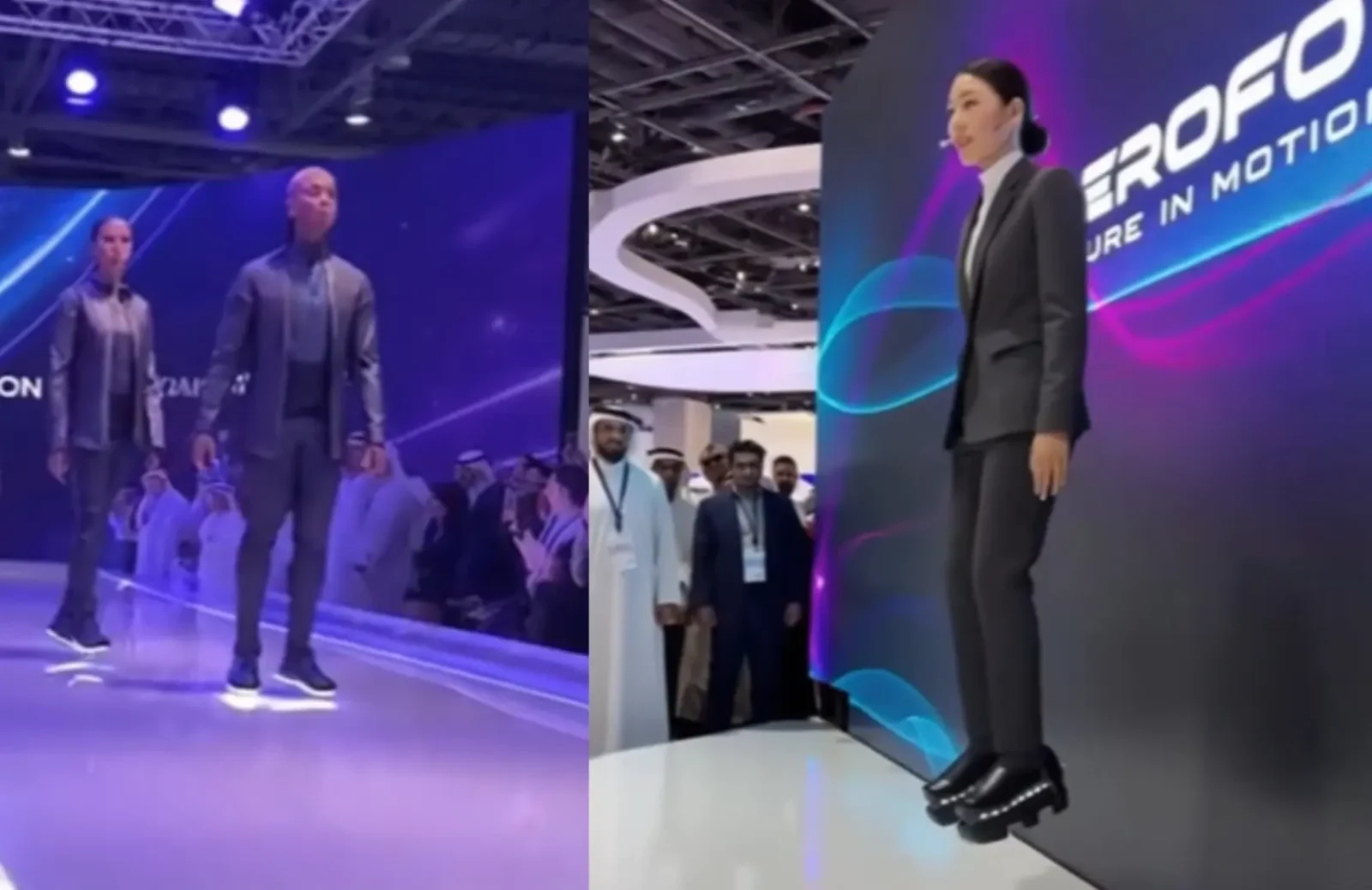
The internet’s fascination with futuristic technologies often outpaces the realities of science and engineering. One striking example is the viral, AI-generated phenomenon surrounding “Aerofoot,” a purported innovation that allegedly allows users to levitate or hover using high-tech footwear. The footage, crafted with the help of artificial intelligence tools, shows people seemingly hovering a few feet above the ground while wearing ultra-sleek shoes at what appears to be a futuristic version of GITEX Global labeled “2029, Future in Motion.”
On first glance, it’s thrilling: a vision of human flight, mobility unbound by roads, and shoes that defy gravity. Yet upon closer inspection and through investigations by outlets like Yahoo News, PrimeTimer, and Gulf News, the so-called invention reveals itself as an elaborate illusion: an AI-generated artwork, not a scientific breakthrough.
Aerofoot’s High-Tech Showcase and the Illusion That Captivated the Internet
The branding, paired with the futuristic backdrop of a high-profile tech event, lent the spectacle a convincing and genuine sense of authenticity. The presentation was complete with digital banners and sleek promotional styling, implying that Aerofoot represented the next step in personal flight technology.
However, fact-checkers swiftly unraveled the illusion. The videos were traced back to Jyo John Mulloor, a Dubai-based digital artist known for his AI-powered conceptual creations. Mulloor’s work, though visually striking and creative, exists firmly within the realm of speculative digital art, not engineering reality.
The small, boot-sized form factor seen in the video provides no plausible mechanism for the necessary propulsion system, battery capacity, or stabilization hardware. Moreover, no visible signs of exhaust, rotor systems, or tethered support structures appear in the clips. Equally problematic is the reference to “GITEX 2029,” a future event that does not yet exist.
The idea of flying shoes taps social media’s instant gratification loop, which creates a perfect storm of virality. People share before they think, and algorithms amplify before they verify. The invocation of authority through terms like “GITEX” or futuristic branding further legitimizes the falsehood. As Gulf News noted, AI-generated content like this blurs the boundaries between fantasy and reality, eroding the public’s ability to distinguish authentic innovation from digital artistry.

Artificial intelligence is both a creative engine and a mirror reflecting human curiosity
Artificial intelligence now sits at the intersection of imagination and engineering. The Aerofoot case highlights how advanced AI tools, particularly generative visual systems, are reshaping our understanding of authenticity. What once required costly production studios or physical prototypes can now be achieved through algorithms that render photorealistic textures, physics simulations, and believable human movement. From a creative standpoint, this democratization of visual technology represents a genuine milestone. Artists like Jyo John Mulloor use these tools to express futuristic concepts, allowing audiences to visualize possibilities that might still be decades away.
However, this same accessibility introduces a new challenge: the blurred boundary between conceptual design and perceived reality. AI-generated visuals are now so sophisticated that they can easily be mistaken for documentation of real-world technology. In Aerofoot’s case, the visual precision of the lighting, reflections, and human gestures was convincing enough to mislead viewers unfamiliar with digital art cues. This does not signify negative intent, but it reveals how rapidly AI content creation has outpaced public understanding of its capabilities.
It is also worth noting that AI’s role in shaping perception extends beyond viral clips. In fields like industrial design, simulation, and virtual prototyping, these same algorithms are indispensable tools. They allow engineers to test hypothetical ideas before manufacturing begins. The challenge, therefore, is not the technology itself but the context in which it is consumed. When AI creations are presented as art or conceptual speculation, they expand imagination. When they circulate as unverified facts, they distort the collective understanding of scientific progress.
The Aerofoot case doesn’t condemn artificial intelligence; instead, it highlights its inherently dual nature, both creative and deceptive. AI stands simultaneously as a tool of creation and a lens through which we observe ourselves. On one hand, it serves as a creative engine, a system capable of transforming imagination into vivid, tangible expressions that once belonged solely to the realm of science fiction.
On the other hand, it acts as a mirror of human curiosity, revealing our relentless desire to push boundaries, to visualize futures not yet realized, and to test the limits of belief itself. Used responsibly, it can help us envision the future. Used carelessly, it can convince us that the future has already arrived. The distinction between those two outcomes depends entirely on how we engage with it.
Explore Courses
.jpg "Ondrej Chybik - Rethinking Architecture")