



Architectural design today is experiencing a fundamental shift from “drawing logic” to “information logic.” With the accelerating wave of digitalization and intelligent technologies, project processes are increasingly structured upon information flow and cross-disciplinary collaboration.
In the context of information and AI technology, information models are central to design, development, and management. Building Information Modeling (BIM) has become the primary framework for integrating architectural information and enabling cross-disciplinary interoperability. Parametric design introduces generative logic through computational relationships and adjustable variables, promoting systematic evolution and translating geometry into computable data. Artificial intelligence is growing to support automated design generation, optimization, and decision-making through data analysis and deep learning. Together, these technologies accelerate conceptual exploration and streamline information-model construction, making information models the essential link between conceptual design, simulation, and construction.
Yet each digital platform maintains its own data logic, leading to persistent challenges in interoperability and cross-platform information transfer. At an industry level, the lack of shared online collaborative platforms prevents design institutes and clients from forming collective data assets, resulting in fragmented project datasets. Despite improvements in workflow efficiency, issues of data exchange, software compatibility, and interdisciplinary coordination remain. While information-based project processes can shorten timelines and enhance resource efficiency, the efficiency and accuracy of information transfer have become critical determinants of design quality and project execution.
Design-Engineering-Fabrication
Throughout the history of architectural theory, two tendencies have repeatedly emerged: the pursuit of mathematical-geometric clarity and the use of nature as a basis for forming generation. The former reflects the human pursuit of proportion and order, while the latter emerges from mimetic observations of natural patterns and environmental behavior. Both are processes of transferring information from the macro to the micro scale, moving the interpretation and formulation of site, function, and concept toward geometry, construction logic, and material systems through data.
From the construction perspective, buildings grow from micro-elements into macro systems through the layered assembly of materials, components, and units. Industrialization and digitalization further systematize this process, in which buildings are decomposed into standardized components. Real-world design input is rarely complete or linear; it is often ambiguous or incomplete, requiring ongoing inference, user interaction, and iterative refinement. The relationship between design and construction is also no longer a simple linear handoff from drawings to building. Instead, it is the dynamic coupling of multi-scalar information flows.
Within the framework of “design as information generation, construction as information materialization,” design tools actively shape the organization of information flows, influencing design logic and architectural outcomes.
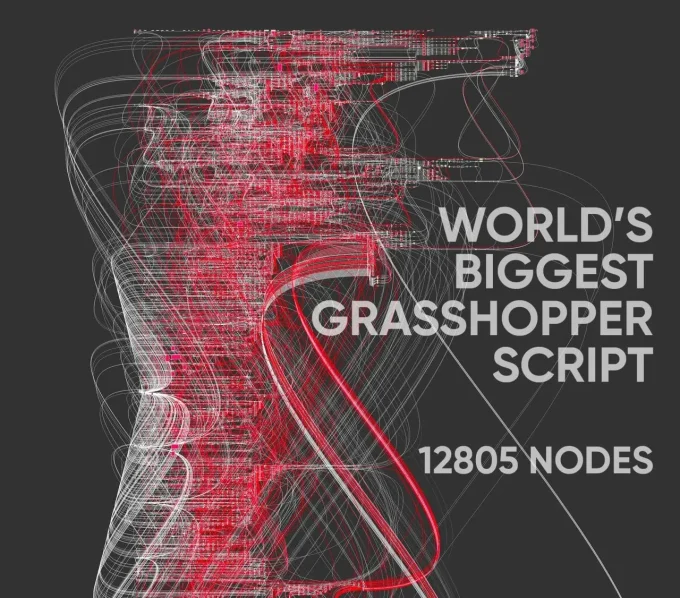
In the design process, tools such as Rhino, Maya, and 3ds Max focus on macro-scale form and spatial creation. Grasshopper enables computational exploration by converting geometric, functional, environmental, and contextual constraints into adjustable parameters, supporting multi-objective and iterative early-stage design. In parallel, BIM technologies (e.g., Revit) construct information models that correspond to engineering systems. These virtual models must ultimately be translated into manufacturing and assembly information during construction, which depends on fabrication, tolerances, and logistics information. Accordingly, the architectural production process comprises three interconnected layers:
- Form & Space – Design & Conceptualization (Design Model)
- Components & Systems – Engineering & Coordination (Engineering Model)
- Materials & Processes – Fabrication & Assembly (Construction Model)
Successful project delivery depends on whether information passes continuously and accurately across these layers. The challenge is to transmit design intent efficiently into fabrication without distortion or loss, making the continuity of the information chain a central issue in contemporary architectural production.
Efficiency and Accuracy in Design Information Flow
Traditionally, conceptual design and construction documentation are separated into different steps, relying on extensive manual interpretation and information reconstruction. Although BIM bridges some gaps, design models still require significant re-modeling within BIM for coordination and technical documentation. This reveals the limitations of the traditional approach from an information-transfer perspective, especially in complex projects where manual reconstruction limits design innovation.
Design information complexity is shaped by three factors as follows:
- Geometric complexity;
- Number of component types;
- Quantity of components.
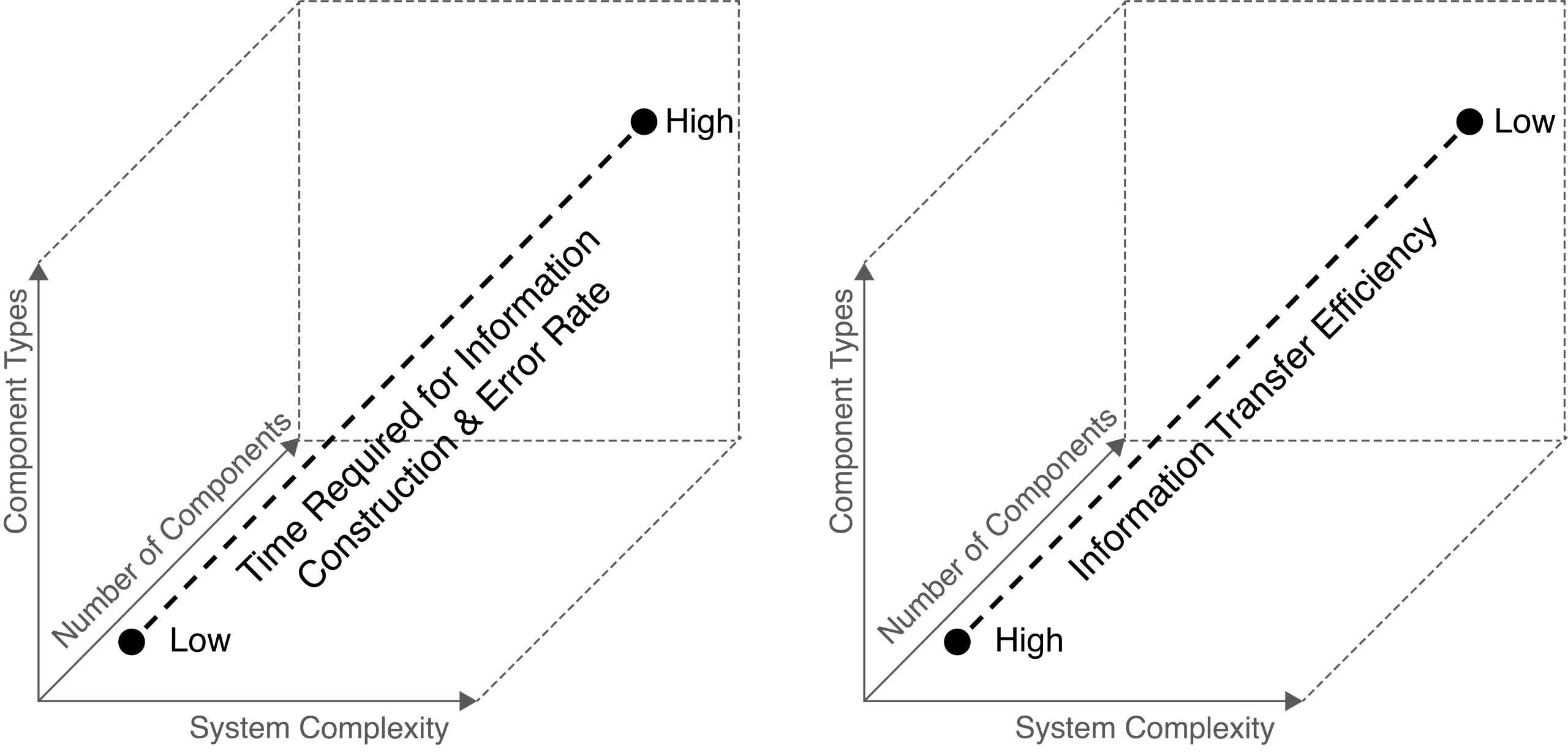
As shown in Figure 1, these factors dramatically affect the accuracy and efficiency of information transfer. When these factors increase simultaneously, BIM model-building difficulty escalates exponentially, and the accuracy of design-to-construction translation becomes highly vulnerable.
Although these dimensions cannot be fundamentally reduced once a design is established, efficiency can still be improved through the optimization of data interpretation, consolidation, and information-flow pathways. This reduces the cost of construction modeling and increases cross-platform accuracy.
Based on these three factors, the following provide practice-based analyses that offer new methodological insights for information systems.
1. Component Classification to Consolidate Information
In complex projects, classifying and consolidating component types is an essential strategy for reducing model complexity and improving information-flow efficiency, which is an important part of transferring data in the design-engineering-fabrication process. In real construction, components typically contain installation tolerances that allow minor variations without affecting performance. This tolerance provides the basis for virtual component classification.
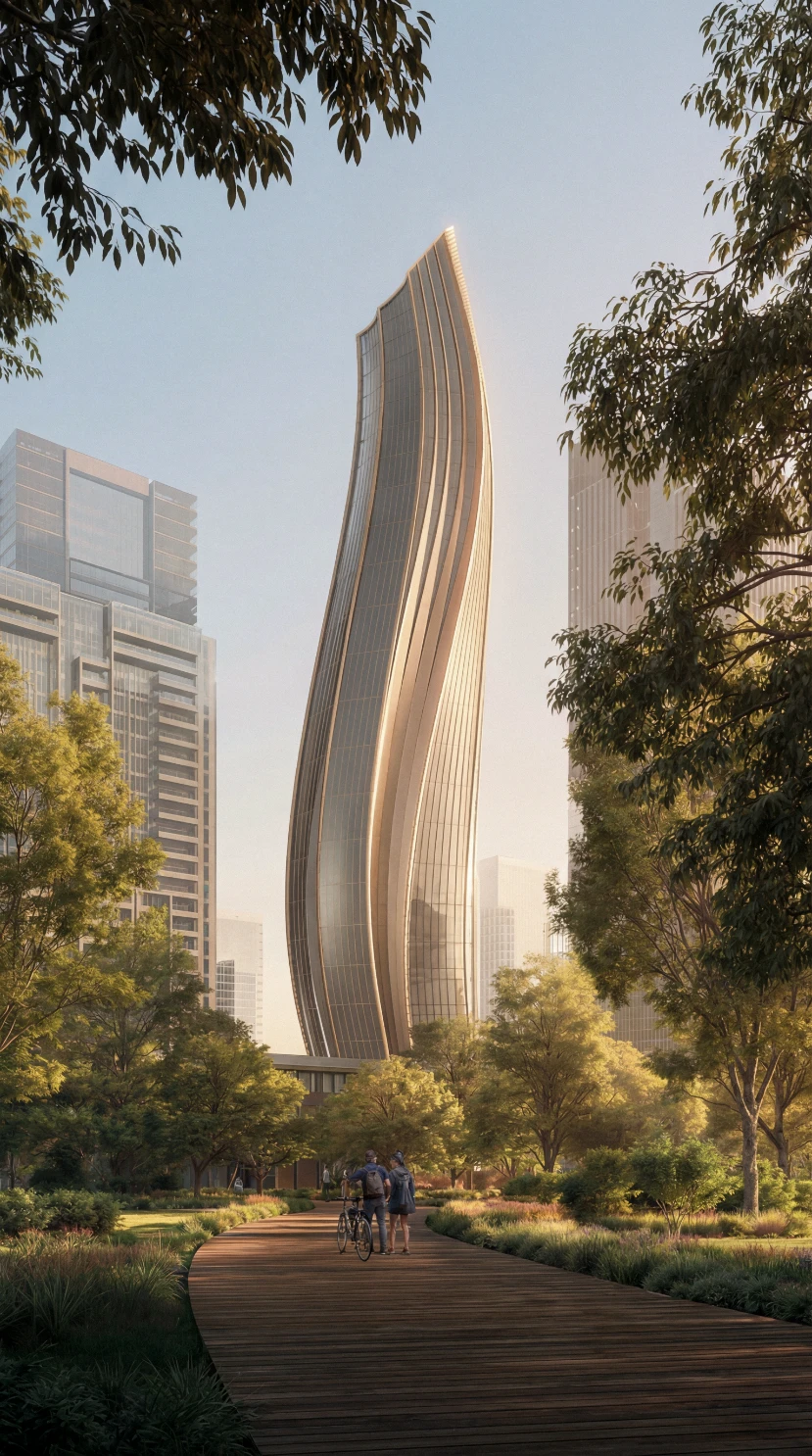
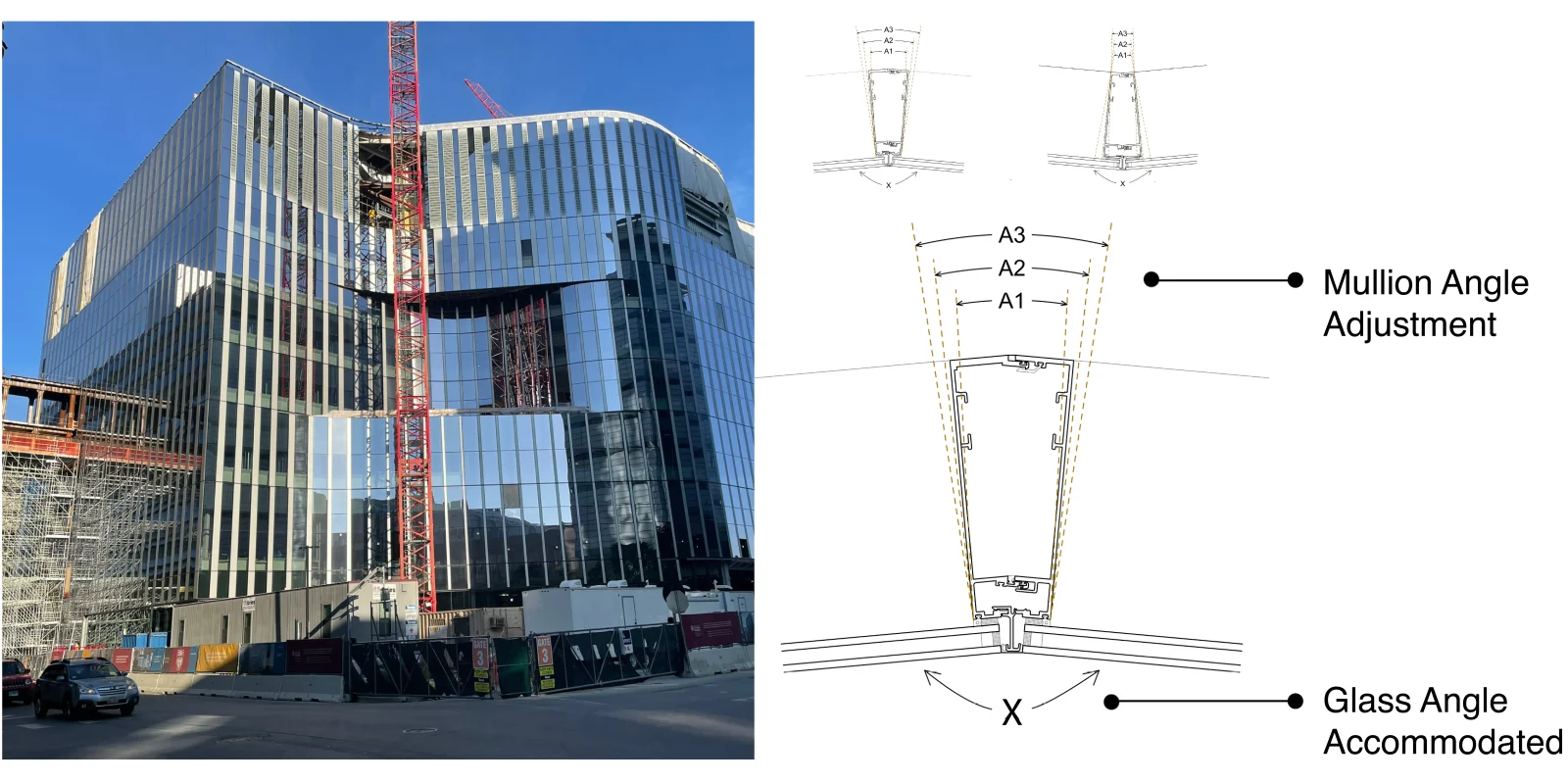
For example, in the design of the University of Chicago’s Cancer Center, continuously varying façade curvature created hundreds of mullion types if divided strictly by geometry, which greatly increased BIM complexity. However, construction analysis revealed that introducing a 1° tolerance in mullion rotations absorbed minor geometric variation without compromising constructability. As a result, the number of mullion types was reduced to eight, greatly reducing the complexity of the information model.
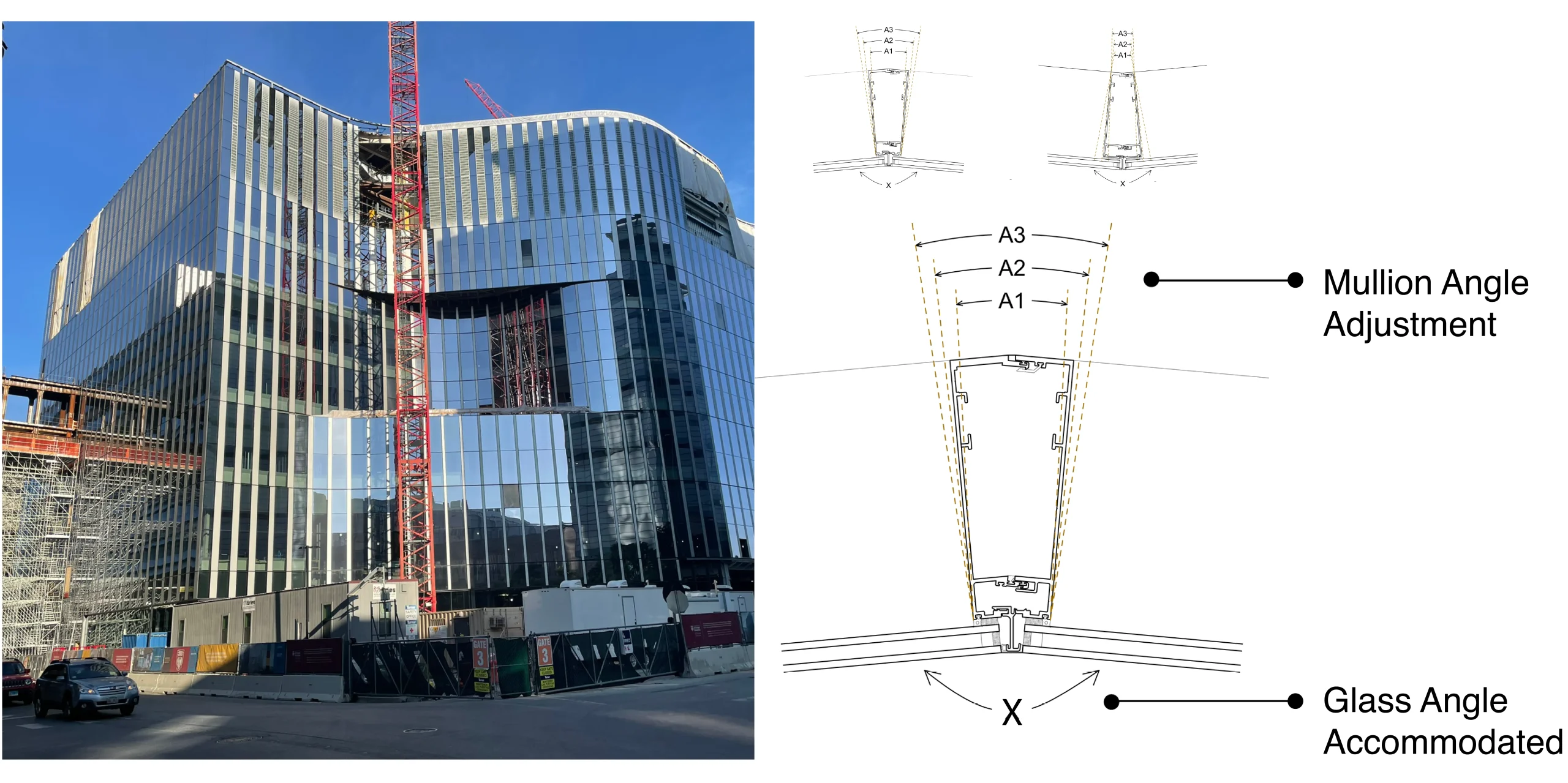
Abbie Foundation Cancer Pavilion, UChicago Medicine, Image Courtesy of Yazdani Studio
Methodologically, this represents a “fabrication-logic-based classification”: absorbing geometric variation through controlled tolerances allows substantial simplification without compromising design intent. Understanding the limitations and potential of the manufacturing process would help designers push the boundaries of design and engineering.
2. Parametric Integration for Efficient Data Management
With increasing geometric complexity and data volume, efficient transfer and management of information have become central challenges. Parametric tools process large datasets and support the generation of complex geometry. Take the design process as an example. Conceptual geometry is often generated in Rhino/Grasshopper, while drawings and engineering data are prepared in Revit or CAD. Accurate data transmission between Rhino and Revit is therefore critical. And parametric design tools have played key roles in shaping information flow.
Two common workflows include:
(1) Geometry-control-point–based data transfer. Steps include:
- Extracting key control points in Rhino & Grasshopper;
- Exporting XYZ coordinates via Excel or online platforms;
- Reading coordinates in Revit/Dynamo to auto-generate components.
Its advantages include reduced manual working hours and increased accuracy. The limitations are one-directional data flow and no real-time feedback.
(2) Direct linkage between design and BIM platforms
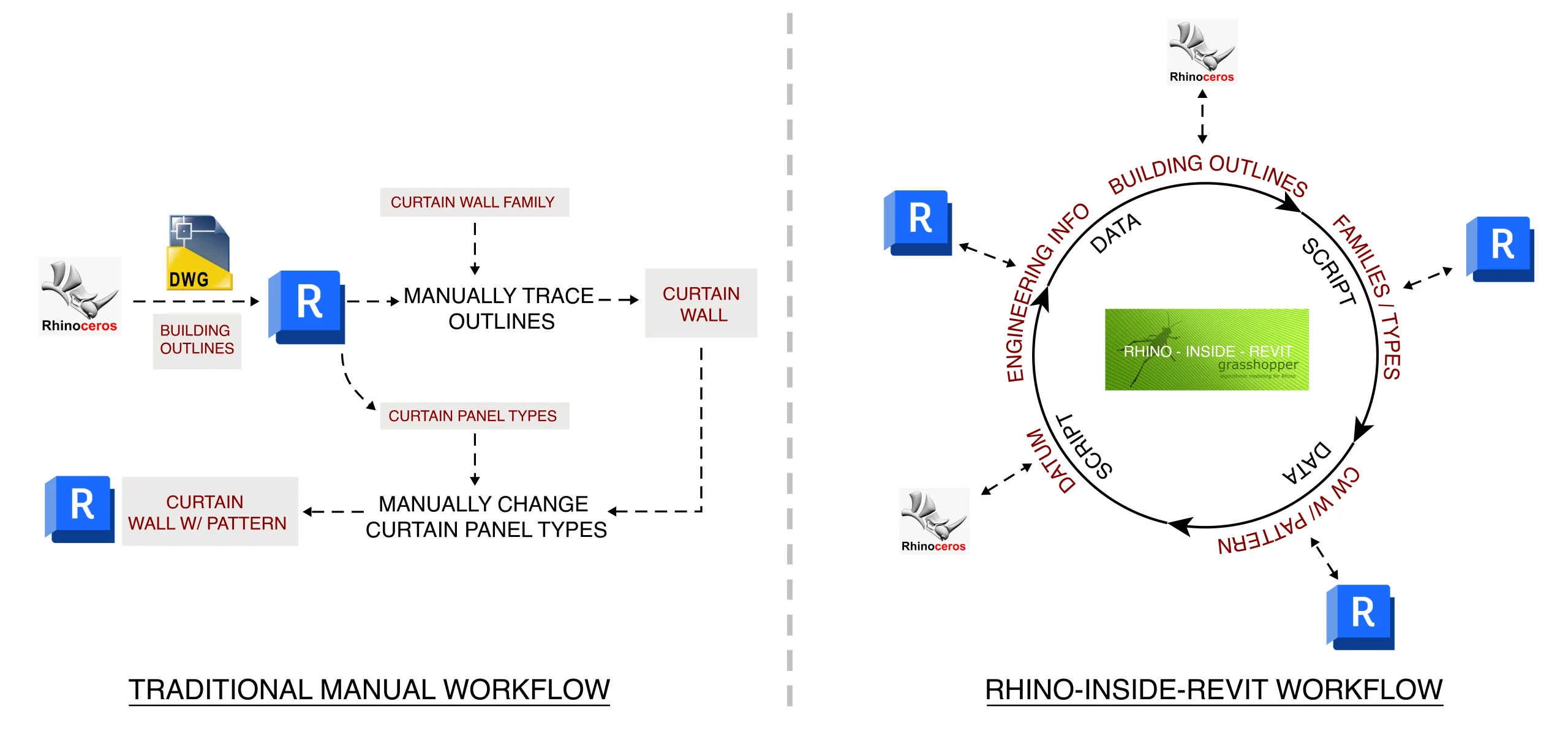
The ideal workflow supports bi-directional communication. Rhino Inside Revit is currently the most effective bridge, embedding Rhino and Grasshopper into Revit and allowing real-time geometry and information synchronization.
Figure 3 shows that while traditional workflow works as a linear process requiring multi-stage geometric translation, Rhino Inside Revit eliminates intermediaries and serves as a data platform where the design and engineering information can be brought in, coordinated, and fed back to different parts of the project team, which establishes a new information mode that benefits the complex design process and promotes better communication.
3. System Complexity
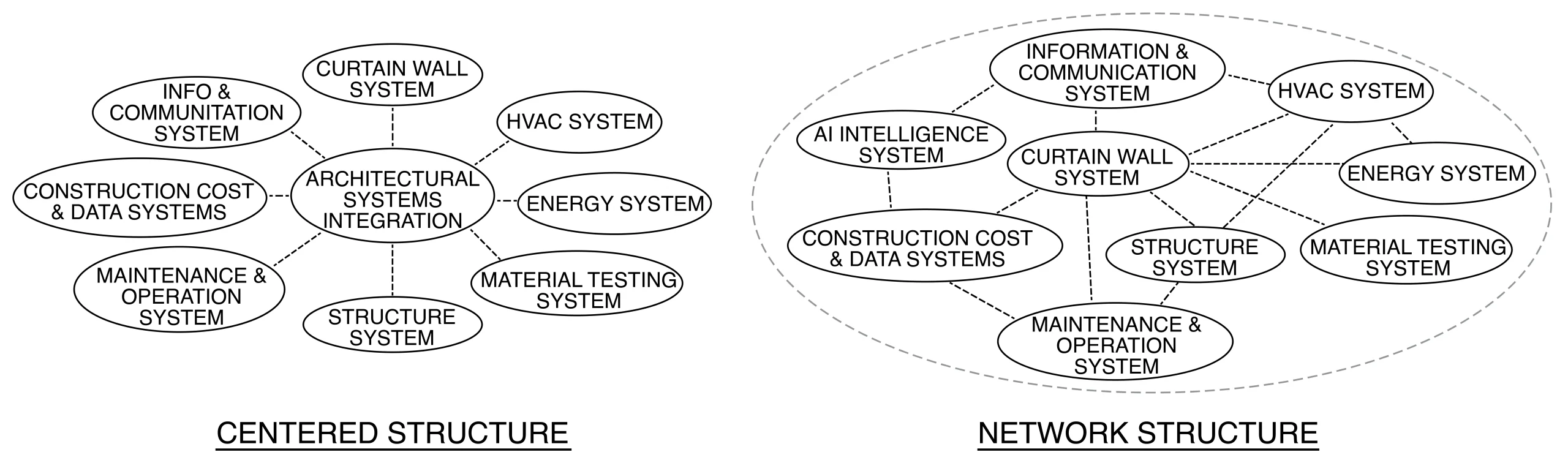
Contemporary architecture is no longer the product of a single artistic vision but the accumulation of systems, regulations, technologies, and industrial processes. A building’s performance depends on the integration of multiple subsystems. As AI advances, new systems such as intelligent construction and predictive maintenance will become further embedded. The advancement of systems organizations will be critical to the success of information flow.
Traditional workflows adopt a center-out structure: architects propose a form first; engineering systems evaluate later. This delays system-level influence and reduces holistic integration.
BIM establishes a multidisciplinary, lifecycle data framework, which is more towards a network organization. Yet, engineering influence remains limited in early design. If structural and MEP logic were embedded during form generation, they could act as generative constraints or even sources of design ideas. Tools such as Karamba3D and KIWI3D already enable structural engineers to perform parametric structural analysis within Rhino/Grasshopper, signifying early methodological convergence.
4. Change From Fabrication
Contemporary aesthetics and construction technologies jointly drive architecture toward complex curved geometries. Digital tools significantly expand design freedom, but deliverable drawings still require geometric rationalization, involving:
- Converting freeform geometry into rule-based, engineerable geometry;
- Adjusting geometry according to fabrication processes and material limitations.
Information and AI technology are accelerating the first step. Tools like Kangaroo automate mesh relaxation and curvature analysis. Machine learning may further automate geometric optimization. The second step remains limited by fabrication technologies. Although additive manufacturing is advancing, it has not reached large-scale industrialized construction. Advances in high-freedom fabrication will reconfigure the logic of form-making, allowing complex geometries to be realized without simplification and driving a fundamental reorganization of the design production information chain.
Looking Forward
The purpose of better information flow in the project process is to establish a more efficient, accurate information management system across the design and construction continuum. Whether information remains continuous and consistent across modeling, collaboration, and construction directly affects project quality, material consumption, and energy performance. Thus, improving the system contributes not only to production efficiency but also to lifecycle sustainability. It also frees design teams from repetitive modeling work, allowing more time for exploration of form, structure, and experience.
Progress in architecture arises not only from shifts in aesthetic trends but also from the reconstruction of information pathways among design, engineering, and construction. When engineering, structure, MEP, façade, and cost systems participate from the beginning through shared data, architectural production shifts from a linear progression to a multidisciplinary data-driven process. By establishing efficient and transparent information flows, architectural practice can secure both quality and efficiency while also expanding the room for creative exploration and public value generation.
By Haisheng Xu
Explore Courses
.jpg "Ondrej Chybik - Rethinking Architecture")