





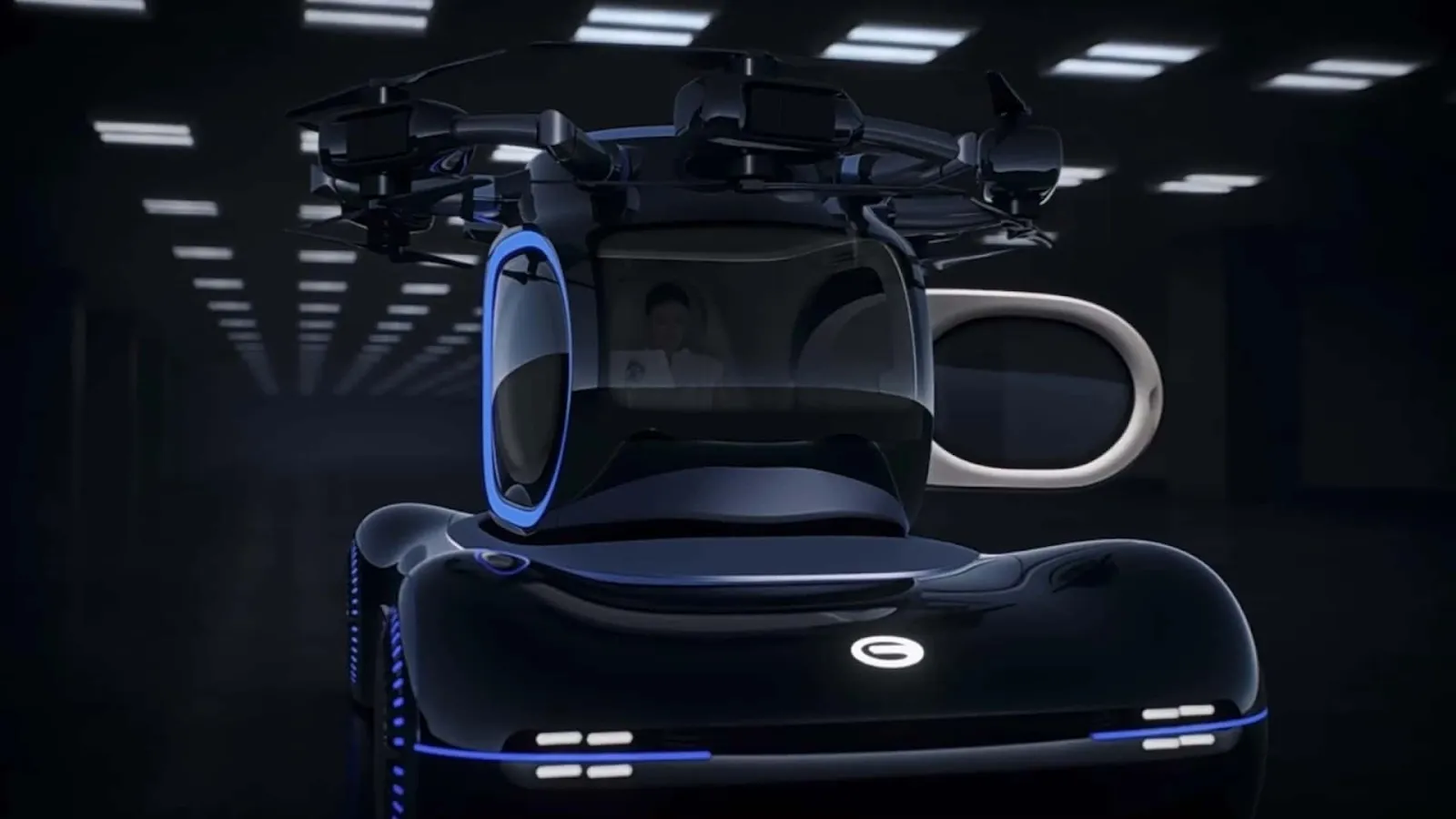
At the 2025 Shanghai International Auto Show, GAC Group (commonly known as GAC) has revealed its latest concept vehicle, the GOVE (which stands for GAC On-the-go Vertical EV), an electric vertical takeoff and landing (eVTOL) flying car concept that envisions the convergence of road mobility and aerial transport in future urban environments.
Designed with 2028 urban mobility in mind, the GOVE integrates electric propulsion technology, aerodynamic lift systems, and intelligent stabilization mechanisms to enable smooth transitions between driving and flying. The concept underscores GAC’s purpose to contribute to China’s growing low-altitude economy, where personal air mobility and ground-based transport networks are set to merge.

In its current form, the GOVE remains a concept rather than a production vehicle; nonetheless, it demonstrates several technical innovations and architectural choices that signal GAC’s purposes in the advanced mobility sector.
GOVE: Dual-Mode Modular System

The GOVE employs a modular architecture, dividing the system into two distinct units:
- A flight pod (upper module) that houses the passenger and flight propulsion systems.
- A road-based chassis (lower module) with wheels for ground travel, which can also operate autonomously.
One of the distinctive design features is the ability of the flight pod to detach from the lower chassis and proceed autonomously by air, while the road chassis returns to base or another docking location on its own. This modularity allows the system to separate flight and drive functions, potentially optimizing each for its environment rather than forcing compromise.
Mechanically, the flight pod includes a set of rotor arms or propeller booms that can deploy for vertical flight and stow for ground-driving mode. The road chassis is designed to support the flight pod during drive mode and then serve as a landing base during flight mode.
Propulsion, Lift, and Stabilization Systems
From available disclosures, the GOVE’s flight pod utilizes a distributed electric propulsion (DEP) system, which means multiple electric motors and propellers are used, providing redundancy and enhanced safety in the event of motor/propeller failure. For example, one summary describes “12 propellers, 12 electric motors” for one version of the concept.

The vertical takeoff and landing (VTOL) mode is enabled by deploying rotor arms/booms to raise the pod off the chassis and transition to forward flight. The use of electric propulsion aligns with global trends toward zero-emissions mobility. Though detailed performance data (such as thrust, power ratings, and battery capacity) is not publicly disclosed, this architecture gives a broad view of the technical industry.

The intelligent stabilization systems and autonomous control stack (as indicated by GAC’s reference to “ADiGO-Pilot” for the road chassis) point to a future where both ground and air modes may incorporate high levels of autonomy.
GAC’s Smart Mobility Strategy in China
The GOVE is a flying car prototype and a platform for urban and peri-urban mobility. By combining road and flight modalities, it attempts to address the “first-mile/last-mile” problem and to bypass congested roads by leveraging low-altitude airspace.
Specifically, for daily commuting within and between cities, the GOVE could allow a user to drive from home to a takeoff pad, detach and fly over traffic, then land and drive to the final destination. The modular separation also means the road chassis could remain behind or return independently, optimizing the usage of hardware.
GAC positions the vehicle as part of its “smart mobility” strategy. The concept aligns with China’s push for an expanded general-aviation ecosystem and what is often referred to as a “low-altitude economy”—i.e., flights at lower heights, within urban/near-urban environments.

From a strategic standpoint, the GOVE concept signals GAC’s intention to move beyond traditional EVs into shared mobility and advanced aerial systems. In China, this aligns with government policy that encourages the development of low-altitude general aviation and urban air mobility infrastructure. For GAC, the modular flying-car concept can serve as a technological showcase, attracting investment, talent, and public attention.
By placing itself in the eVTOL/roadable vehicle space, GAC aims to position itself ahead of the competition and build competencies in areas such as autonomy, lightweight structures, electric propulsion, battery systems, and air-vehicle integration.
The GAC GOVE concept represents a plausible next step in the evolution of mobility, one where the boundary between road and air is blurred. Its modular design, distributed electric propulsion, and dual-mode operation are technically intriguing and reflect current trends in urban air mobility and electric vehicles.
Source: GAC (GAC Group) via Electrek
Explore Courses
.jpg "Ondrej Chybik - Rethinking Architecture")