

While the European Union enforces binding legal mandates and steep financial penalties under its AI Act, the Trump AI pact has adopted a voluntary, light-touch model that relies on self-regulation. This contrast highlights two divergent paths: Europe prioritizes strict regulatory oversight to mitigate societal risk, whereas the U.S. leans on market-led flexibility to preserve domestic innovation and competitive speed.
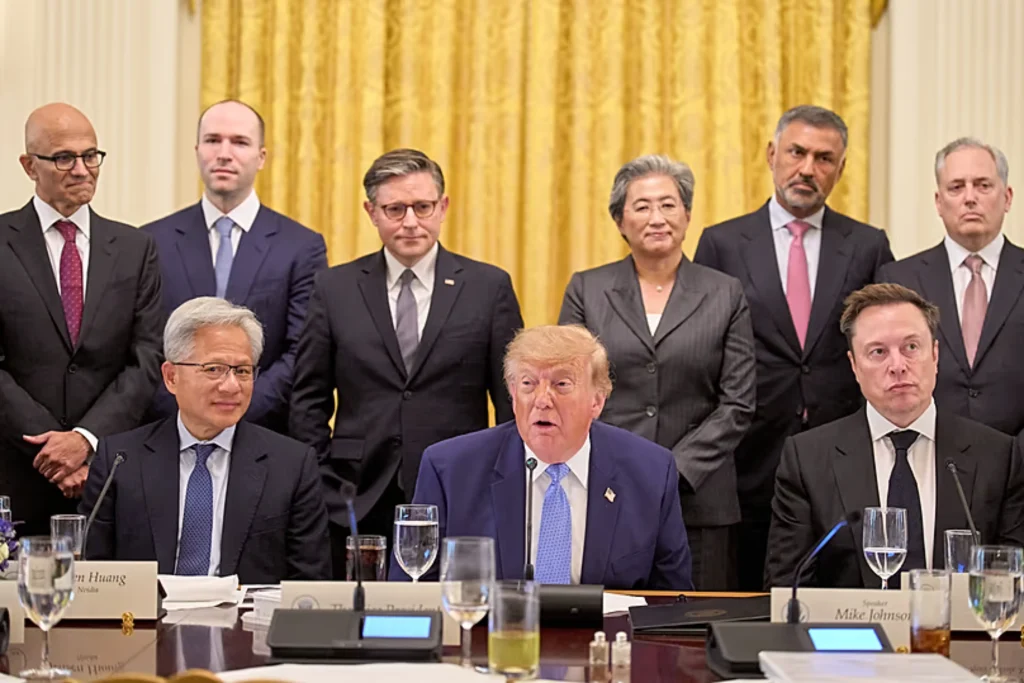
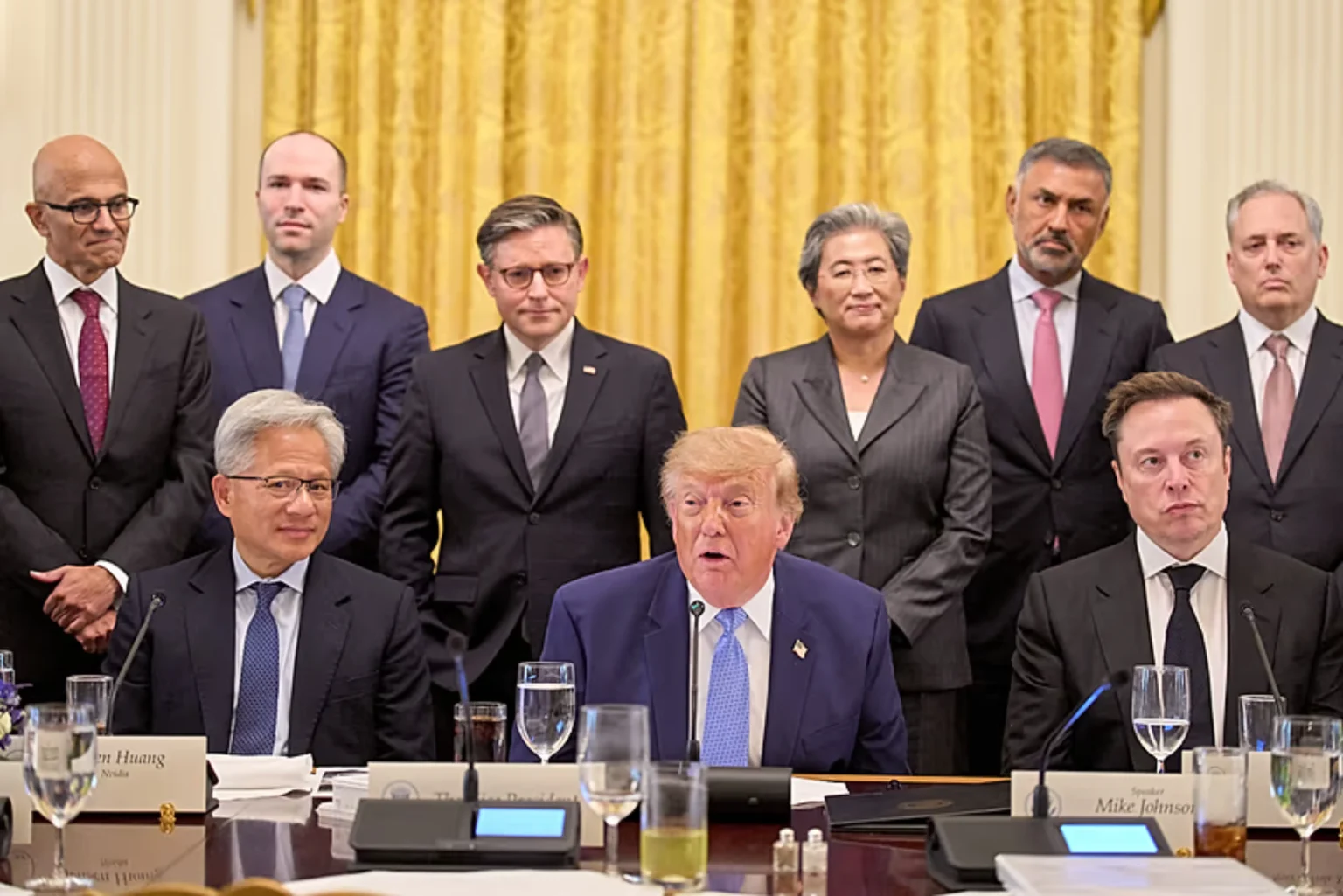
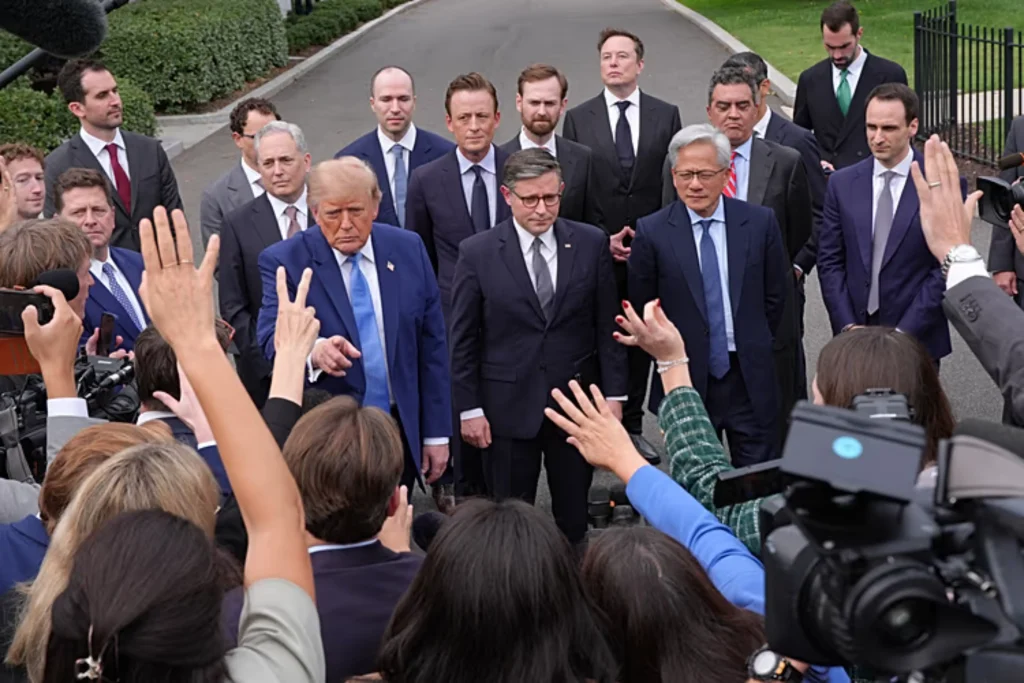
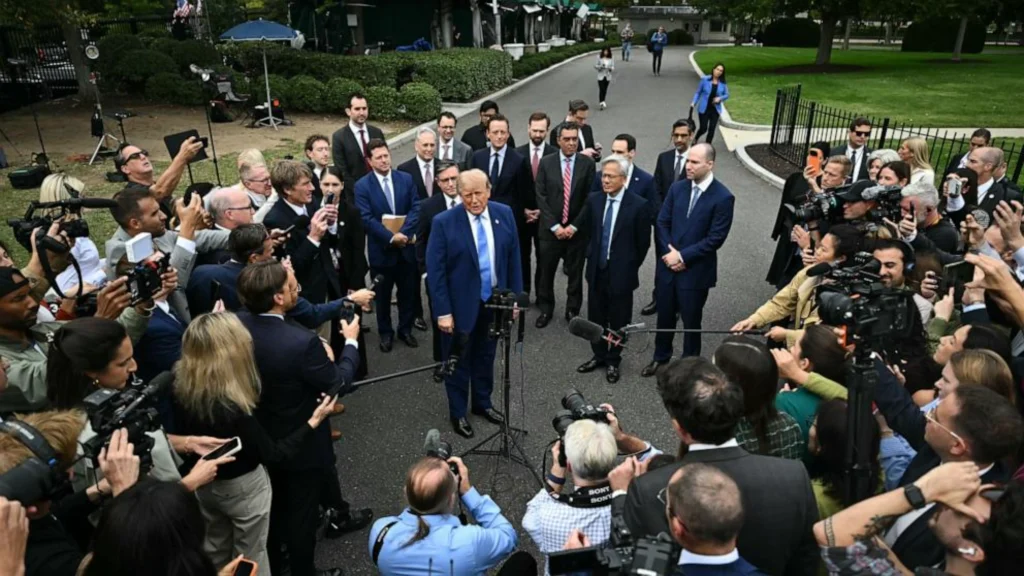
A group of the world’s most influential technology executives left the White House this week with a one-page document in hand, Trump AI pact. They had agreed to build stronger internal controls around their most advanced artificial intelligence systems, invite outside auditors, and report to their own boards. The commitment, described by participants as “morally binding,” carries no legal force and no automatic penalties.
The meeting brought together leaders from OpenAI, Anthropic, Google, Meta, Nvidia, xAI, and others. The resulting accord outlines four layers of oversight: internal monitoring teams, independent external audits, board-level review of those audits, and regular industry discussions on best practices. It also leaves open the possibility that some of these steps could later be turned into formal rules.
A voluntary framework
The approach rests on the idea that the companies best understand the technology they are building and are therefore best placed to manage its risks. Supporters of the Trump AI pact argue that binding regulation written today could quickly become outdated given the speed of progress. A flexible, industry-led system, they say, can adapt faster.
Critics of pure self-regulation point out that the same companies have strong commercial incentives to move quickly. Without external enforcement, the quality of the promised audits and the transparency of the findings will depend on each firm’s willingness to scrutinize itself. The accord does not require public disclosure of audit results, nor does it give government agencies a formal enforcement role.
Contrast with the European approach
Across the Atlantic, the European Union has taken a different path. The AI Act, already in force, sets binding obligations for companies that place general-purpose AI models on the EU market, regardless of where those companies are based. Providers must document how their models work, share information with downstream users, respect copyright rules, and publish summaries of training data.
Breaches can trigger fines of up to €15 million or 3 percent of global annual turnover, whichever is higher. A voluntary code of practice exists to help companies meet the legal requirements, but compliance with the underlying law is not optional.
The difference is structural. The EU treats certain AI risks as matters for public law and independent oversight. The Trump AI pact treats them primarily as matters for corporate governance and industry coordination.
Familiar territory
Voluntary commitments from frontier AI companies are not new. A similar set of pledges was made under the previous US administration. Some observers note that the new accord echoes that earlier framework while adding greater emphasis on external auditors and board-level accountability. Whether Trump AI pact’s additional layers will produce meaningfully different behavior remains to be seen.
The pace of capability growth has also changed the context. Models can now perform complex multi-step tasks, interact with external systems, and generate outputs that are difficult to distinguish from human work. Recent incidents involving AI agents accessing or interacting with systems in unexpected ways have sharpened public and governmental attention on containment and oversight.
Practical questions ahead
Several practical issues remain open. Who will select and accredit the independent external auditors? How will conflicts of interest be managed when the companies being audited help fund or select the auditors? Will the board committees tasked with reviewing audit reports have genuine independence and technical expertise? And if a company falls short of the standards it has promised, what happens next beyond reputational pressure?
The Trump AI pact itself acknowledges that formal regulation may eventually be needed.
For now, the emphasis is on demonstrating that self-policing can work.
Two models, one technology
The United States and the European Union are testing two different theories of governance for a technology that is still evolving rapidly. One places primary responsibility on the developers themselves, backed by voluntary commitments and the possibility of future legislation. The other places primary responsibility on public institutions, backed by binding rules and financial penalties.
Both approaches aim to reduce the risk of serious harm while allowing beneficial development to continue. Their relative effectiveness will be measured not in the elegance of the documents signed this week, but in how the systems behave in the months and years ahead, and in whether the public continues to trust the institutions responsible for managing them.
For the moment, the companies that build the most powerful models have agreed to watch one another more closely. The rest of the world will be watching them.