


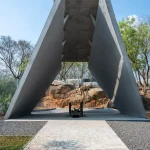
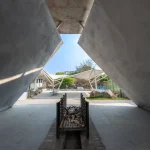
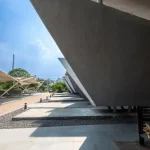
Cities rarely make room for quiet grief. In the middle of Hyderabad’s noise and density, a relatively empty pocket of land was set aside for something more deliberate: a place where people could express sorrow, sit with memory, and eventually accept the departure of someone they loved. That place is Vaikuntha Mahaprasthanam, a Hindu crematorium designed by DA Studios and completed in 2025.
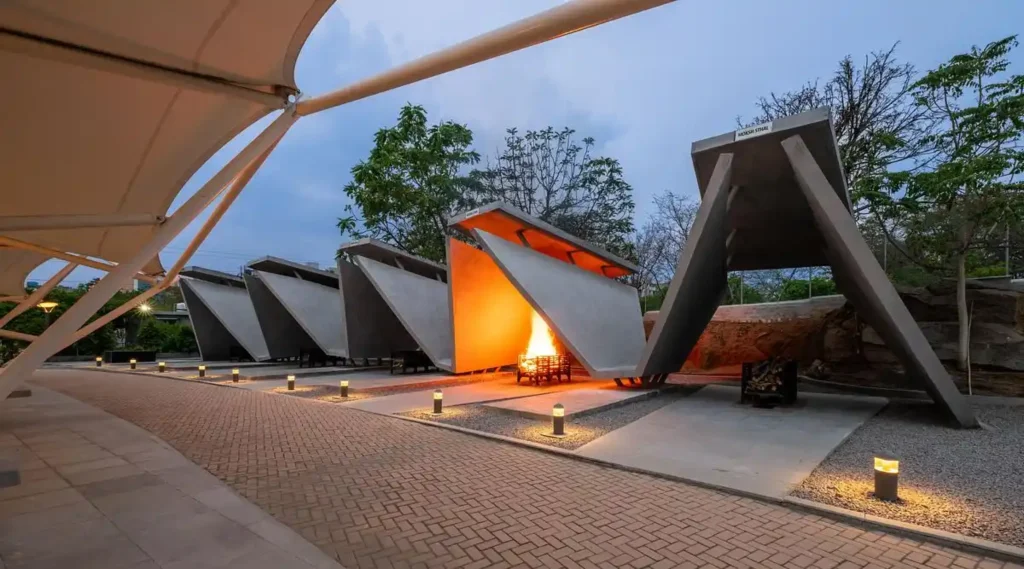
Vaikuntha Mahaprasthanam occupies 3.7 acres within a larger existing burial ground. Of that area, roughly 1,015 square meters have been carefully shaped into ceremonial paths, waiting zones, offices, change rooms, toilets and, at the center, a cluster of pyres. The architecture does not try to disguise the purpose of the site. Instead, it gives form to the emotional sequence that unfolds there.
Thresholds Rather Than Buildings
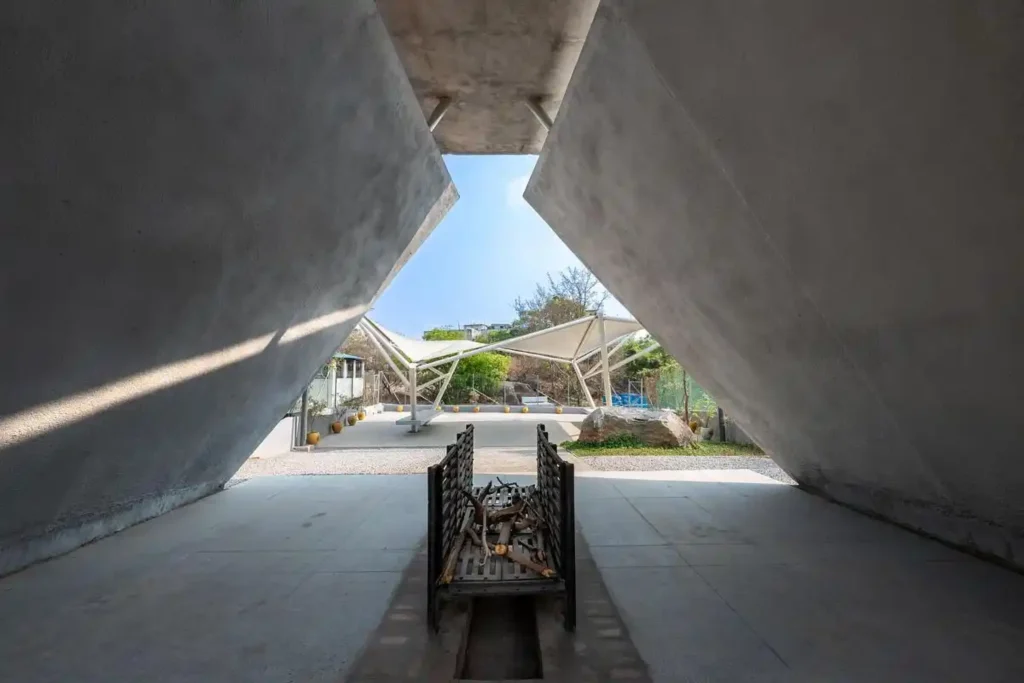
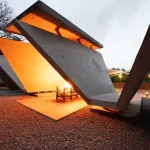
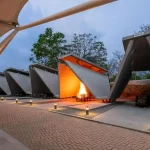
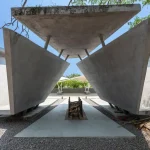
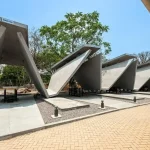
The dominant idea is the threshold. A cluster of angled planes rises to form the pyres. These planes do not enclose in the conventional sense. They create portals, archways, and passages that the architects describe as doorways into higher realms. The forms look almost fragile, as if they themselves require support. That visual fragility is intentional. It mirrors the state of a person who has just lost someone close. Only under such weight, the design suggests, does individual and collective strength become visible.
The planes lean against one another, transferring load and creating mutual stability. From certain angles, the group of pyres resembles a heartbeat recorded in concrete and steel. From others, it reads as a family shouldering a shared burden. The architecture therefore operates on two levels at once: it provides the practical facilities required for cremation while continuously reflecting the psychological condition of those who use it.
Vaikuntha Mahaprasthanam: Structure That Levitates
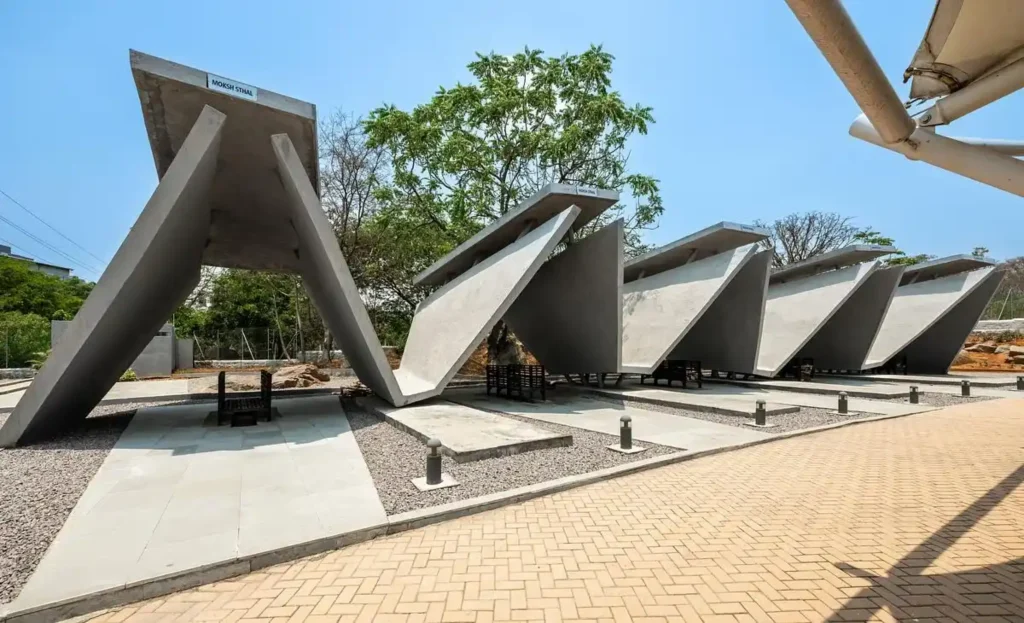
The physical construction reinforces the metaphor. Each pyre sits on a substructure of hollow steel pipes. Expanded polystyrene boards sandwiched in wire mesh are fixed to the pipes, reinforced with additional steel, and then shotcreted with concrete. The resulting shells appear to float above the ground on slender supports. The levitated quality is meant to evoke a sense of elevation, of movement toward a higher plane. Because conventional shuttering and heavy scaffolding were largely avoided, the system also allowed relatively rapid construction, an important practical consideration in a growing metropolis.
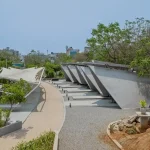
In front of the five main pyres and one larger secluded pyre stand the waiting areas. These are covered by tensile fabric membranes stretched over steel frames. The fabric surfaces are described as mnemonic screens, places where recollections, flashbacks, and the slow recognition of absence can unfold while the pyre burns beyond. The waiting structures are deliberately gaunt, aligning visually with the pyres yet offering a different kind of enclosure: one that shelters the living rather than the departed.
Space Scaled to Ritual
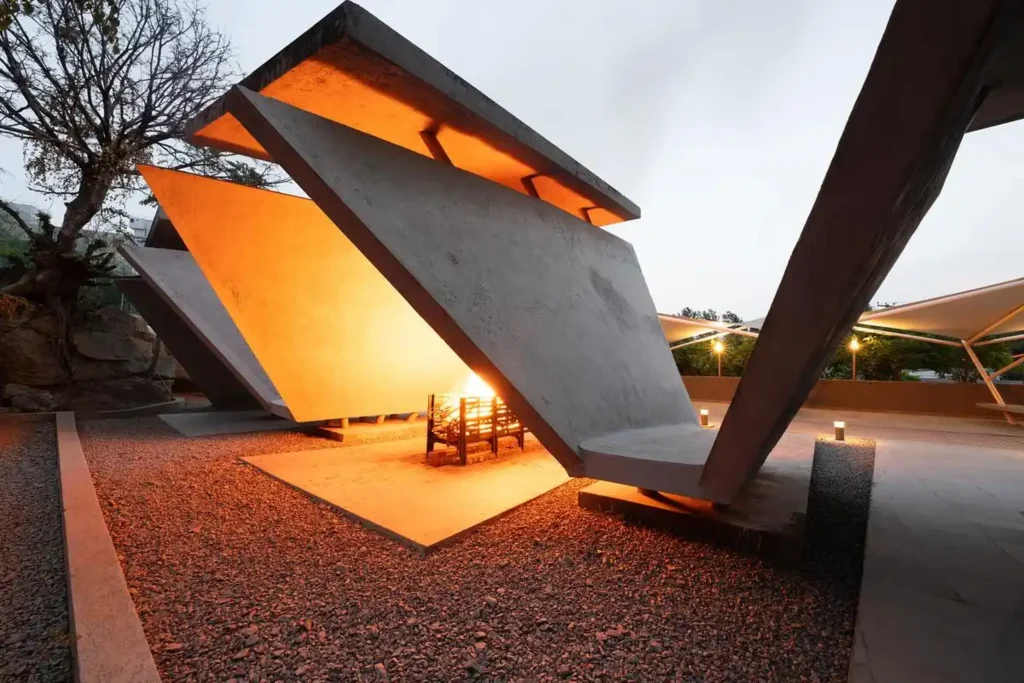
The character of the space is serene and linear. Clean planes, slanting walls and radiating lines define the composition. Scale, however, is carefully judged. Each form is large enough to acknowledge the gravity of the moment without overwhelming those who must pass through it. The architecture remains quiet so that the human presence, the rituals of preparation, offering and farewell, can remain central.
Parametric and computational thinking appears less as surface ornament and more as an underlying organizational method. The angles of the walls, the spacing of the planes, the relationship between pyre and waiting membrane, and the distribution of light and shadow were all studied to produce both structural efficiency and emotional clarity. The forms are not arbitrary. They are the result of testing how inclined surfaces can simultaneously protect, frame views, and express mutual support.
A Site Within a Larger Landscape
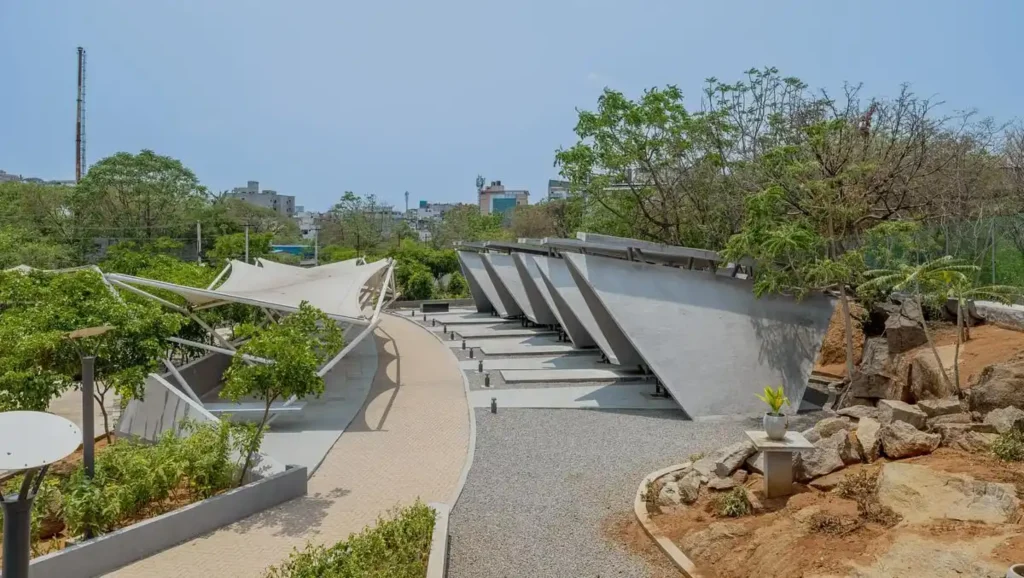
The designed areas sit inside a much larger burial ground of more than fifteen acres. Access roads, internal paths, parking, a ceremonial yard, storage lockers, and service rooms complete the practical requirements. Yet the project’s power lies in how these functional elements are subordinated to a clear emotional sequence: arrival, waiting, passage, and eventual departure from the site. The architecture of Vaikuntha Mahaprasthanam does not rush the process. It provides measured stages in which grief can be felt without being forced into premature resolution.
A quotation from the philosopher S. Radhakrishnan appears in the project description: “All becoming is an untenable contradiction. That which becomes is not being… Since the things of the world are struggling to become something else, they are not real.” The architecture does not illustrate the quote directly. Instead, it creates conditions in which the living can confront the tension between presence and absence, between the body that is leaving and the memory that remains.
Architecture of Continuity
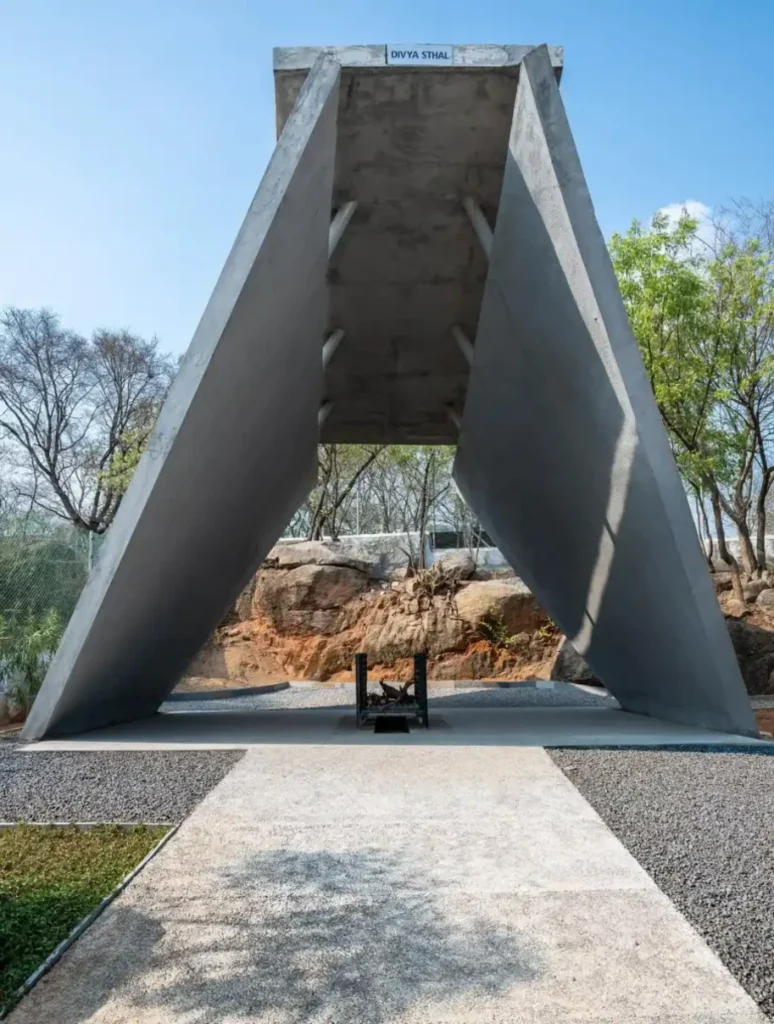
Vaikuntha Mahaprasthanam belongs to a small but growing group of contemporary crematoria that treat the final rite as a spatial and psychological journey rather than a purely technical procedure. Earlier work by the same studio on related sites in Hyderabad had already explored how precast elements and carefully ordered processional routes could restore dignity to neglected grounds. This project continues that inquiry with greater formal freedom. The planes are lighter, the waiting membranes more expressive, and the symbolic language more explicit.
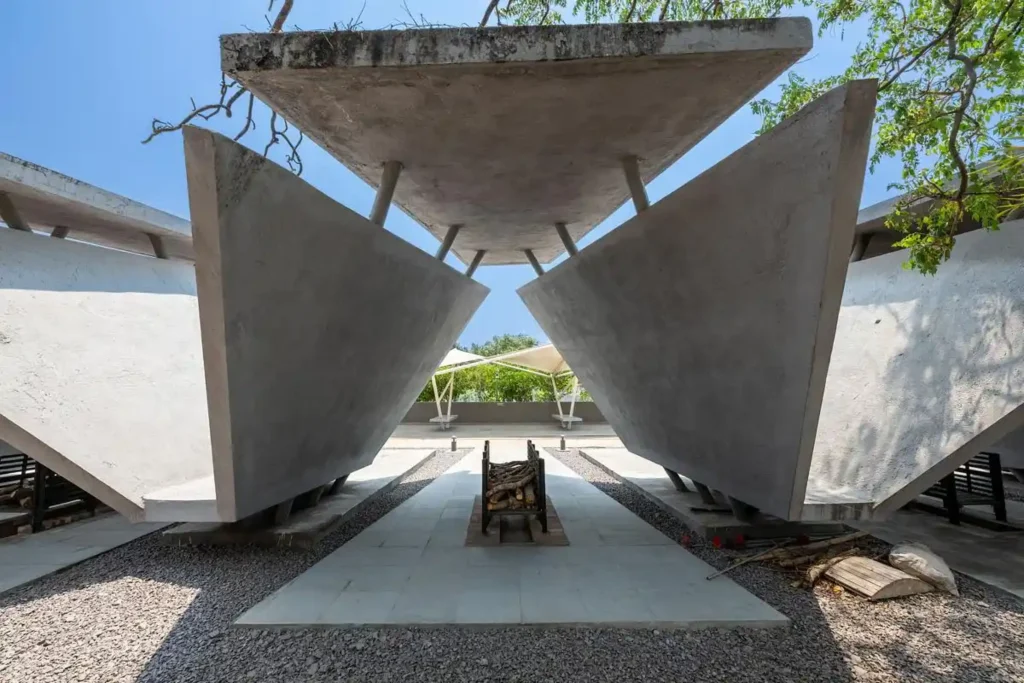
What distinguishes the design is its refusal to separate structure from meaning. The same inclined walls that give the pyres their distinctive silhouette also provide mutual bracing. The same tensile canopies that shade the waiting families also act as screens for memory. The same elevated forms that suggest ascent also make the heavy work of construction appear almost weightless. In a city where space for public emotion is scarce, the crematorium offers a rare continuity between the physical act of farewell and the inner work of acceptance.
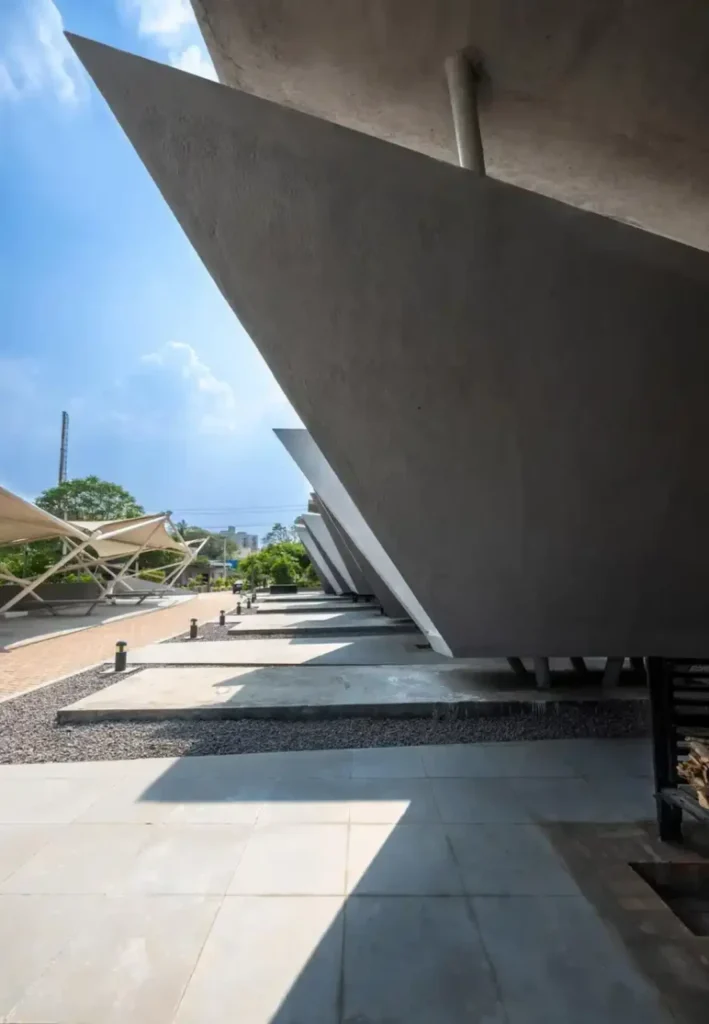
The result is not a monument to death but a carefully tuned environment for the living. It acknowledges the weight of loss while quietly asserting that even under that weight, support is possible, and that the passage through grief can be given a form worthy of the people who must walk it.
In a city that rarely pauses, Vaikuntha Mahaprasthanam offers a measured sequence of planes and thresholds where grief can be carried, shared, and slowly released.