

With a rising global affinity for K-pop culture, K-dramas, Korean skincare and beauty products, K-movies, and Korean cuisine, as part of the Korean Wave, it is the right time to explore the urban character and architectural language of Korean cities. Situated at the heart of South Korea, Seoul has evolved into a platform to showcase bold, experimental architecture, ironically set against the backdrop of lavish Korean temples and palaces. Making the architectural landscape of Seoul rich and diverse, and Seoul an unmissable city from an architect’s itinerary.
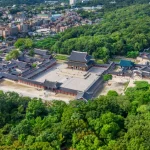
The urban scene of Seoul boasts a mix of juxtaposing architectural styles, from regional traditional Korean temples and palaces to contemporary cutting-edge infrastructure and skyscraper buildings. At its core, the city of Seoul preserves some of the masterpieces of traditional Korean Architecture, including the Jongmyo Shrine, Changdeokgung Palace Complex, and the Royal Tombs of the Joseon Dynasty, which are designated as UNESCO World Heritage sites.
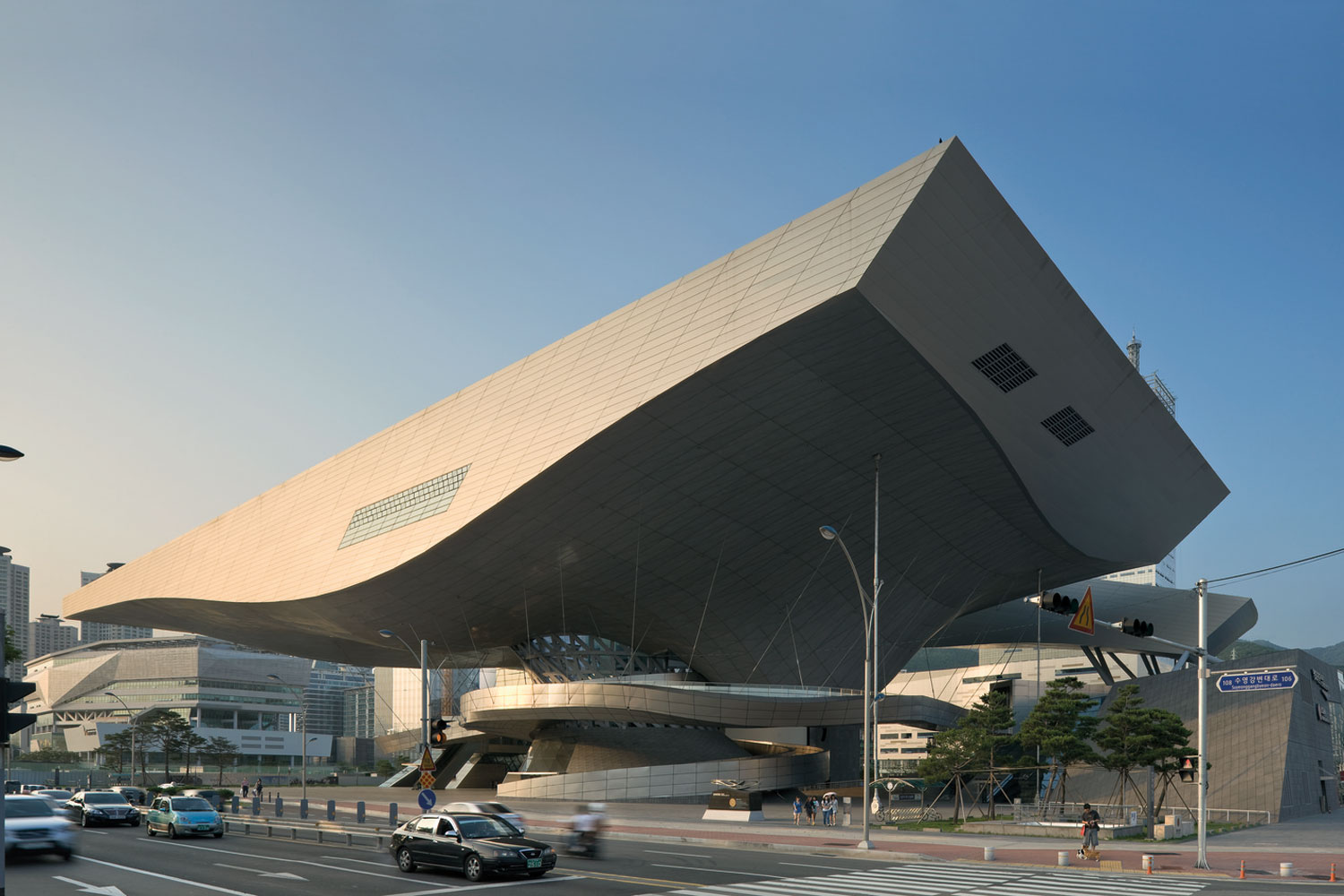
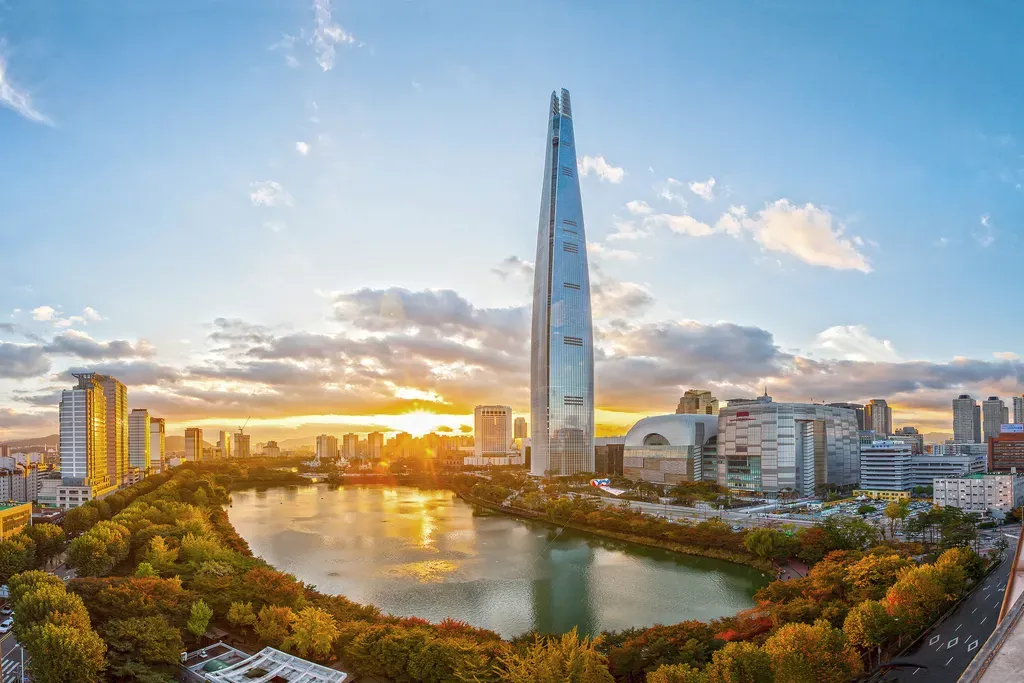
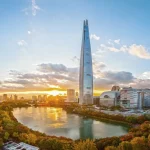
Additionally, the vibrant city boasts some of the timeless, bold, and contemporary architectural structures of this century, designed by renowned and affluent architects. Dongdaemun Design Plaza by Zaha Hadid Architects, Lotte World Tower by Kohn Pedersen Fox, and the Leeum, Samsung Museum of Art, designed by Rem Koolhaas, Mario Botta, and Jean Nouvel, are some of the distinctive Contemporary architecture in Seoul.
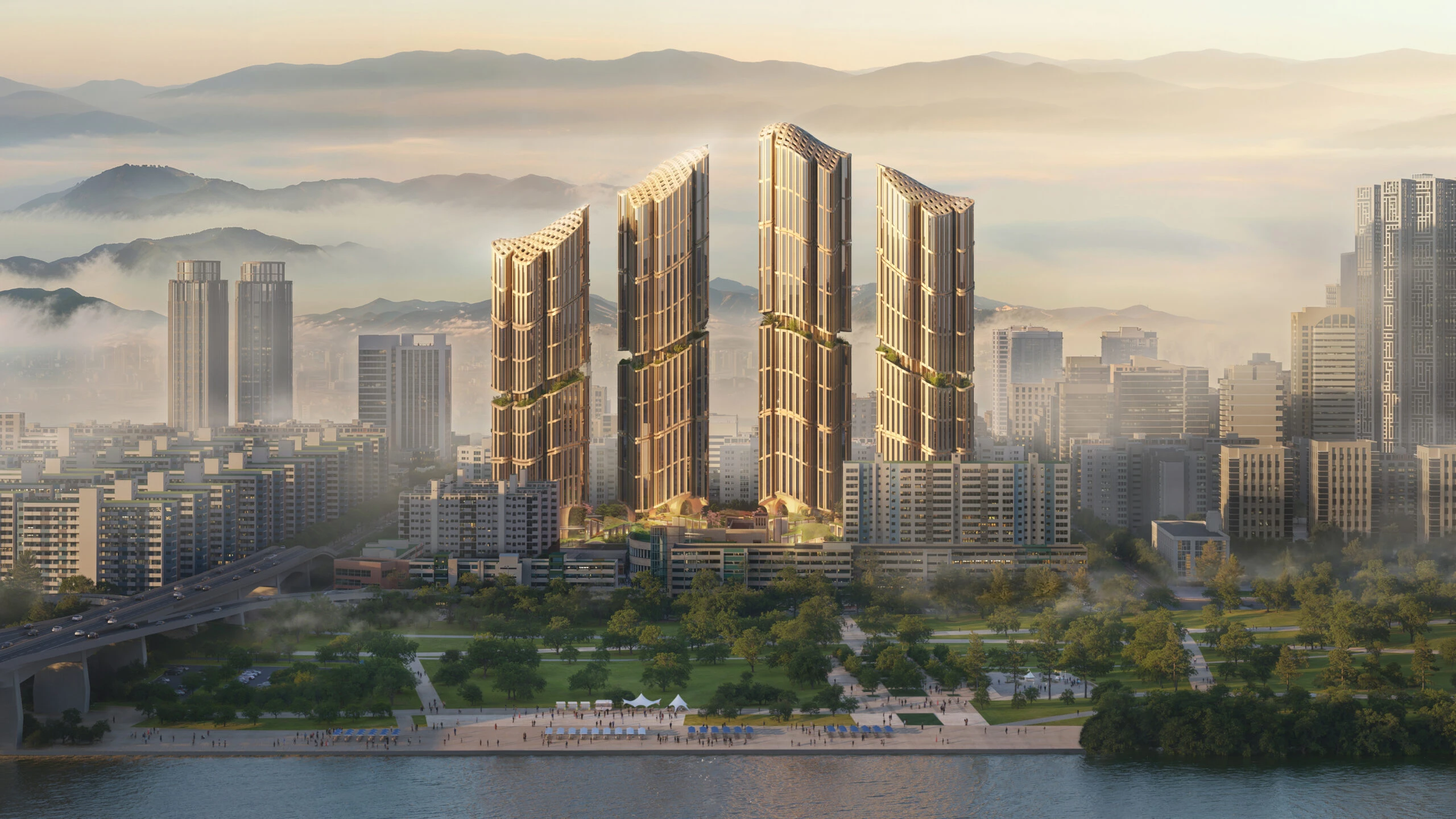
The upcoming projects, including the redesign of the Coex Convention Center by Heatherwick Studio, the first-ever spiraling residential towers, “Biophilic Nexus” by UNStudio, and the transformation of Nodeul Island into a new public park by Heatherwick Studio, are set to further revolutionize the ambitious city of Seoul and its skyline.
1. Jongmyo Shrine
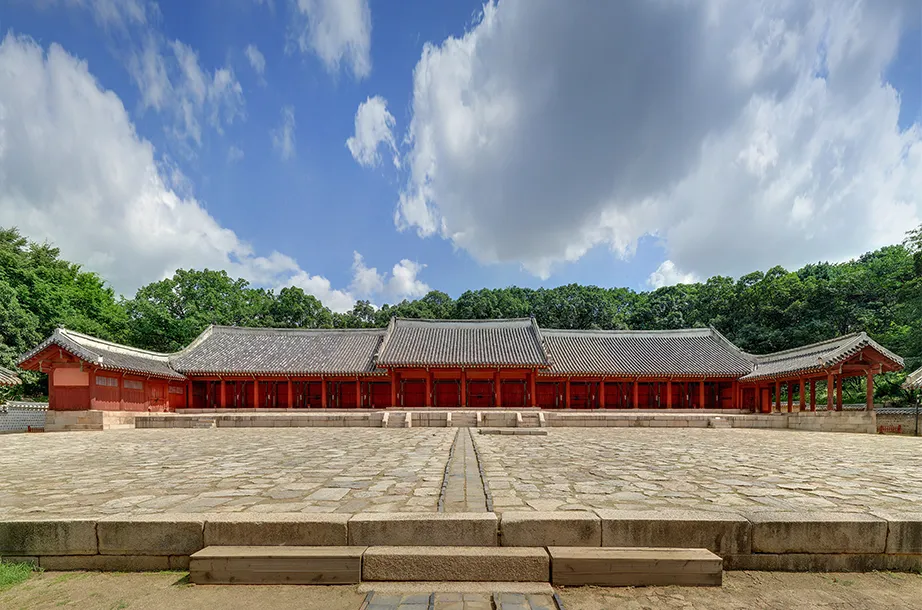
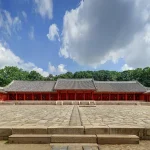
Jongmyo, with its authentic Korean Confucian Architecture, is one of the oldest existing Confucian royal shrines located at the heart of the evolving Seoul City. The site, spread over a massive area of 19.4 hectares, has been a UNESCO World Heritage site since 1995. The Jongmyo Shrine primarily preserves and protects the spirit tablets of the former kings and queens of the Joseon Dynasty. Back then, kings often visited the Jongmyo shrine to participate in the ancestral rites, believing it would bring prosperity and ensure the safety of their subjects.
Built in the late 14th century, unfortunately destroyed during the Japanese invasion in the 16th century, the shrine was rebuilt in the early 17th century with additional spaces and stands intact, with the expansions it saw thereafter. Architecturally, though the Shrine has suffered invasions and demolitions, it remains preserved in its entirety, authentic to the unique spatial layout that it initially followed.
The Royal Shrine was originally constructed in the 14th century at Yonhwabang, the eastern part of the old walled city, with only one memorial hall for keeping the ancestral tablets of Taejo, the first King of the Joseon Dynasty, up to the 4th generation. It was King Taejo who shifted the capital from the city of Kaegyong to the city of Hanyang, present-day Seoul. The other spaces back then included a hall for deceased meritorious officials, a hall for seven deities governing the grounds and buildings of the shrine, a royal pavilion exclusively for the king to prepare for the rituals, warehouses, a kitchen, and a changing room for musicians.
Today, Jongmyo hosts Jeongjeon, the main shrine, and an auxiliary shrine called Yeong Jeon, the Hall of Eternal Peace. The supporting spaces include store rooms and kitchens in addition to Mangmyoru, a space where the king cherished the ancestral kings, Gongmingdang, another shrine to the Goryeo King Gongmin, and Jaegung, a main hall with two wings, where the King and others waited for the rites to take place. Even today, ancestral worship rites are carried out in Jongmyo with traditional ritual music and dance performances.
2. Changdeokgung Palace Complex
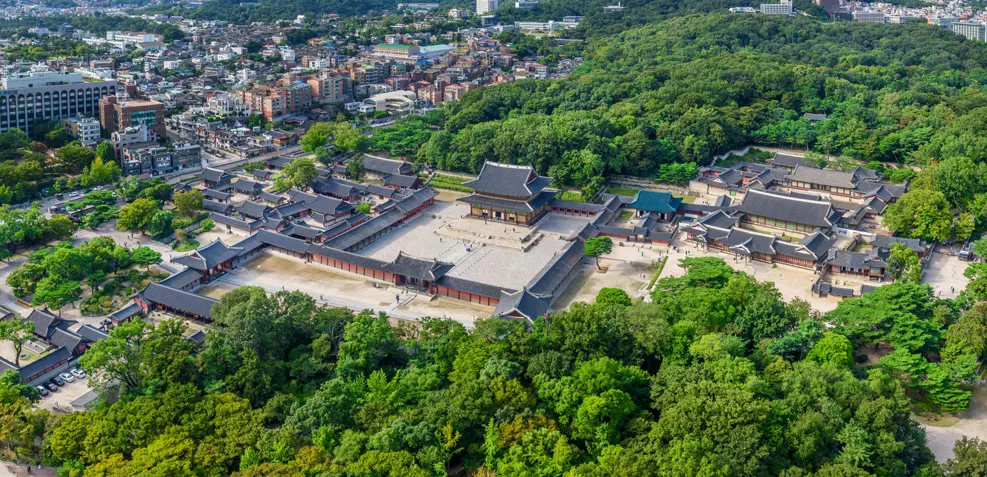
Changdeokgung Palace Complex, with lush green Korean gardens, the secondary Changdeokgung Palace, and authentic Korean residential and official buildings, is another magnificent piece of architecture that the Joseon dynasty rulers gifted to Seoul. This complex spans approximately 58 hectares of land with uneven topography in Jongno-gu, northern Seoul, situated at the base of Ungbong Peak in Mount Baegaksan. This site is also inscribed as a UNESCO World Heritage Site.
Changdeokgung Palace was constructed in the 15th century as the secondary palace to Gyeongbokgung. The Changdeokgung Palace Complex served this purpose for the next 20 decades before the Japanese invaded Seoul and burned the palace. However, in the late 16th century, the Changdeokgung Palace was rebuilt, and it has remained the main seat of the dynasty for over 250 years since.
The Complex was designed according to the traditional ‘pungsu’ principle, embracing nature and adapting to the uneven terrain with the buildings on the south and a secret garden at the rear, landscaped with a series of terraces planted with 56,000 specimens of various species of trees and plants, and lawns, a lotus pool, and pavilions.
The Changdeokgung Palace differed from other Korean palaces in that it was designed to be adapted to the natural topography. The residential and official buildings surrounding the Palace, following traditional palace layout principles, were constructed using wood and set on stone podiums, topped with traditional Korean tiled hipped roofs featuring a corbelled multi-bracket system and ornamental carvings. It is believed that the Changdeokgung Palace Complex had a significant impact on shaping traditional Korean architecture and landscape.
3. Ewha Womans University by Dominique Perrault Architecture
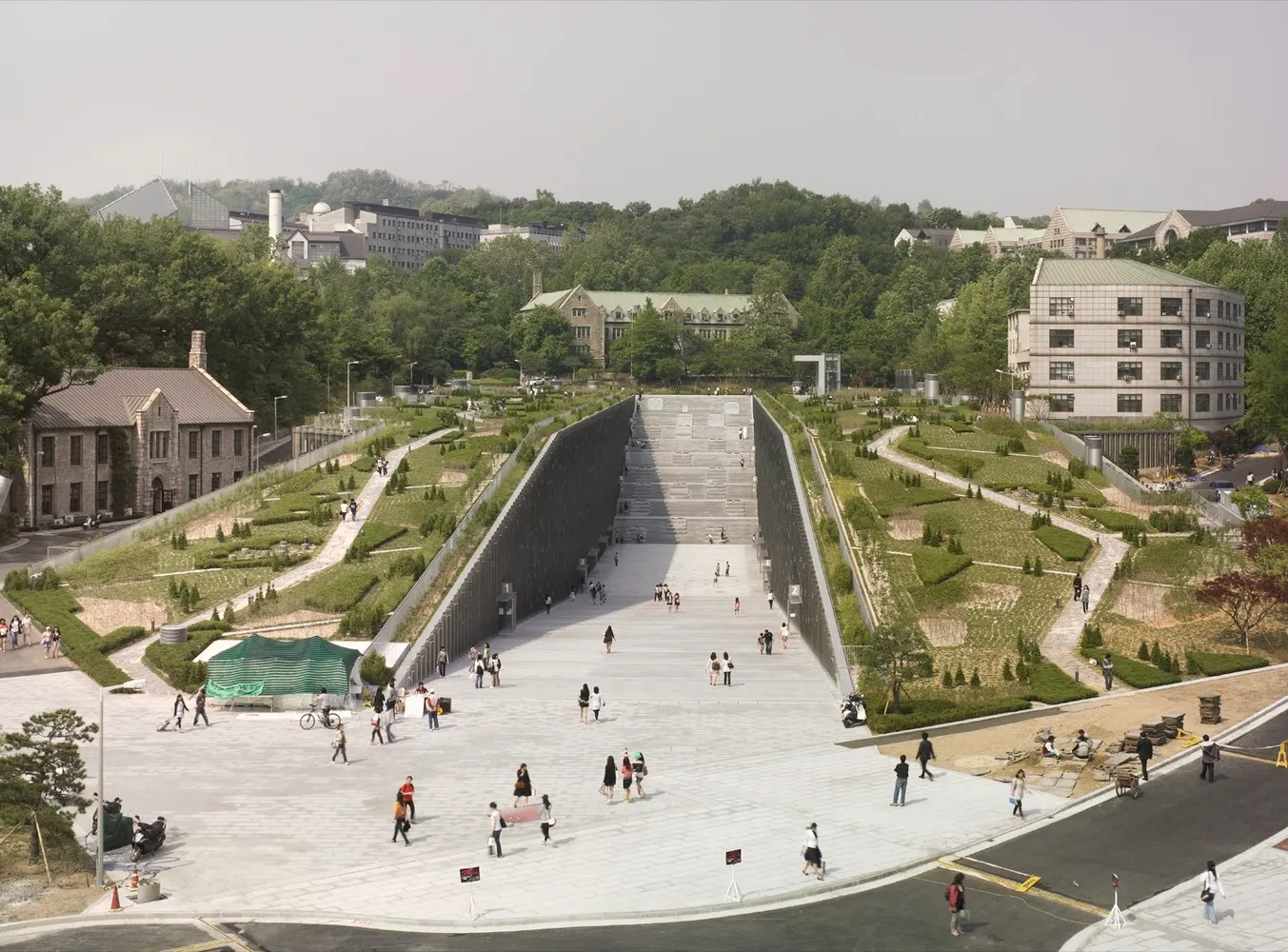
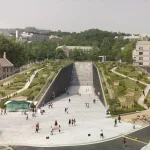
The Ewha Womans University Campus Center, designed by the renowned French Architect Dominique Perrault, is a landmark building in Sinchon, Seoul. The campus is designed to be unique, emphasizing how Seoul embraces daring Contemporary Designs at its heart.
The distinguishing feature of this Campus building is its form and relationship with the surroundings. Unlike rising high above the ground, this six-storey building is buried and seamlessly blends with the site’s topography.
A central valley, a sunken landscaped path, and athletic sports strip dissect the campus building into two, giving the major form and appearance of the campus. The valley gently slopes downwards, linking the urban fabric and the campus. The campus building is clad in glazed curtain walls, ensuring visual permeability between the sunken valley and the surrounding area. The valley ends in a flight of stairs that reach the hilltop, which can also be used as an amphitheater.
The classrooms, administration facilities, cafes, and restaurants are all topped with a green roof, guaranteeing sustainability by enhancing biodiversity, managing stormwater, reducing urban heat, and improving insulation. In addition to the green roof, the integrated thermal labyrinth and geothermal systems assure up to 25 percent energy savings.
Ewha Womans University’s Campus Center redefines and adds life to the urban fabric around it. Dominique Perrault, the principal architect of notable projects like the Paris Library and Berlin’s Velodrome, again assures that it is not necessary to go higher to build a striking, bold, and unique structure through his design for Ewha Womans University.
4. Kolon One & Only Tower by Morphosis Architects
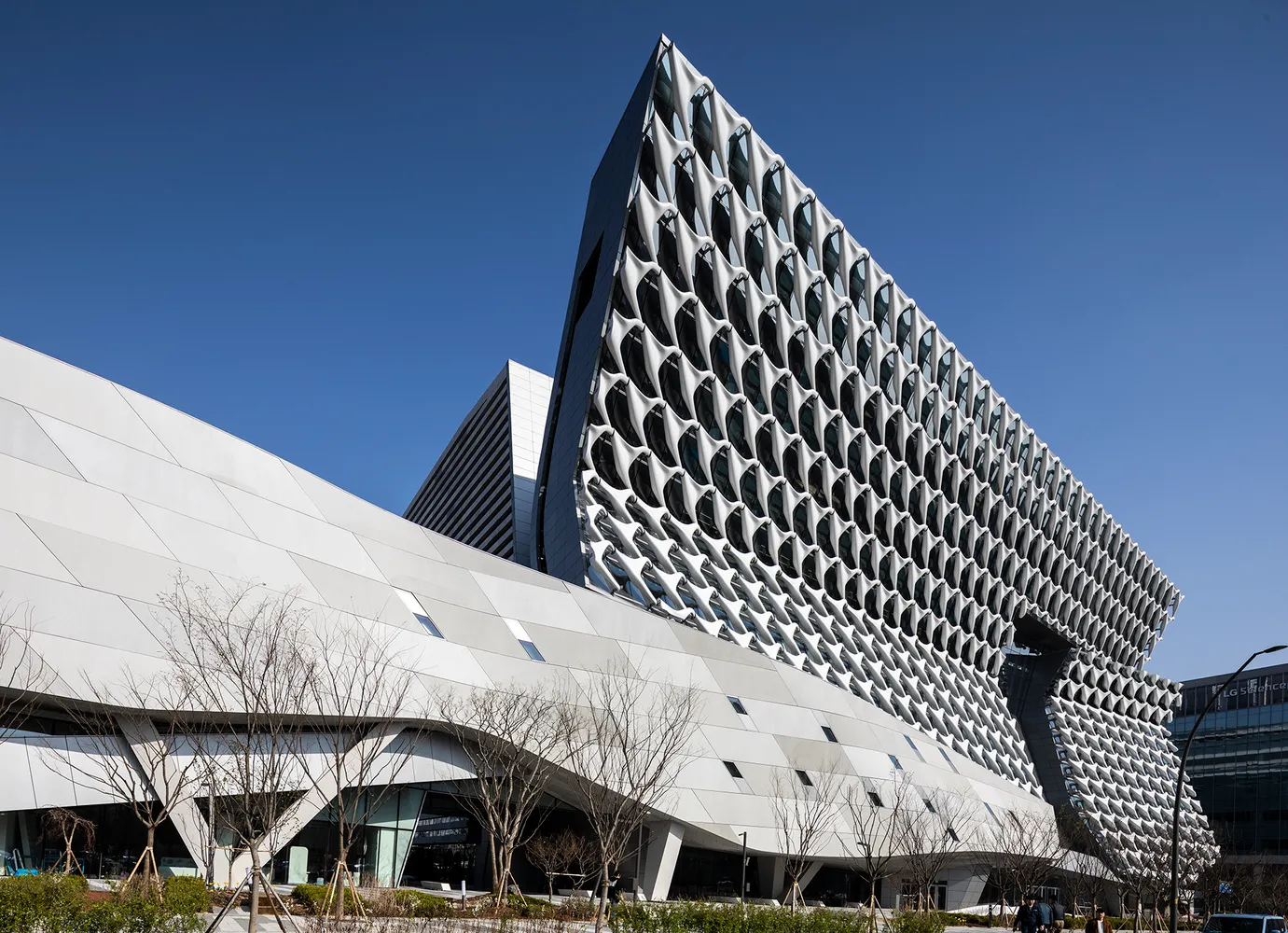
Morphosis Architects designed the Kolon One & Only Tower as a research and development hub in Magok, Seoul, for the Kolon Group, one of South Korea’s leading textile manufacturing companies. The Kolon Group operates across all disciplines, comprising 38 divisions, including Research & Development, primary material manufacturing, and product construction, which produce textiles, chemicals, and sustainable technologies, as well as authentic athletic and ready-to-wear clothing.
The Architects have made a statement about the company’s forward-looking, sustainable approach, use of cutting-edge technologies, and innovative products, featuring an intricate parametric facade design. The exclusive facility features laboratories designed with a focus on flexibility, conventional administrative offices, and vibrant social spaces that promise interdepartmental interactions, enhance workplace culture, and boost productivity.
While 55 percent of the tower’s habitable space is allocated for laboratories and 30 percent of that is devoted to offices, the remaining 123,000 square feet of space is designed as active collaborative areas, as per Kolon’s Chairman Lee Wong Yeoul’s vision of creating social and interdisciplinary spaces that prioritize employees’ well-being. The Kolon Group and the architects have strived to achieve sustainability throughout the project, and subsequently, the Kolon One & Only Tower is on track to achieve LEED Gold certification.
This five acre project near Magok’s central park is one of the first projects to highlight Seoul Metropolitan Government’s mission to transform the district into an “industrial ecosystem” attracting other regional and international companies to shift their headquarters to Seoul, not only promising a bright future of Seoul as an industrial hub too but also adding to the multifaceted nature of Seoul’s Urban Scene.
5. Seoul Memorial Park By Haehn Architecture
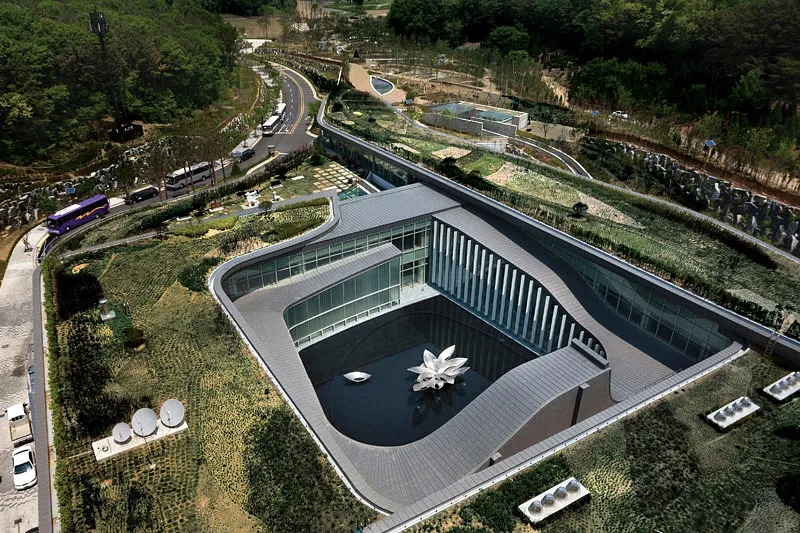
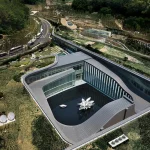
Haehn Architecture has seamlessly integrated the Seoul Memorial Park into the rolling landscape of the Woo-Myun Mountain valley. The two-storey high crematorium is designed as a linear building mimicking the ridges of the surrounding mountains. The linear building, with spaces for fulfilling rituals, is wrapped around a courtyard featuring a reflection pool at its heart, forming the centerpiece of the crematorium.
The designers have employed the concepts of Flower Ascension, Road Ascension, Light Ascension, Kite Ascension, and Spirit Ascension to achieve the impact that the modern crematorium creates in the background of the mountains. By placing a flower in the reflection pool, the designers have incorporated the concept of flower ascension.
Light Ascension is achieved by maximizing natural lighting through linear glazed facades, while Road Ascension is achieved by creating environmentally friendly spaces along the pathways. The sole idea of Kite Ascension is to provide a space to cherish memories. Through Spirit Ascension, the sustainability aspect is addressed through the use of a double-casing cremator system, which minimizes pollution and energy consumption.
With a simple yet powerful design in harmony with nature, the architects have enhanced the experience, touching the souls of bereaved families and soothing them. Seoul Memorial Park, opened in 2012, is essentially a 21st-century Crematorium designed with no limits on creativity yet utmost respect for the souls who left earth, their families and feelings, the rituals, and the surroundings in which it is set.
6. Seoullo Skygarden by MVRDV
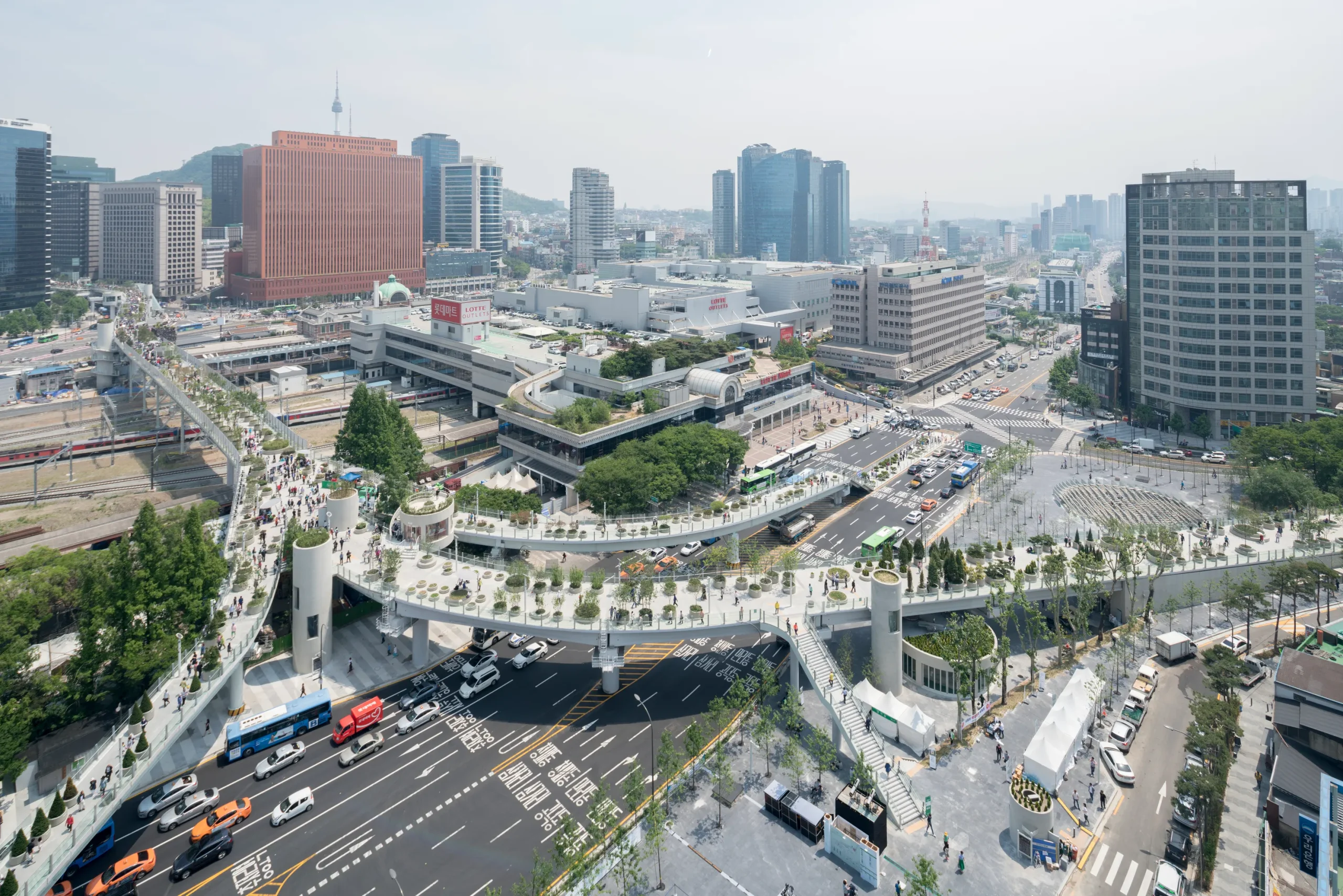
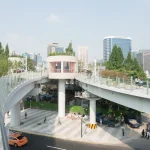
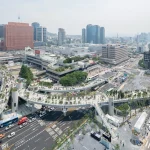
MVRDV has transformed a 938-meter-long highway from the 1970s adjacent to Seoul’s Main Station into a sky garden, civic hub, and pedestrian pathway, with the goal of inspiring future infrastructure projects in Seoul and throughout Korea, while also preserving the diverse Korean flora species. Gathering 24,000 plants, including different types of trees, shrubs, and flowering plants, on the steel structure 16 meters from the ground, MVDRV, with the help of Ben Kuipers, Dutch Landscape Designer, and KECC, the local landscape partner, has created an educational arboretum and a nursery in the Seoullo Skygarden.
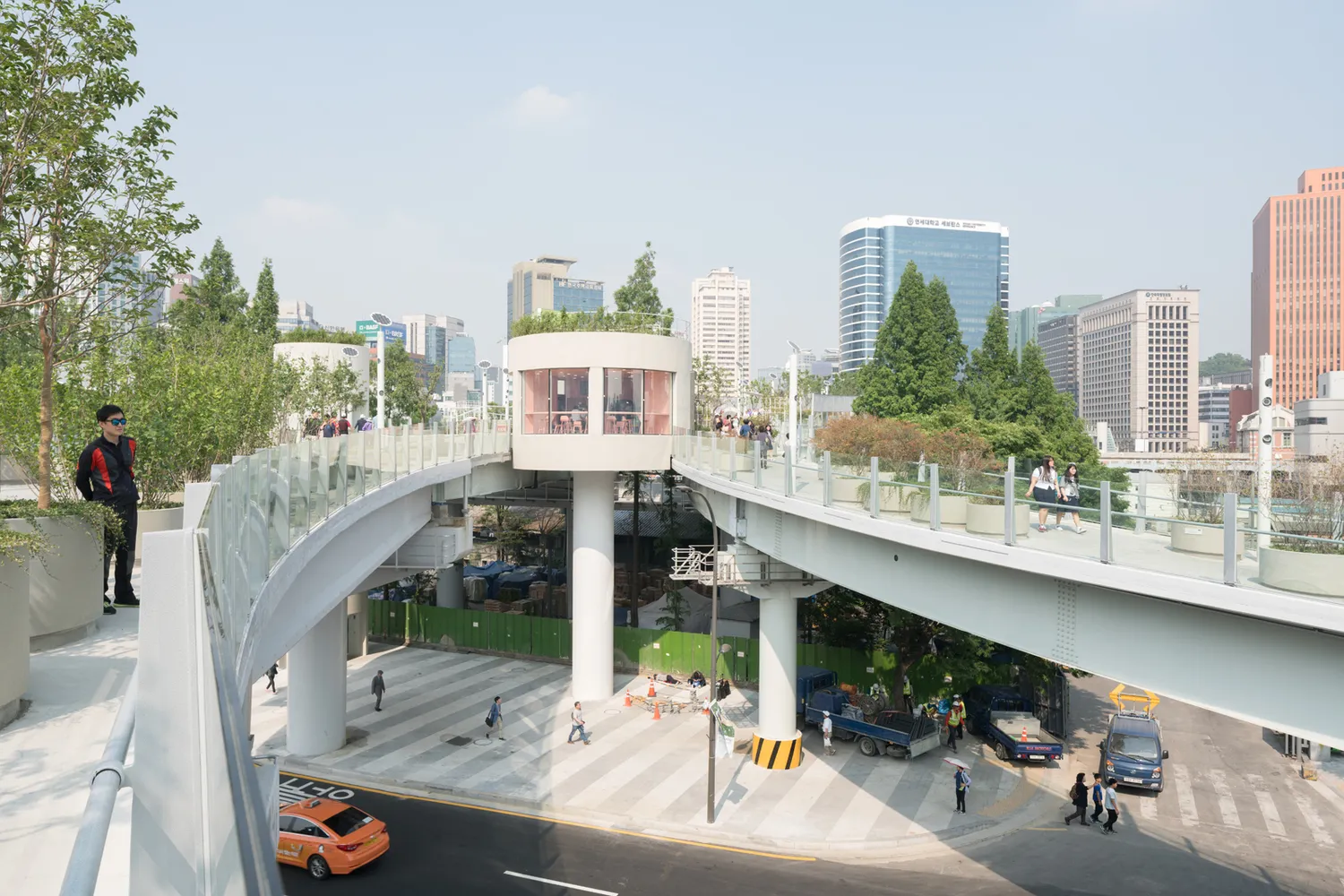
Since its opening in 2017, it is the social spaces integrated within the garden pockets that have enriched the skygarden as a civic hub at the heart of Seoul City. The Architects have seamlessly integrated 16 pavilions housing cafes, shops, exhibitions, gardeners’ pavilions, trampolines, foot baths, stages, children’s theatre, and information centres where fun activities can thrive, enhancing the overall experience via the landscaped elevated pedestrian pathway.
Several stairs, lifts, bridges, and escalators that dot the length of the skygarden ensure the skygarden is well-connected to the surrounding urban areas, attracting pedestrians. It is projects like Seoullo Skygarden and New York’s High Line that challenge the very understanding of infrastructure and a green city, and pave the way to an environmentally friendly, socially sustainable future for cities.
7. Dongdaemun Design Plaza by Zaha Hadid Architects
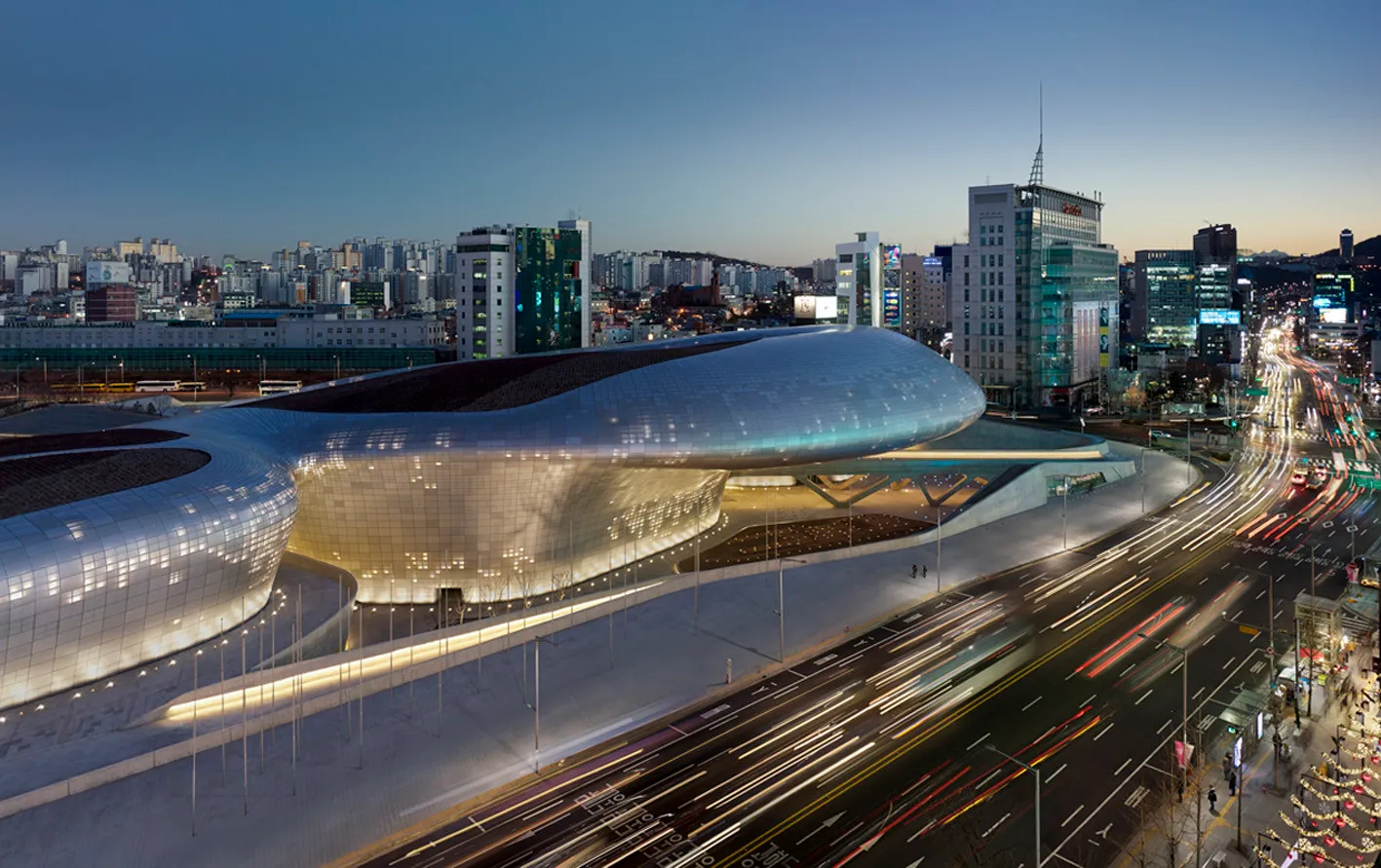
Zaha Hadid Architects’ designs are futuristic, and the Dongdaemun Design Plaza (DDP), located at the heart of Seoul’s fashion and cultural district, Dongdaemun, is no exception. The Dongdaemun district of Seoul is a historically significant area that has evolved into a fashion hub, featuring shopping centers and cafes open day and night.
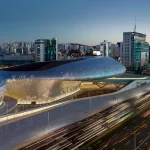
The design of the plaza revolves around the cultural city, ancient walls, and strikes a balance between culture, history, nature, and technology. The Dongdaeum Design Plaza, spread across 86,574 square meters of area, features an Art Gallery, Exhibition Halls, Conference Hall, Design Museum, Design Labs & Academy Hall, Media Centre, Seminar Rooms, Designers Lounge, and a 24-hour Design Market under its rolling unique roof, nurturing the design community of Dongdaemun.
The plaza, with its sinuous curves and gravity-defying form, is a landmark building that evokes awe, constructed on a site of 60,000 square meters, which was previously occupied by the Dongdaemun stadium. The plaza embraces the site’s past and extends into a 30,000 square meter park, creating a lively, walkable space for the people of Dongdaemun throughout the day and night. The LED lighting accentuates the form of DDP, making it a glowing fluid sculpture at night.
Dongdaemun Design Plaza, designed by Zaha Hadid Architects using parametric building information modelling software and design computation, set the bar high for future construction projects in Seoul. Zaha Hadid’s Dongdaemun Plaza, which opened in 2014, stands as a striking piece of architecture, making a bold statement about the direction in which Seoul’s Contemporary Architecture is moving.