
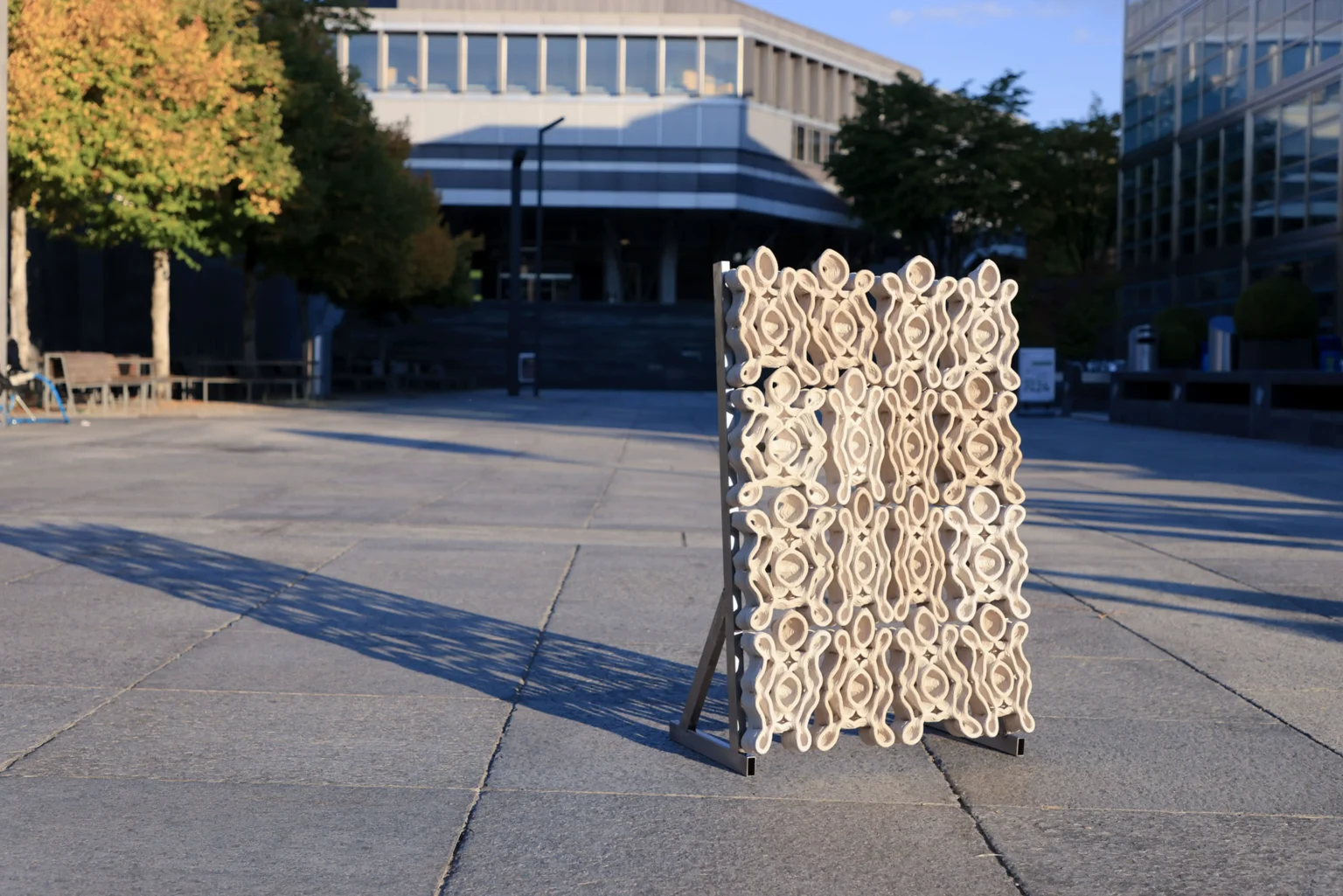

Bacteria have been binding sand into rock for millions of years. At ETH Zurich, an architect has taught them to do it on command, turning microscopic life into a manufacturing partner for free-form architectural elements that never see a kiln.
Cement is one of the most energy-hungry materials we make. Producing it requires temperatures above 1,000 degrees Celsius and releases large amounts of carbon dioxide. At the Department of Architecture at ETH Zurich, recently graduated researcher Karen Antorveza Paez has spent years exploring a quieter alternative. Instead of heat, she uses living bacteria to bind grains of sand into solid structures that can take architectural form.
The process is called microbiologically induced calcite precipitation, or biocementation. Certain bacteria, notably Sporosarcina pasteurii, produce an enzyme that breaks down urea. In the presence of calcium, this reaction generates calcium carbonate, the same mineral that forms limestone, seashells and chalk. The microscopic crystals grow between sand grains and interlock them, creating a solid material at room temperature.
What is new is the control. Antorveza Paez has combined this biological process with digital manufacturing so that the bacteria become active participants in the making of designed objects rather than passive additives.
Printing with Living Ink
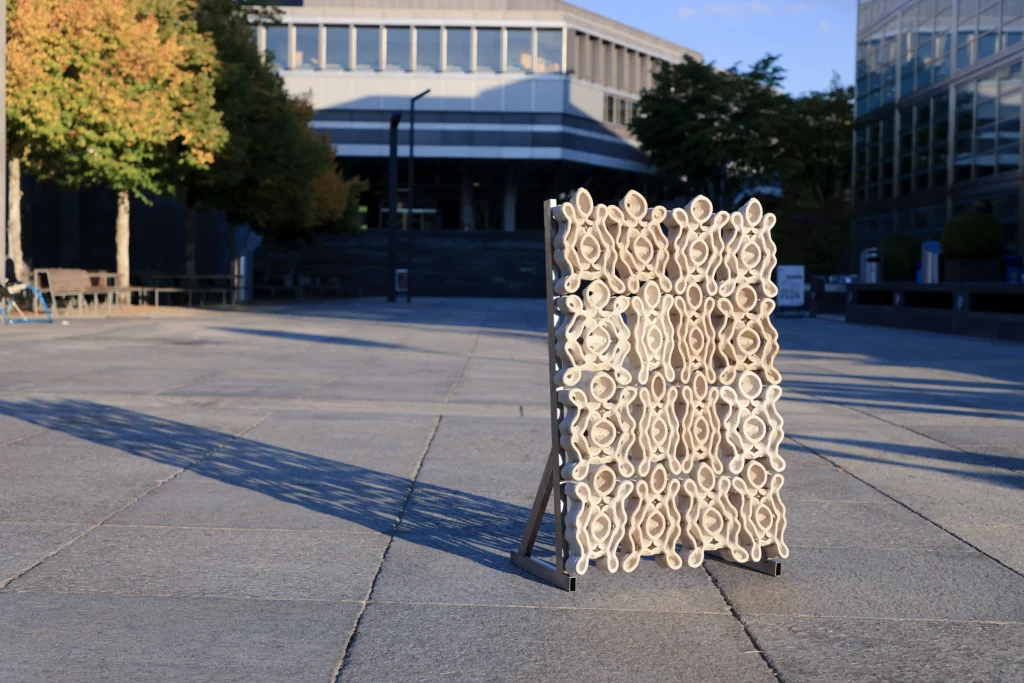
The first method developed during her doctoral work is 3D biocement printing. The team created a bio-ink consisting of a water-based gel made with alginate and xanthan, mixed with sand and live bacteria. This paste can be extruded by a 3D printer into complex geometries, much like conventional printing pastes.
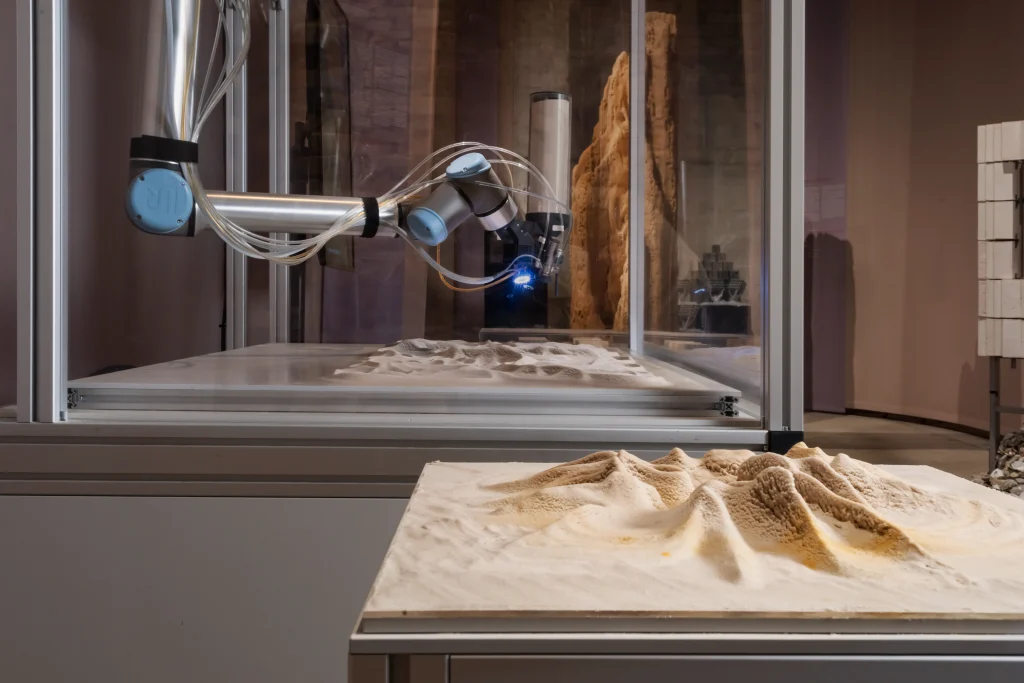
Image credit: Matteo Losurdo / ETH Zurich
Once printed, the delicate structure is immersed in a mineralization bath containing urea and calcium chloride. The bacteria begin their work. Over two to five days, with the bath refreshed daily, calcium carbonate crystals form wherever the bacteria are present. The printed object slowly hardens. When it is dry, the bacteria are no longer active. What remains is a solid mineral structure held together by interlocking crystals.
Antorveza Paez compares the process to baking a cake. The printed form is the soft dough. The bacteria act as the oven, transforming the malleable mass into something firm without any external heat. The result has been used to produce facade elements that can provide shade or serve as partition surfaces.
Spraying Like Stromatolites
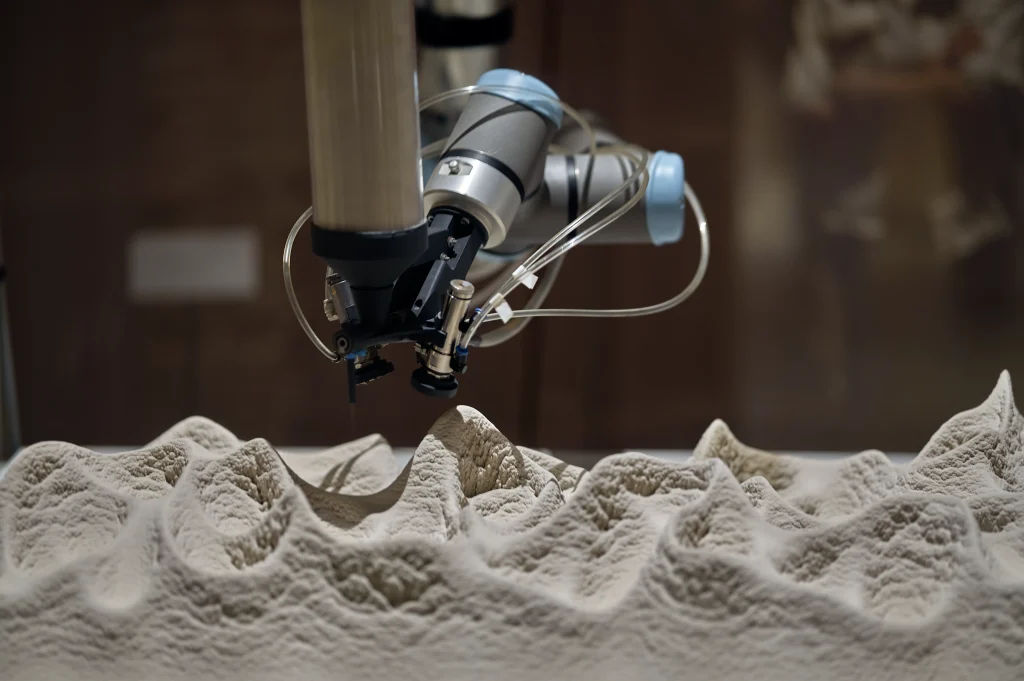
A second approach removes the immersion bath entirely. A robotic arm applies successive layers of bacteria, mineralization solution, and sand directly onto a surface. The process builds height layer by layer, inspired by the way stromatolites form in nature when microorganisms deposit minerals over long periods.
This robotic spraying method was demonstrated continuously for six months at the 2025 Venice Architecture Biennale, allowing visitors to watch the material accumulate in real time. The focus here shifts from the material recipe to the machine and the precise control of three parallel material streams. Antorveza Paez notes that while the printing method is more advanced in material understanding, the spray process still requires further research into its internal structure and mechanical performance.
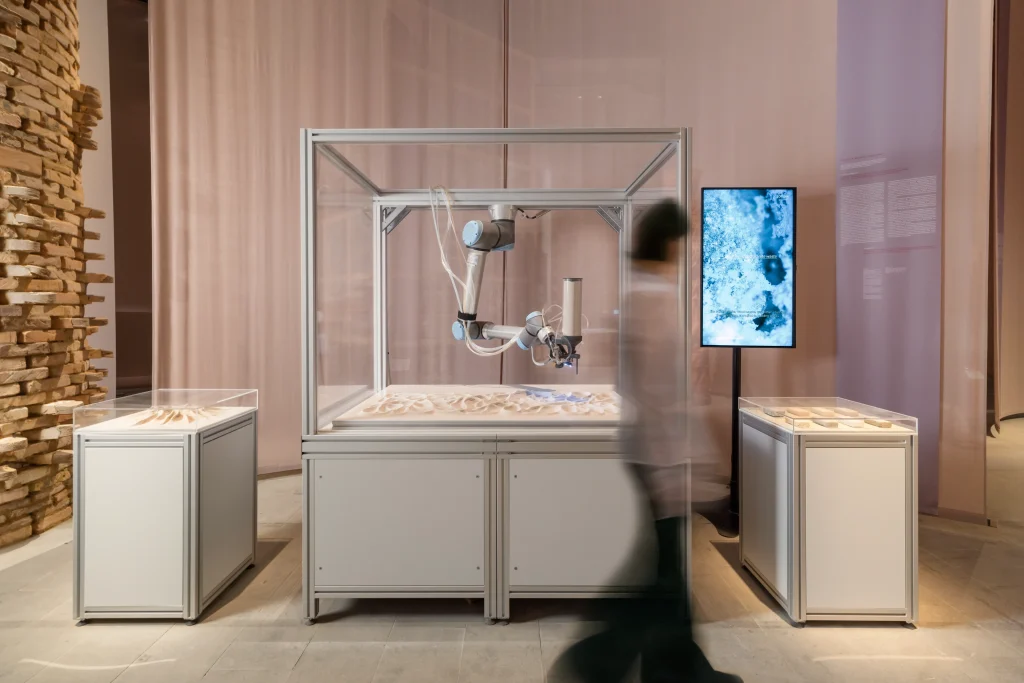
Image credit: Matteo Losurdo / ETH Zurich
The two techniques complement each other. Printing suits discrete architectural elements. Spraying suits larger surfaces and continuous growth.
Design at the Scale of Microbes
What makes this work architecturally significant is the shift in authorship. Traditional materials arrive ready-made. The designer specifies form and the material responds. In bio-cementation, the material itself is still becoming while the form is being defined. The designer must think about bacterial activity, nutrient flow, crystal growth rates and the time required for strength to develop.
This introduces a temporal dimension that conventional digital fabrication rarely considers. A printed component is not finished when it leaves the printer. It continues to change for days. The design process must account for that living interval. Porosity, surface area and internal geometry all influence how effectively the bacteria can mineralize the structure. Computational design tools become essential for predicting and optimizing these biological parameters alongside structural ones.
The work also reframes the relationship between architect and material. Antorveza Paez has spoken of her fascination with nature’s ability to produce sophisticated materials and the possibility of making those processes available for contemporary problems. In her approach, the bacteria are not hidden inside a product. They are collaborators whose activity is visible in the final texture and performance of the element.
Limits and Next Questions
The research is careful about its claims. Current bio-cement is closer to mortar than to structural concrete. The precise recipes that would allow consistent, high-strength, long-lasting performance are still being developed. Grain size distribution, bacterial concentration, nutrient supply and drying conditions all affect the outcome. Decades of refinement went into modern concrete. Bio-cementation is only beginning that journey.
There is also an environmental caveat. The reaction produces ammonium as a by-product, which is environmentally damaging if not properly managed. Antorveza Paez is now working on a third study that examines the full environmental impact and seeks ways to handle or reduce this waste stream. Without solving that problem, the sustainability advantage remains incomplete.
Still, the direction is promising. By combining living processes with digital control, the research opens a path toward architectural elements that are grown rather than fired, formed at ambient temperature, and potentially recyclable or re-mineralizable in new ways.
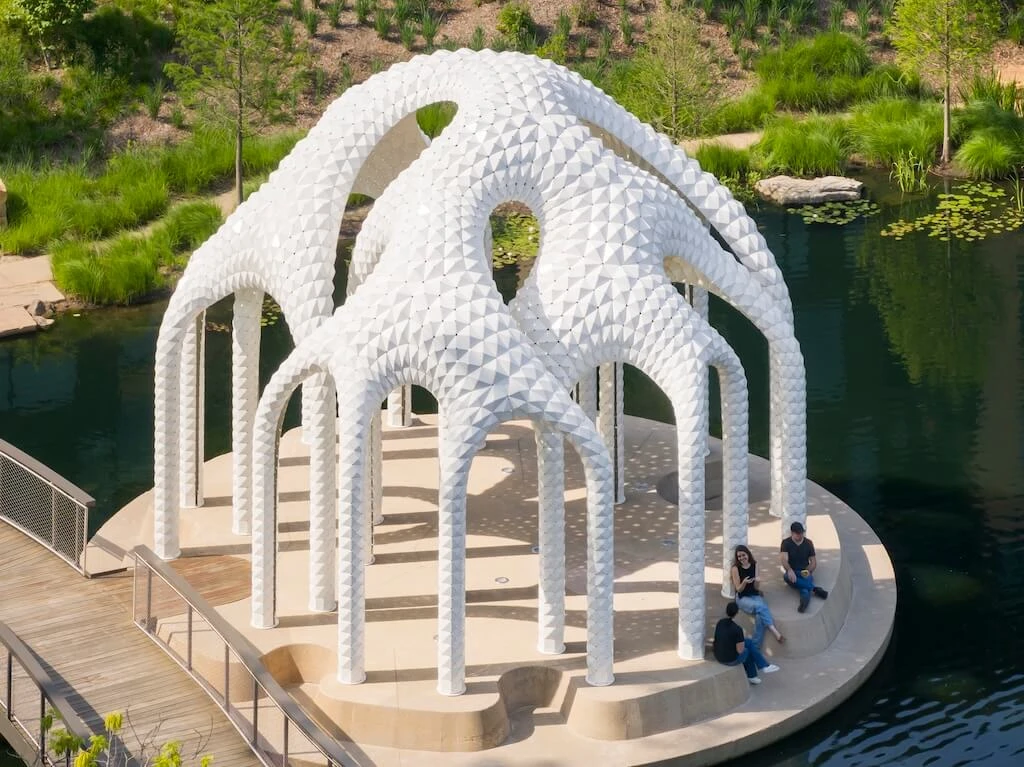
The facade element shown in the ETH images is modest in scale, yet it carries a large idea. Sand, bacteria, water and time have produced a designed object that never entered a kiln. In a construction industry still heavily dependent on high-temperature processes, that fact alone is worth attention. The bacteria have become masons. The question now is how skillfully we can learn to work with them.