
The numbers shared in Architectural Record’s article “In Too Deep: Debt Burdens” last month may not be new, but they are concerning. The important aspect is that these issues are finally being addressed.
Architecture graduates face significantly high student debt compared to their earning potential. Research from Yale’s Tobin Center for Economic Policy shows that these graduates can expect only a 4% return on their educational investment—considerably lower than the 173% return in medicine, 41% in law, or even 19% in civil engineering. However, the debt discussion often overlooks a critical factor: the root cause is not a lack of recognition of an architect’s value or rising tuition costs. Instead, it stems from a structural mismatch between the profession’s supply and its accessible market.
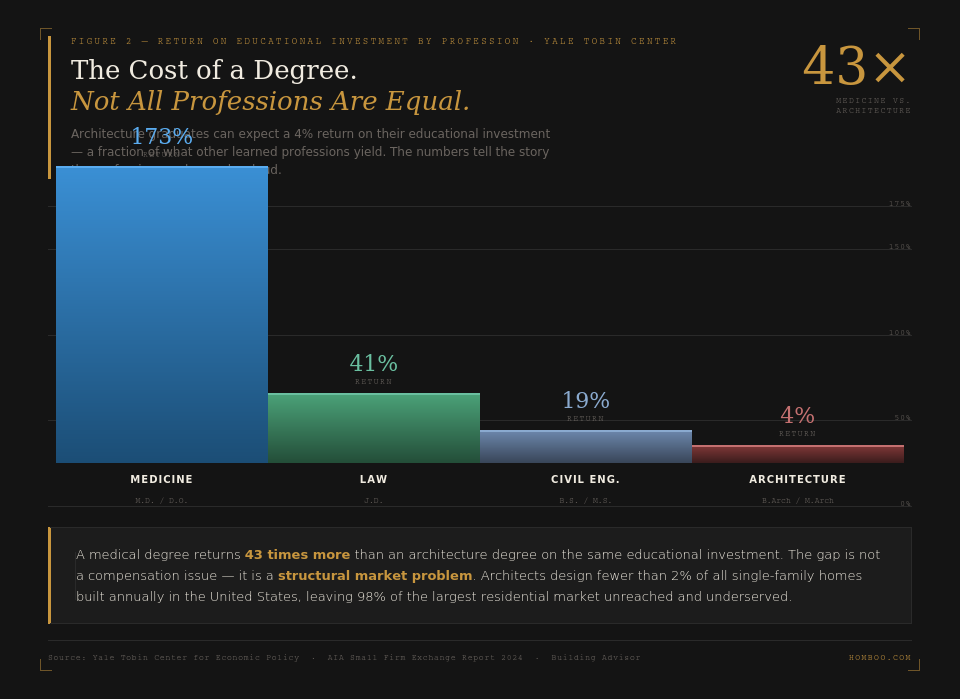
The Pyramid Nobody Talks About
To comprehend why architects earn comparatively low incomes relative to their level of investment in education and training, it is crucial to acknowledge the structural imbalance between the number of architects and the availability of clients or firms hiring them. This situation should also be assessed honestly in relation to other professions that require specialized knowledge. The math is straightforward.
As of 2024, there are approximately 1,080,000 licensed physicians in the United States. Their potential client base, in the most direct sense, is the entire population of around 340 million people—meaning each physician corresponds to a potential client base of approximately 314 people.
In contrast, the architecture profession presents a different narrative. Its work-client spectrum includes large private and institutional commissions—office buildings, hospitals, airports, schools, shopping centers, and government facilities. Still, these projects are infrequent, highly competitive, and concentrated among a relatively small number of large, well-established firms. The remaining practitioners compete primarily for small-scale commercial and residential buildings, renovations, and townhouses.
The family house market accounts for roughly 2% of all homes built annually—approximately 20,000 homes in a market of over one million. In other words, the profession’s accessible residential client base is not the 340 million people who live in homes—it is the small fraction who can afford a custom commission. The result: fewer than one accessible residential commission per six licensed practitioners annually.
In architecture, the same pyramid reveals a fundamentally different reality. Physicians and lawyers serve a potential client base that is effectively the entire population. Architects, by contrast, compete intensely for a client base that represents a fraction of their own numbers—and the profession graduates thousands of new practitioners every year into that same constrained market.
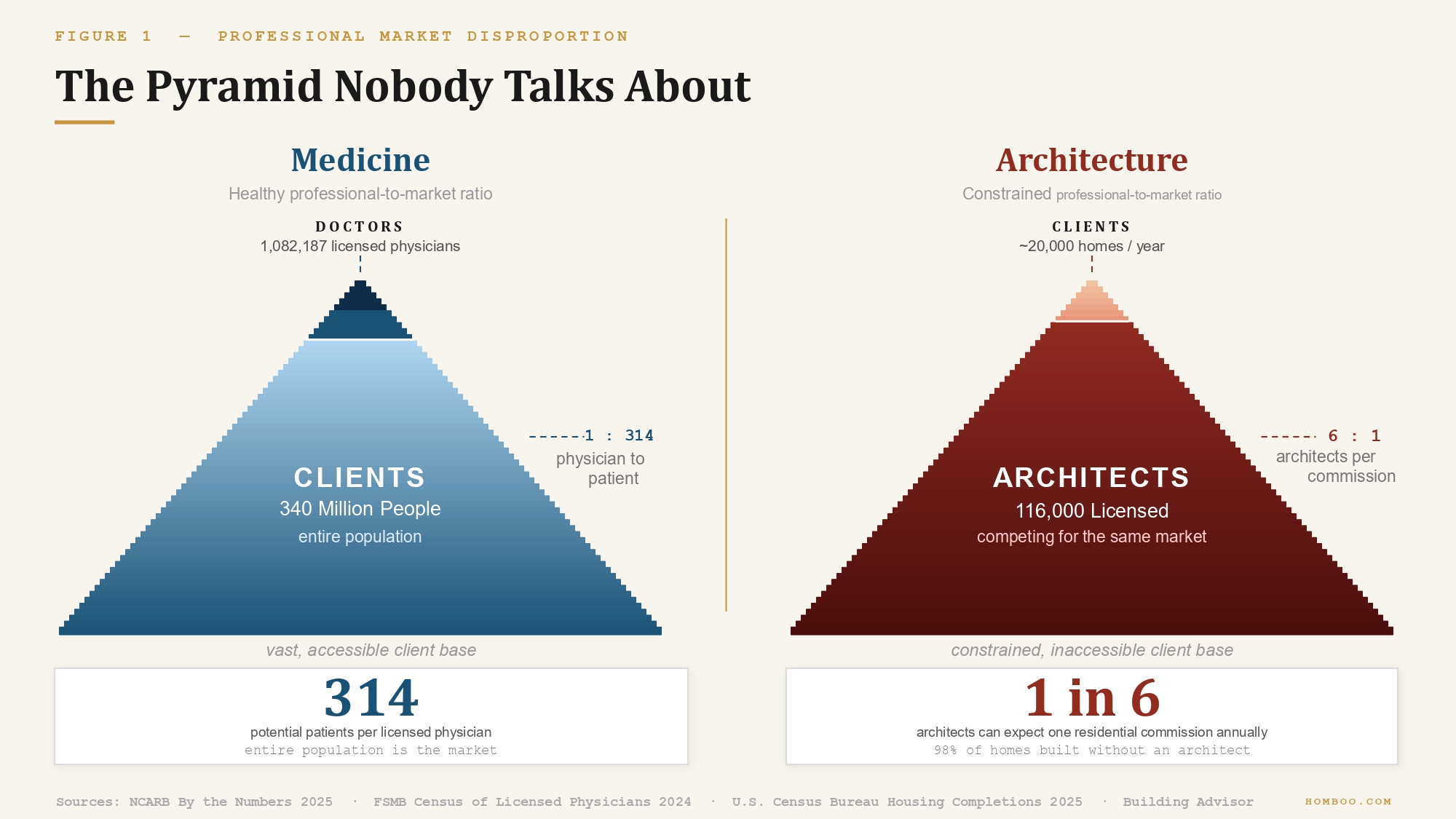
Debt Is the Symptom. The Disease: A Market Unreached at Accessible Cost.
Understanding this structural reality reframes our view of the debt crisis. Architecture graduates are not merely unlucky — they are entering a profession whose economic model inherently limits the number of clients accessible to most of its practitioners.
According to the AIA’s 2024 Small Firm Exchange Annual Report, 75% of all architecture firms have fewer than 10 employees—28% are sole practitioners, 32% have two to four employees, and 15% have five to nine. The overwhelming majority of the profession operates at a scale that structurally excludes it from large institutional and corporate commissions. For these firms, the accessible market grows at a much lower pace. It is and has always been insufficient.
Large firms, along with a small number of midsize firms, capture institutional, governmental, and corporate commissions. The remaining market—primarily high-end custom residential—is competed for by thousands of small and midsize practices. The outcome is predictable: lower earnings, slower debt repayment, and a shrinking pipeline of practitioners willing to endure the investment.
This dynamic, combined with student loan debt, diverts funds from obtaining licensure and joining professional organizations. Practitioners burdened by debt are less likely to start their own small practices or take ownership opportunities when they arise. Firm-level loan repayment programs demonstrate genuine concern for employees — but they address only a symptom, not the underlying structural cause.
The Solution: A Market That Has Always Been There, But Not in the Portfolio
The single-family housing market is the largest segment of the built environment in the United States. It accounts for over one million new homes completed each year and a stock of approximately 90 million existing homes. This market is where most Americans spend most of their lives. However, it has largely been a sector from which the architectural profession has been structurally absent for generations.
For centuries, the commission model was the only logical approach in architecture. Architects initially worked primarily for pharaohs, kings, emperors, the Church, and nobility—these were their main clients. Today, architects serve as well a wide range of clients, including public and private corporations, government institutions, and various organizations.
However, the Industrial Revolution introduced a new segment of society: the middle class, and with it, the single-family housing market. This shift happened faster than the architecture profession could create and adapt its delivery system. What the profession needs today is an additional approach—a means to reach a broader audience, specifically middle-class homeowners. This new approach should provide well-designed, thoughtful architecture at a cost the market can afford.
Medicine, forced by the financial collapse of 1929, found its vehicle in the Baylor Agreement, which gave birth to Blue Cross and Blue Shield. The insurance model did not lower the quality of healthcare—it transformed the cost of accessing it. A monthly fee accessible to most families unlocked treatments worth millions of dollars, connecting doctors and hospitals to society in a transcendental act of service. Architecture has never encountered its equivalent moment — and the necessary connection to society was never established.
Frank Lloyd Wright understood this problem nearly ninety years ago. In 1938, he answered Life Magazine’s call to design affordable homes for middle-class American families, creating his Usonian series—compact, resolved, humanly scaled designs for people earning ordinary incomes. His designs captivated the public. He spent the last decades of his life attempting to bridge architecture and the broader society it was born to serve. He never solved the delivery problem.

What the Profession Owes Itself
The debt crisis will not be resolved by loan assistance programs, tuition reductions, or advocacy alone—though all these matter. It will be resolved when the profession grows and expands its accessible client base to match the scale of its social ambition and the size of its educational investment.
The bespoke commission model will continue serving its traditional clientele well. But the profession must recognize that a vast, underserved market segment exists — one that operates under different design and delivery rules. The profession has an extraordinary, largely unrealized asset: decades of thoughtful, resolved residential designs that never found their builder — not because the work lacked merit, but because the cost of access made it impossible.
The middle-class housing market does not require architects to compromise on quality or abandon the commission model. It invites the profession to embrace a parallel delivery model that broadens its reach at a cost that clients can afford. This is how the profession fulfills its purpose of service—connecting thoughtful, practical designs to the society it was always meant to serve, through a vehicle that has historically been missing.
By doing this, we can elevate home design standards for families everywhere and contribute to shaping broader society with our knowledge and creativity. How do we keep students in the pipeline and emerging professionals from leaving the field entirely? The answer begins with a profession that reaches more of the society it was always meant to serve—and builds an economic foundation worthy of the investment its practitioners make to enter it.
Wright had the vision. Now the vehicle exists.
Homboo was built to be that vehicle — a curated platform connecting architects’ unrealized residential designs directly with the middle-class market that has always been there but never had a door. For the first time, the homeowner who could never afford architecture can access it. And the architect whose design deserved more than a hard drive could reach them.
The public was captivated. The path from design to doorstep remained closed.
The relevance of any profession is directly proportional to its reach and the level of service to society.