

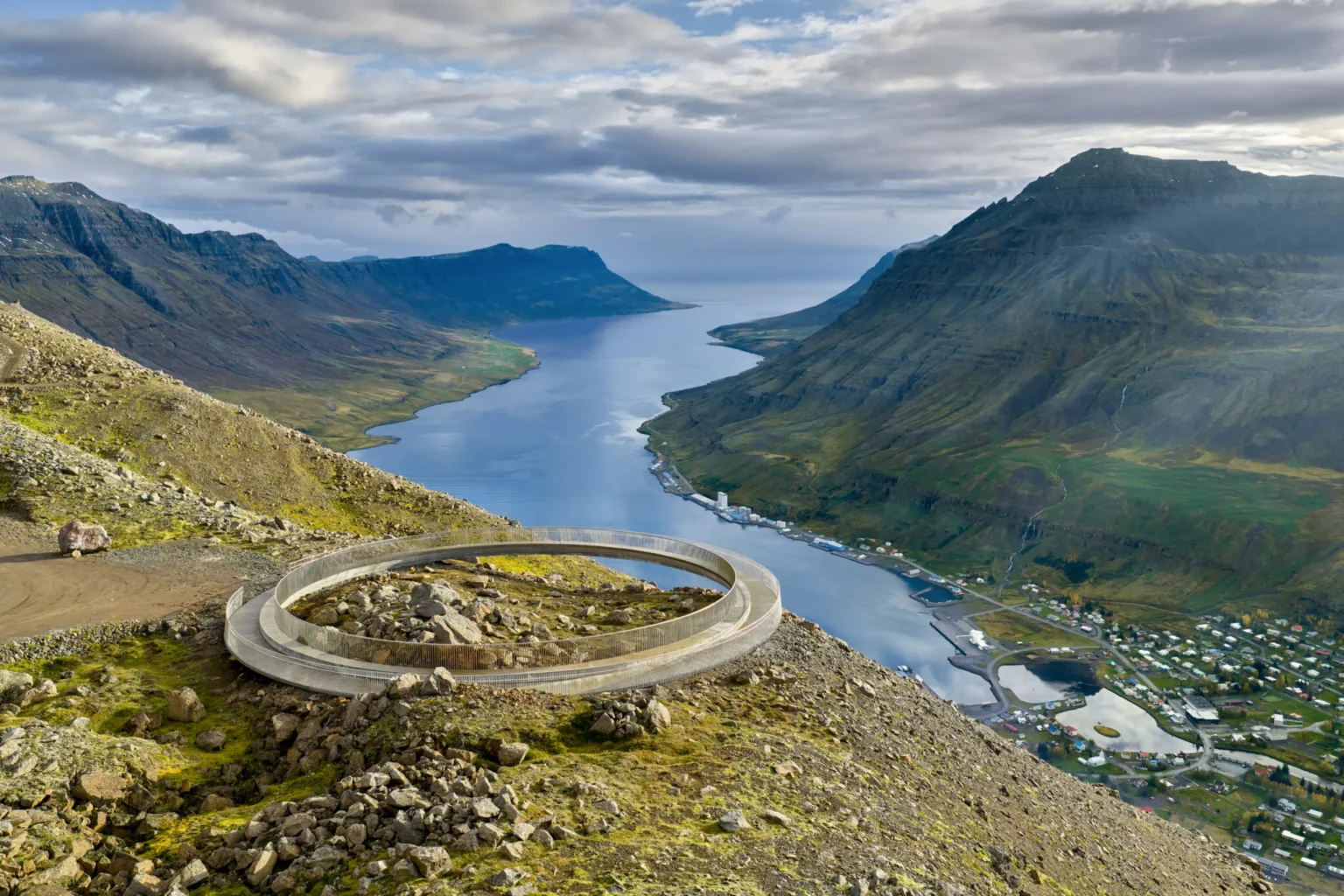


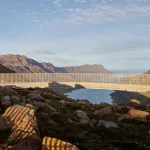
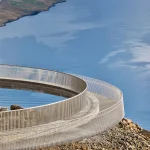

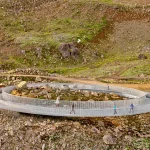
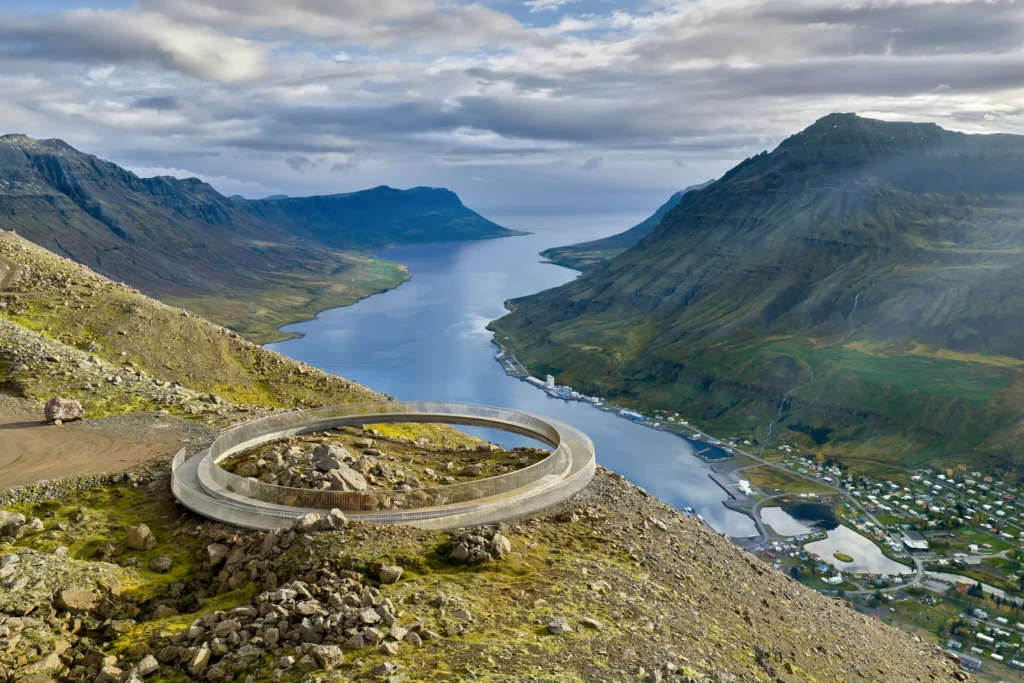
Designed by Arkibygg Architects and Esja Architecture, Ring-of-Bjolfur translates a local legend into a precise geometric form. According to the medieval Book of Settlements, the Viking settler who gave the mountain its name was later buried there with his most valued possessions. Those objects were never found. The architects responded by leaving a ring: a large, silver-toned circle that now occupies the ridge.
2026: Ring of Bjolfur is now complete
Some gifts are never recovered.
They wait in the ground, turning silence into legend.
A circle appears on the ridge where the wind never rests,
as if the mountain itself decided to keep a promise.
High above Seyðisfjörður, that promise has taken form. What began years ago as a competition-winning concept has been built, post-tensioned, and opened. The ring-of-bjolfur is no longer a proposal. It is a completed piece of architecture that sits 650 meters above the fjord and offers continuous views in every direction.
Geometry as Experience
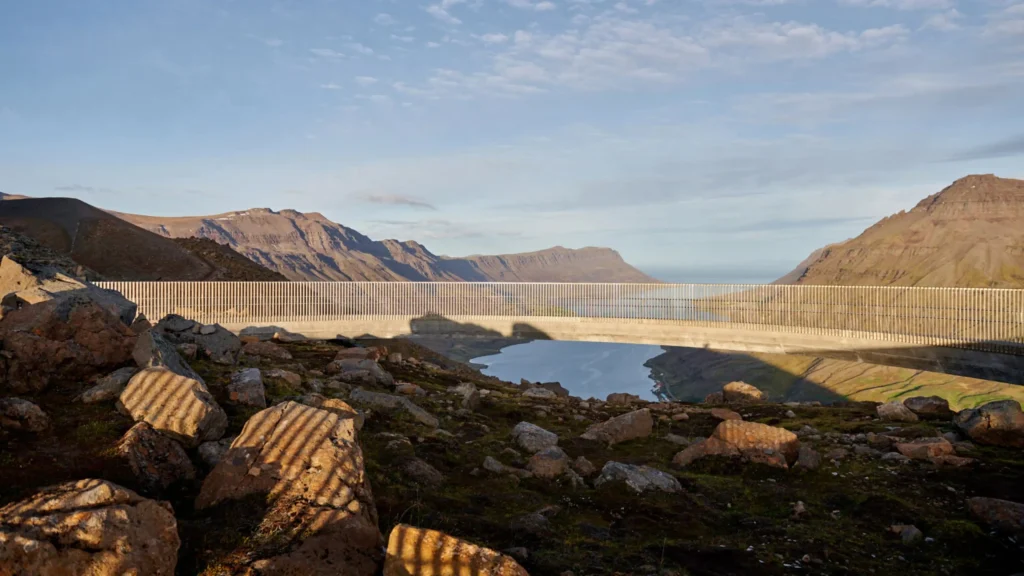
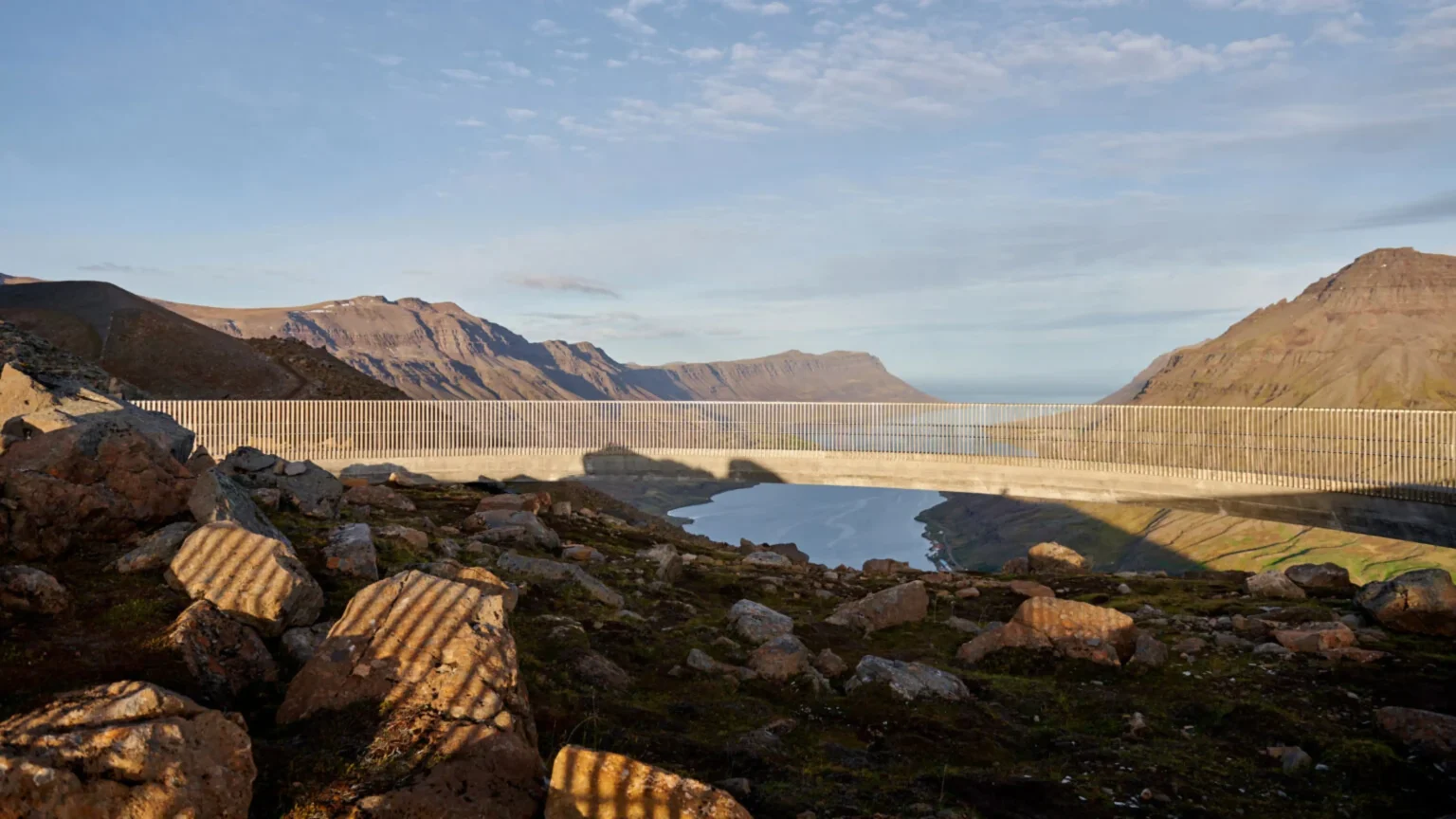
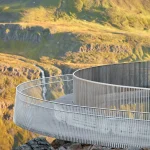
The completed structure measures 32 meters in diameter. A continuous walkway and integrated bench run around its roughly 100-meter circumference. Because the form is closed, the experience is never static. As visitors move, the framed landscape changes: the town and harbor below, the long reach of the fjord toward the Atlantic, the surrounding peaks, and the mountain rising behind.
One section of the ring cantilevers beyond the ridge edge. Here the ground falls away, and the view opens without interruption. The effect is both thrilling and calm. The circle does not compete with the landscape; it organizes it.
Structure in Extreme Conditions
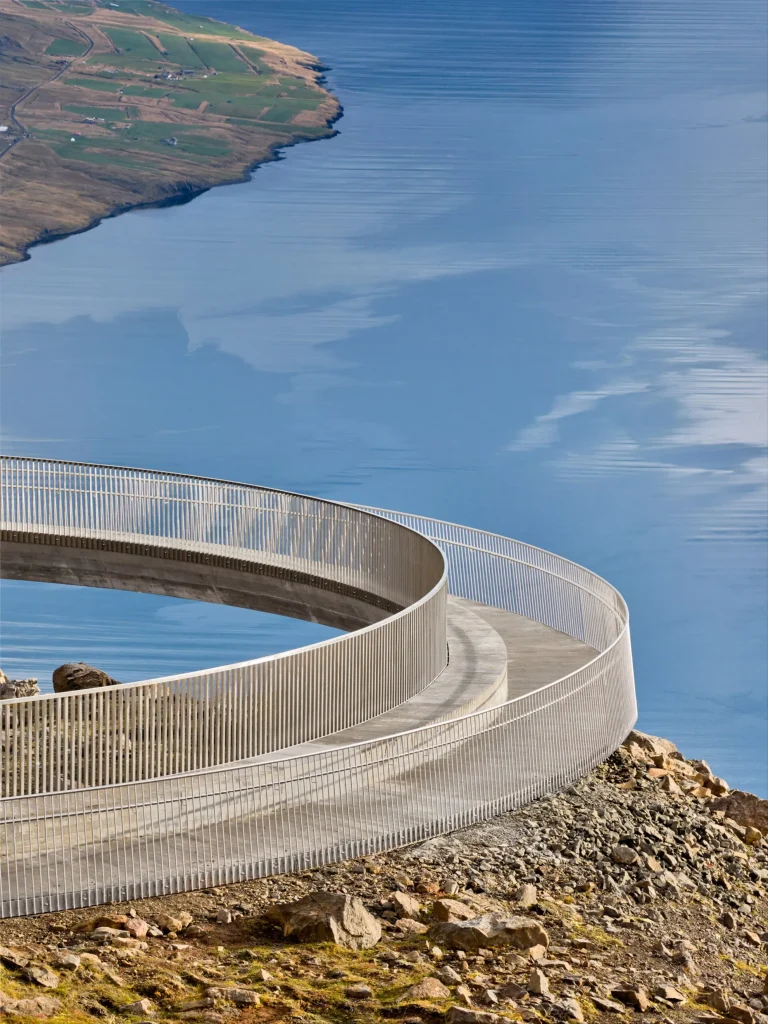
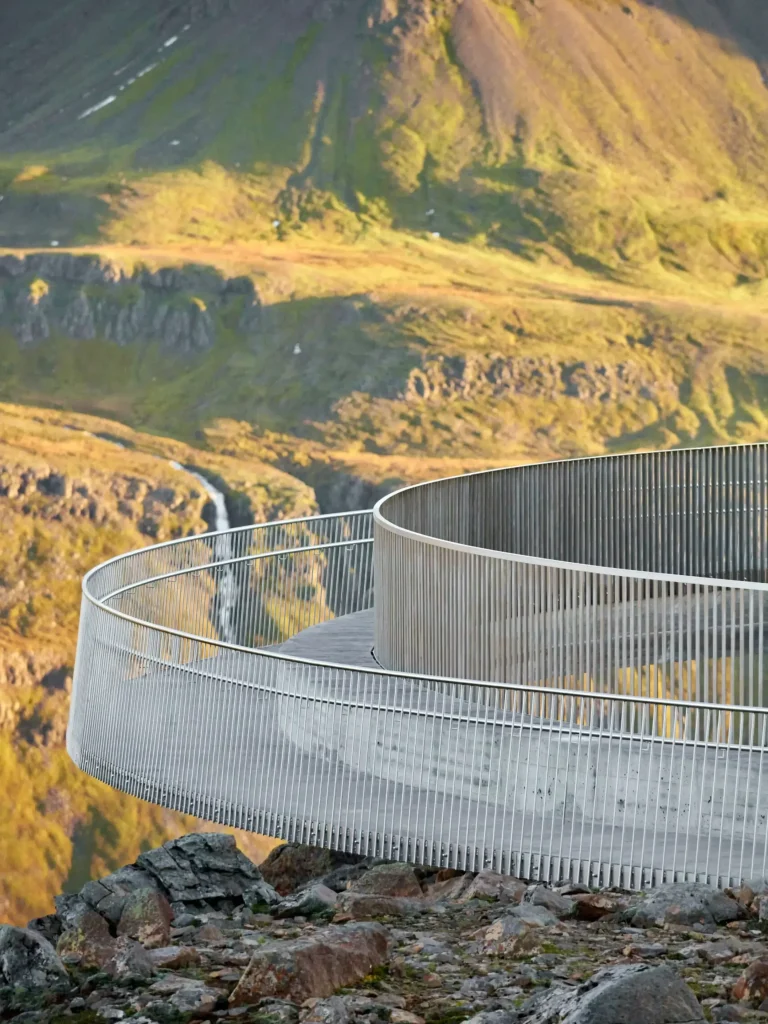
Building on an exposed Icelandic ridge required careful engineering. Structural design by Exa Nordic used post-tensioned concrete to create a continuous, efficient ring that is anchored at only four points. After the concrete reached sufficient strength, the tendons were tensioned, allowing temporary supports to be removed and the cantilever to stand independently.
Materials were chosen for longevity and low maintenance. Concrete and stainless-steel railings resist the combination of wind, freeze-thaw cycles, and long periods under snow. The pale, silvery finish deliberately echoes the idea of precious metal while remaining practical in a climate that leaves little room for delicate surfaces.
Construction itself was constrained by the short summer season and difficult access. Work began later than planned due to snow, and the program allowed for weather delays. Formwork and reinforcement were prepared carefully to minimize time spent on the exposed site. Disturbed ground was restored with native vegetation, and existing boulders were replaced wherever possible.
Design Ideology
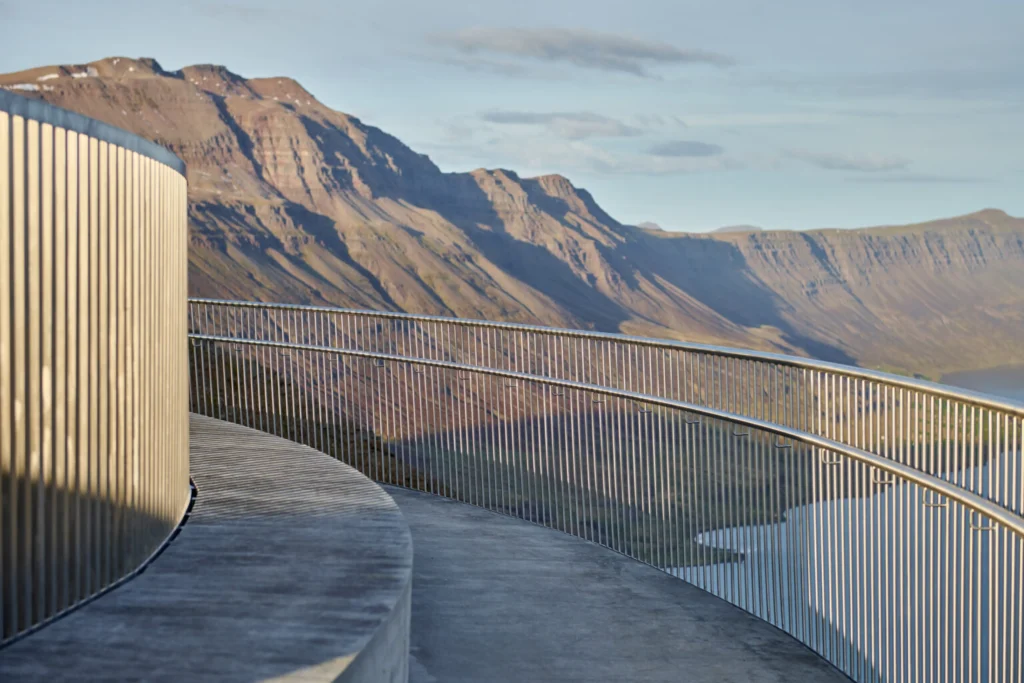
The project rests on a simple but rigorous idea: that architecture can hold a story without illustrating it. The ring does not depict a Viking burial or recreate historical forms. It offers a contemporary object whose shape and materiality quietly reference the legend while performing a clear public function.
Accessibility was treated as fundamental rather than additional. The platform is wheelchair accessible, and the continuous bench allows people to pause anywhere along the circuit. By concentrating visitors on a single, well-designed destination, the project also protects the fragile surrounding ridge from uncontrolled foot traffic.
Impact After Completion
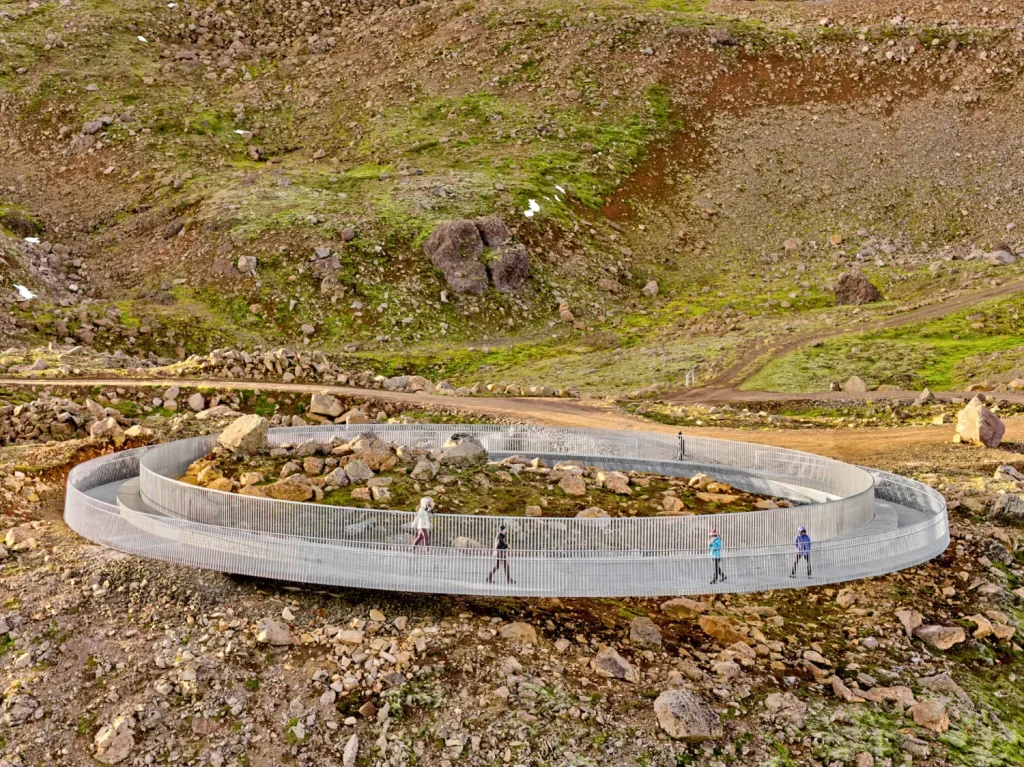
Since opening, the ring-of-bjolfur has begun to function as both viewpoint and landmark. It gives the public safer, more equitable access to a dramatic location that previously required informal scrambling. It has also drawn attention for its restraint. In a period when many tourist infrastructures chase spectacle, this project succeeds through precision and understatement.
Recognition has followed. The completed work was shortlisted for the 2026 Dezeen Awards in the small projects category and won the public vote. Earlier, the design had already received a jury selection at the Architizer A+ Awards. These acknowledgments confirm that a modest program, when executed with clarity, can carry cultural and architectural weight.
A Finished Circle
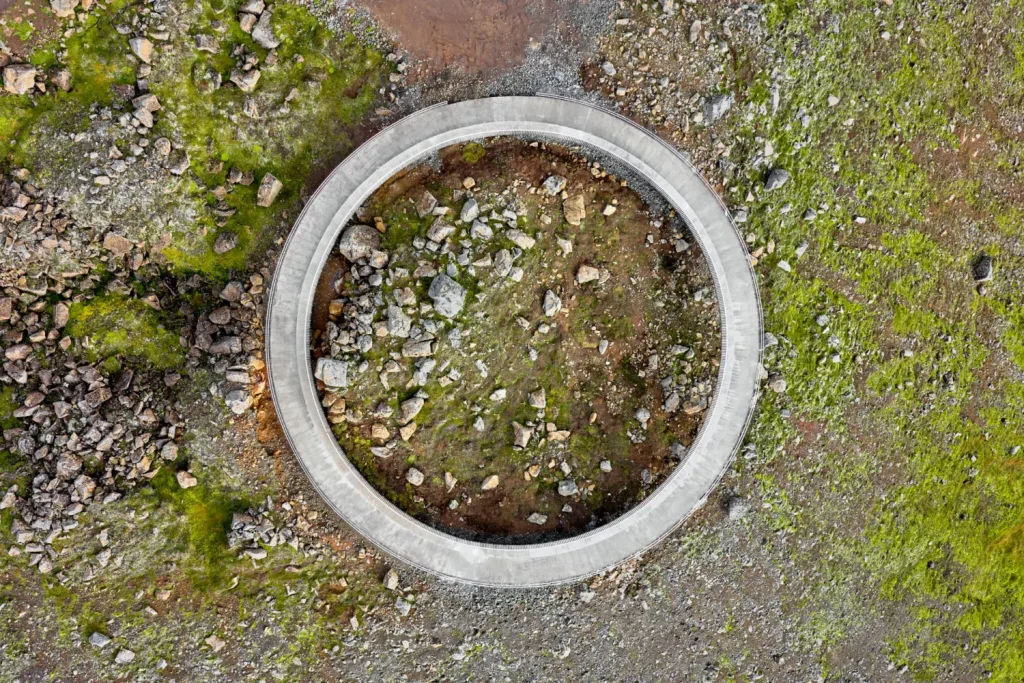
The ring-of-bjolfur demonstrates how a strong conceptual idea can survive the realities of remote construction, harsh weather, and public use. The geometry remains pure. The material is honest. The legend is present without being forced.
Standing on the completed platform, visitors encounter more than a view. They encounter a carefully calibrated relationship between folklore, landscape, and contemporary making. The silver ring that was never found has, in a sense, been returned — not as treasure, but as a place to stand, look, and remain for a while.