


A tile can disappear from a showroom long before the last box leaves a warehouse. For a homeowner repairing a bathroom or extending a backsplash, that difference matters. Stock may still be available, but finding it can depend on knowing a supplier the homeowner or installer has never heard of.

Solidshape helps close that gap by bringing tile from smaller suppliers into an online catalog where buyers can discover it. Suppliers gain a way to reach people beyond their usual customers, while buyers gain access to products that local searches may miss.
Elchin Mirzayev, President and Co-founder of Solidshape, puts the company’s approach this way: “At Solidshape, we remain focused on fundamentals: long-term thinking, infrastructure over appearances, and solving real supply chain problems in a durable way.”
Why good tile remains difficult to find
Solidshape works with smaller tile suppliers whose inventory extends beyond the collections they can afford to promote. Collections that sell regularly tend to receive the most attention, with showroom displays and sales conversations reinforcing that demand. Promoting every size, finish, and coordinating piece takes resources that a small team may struggle to provide.
The imbalance becomes harder to manage as a catalog grows. Photographing products, maintaining descriptions, and answering questions all take time. A supplier may know that a particular tile has value while lacking an economical way to promote it to a scattered audience. A shared sales channel can help reach those buyers.
Meanwhile, other stock accumulates. A supplier may have boxes left from an earlier order, an older collection that still has a following, or a color and size combination that sells only occasionally. These items can remain useful even after the distributor shifts its attention to newer products or those that sell faster.
This is the long tail of tile inventory: many products that each attract relatively few buyers. Individually, a particular trim piece or unusual format might generate little local interest. Across a wider market, however, someone may be searching for exactly that item. Until the two sides find each other, the tile occupies warehouse space and keeps the supplier’s money tied up in stock.
Giving existing inventory a wider audience
An online catalog makes it possible to search beyond the suppliers a buyer already knows. Product names, dimensions, and finish details give shoppers a way to narrow their search. For a distributor, a listing can continue presenting a less popular item while the sales team handles everyday demand.
Making overlooked tile easier to find addresses a practical gap in tile distribution. A supplier might have the right product and enough stock, yet have no connection to the person who needs it. Solidshape helps create that connection through product discovery, with project support available when buyers need help assessing their options.
Imagine a contractor in Colorado searching for a finish that a California distributor still carries. Without a visible listing, the contractor may never learn that those boxes exist. A searchable product page opens a conversation about the details that determine whether the order can work, including quantity and shipping.
Why less popular tile can be the right choice
Demand depends on the project. A homeowner finishing an existing installation may care much more about finding a compatible tile than buying the newest collection. A designer working within a particular color palette may prefer a finish that no longer receives prominent showroom space.
Limited quantities can also suit smaller jobs. Stock that would be insufficient for a large floor could cover a backsplash or provide replacement pieces for a repair. That creates a useful match between the amount a supplier holds and the amount a buyer actually needs.
Older collections can suit new projects, too. A ceramic tile does not need to be a recent introduction to work well in a kitchen design. Its appearance, intended use, and available quantity are what matter to the decision. Keeping it discoverable preserves that choice for buyers.
A broader search can give buyers more room to make a considered decision. When an exact match is unavailable, a designer might identify a complementary tile for a transition or a separate area. Seeing available options early allows the project team to discuss those choices before installation begins and late substitutions become necessary.
Checking that a tile will work for the project
Discovery is the first step. Buyers matching existing tile should start with the manufacturer and collection name, ideally supported by a product code, carton label, or original invoice. Dimensions, thickness, and finish also matter. A similar photograph alone cannot establish that two tiles will look right together.
Shade and size can vary between production runs, even within the same collection. Ask about the available lot and compare a sample with the existing installation where possible. An installer can help assess whether differences in size or edge shape will affect the layout. These checks are especially useful for repairs, where new pieces sit directly beside older ones.
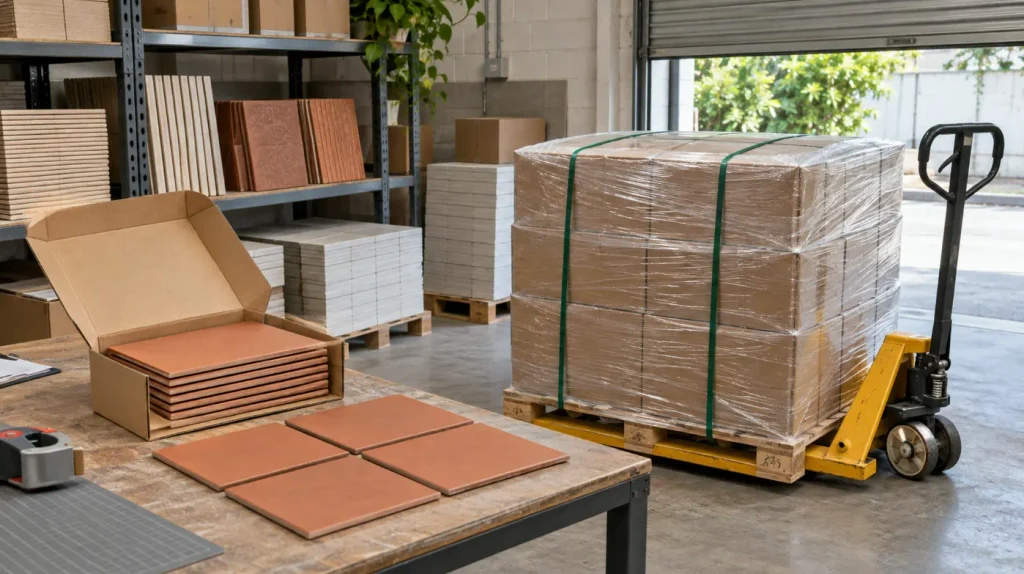
Next, confirm how much tile is available and whether more can be ordered later. Work with the installer to allow for cuts, breakage, and any spare pieces the project needs. Before committing, confirm the total delivered cost, expected shipping timing, and delivery arrangements. A useful listing helps identify a candidate; those details establish whether it fits the schedule and budget.
A more useful sales channel for smaller suppliers
For suppliers, the quality of the listing matters as much as its visibility. Accurate product identification, clear images, and current stock information help buyers decide whether to inquire. Showing the unit of sale and the area each box covers makes quantity comparisons easier. If a product cannot be replenished, stating that early helps prevent unsuitable orders.
When overlooked inventory finds a buyer, the supplier can recover money tied up in stock and free warehouse space. The buyer gains access to tile that was difficult to locate through familiar channels. Those benefits depend on accurate information and a product that suits the job, which is why discovery and practical buying support belong together.
Buyers can begin with Solidshape’s tile catalog and bring the team a product reference, photos or project requirements when the search needs narrowing. A tile that sells infrequently in one market may be exactly what a different project needs.