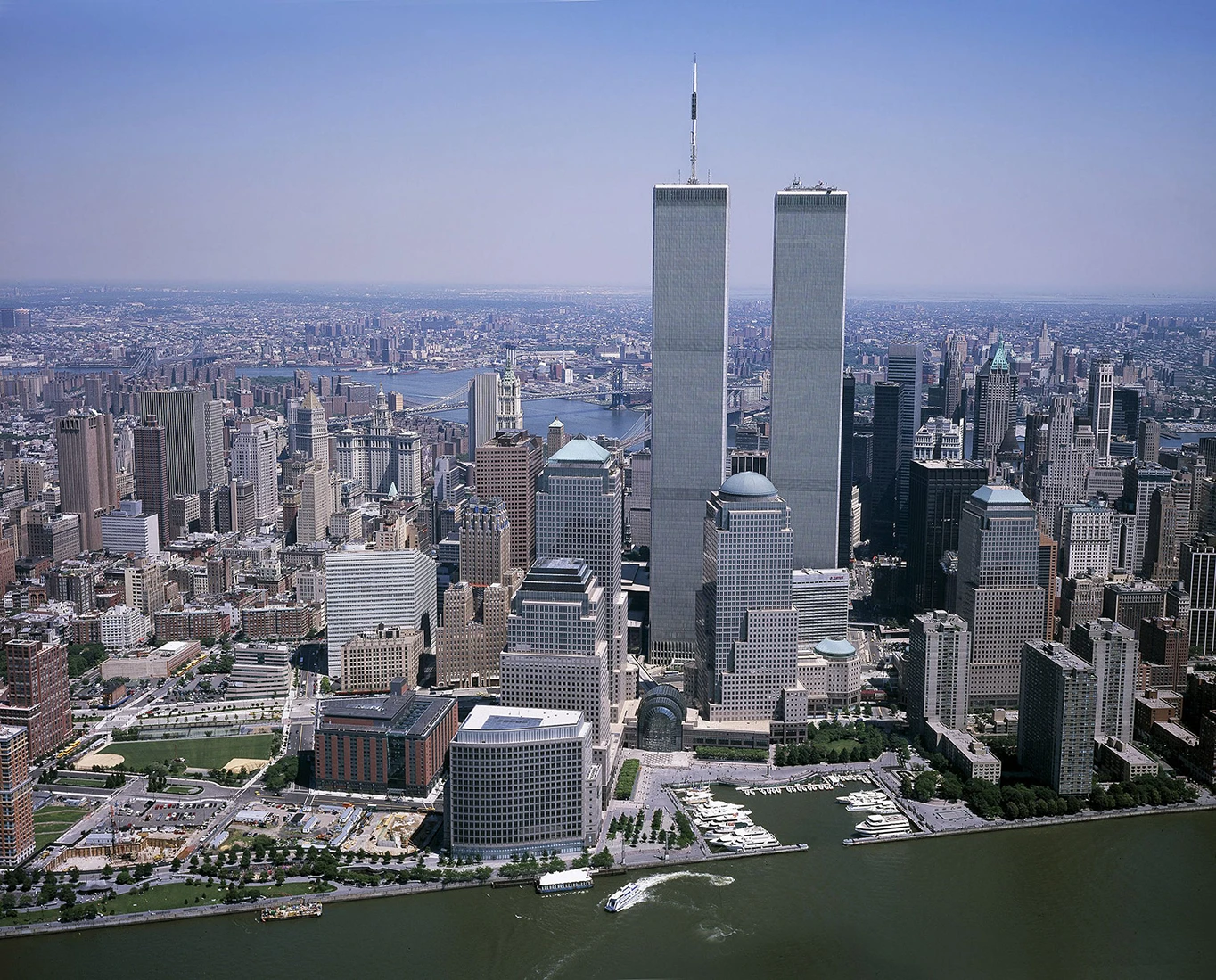


The attacks of September 11, 2001, changed far more than the skyline of New York. They altered the way architects, planners, governments, developers, and citizens understood the relationship between buildings and risk. Architecture had long been concerned with structural safety, fire protection, natural disasters, and human comfort, but after 9/11, another question moved sharply toward the center of architectural thinking: How should cities be designed when buildings and public spaces themselves can become targets?
The answer has never been simple. The decades following 9/11 produced stronger buildings, controlled entrances, security barriers, surveillance systems, redesigned public spaces, new approaches to memorial architecture, and a renewed interest in urban resilience. At the same time, these measures introduced a difficult contradiction. The safer a city tries to become, the more it can begin to resemble a city designed around fear.
The influence of 9/11 therefore cannot be reduced to the architecture of the rebuilt World Trade Center. It represents a broader transformation in urbanism, in which security became embedded within the physical fabric of cities around the world.

From Iconic Towers to Vulnerable Urban Symbols
Before 9/11, the skyscraper represented many things: technological achievement, economic power, globalization, corporate identity, and urban ambition. The World Trade Center embodied these ideas particularly strongly. Its Twin Towers were not merely office buildings but internationally recognizable symbols of New York’s economic and political significance.
Their destruction demonstrated that architecture could acquire a new vulnerability precisely because of its symbolic power. The skyscraper was no longer understood exclusively as an efficient vertical workplace. It could also function as a highly visible target.
This changed the discussion surrounding tall buildings. Architects and engineers increasingly considered issues such as blast resistance, protected structural cores, multiple evacuation routes, emergency communication, fireproofing, refuge areas, and controlled access. Security began influencing decisions that had previously been dominated by aesthetics, economics, circulation, and structural efficiency.
The consequence was not that skyscrapers disappeared. In fact, cities around the world continued to build taller and more spectacular towers. What changed was the hidden infrastructure of safety behind their architectural appearance.

Ground Zero and the Problem of Rebuilding
Nowhere was the relationship between architecture, memory, commerce, and security more complicated than Lower Manhattan. Following the attacks, rebuilding the World Trade Center site became one of the most important architectural and urban-planning projects of the early twenty-first century. The challenge was extraordinary: the site had to accommodate offices, transportation infrastructure, public space, cultural institutions, commercial interests, and, above all, a memorial to nearly 3,000 people who died in the attacks.
Daniel Libeskind‘s master plan established an important conceptual framework for the reconstruction. It proposed a new urban composition around the footprints of the destroyed towers, combining memorial space with new development. However, the eventual buildings differed considerably from the original master plan, illustrating how difficult it was to reconcile architectural ideals with political, financial, engineering, and commercial realities.
The resulting complex became an architectural collage of the post-9/11 city. One World Trade Center, designed by David Childs of SOM, became the dominant vertical symbol. The National September 11 Memorial, designed by Michael Arad with landscape architect Peter Walker, transformed the footprints of the destroyed towers into enormous recessed voids containing waterfalls. The Oculus, designed by Santiago Calatrava, introduced an expressive transportation architecture into the site.
The memorial competition itself demonstrated the international significance of the event. More than 5,200 submissions from 63 countries were received before Arad and Walker’s Reflecting Absence was selected in 2004.
The design is important because it does not attempt to reconstruct the destroyed towers. Instead, absence becomes the architectural subject. The voids represent what is no longer there.
This approach marked an important tendency in contemporary memorial architecture: rather than relying exclusively on heroic statues or monumental objects, memorials could operate through landscape, emptiness, water, material, names, and bodily experience.

Architecture as a Technology of Security
The most widespread architectural consequence of 9/11, however, is less visible than the memorials and skyscrapers of Lower Manhattan. Security increasingly became part of everyday urban design.
Concrete barriers, bollards, reinforced entrances, setback requirements, controlled vehicle access, surveillance cameras, security checkpoints, blast-resistant glazing, hardened facades, and restricted pedestrian zones became common features around government buildings, financial institutions, embassies, transportation hubs, and major public attractions.
Research into New York’s post-9/11 security landscape found that security zones occupied a significant portion of the non-building area surrounding selected civic and corporate districts. Jeremy Németh and Justin Hollander argued that these spaces represented more than temporary responses to terrorism and had effectively become a new category of urban land use.
This is one of the most important transformations in post-9/11 urbanism. Security was no longer necessarily an object added to architecture. It became an organizing principle of space.
A street could be closed to vehicles. A plaza could be redesigned to prevent truck access. A building entrance could be moved away from the street. Landscape elements could double as security barriers. Benches, planters, walls, and sculptures could become defensive infrastructure. The result was a new architectural language in which ordinary urban elements acquired security functions.

The Rise of the “Safe” Public Space
Public space has always been political. Parks, plazas, streets, and civic squares provide places for gathering, protest, celebration, commerce, and spontaneous social interaction. Post-9/11 security measures introduced another priority: controlling who and what could enter these spaces.
Washington, D.C., offers a particularly important example. The National Mall, one of the most symbolically significant public spaces in the United States, became the subject of extensive security planning after 2001. Scholars observed a fundamental tension between protecting a highly symbolic democratic space and preserving its openness for political demonstrations and public gatherings.
This tension exists in cities around the world. The question is not simply whether a public space is physically accessible. It is whether people can still experience it as genuinely public.
A plaza surrounded by barriers, cameras, checkpoints, private security personnel, and rules governing movement may technically remain open, yet feel fundamentally different from the open civic space envisioned by traditional urbanism.
Post-9/11 urbanism therefore produced an uncomfortable paradox: security can protect public space while simultaneously changing its public character.

Airports and the Architecture of Controlled Movement
Few building types demonstrate this transformation more clearly than airports.
Airports had security systems before 2001, but the attacks accelerated the development of highly controlled circulation environments. Passenger movement became increasingly organized around screening, identity verification, restricted zones, surveillance, controlled queues, and separation between secure and non-secure areas.
Architecturally, this changed the experience of movement. The traditional airport could be understood as a building organized around arrival, departure, waiting, and orientation. The contemporary airport increasingly resembles a carefully choreographed security system in which the passenger is continuously categorized and monitored.
This has also influenced other transportation infrastructures, including train stations, subway systems, ports, and major intermodal terminals. The city became a sequence of thresholds: public, semi-public, controlled, screened, and restricted.
In this sense, post-9/11 architecture is partly an architecture of circulation management. The question is no longer simply “Where should people go?” It is also “Who is allowed to go there, under what conditions, and how can their movement be monitored?”

The Globalization of Security Urbanism
Although 9/11 was an American tragedy, its architectural consequences quickly became global. The 2004 Madrid train bombings, the 2005 London bombings, attacks in Paris, Mumbai, Brussels, Beirut, and numerous other cities reinforced the perception that terrorism could occur within ordinary urban environments. Security consequently became an international concern rather than a specifically American architectural issue.
Government buildings, diplomatic facilities, financial districts, stadiums, shopping centers, cultural institutions, religious buildings, and transportation infrastructure increasingly incorporated security strategies.
The embassy became particularly important. Diplomatic architecture had already developed sophisticated security requirements, but the post-9/11 environment intensified attention to setbacks, blast protection, controlled entrances, structural redundancy, and separation between public and secure functions.
Similarly, major corporate headquarters began to treat security as part of architectural identity. The secure building did not necessarily have to look like a fortress. Contemporary architecture increasingly attempted to conceal defensive systems within landscaped plazas, structural elements, facade systems, and carefully controlled circulation.
This produced what might be called the invisible fortress: buildings that appear open and transparent while incorporating complex layers of protection.

From Fortress Architecture to “Hostile” Urbanism
The security city has another, more controversial dimension. Measures initially introduced to protect cities from terrorism can also influence how cities treat ordinary users.
Anti-terrorism barriers may prevent vehicles from entering pedestrian spaces, but they can also restrict informal activities. Surveillance can improve emergency response while expanding the monitoring of everyday behavior. Controlled plazas can protect important buildings while reducing opportunities for spontaneous gatherings. This has led urban scholars to question whether the post-9/11 city has gradually exchanged openness for defensibility.
Research on New York found that security interventions contributed to the shrinking and privatization of public space. Scholars argued that such zones could remain even after immediate threats diminished, becoming permanent characteristics of the global city.
This critique is especially important because security is rarely neutral. Decisions about what needs protection, who appears suspicious, and which activities are considered acceptable are ultimately social and political decisions.
Architecture can therefore participate in producing exclusion without appearing explicitly exclusionary.

Surveillance and the Digital City
The post-9/11 city is not protected only by physical barriers. It is also monitored through increasingly sophisticated digital systems.
CCTV networks, facial recognition, access-control systems, license-plate recognition, biometric identification, data analytics, and interconnected emergency systems have transformed the relationship between architecture and surveillance.
Buildings have become data-producing environments.
Doors can identify users. Elevators can restrict access. Cameras can track movement. Security systems can detect unusual behavior. Smart-building technologies can connect physical spaces to centralized monitoring platforms.
This development has accelerated with the broader rise of smart-city technologies. Although not all smart-city systems emerged because of 9/11, the post-9/11 security culture helped normalize the idea that urban environments should continuously collect information in order to anticipate and manage risk. The contemporary city is therefore increasingly both physical infrastructure and information infrastructure.

Memorial Architecture and the Geography of Trauma
Perhaps the most constructive architectural response to terrorism has been the evolution of memorial spaces. After 9/11, architects and landscape designers faced the difficult problem of representing an event that was still emotionally immediate. The challenge was not simply to commemorate the dead but to establish a meaningful relationship between memory and everyday urban life.
The memorial at Ground Zero is particularly significant because it places remembrance within an active commercial and transportation district. Visitors encounter waterfalls, trees, names, and open space while surrounded by offices, streets, retail spaces, and tourists.
This coexistence matters. A memorial that is completely separated from ordinary life can become frozen in history. A memorial integrated into the city can allow memory to remain part of everyday experience.
The architectural response to 9/11 also influenced memorials elsewhere. Contemporary memorial architecture increasingly uses absence, landscape, fragmented forms, traces, names, and carefully choreographed movement to address traumatic events. Scholars of memorial architecture have identified this as part of a broader transformation in how societies use architecture to process collective trauma and “post-memory.”

The Architecture of Resilience
Another major legacy of the post-9/11 period is the concept of resilience. Resilience differs from conventional security. Security attempts to prevent an event. Resilience asks how a city can continue functioning when prevention fails.
This distinction has influenced urban planning far beyond terrorism. Cities increasingly plan for earthquakes, floods, pandemics, cyberattacks, infrastructure failures, climate change, and extreme weather alongside terrorism.
The resilient city therefore emphasizes redundancy, adaptability, multiple transportation routes, distributed infrastructure, emergency communication, flexible public spaces, and rapid recovery.
In architectural terms, resilience encourages buildings that can continue operating under abnormal conditions rather than simply resisting a single threat. This represents an important evolution. The post-9/11 city gradually moved from the idea of the secure building toward the idea of the adaptive city.
From Openness to Controlled Transparency
One of the most interesting aesthetic consequences of this transformation is the changing meaning of transparency. Modernist architecture celebrated glass as a symbol of openness, technological progress, and visual connection. Post-9/11 architecture complicated this symbolism.
Glass can create openness, but it can also be vulnerable to blast pressure. Transparent entrances can encourage public accessibility, but they can also require sophisticated screening systems. As a result, contemporary buildings frequently combine visual transparency with controlled physical access.
The building may look open while functioning as a highly regulated environment. This contradiction reflects a larger condition of contemporary architecture: appearance and performance increasingly diverge. A building can communicate openness aesthetically while operating defensively through hidden systems.
The New Monumentality
9/11 also revived debates about monumentality. The twentieth century had often treated monumentality with suspicion. Modernist architecture preferred functionalism, abstraction, and the language of progress. Yet the destruction of the World Trade Center demonstrated the continuing power of symbolic architecture.
One World Trade Center is not merely an office tower. Its height of 1,776 feet deliberately connects the building to the symbolic language of American independence. Its existence raises an important question: Can a commercial skyscraper simultaneously function as a national monument?
The answer is complicated. The rebuilt World Trade Center had to operate economically while carrying enormous symbolic expectations. It needed to attract businesses, support Lower Manhattan, create public space, and communicate resilience.
The result is architecture operating simultaneously on several levels: commercial, infrastructural, civic, emotional, and geopolitical.

The City After Fear
More than two decades after 9/11, its architectural legacy is no longer limited to obvious security infrastructure. It has influenced how architects think about entrances, circulation, structural redundancy, emergency planning, public space, surveillance, memorialization, urban resilience, and symbolic buildings. Yet the central lesson may be less about security than about how cities respond to uncertainty.
The danger of post-9/11 urbanism is that fear can become permanently embedded in the built environment. When every plaza is treated as a potential target, every entrance as a potential vulnerability, and every stranger as a potential threat, the city can lose some of the openness that makes urban life valuable in the first place.
The challenge for contemporary architects is therefore not to eliminate security. That would be unrealistic. Instead, the task is to integrate security without allowing it to dominate the civic experience. A successful post-9/11 city should be capable of protecting people while remaining accessible, diverse, democratic, and visually open.
Designing for Memory, Security, and Freedom
Post-9/11 architecture and urbanism represent one of the most consequential shifts in contemporary architectural culture. The attacks exposed the vulnerability of iconic buildings, transformed the politics of rebuilding, intensified security requirements, expanded surveillance, reshaped public space, and generated a new generation of memorial architecture.
But the deeper legacy is a question rather than a particular architectural style. How can architecture protect people without turning the city into a fortress?
The answer requires moving beyond the simplistic opposition between openness and security. Cities need protection, but they also need freedom, spontaneity, public interaction, cultural diversity, and the ability to gather without suspicion.
The rebuilt World Trade Center illustrates this struggle particularly well. Its memorial preserves absence, its skyscraper represents continuity, its transportation infrastructure reconnects the city, and its security systems acknowledge a changed world. The site is therefore not simply a reconstruction of what existed before 2001. It is an architectural record of how the twenty-first-century city learned to live with memory and risk.

Ultimately, post-9/11 urbanism is not only about terrorism. It is about the broader condition of contemporary cities, where uncertainty has become an increasingly important design factor. Climate change, pandemics, political violence, technological surveillance, infrastructure failure, and social instability all force architects to reconsider what resilience means.
The most successful architecture of the future will therefore need to do something remarkably difficult: make cities safer without making them less human.
That may be the most important architectural challenge inherited from September 11.