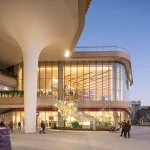
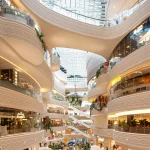
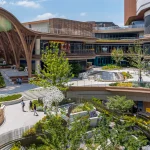
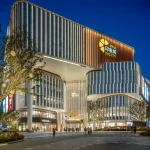
Shanghai has no shortage of shopping centers. Most of them operate as sealed boxes: bright, efficient, and largely indifferent to the city outside their walls. Hongqiao Qianwan Incity MEGA, which opened in late 2025 along the historic Suzhou Creek, tries something different. Designed by Lead8, the roughly 256,000-square-meter complex presents itself as an urban retail resort rather than a conventional mall. The difference is felt the moment you begin to walk through it.
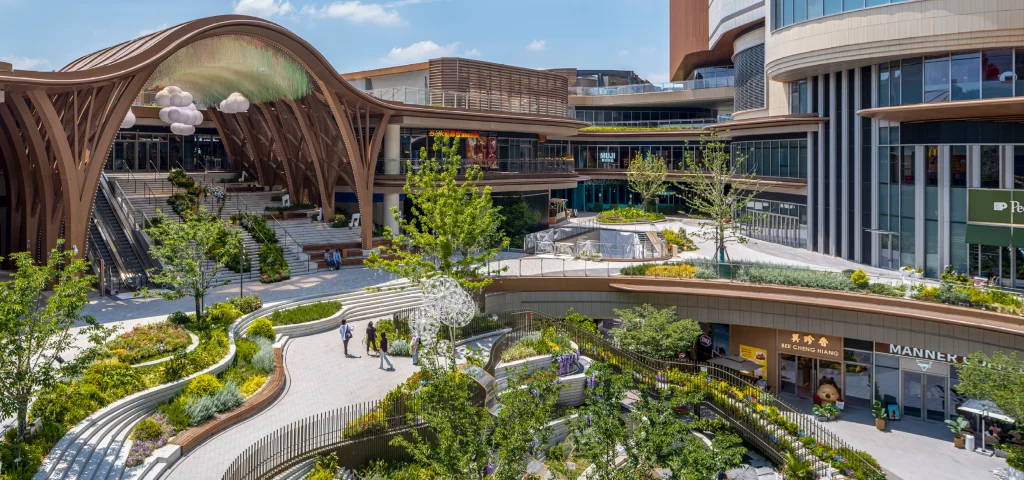
The project sits in the Qianwan area of the Hongqiao International Central Business District in Minhang. It forms part of a larger 400,000-square-meter super complex that already includes the Costco China flagship store and the Hongqiao International Business Center. Surrounded by new residential communities, schools and transport links, the site was always going to be busy. The question was whether the architecture would treat that activity as something to contain or something to choreograph.
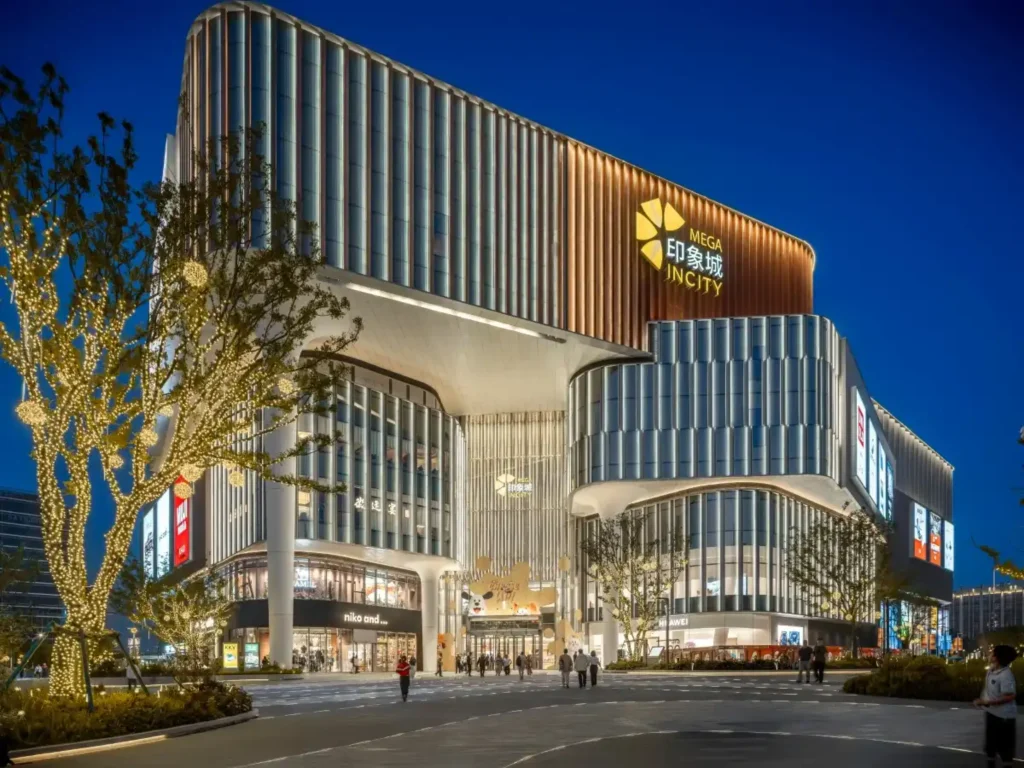
An open-air urban escape
Lead8’s design draws directly from the Jiangnan landscape and the fluid presence of Suzhou Creek. Flowing lines, organic massing, and layered terraces replace the usual hard edges of retail architecture. The building combines an enclosed shopping volume with a semi-open commercial street system. Ecological corridors, sunken plazas and multi-level outdoor spaces create a sequence that feels closer to a landscape than a floor plate.
Visitors move between interior and exterior without sharp transitions. Cascading planting, water references and shifts in level produce the sensation of walking through a series of small canyons, streams and terraces. The designers describe the experience as a micro-vacation. In practice, it simply means that time spent inside the complex does not feel like time spent indoors.
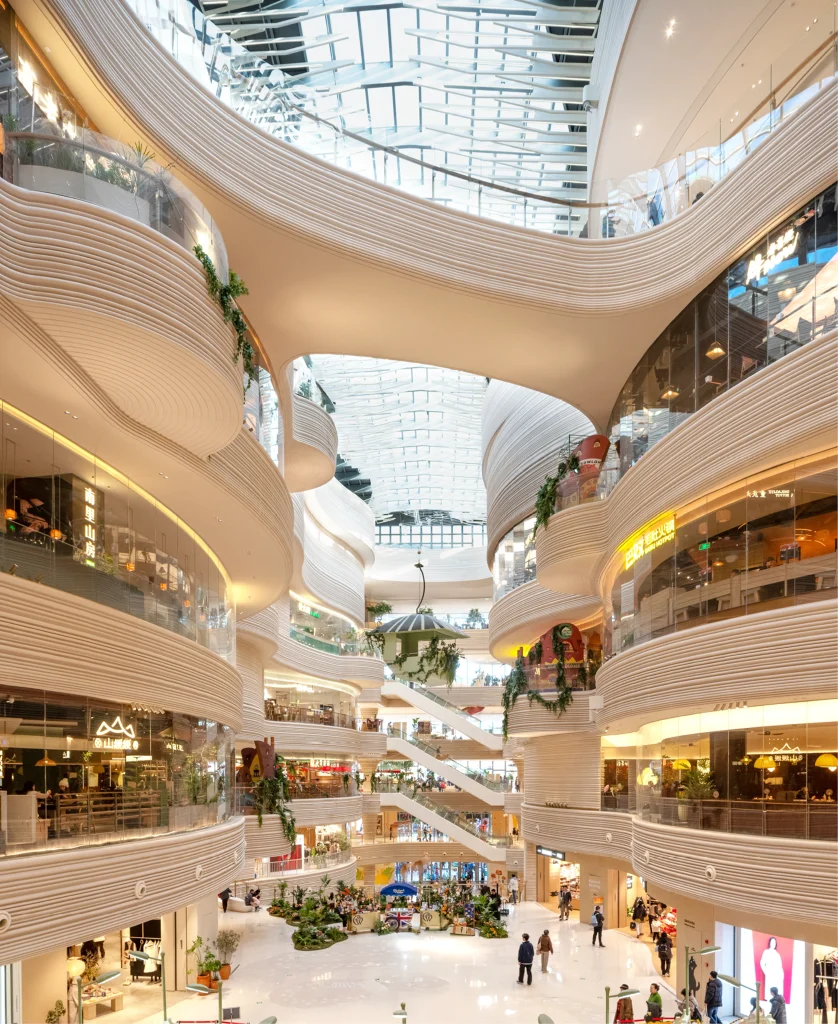
The same language continues into the interiors. Biophilic principles guide the public spaces. Soft curves, natural materials and carefully placed greenery create zones of relative calm within the larger commercial energy. The goal is not to eliminate retail intensity but to give it breathing room.
More than retail
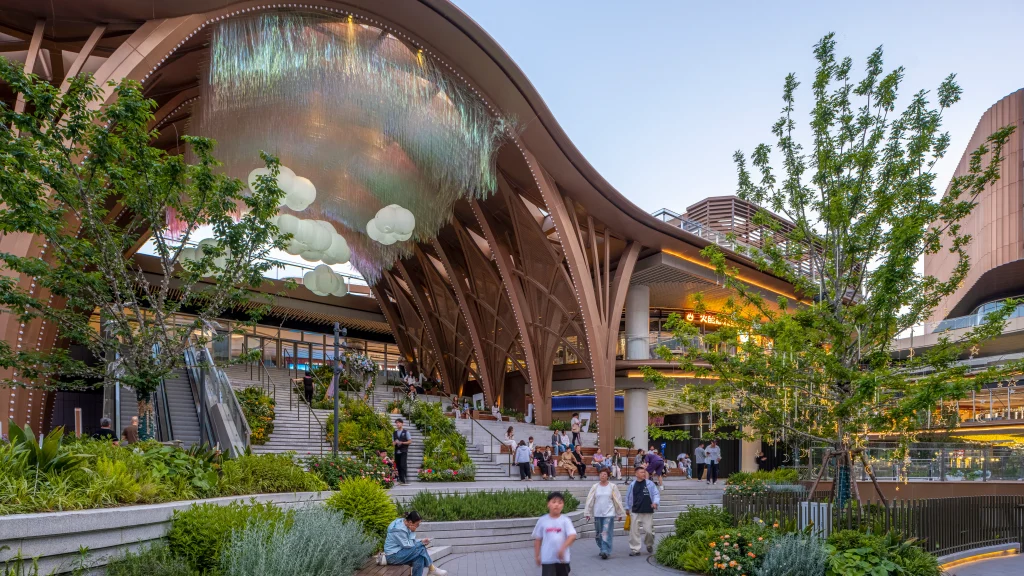
The program reflects the architectural ambition. More than 300 brands occupy the floors, covering fashion, dining, sports, entertainment, family activities and pet-friendly offerings. A significant proportion are first stores or concept formats for the Chinese mainland or for Shanghai. The mix is deliberately broad: international chains sit alongside lifestyle and experience-driven tenants.
What distinguishes the project is the way these uses are organized around social and recreational space rather than pure transaction. Outdoor wine and coffee areas, a food market with seasonal programming, dedicated pet zones, and family-oriented activity spaces turn the complex into a place people stay rather than pass through.
The architecture supports this by providing generous public areas that are not entirely dependent on retail turnover.
Six immersive themed zones further structure the experience. During the opening period, these included a large Disney collaboration around Zootopia 2, but the underlying idea is longer-term: to treat the mall as a sequence of distinct atmospheres rather than a uniform commercial field.
Sustainability as infrastructure
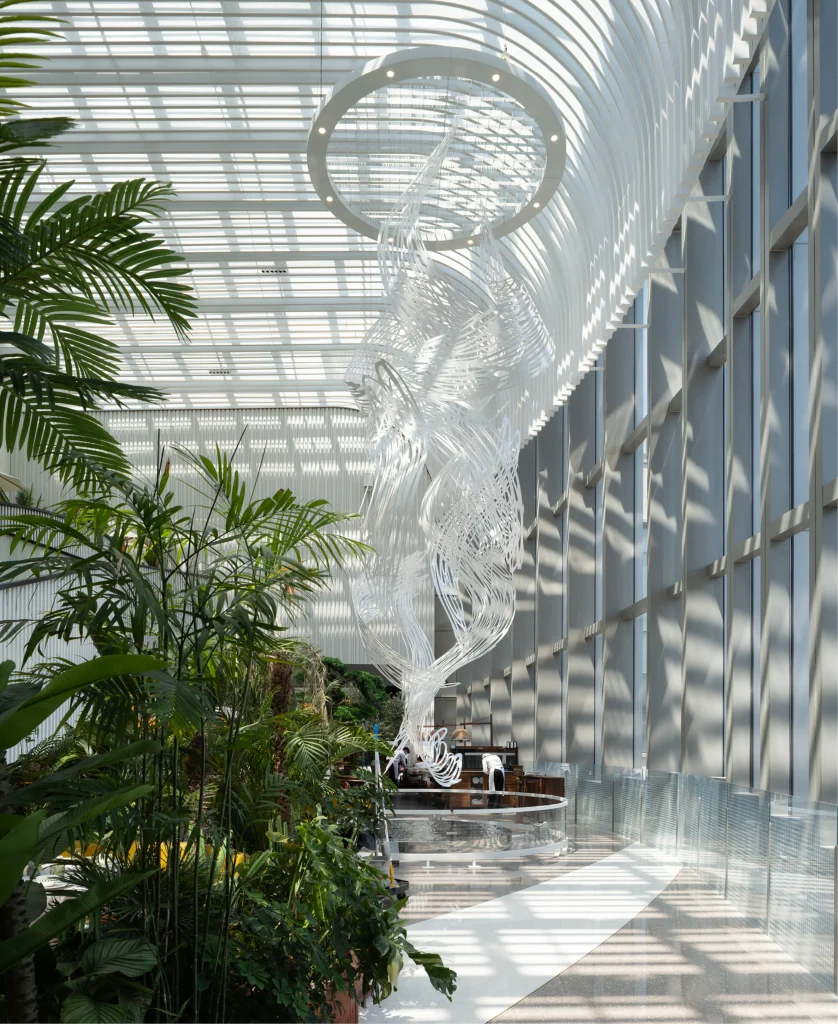
Hongqiao Qianwan Incity MEGA achieved LEED Gold certification. Green roofs, biodiversity-focused planting and energy-efficient systems form part of the core design rather than late-stage additions. In a dense and rapidly developing district, these measures address the urban heat island effect and contribute to local air quality. The landscape is not merely decorative. It performs.
The same pragmatic approach appears in the relationship to surrounding infrastructure. The complex is positioned to benefit from existing and planned metro connections. Its scale and mix of uses are calibrated to serve both the immediate residential population and the wider Hongqiao business community. Architecture here is asked to absorb intensity without becoming oppressive.
Walking as the measure
The most useful way to understand the project is simply to walk it. The sequence of spaces rewards movement. You leave a climate-controlled retail hall and find yourself on a planted terrace. A few steps later, the path drops into a sunken plaza where the sound of the city softens. Further on, the building opens again toward the creek side. The architecture never fully closes in.
This continuous negotiation between enclosure and openness is the project’s central achievement. Traditional malls maximize controlled interior volume. Hongqiao Qianwan Incity MEGA deliberately gives some of that volume back to landscape, air, and public occupation. The commercial floors remain efficient, yet they are threaded with routes that feel more like an urban park system than a shopping circuit.
Lead8 has described the development as a social anchor. The phrase is accurate. In a district still filling out with housing, offices, and infrastructure, the complex offers a shared ground where different age groups and daily routines can overlap. Families, young professionals, residents walking dogs, and people simply looking for a place to sit all find space within the same framework.
A model for the next commercial generation
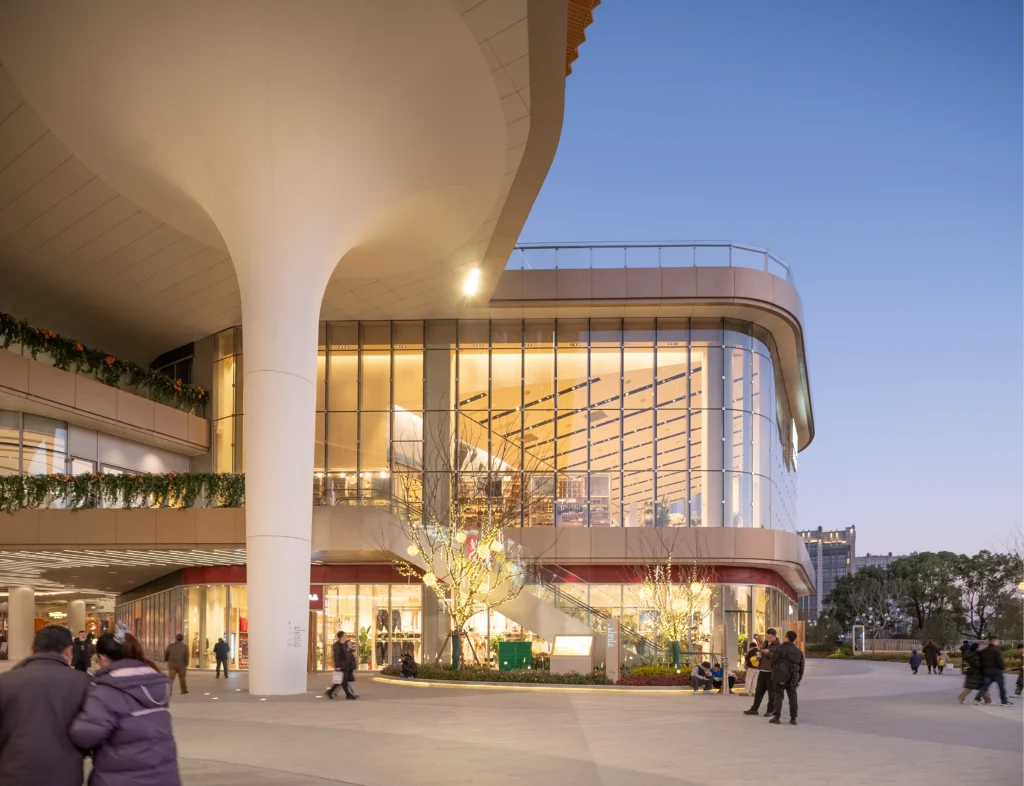
Shanghai continues to build large retail projects. Many will still follow the proven box model because it i\s efficient and familiar. Hongqiao Qianwan Incity MEGA suggests another possibility: that commercial architecture can borrow the spatial generosity of landscape and the social openness of the street without losing commercial clarity.
The flowing forms, the layered terraces, the biophilic interiors and the LEED Gold systems are all tools in service of that idea. None of them is radical in isolation. Together they produce a place that feels less like a destination you arrive at and more like a piece of the city you move through.
In the end, the project succeeds because it takes walking seriously. It understands that the quality of a retail environment is measured not only by the brands it contains but by the character of the paths that connect them. Along Suzhou Creek, Lead8 has given Shanghai a large commercial complex that still leaves room for air, for planting, and for the simple pleasure of moving at a human pace. That, more than any single formal gesture, is what makes Hongqiao Qianwan Incity MEGA feel like an urban resort rather than another mall.