


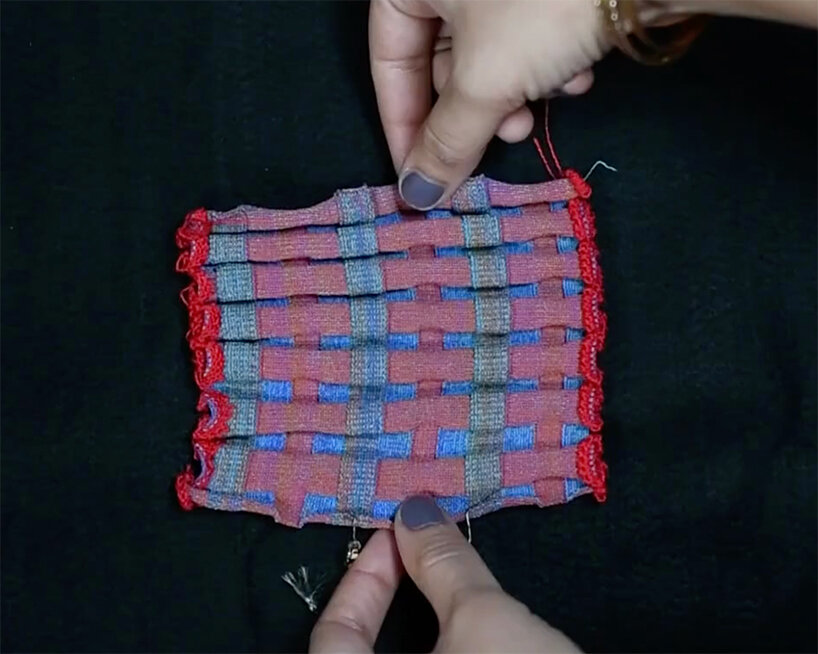
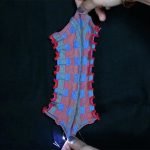


Researchers at the Harvard John A. Paulson School of Engineering and Applied Sciences (SEAS) have developed a new class of programmable knitted textiles that can switch between multiple stable three-dimensional shapes while also functioning as soft electronic sensors. Created using standard industrial knitting techniques, the material combines mechanical intelligence with embedded conductive yarns, opening new possibilities for wearable technology, responsive products, and interactive textiles.
The research was led by Kausalya Mahadevan, now a postdoctoral associate in the laboratory of Katia Bertoldi, William and Ami Kuan Danoff Professor of Applied Mechanics at Harvard SEAS. Their findings were published in Advanced Functional Materials.
Turning Conventional Knitting into Programmable Materials
The team transformed an ordinary weft-knitting process into a manufacturing method for creating textiles with programmable mechanical behavior. Using commercially available industrial knitting machines, they produced dense elastic fabrics that naturally curve into three-dimensional forms after fabrication.
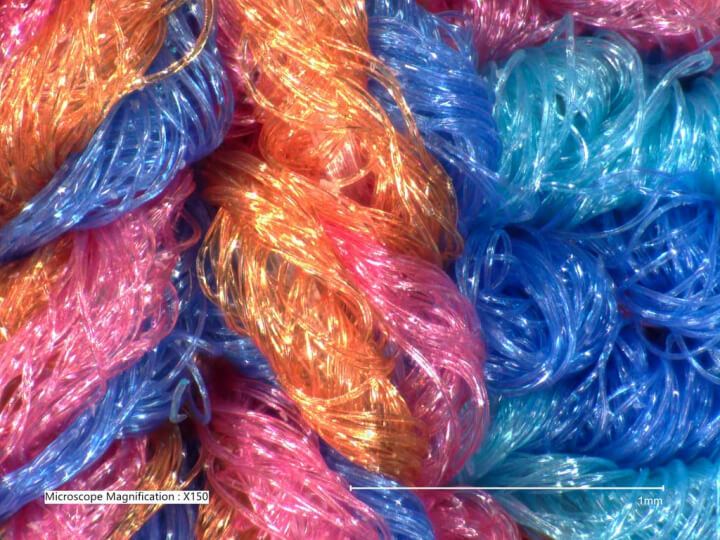
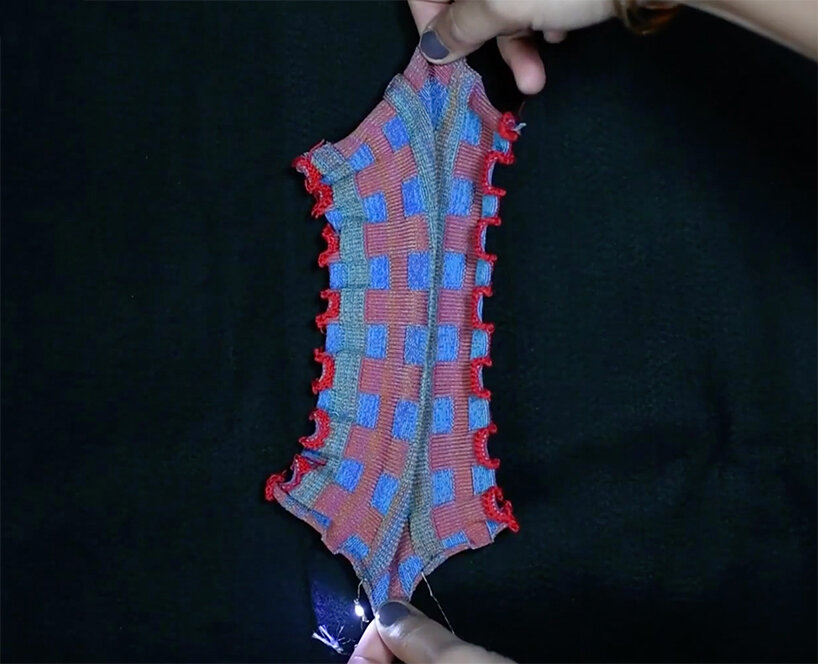
The shape transformation is driven by internal stresses created during knitting. By carefully selecting highly elastic yarns and employing a knitting technique known as plating, the researchers controlled how different yarns appear on opposite faces of the textile. This arrangement allows the fabric to develop predictable curvatures and maintain several stable configurations without continuous external force.
Fabrics with Multiple Stable Shapes
A defining feature of the new textile is multistability, the ability to remain stable in more than one shape.
When pressure is applied, the fabric rapidly snaps from one configuration to another and remains in that position until another force changes it again. This behavior is comparable to the operation of a mechanical switch, providing clear tactile feedback while requiring no motors or complex mechanical assemblies.
To understand how different patterns affect this behavior, the researchers systematically varied horizontal and vertical knitted structures and analyzed how geometry and material properties influence the snapping response. They also developed computational models capable of accurately predicting the fabric’s mechanical performance without simulating every individual yarn, making future textile design faster and more scalable.

Integrated Conductive Yarns Enable Smart Functions
Beyond changing shape, the textiles were engineered to perform electrical functions by incorporating fine conductive yarns directly into the knitting process.
As the fabric snaps between stable configurations, electrical circuits open or close, allowing the textile to operate as a soft switch or motion sensor. Since the sensing capability is integrated into the knitted structure itself, the system avoids bulky rigid electronic components while maintaining flexibility and comfort.
Demonstrated Applications
The Harvard team showcased several working prototypes that demonstrate the versatility of the technology.
One prototype used a multistable knitted shell to switch an LED light on and off whenever the fabric changed shape. Another created a wearable textile switch positioned over the knee or elbow that detected snapping movements and transmitted signals to an Arduino microcontroller for step counting and movement tracking.
The researchers also designed a reconfigurable knitted lampshade featuring three independent textile switches, each controlling a different colored light as the fabric stretched and snapped between configurations.
Manufacturing with Existing Textile Infrastructure
A significant advantage of the research is its compatibility with existing textile manufacturing.
The fabrics were produced using industrial double-bed weft-knitting machines commonly used in garment production, suggesting that the technology can be scaled without requiring entirely new manufacturing systems. This compatibility could accelerate the adoption of programmable textiles across consumer products and wearable devices.
Future Potential for Wearable Technology and Adaptive Design
The researchers see broad opportunities for multistable textiles in applications that require lightweight, flexible, and interactive materials.
Potential future uses include wearable health monitoring systems, motion-sensitive clothing, tactile human-machine interfaces, adaptive furniture, responsive architectural installations, and smart interiors capable of changing configuration while remaining entirely textile-based. The work also advances the growing field of mechanical metamaterials by demonstrating how textile structures can be engineered to perform complex mechanical and sensing functions through geometry alone.
Credit: Harvard University