












Architecture has long occupied a paradoxical position among the professions. It is associated with prestige, creativity, cultural influence, and intellectual rigor, yet architects often earn considerably less than professionals with comparable levels of education and responsibility. Becoming an architect typically requires five to seven years of formal education, a lengthy internship, professional licensing, and continuous professional development. Despite these demands, architects in many countries struggle with relatively modest salaries, long working hours, and intense competition.
This contradiction raises an important question: Why do architects, who shape cities and influence billions of dollars in construction investment, often earn incomes that fail to reflect their contributions? Examining architects’ earnings across the world reveals not only economic disparities between countries but also structural problems within the profession itself. While architects in Switzerland, the United States, Australia, and parts of Northern Europe enjoy relatively high salaries, many architects elsewhere face financial instability and limited opportunities for career advancement.
The Global Income Landscape of Architects
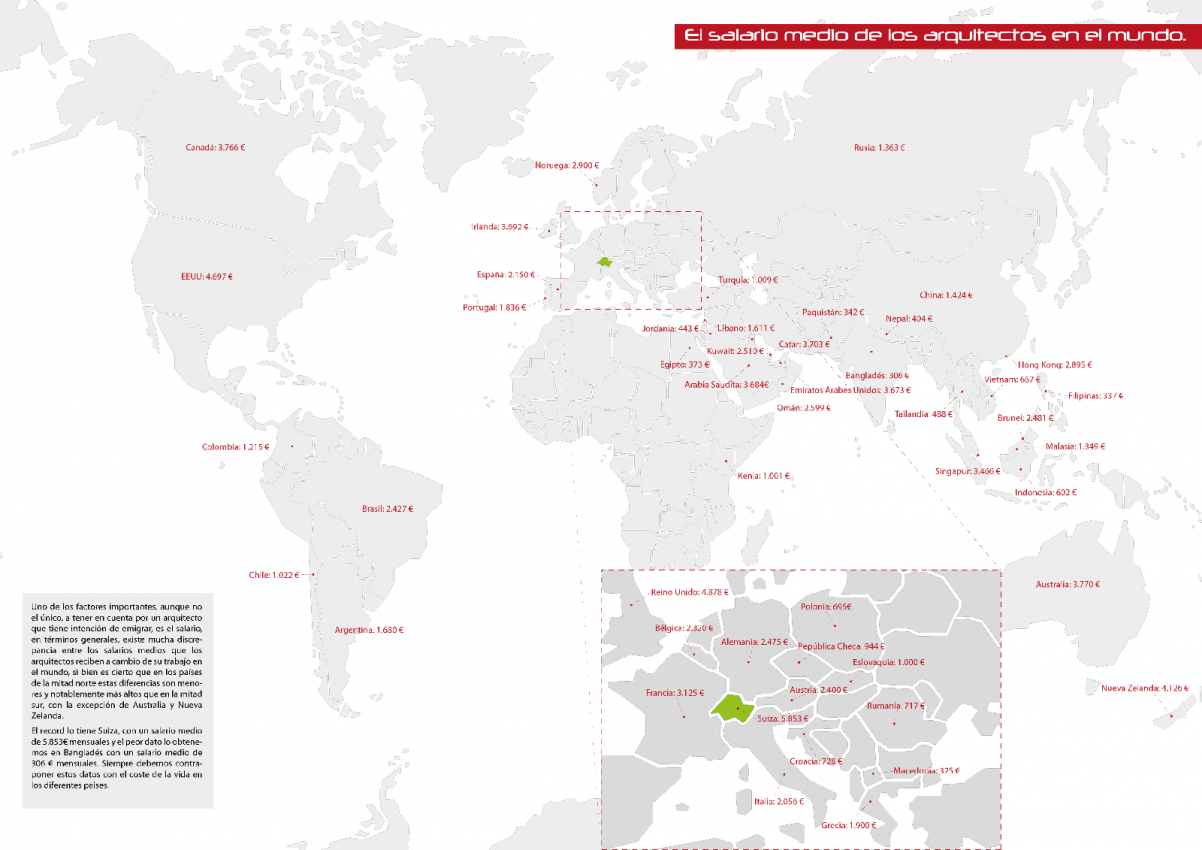
Architects’ salaries vary dramatically around the world. These differences reflect national economic conditions, construction activity, professional regulation, taxation, labor markets, and cultural attitudes toward design. Nevertheless, broad patterns emerge.
Countries such as Switzerland, Luxembourg, Norway, Denmark, the United States, Australia, Canada, Germany, and the Netherlands consistently rank among the highest-paying markets. Mid-career architects in these countries often earn between USD 70,000 and USD 150,000 annually, while senior architects and firm partners may exceed USD 200,000.

By contrast, architects in Southern Europe, Latin America, much of Asia, and Africa typically earn considerably less. In countries such as Italy, Spain, Turkey, Brazil, India, Egypt, Pakistan, and Iran, annual incomes may range from USD 3,000 to USD 40,000, even for experienced professionals. In some developing economies, architecture remains financially inaccessible as a long-term career without supplementary teaching, consulting, or entrepreneurial activities.
Although exchange rates partly explain these disparities, purchasing power does not eliminate the gap entirely. Architects in high-income countries generally enjoy greater financial security, stronger social protections, and more predictable career trajectories than their counterparts elsewhere.
Salary Differences Reflect More Than National Wealth
A common assumption is that richer countries simply pay everyone more. While this is partly true, architecture demonstrates that economic prosperity alone does not determine professional income.
Consider Switzerland and the United Kingdom. Both possess sophisticated construction industries and internationally respected architectural traditions. Yet Swiss architects frequently earn nearly twice as much as architects in Britain. Similarly, architects in Australia often receive higher salaries than those in France despite comparable standards of living.
These differences stem from several structural factors:
- Professional licensing systems
- Labor market shortages
- Government investment in infrastructure
- Private development activity
- Construction productivity
- Fee regulations
- Cultural appreciation for architectural services
Countries that recognize architecture as a high-value professional service generally reward architects more appropriately than countries where design is viewed as an optional expense.
The Cost of Becoming an Architect
Architecture is among the most demanding professional educations. Students spend years mastering:
- Structural systems
- Environmental design
- Building technology
- History and theory
- Urban planning
- Digital modeling
- Building regulations
- Construction management
- Professional ethics
Unlike many university degrees, architecture requires extensive studio work, where students routinely invest nights and weekends producing complex design projects. Following graduation, many jurisdictions require several years of supervised practice before licensing examinations.
In total, becoming a licensed architect often requires between seven and ten years. Ironically, graduates entering the workforce frequently discover that their starting salaries resemble those of professions requiring significantly less training. This discrepancy contributes to growing dissatisfaction among young architects worldwide.

The Myth of Prestige
Architecture has traditionally been regarded as a prestigious profession. Popular culture reinforces this perception through celebrated architects whose buildings become global landmarks. Figures such as Frank Gehry, Norman Foster, Zaha Hadid, and Bjarke Ingels are often portrayed as creative visionaries whose work shapes the future of cities. Yet these internationally recognized architects represent an exceptionally small proportion of the profession.
The reality for most architects is considerably different. The majority work within medium-sized firms, preparing construction documents, coordinating consultants, attending meetings, managing regulations, and responding to client revisions. Their work is intellectually demanding but rarely glamorous.
The prestige associated with architecture often obscures the economic realities experienced by ordinary practitioners.

Why Architects Are Often Underpaid
Several structural problems contribute to relatively modest architectural salaries.
1. Oversupply of Graduates
Many countries produce more architecture graduates than their labor markets require. Universities continue expanding architecture programs because they attract students and generate tuition revenue. However, the construction industry cannot absorb every graduate. The resulting oversupply weakens bargaining power and suppresses salaries.
2. Fee Competition
Architectural firms frequently compete on price rather than quality. Public procurement systems often prioritize the lowest bid rather than long-term value. As architectural fees decline, salaries inevitably follow.
3. Clients Undervalue Design
Many clients perceive architecture primarily as a regulatory requirement rather than an investment. They willingly spend millions on construction while negotiating aggressively over architectural fees that represent only a small percentage of project costs. This undervaluation limits the financial capacity of firms.
4. Long Project Cycles
Architectural projects may take years to complete. Unlike software companies or manufacturing businesses that can rapidly scale products, architectural firms generate revenue project by project. Growth remains constrained by human labor.
5. Limited Scalability
Architecture is fundamentally a service profession. Each project requires customized design, coordination, documentation, and supervision. Although digital technologies improve efficiency, architecture remains difficult to automate completely.
High Salaries Do Not Always Mean Better Lives
Nominal salaries can be misleading. Architects in New York, London, Sydney, and San Francisco may earn impressive incomes while simultaneously facing extremely high housing costs.
Conversely, architects in countries with lower salaries may enjoy lower living expenses. Purchasing power, therefore, provides a more meaningful comparison than gross income alone.
Switzerland consistently performs well because high salaries outweigh high living costs. Australia, Norway, Denmark, and Canada also maintain strong purchasing power.
By contrast, some countries combine modest salaries with rapidly increasing housing costs, reducing architects’ financial well-being despite respectable nominal incomes.
The Entrepreneurial Divide
Income inequality within architecture is substantial. Two architects with identical qualifications may experience dramatically different careers. An employee in a medium-sized practice may earn USD 70,000 annually. The owner of a successful multidisciplinary firm may earn several hundred thousand dollars each year. The difference lies less in design talent than in entrepreneurship.
Running a profitable architectural practice requires:
- Business development
- Marketing
- Client relationships
- Financial management
- Leadership
- Negotiation
- Risk management
These skills are rarely emphasized in architecture schools. Consequently, many architects become excellent designers but struggle as business owners.
Technology Is Changing the Profession
Artificial intelligence, Building Information Modeling (BIM), computational design, automation, and digital fabrication are transforming architectural practice. Routine drafting tasks are increasingly automated. Visualization software generates images in minutes rather than days. AI can assist with conceptual design, code checking, documentation, scheduling, and optimization.
These technologies may reduce demand for repetitive production work while increasing demand for architects capable of strategic thinking, interdisciplinary collaboration, and complex problem-solving. Future income growth is therefore likely to favor architects who combine design expertise with digital skills.
As the architecture profession continues to evolve, expanding your expertise beyond traditional practice has become more important than ever. Developing skills in computational design, AI, digital fabrication, BIM, visualization, and emerging technologies can open new career opportunities and help architects stay competitive in a rapidly changing industry. Explore specialized online workshops and courses at PAACADEMY, taught by leading professionals from around the world.

Regional Perspectives
North America
The United States and Canada remain attractive destinations for architects due to relatively high salaries, diverse project types, and strong private-sector investment. However, competition is intense, particularly in major metropolitan areas.
Europe
Northern Europe generally provides the best balance between income, work-life balance, and professional recognition. Southern Europe faces greater challenges, including lower fees and slower construction markets.
Australia and New Zealand
Australia offers one of the world’s strongest architectural labor markets. Large infrastructure investment, population growth, and relatively high wages make it attractive for internationally qualified architects.
Middle East
Countries such as the UAE, Saudi Arabia, and Qatar offer competitive salaries, often enhanced by tax advantages. Nevertheless, employment conditions vary considerably depending on the employer and the project pipeline.
Asia
Rapid urbanization creates an enormous demand for architects. However, long working hours and intense competition often suppress average salaries.
Developing Countries
Architects frequently supplement their income through teaching, consultancy, visualization services, interior design, or project management. Pure architectural practice alone may provide limited financial security.
Education Must Change
Architecture schools continue emphasizing design excellence while often neglecting the economic realities of practice. Graduates should also develop competencies in:
- Business strategy
- Financial literacy
- Marketing
- Contract administration
- Digital technologies
- Data analysis
- Entrepreneurship
- Real estate economics
Understanding how buildings generate economic value is becoming just as important as understanding how they are designed.
A Profession at a Crossroads
Architecture faces a critical moment. The profession continues to attract talented, creative individuals motivated by the desire to improve cities and communities. Yet many leave practice within the first decade because financial rewards fail to match professional demands. Meanwhile, technological disruption is reshaping traditional workflows.
Architects who rely solely on conventional drafting and documentation risk becoming increasingly vulnerable to automation. Those who integrate design thinking with technology, sustainability, research, management, and entrepreneurship are likely to command significantly higher incomes.

Creativity Alone Is No Longer Enough
The global distribution of architects’ incomes reveals more than differences between national economies. It exposes long-standing structural weaknesses within the profession itself. Despite requiring extensive education, technical expertise, legal responsibility, and creative problem-solving, architecture often remains undervalued compared with engineering, medicine, law, or software development.
The future of architectural practice will depend less on producing beautiful drawings and more on demonstrating measurable value. Architects who understand finance, technology, sustainability, urban systems, and business strategy will be better positioned to negotiate higher fees, build resilient practices, and expand their influence beyond traditional design services.
Architecture will always remain a cultural discipline as much as a technical one. However, unless the profession addresses its persistent imbalance between educational investment and economic reward, it risks losing many of its most talented graduates to industries that recognize and compensate expertise more effectively. The challenge is not simply to design better buildings, but to redesign the profession itself so that its economic value finally reflects its social importance.