

Books do not stand still in the mind. They turn, return, and rearrange themselves according to the weather of memory. At the Design Museum in London, Es Devlin has given that private motion a public form.

Credit: © Daniel Devlin
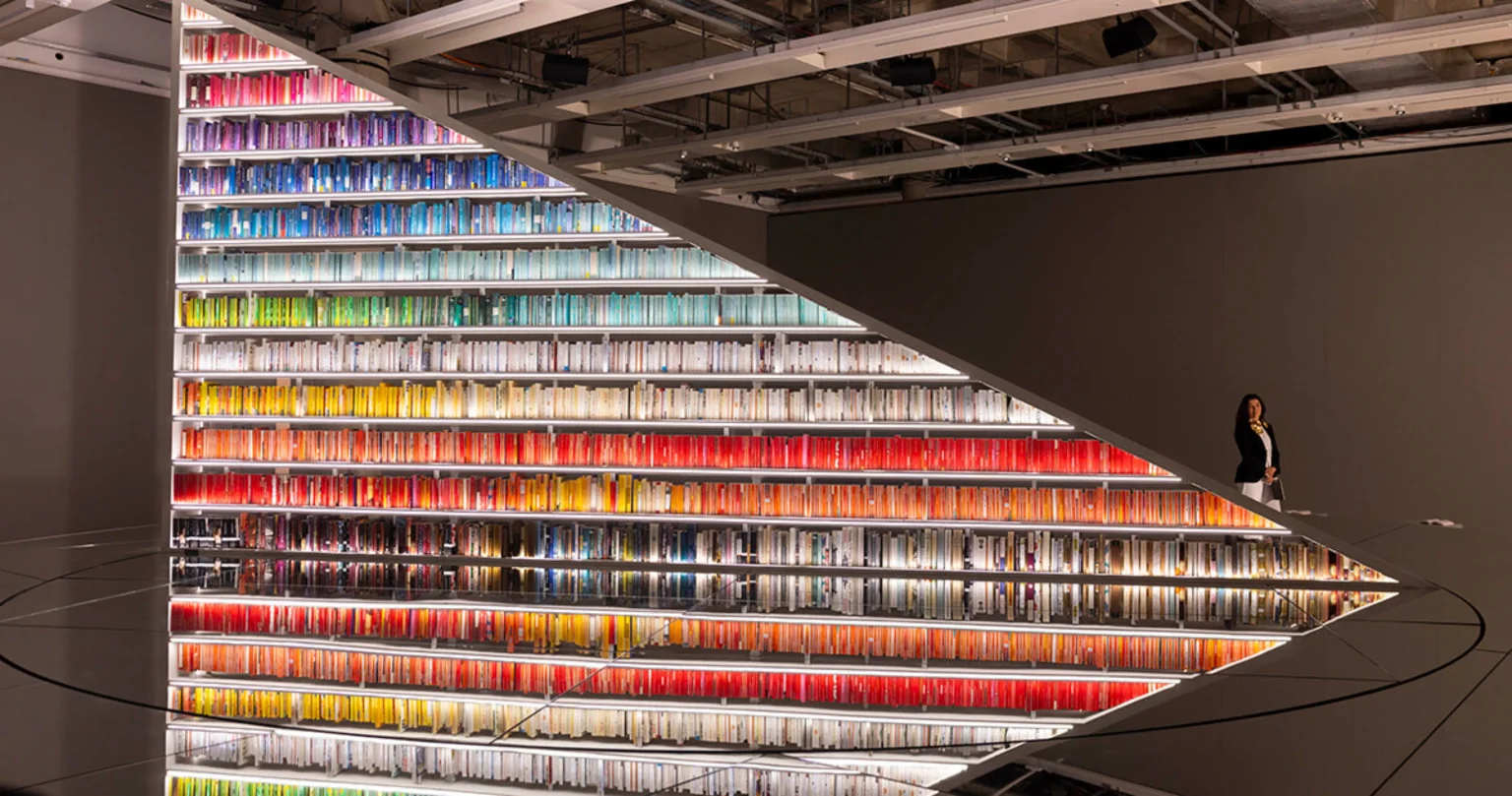
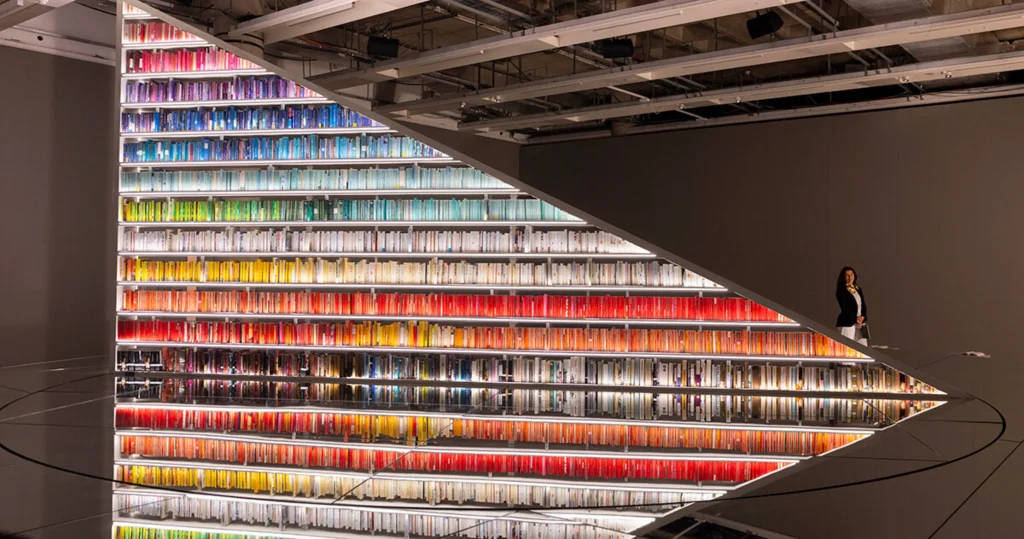
In the final room of her first European retrospective, Es Devlin: Other Worlds, an eight-meter triangular shelf rotates slowly above a circular mirror. More than 2,000 volumes fill its faces, arranged not by author or subject but by color. Some are well-thumbed copies taken directly from Devlin’s own studio shelves: James Gleick’s Chaos, Toni Morrison’s Beloved, Margaret Atwood’s Oryx and Crake. Projections drift across the spines while Devlin’s recorded voice reads selected passages. The effect is both intimate and cosmic, a personal library made into a kinetic instrument.
The installation, titled An Infinite Library, is the fourth in a series of sculptural libraries Devlin has created. Earlier versions appeared at the Pinacoteca di Brera in Milan, on Faena Beach in Miami, and at Castle Howard in Yorkshire. This is the first of her kinetic libraries to stand inside a museum, and it closes the exhibition with deliberate quiet force.
A studio brought indoors
The journey toward the library begins earlier. Visitors first enter a detailed reconstruction of Devlin’s South London studio, complete with books, models, drawings and the ordinary debris of making. The space is not a romanticised workspace but a working one, dense with evidence of decades of thought. From there the exhibition moves through archives, sketchbooks and large-scale presentations of stage designs, concert architectures and public installations that have defined her thirty-year practice.
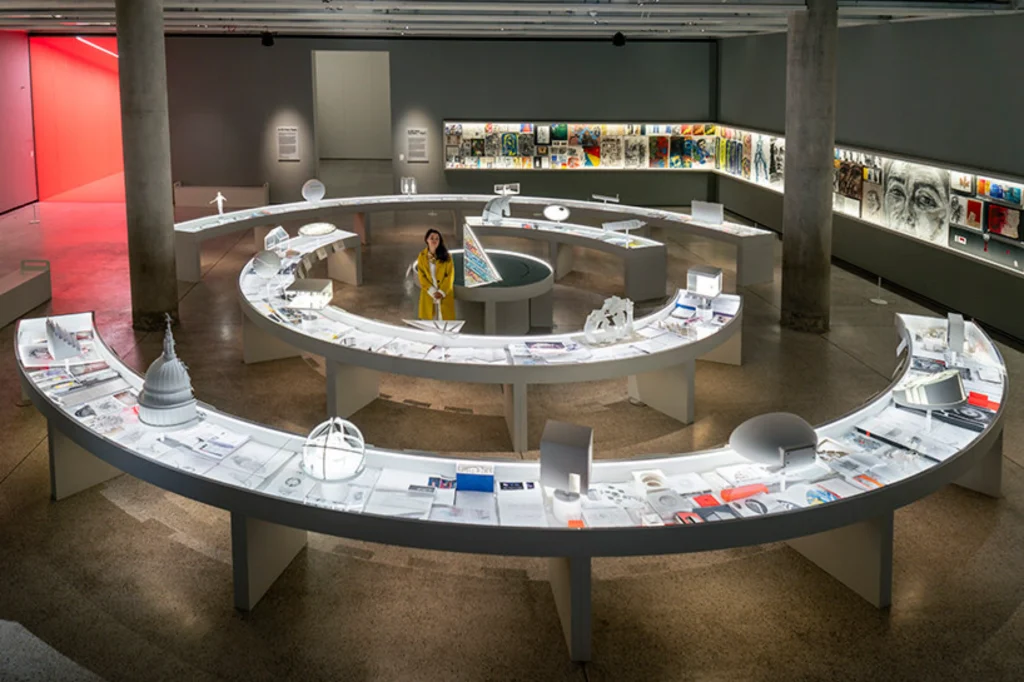
The 30-Year Desk, a circular display designed for the gallery, gathers references to landmark projects: the set for The Lehman Trilogy, the Forest of Us installation in Miami, the London 2012 Olympic closing ceremony, the Super Bowl halftime show, and the ambitious kinetic sculptures created for major concert tours. The desk functions less as a timeline than as a map of recurring obsessions: light, language, geometry, and the threshold between private imagination and collective experience.
Color as order
Credit: © Daniel Devlin
In An Infinite Library, the books themselves become the material of sculpture. Color coding imposes a visual logic that overrides the usual systems of classification. Blues gather, then greens, yellows, reds. The arrangement is not arbitrary; it is another form of reading, one that privileges sensory association over alphabetical sequence. As the structure turns, the spectrum shifts and the mirror multiplies the motion, suggesting an endless shelf that continues below the floor and above the ceiling.
Many of the volumes were supplied by Penguin Random House UK in support of the National Year of Reading. When the exhibition closes in April 2027, the books will be donated to local schools and charities. The library is therefore temporary in two senses: it will stop turning, and its contents will disperse into new hands.
Libraries as instruments
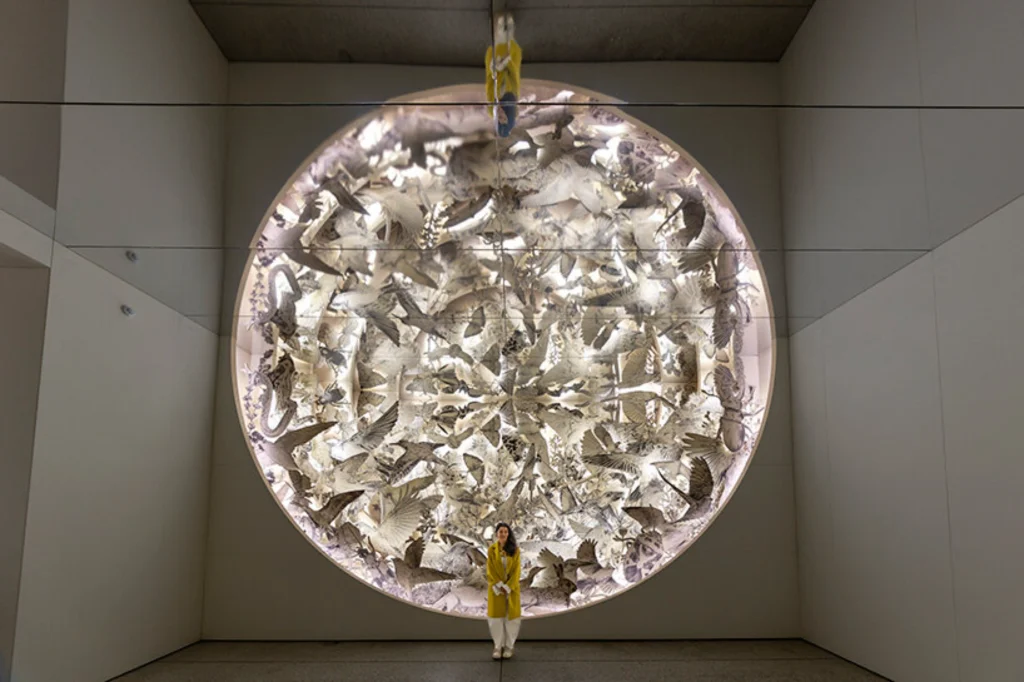
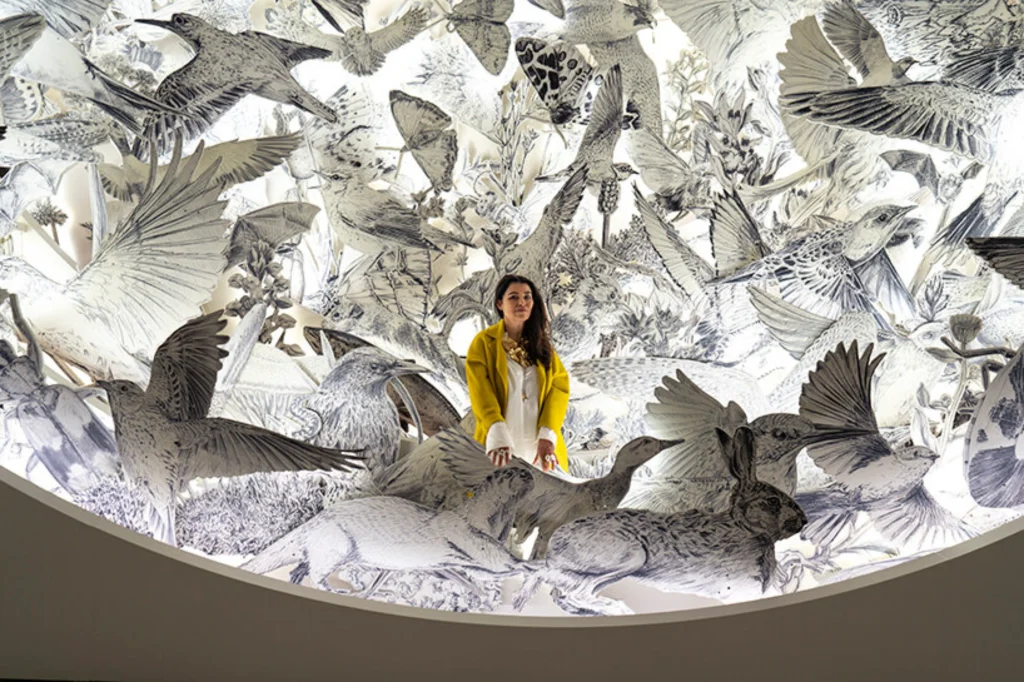
Devlin has long treated libraries as more than storage. In her earlier works they appear as instruments of orientation, places where knowledge becomes spatial and social. Umberto Eco once described a library as a compass of the mind. Devlin’s rotating versions take that metaphor literally. The shelf turns, the light changes, the voice continues. Visitors stand inside a machine for reading that never requires them to open a single volume.
Credit: © Daniel Devlin
The installation also marks a shift in scale. Stage designs for musicians and theatres are ephemeral by nature. A museum commission allows a different duration and a different kind of attention. Here the kinetic system is slower, more contemplative. The books remain the center of gravity.
Es Devlin: An ending that opens
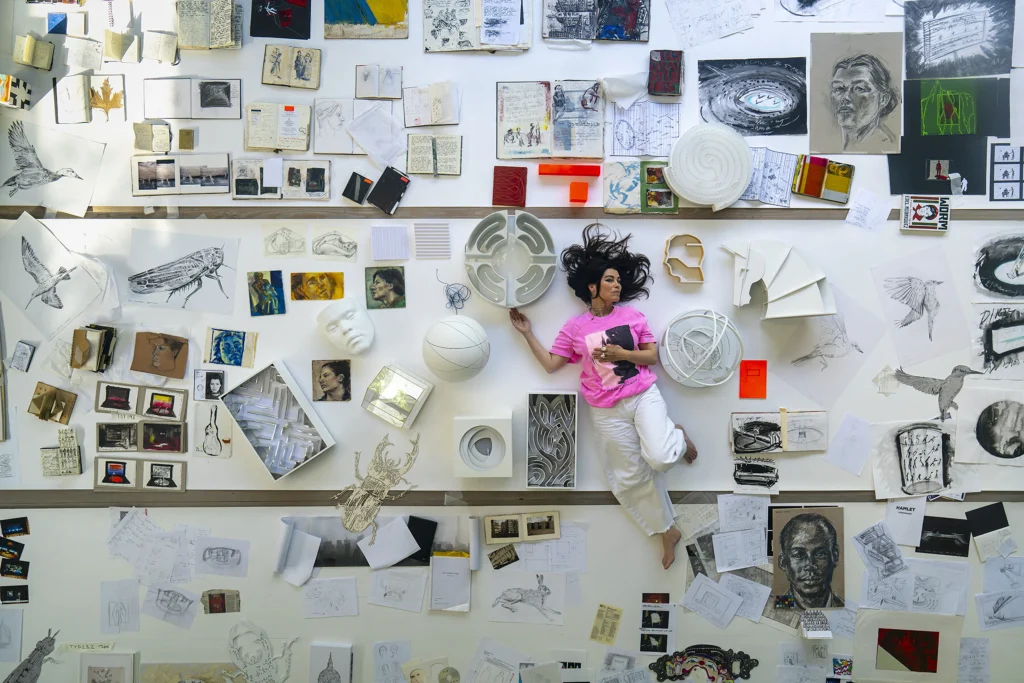
Other Worlds runs until 4 April 2027. It is curated by Johanna Agerman Ross, Danielle Thom and Margherita Dosi Delfini in close collaboration with the artist and her studio. The retrospective does not attempt a definitive summary of a career still in motion. Instead, it offers a sequence of environments in which visitors can encounter the habits of mind that produce Devlin’s work: the accumulation of images, the testing of geometry, the belief that light and language can reshape a room.
An Infinite Library is the last of those environments. It does not explain the preceding rooms. It simply continues their logic. Reading, in Devlin’s practice, is never a solitary activity confined to a chair. It is a spatial event, capable of being shared, projected, and set in motion. The triangular shelf turns, the mirror reflects, and the books keep their silent company, waiting for the next set of eyes.