

A team of researchers at Cornell University has developed what is now considered the darkest fabric ever made, drawing direct inspiration from the black feathers of the Magnificent Riflebird, a bird-of-paradise whose plumage is among nature’s deepest blacks.
What Makes the Riflebird’s Feathers So Black?
The riflebird’s feathers are considered some of the deepest, richest blacks found in nature, and their appearance isn’t due to pigment alone. While melanin does provide a dark base color, the true ultrablack effect comes from the microscopic architecture of the feathers themselves. Each feather is covered with densely packed, branched structures called barbules. These barbules are arranged in a way that creates tiny cavities and angled surfaces capable of trapping incoming light. Instead of bouncing back toward the viewer, light gets funneled inward, bouncing multiple times within the feather’s internal structure until it is almost completely absorbed. This structural absorption is what gives the riflebird’s plumage its velvety, light-devouring appearance.
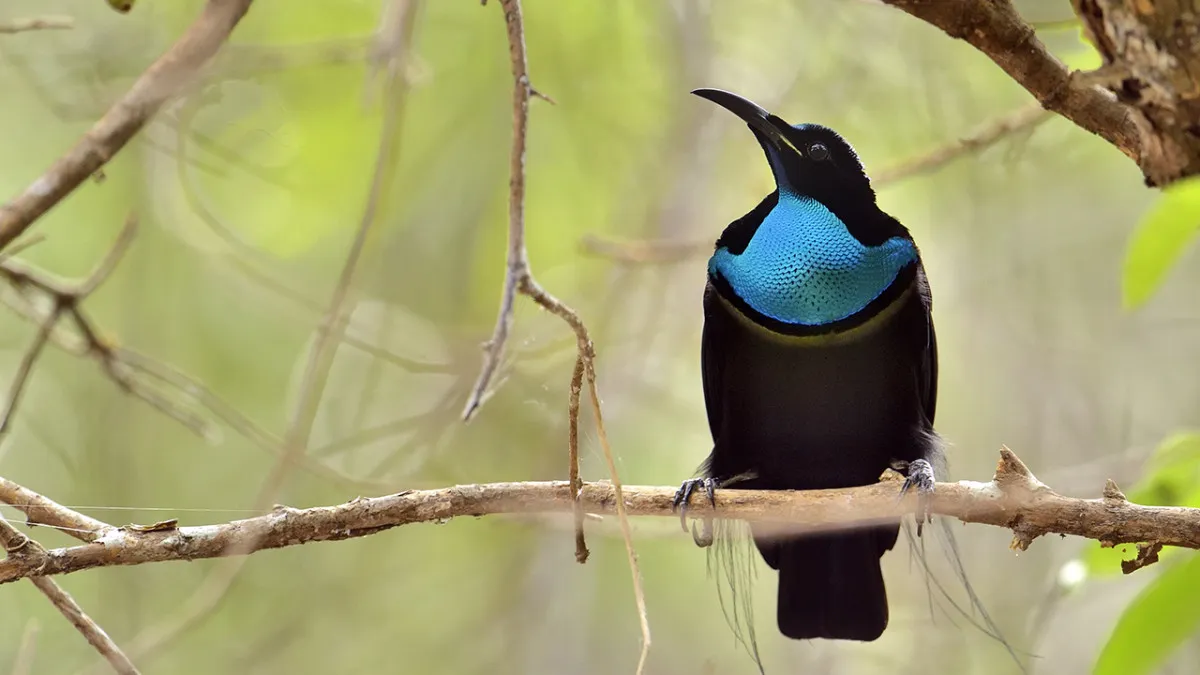
Interestingly, this ultrablack effect is strongest when viewed straight on. At certain angles, some light manages to escape, giving the feathers a subtle sheen and allowing their iridescent patches to stand out in contrast. This dynamic interplay between structural blackness and glossy highlights is part of what makes the bird-of-paradise species so visually striking. Their feathers are not only darker than what pigments alone can achieve, but they are also engineered through evolution to control light with remarkable precision.
When Cornell researchers studied these feathers up close, they recognized that the riflebird’s light-trapping mechanism was an ideal model for biomimicry. Rather than relying solely on dye, they aimed to replicate the same structural strategy in fabric.
By examining how barbules interact with light, the team set out to engineer a textile capable of mimicking this naturally occurring ultrablack effect, bringing one of nature’s most advanced optical tricks into material science.
How Researchers Created the “Ultrablack” Fabric
The method developed in the Cornell lab involves a two-step process applied to a common textile base:
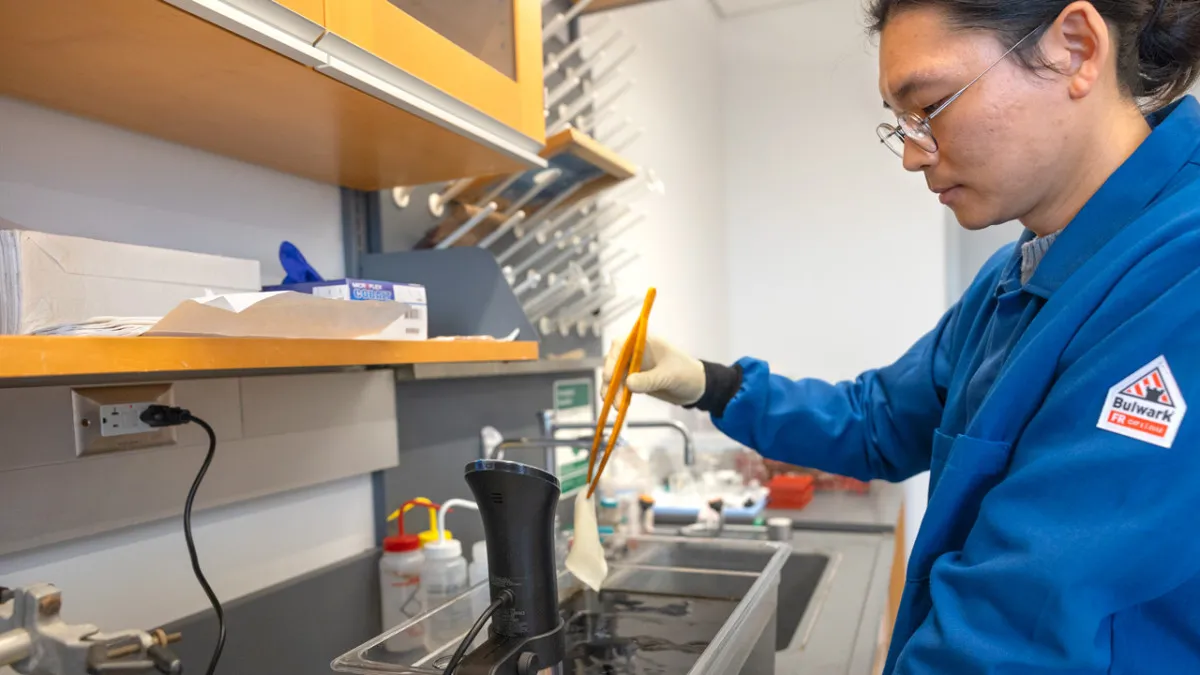
- Dyeing: They started with white merino wool knit fabric and dyed it with polydopamine, a synthetic analog of melanin (the pigment responsible for dark coloration in many animals).
- Plasma Etching: After dyeing, the fabric underwent plasma etching. This process stripped away a bit of the outermost surface of the wool fibers, creating nanofibrils, spiky, nanoscale protrusions. These fibrils mimic the feather barbules of the riflebird.
A surface that doesn’t just rely on pigment to absorb light but uses structure to trap light inside. As a co-author explained, “The light basically bounces back and forth between the fibrils instead of reflecting back out; that’s what creates the ultrablack effect.”
Record-Setting Performance of the Ultrablack Fabric
The newly developed textile demonstrated an exceptionally low average reflectance of just 0.13%, far surpassing the scientific threshold for “ultrablack,” which is anything below 0.5%. This means the fabric absorbs nearly all incoming light, allowing almost no reflection back to the viewer. Such a low reflectance value places it among the darkest materials ever documented, especially within the category of wearable, flexible textiles.
A key advancement of this fabric is its consistency from different viewing angles. Many existing ultrablack materials lose their deep-black appearance when tilted or viewed from the side, revealing unwanted reflections. In contrast, the Cornell-engineered textile maintained its ultrablack quality across a 120-degree angular span, about 60 degrees to either side of center. This stability makes it visually uniform and reliable, even as the fabric moves or drapes, which is essential for clothing and other real-world applications.
Another important achievement is the material’s practicality. The process relies on natural fibers, starting with merino wool and potentially extending to cotton or silk. It does not depend on rare, toxic, or high-cost materials often associated with previous ultrablack technologies. This makes the textile not only effective but also wearable, safe, and scalable for future production. Because it combined structural light trapping, low reflectance, angle stability, and manufacturability, researchers have identified this textile as the darkest fabric ever reported, a breakthrough that blends natural inspiration with practical engineering.
From Lab Prototype to Real Dress
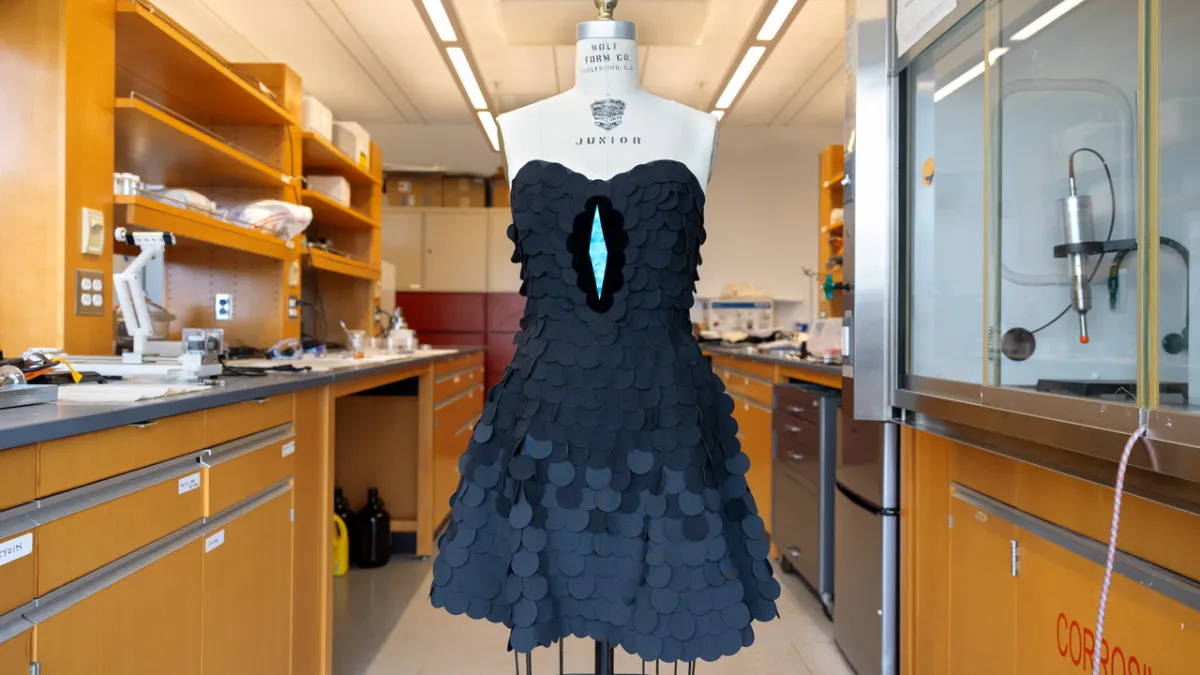
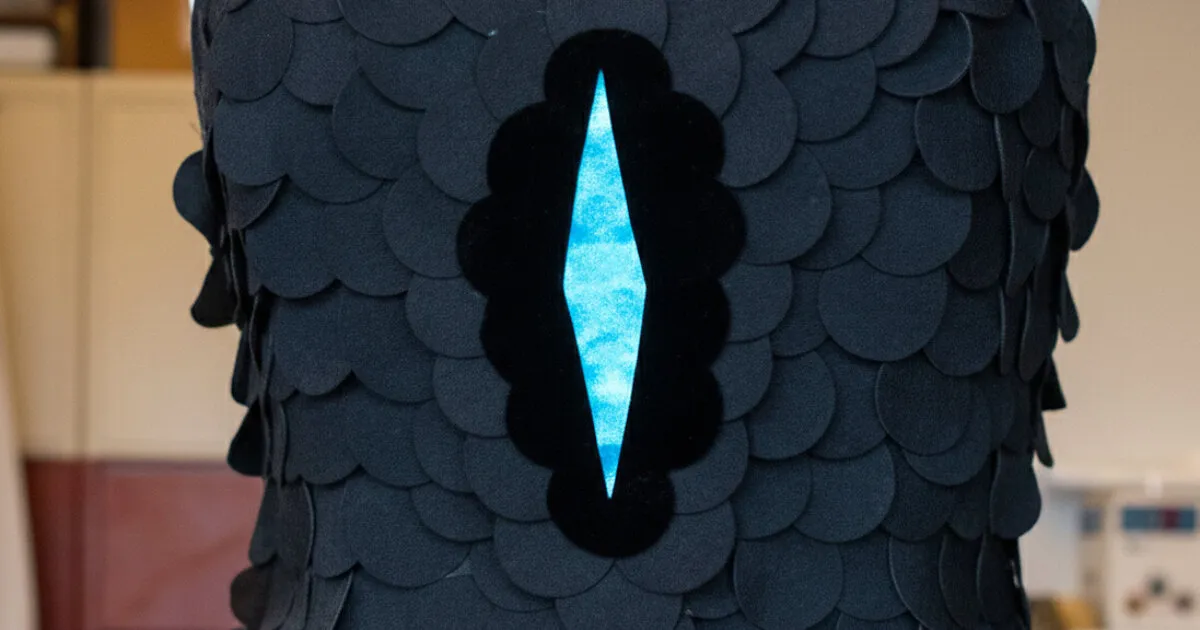
To demonstrate the real-world potential of their new fabric, the researchers worked with a fashion design student at Cornell University, Zoe Alvarez, who created a strapless black dress that used the ultrablack textile as its centerpiece, alongside a subtle accent of iridescent blue.
The team then used photographs of the dress to further test how “true” the black was. They digitally manipulated the images, adjusting contrast, hue, brightness, and vibrance, and found that while the other colors in the image shifted as expected, the ultrablack sections of the fabric stayed perceptually unchanged. That behavior helped confirm that the material’s deep black appearance is the result of genuine, structural light absorption.
This experiment shows that the ultrablack fabric is suitable for wearable garments, combining high-fashion potential with a scientifically validated ultrablack effect.
The research team, led by Larissa Shepherd, has applied for provisional patent protection through the Cornell Center for Technology Licensing (CTL) and is exploring commercial applications. They hope to expand beyond wool to other natural fibers like cotton and silk and to bring ultrablack textiles into practical use, whether in fashion, solar technology, or beyond.