

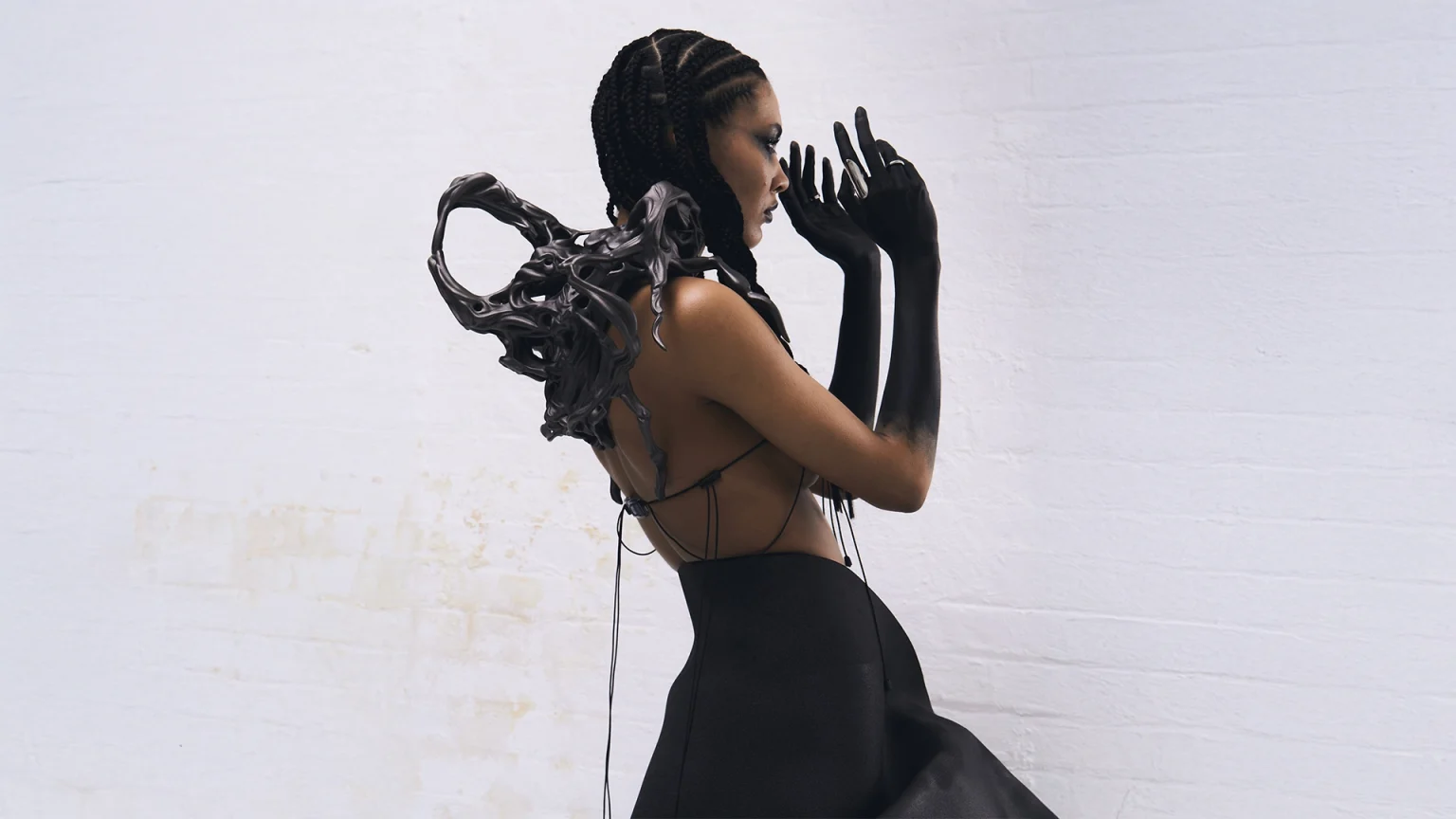
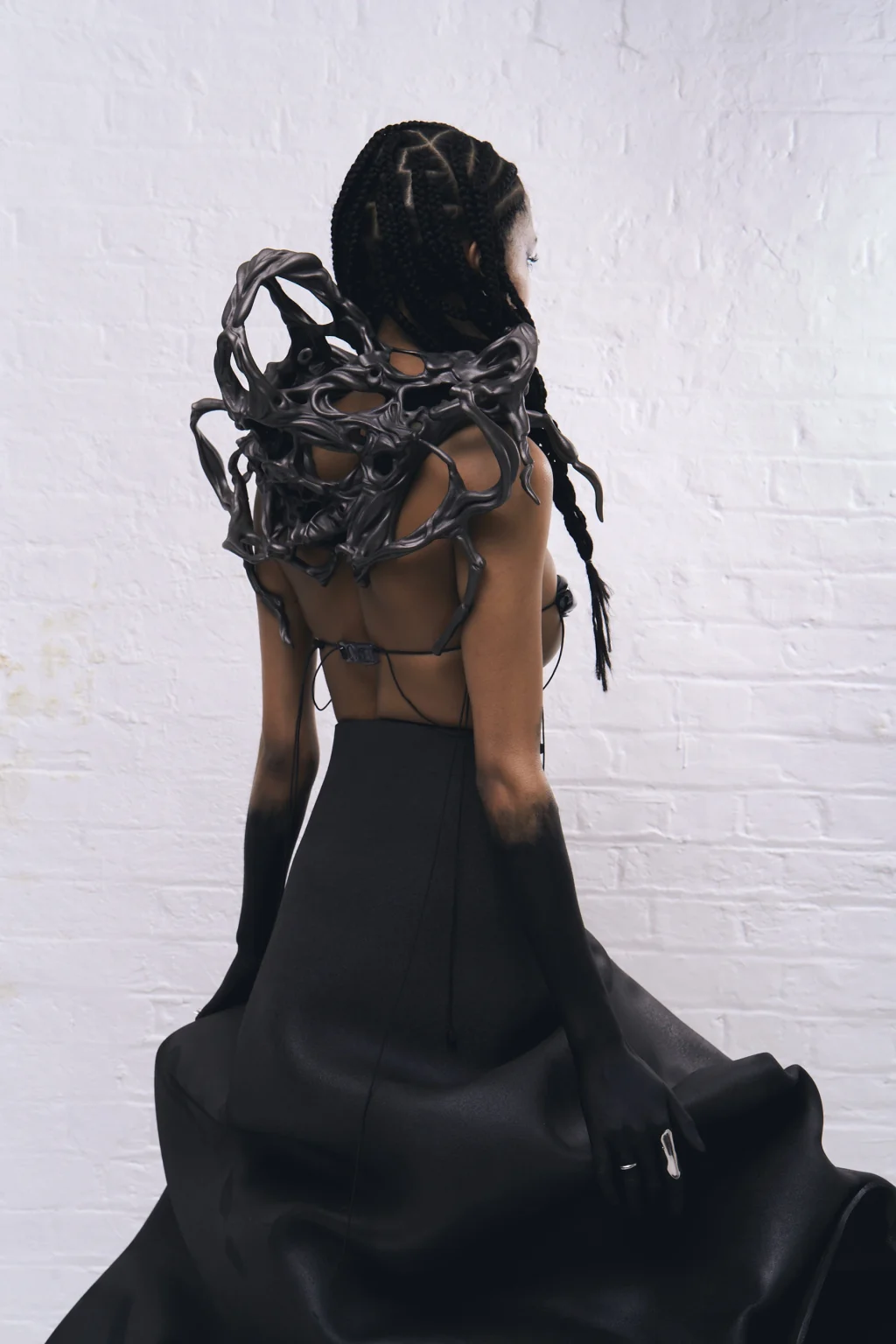


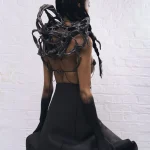
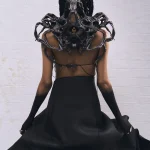
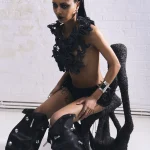
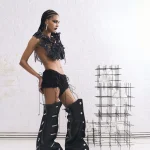
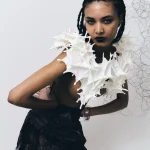
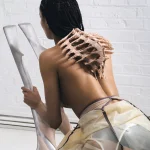
London-based artist, architect, and designer Daniel Widrig explores the relationship between the human body and digitally generated form in EXOFORM, a series of computationally designed and fabricated sculptures. Moving across fashion, sculpture, furniture, and architecture, the project considers how digital design tools can produce objects that respond to the body while extending beyond its familiar boundaries.
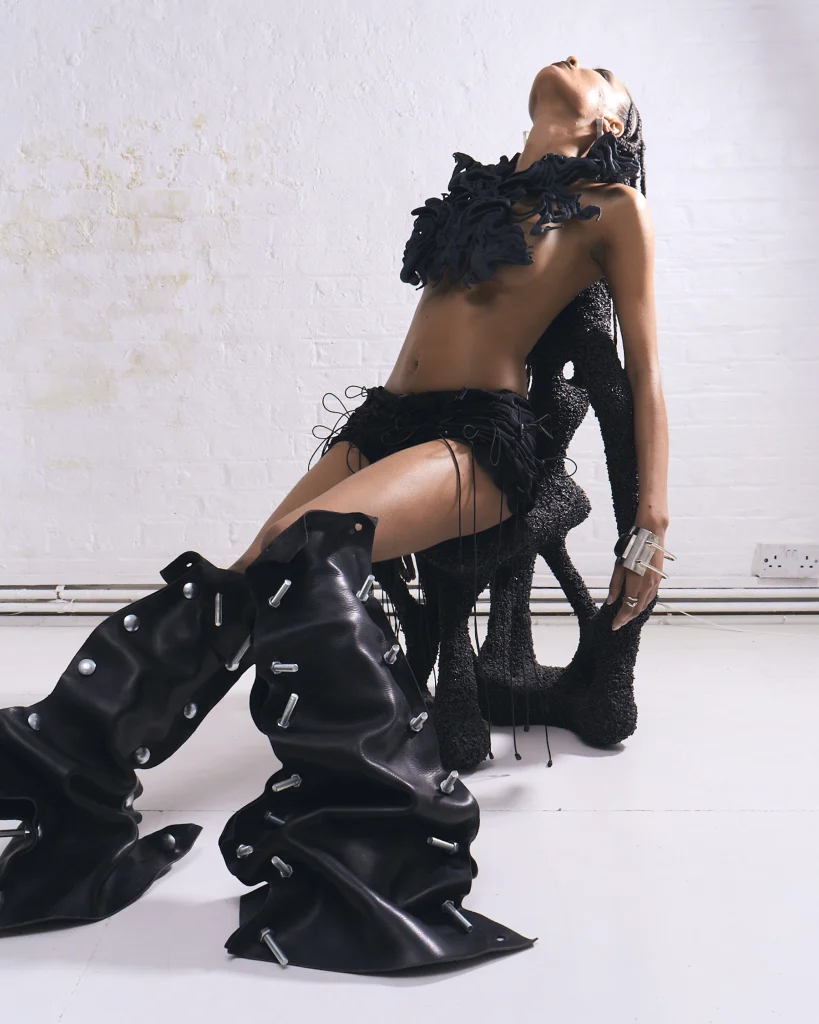
The series includes wearable sculptures, furniture-like pieces, and larger structures that interact with the human figure at different scales. Across the collection, the distinction between what is worn, held, used, and occupied remains intentionally open. A piece may wrap closely around the body in one composition, while another develops into an object that appears capable of existing independently within space.
Designing From the Human Body
The body functions as a point of departure for EXOFORM’s geometry. Forms grow around limbs, shoulders, the torso, and other anatomical features, creating new outlines that alter the proportions and visual reading of the human figure.
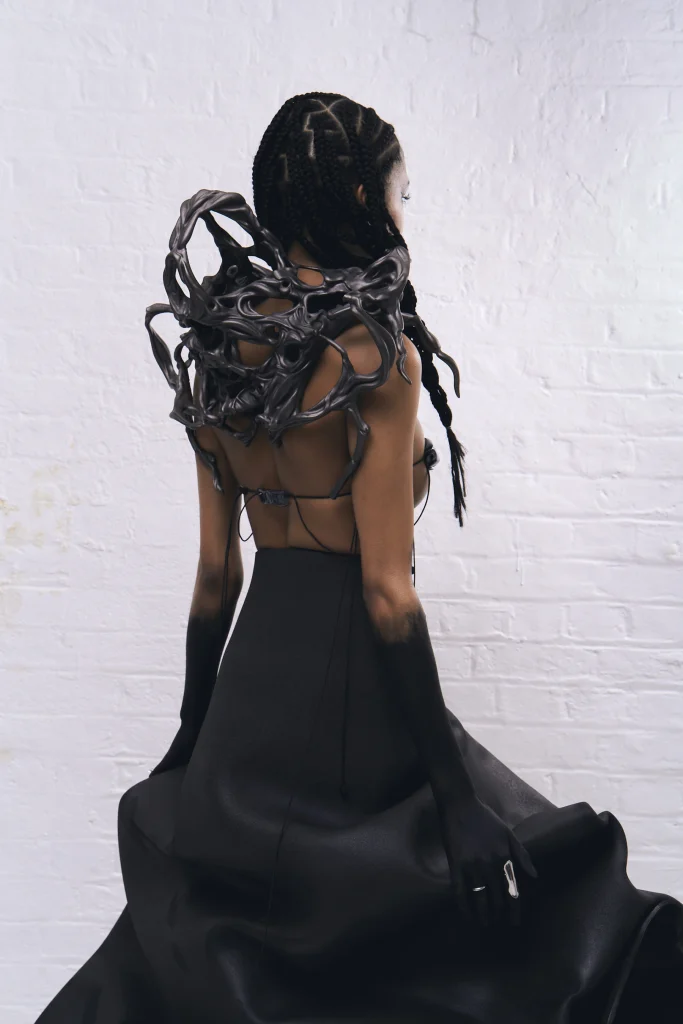
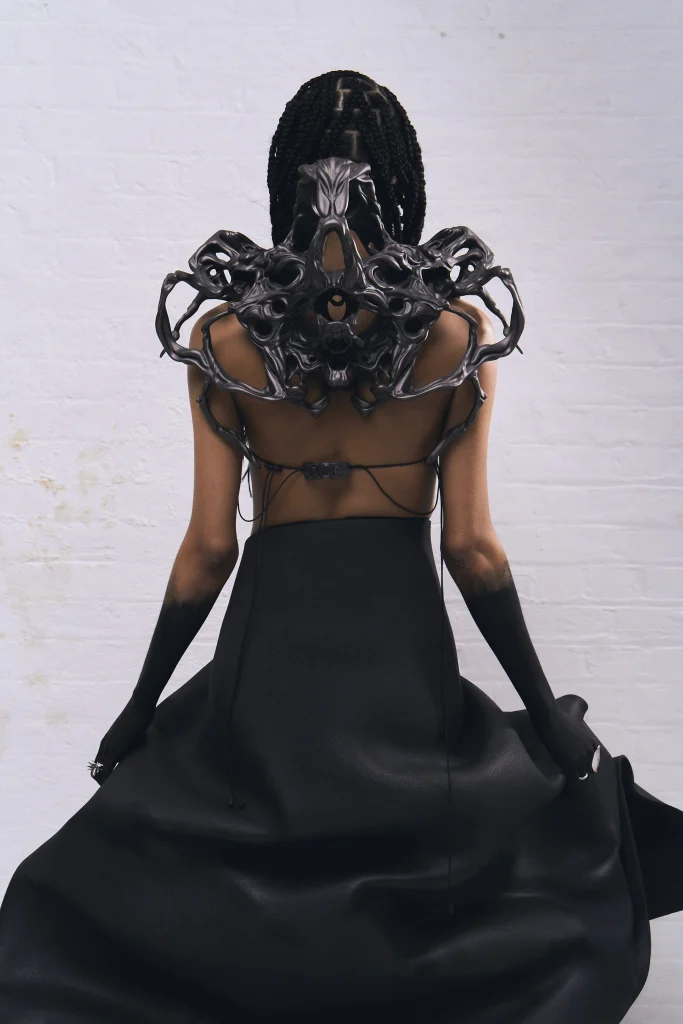
Some pieces maintain a close relationship with anatomy, almost functioning as external skeletal systems or protective shells. Others move further outward, becoming larger objects that can be sat on, leaned against, carried, or approached as sculptural structures.
This shift in scale creates continuity across the collection. Wearable objects and furniture are not treated as completely separate design categories. They share a common formal vocabulary, allowing similar geometries to move from the scale of the body toward the scale of objects and spatial structures.
Computational Processes Translated Into Physical Form
EXOFORM was developed through computational modeling and iterative digital processes. Growth, deformation, branching, repetition, and accumulation contribute to geometries that would be difficult to develop through conventional modeling methods alone.
The resulting forms vary considerably throughout the series. Dense volumes appear beside open frameworks, porous surfaces, branching systems, and interlocking components. Certain pieces recall bones, cartilage, tissue, or exoskeletons, although these biological references remain abstract.
Digital fabrication brings these geometries into the physical world. Complex digital models become objects that can interact directly with the weight, movement, and proportions of a person. This transition is an important part of the project, since the work is not limited to computational experimentation on screen. Its geometry ultimately has to exist alongside a physical body.
From Wearable Sculpture to Furniture
One of the central aspects of EXOFORM is its movement between different design scales and functions. The collection does not establish a strict separation between a wearable sculpture and a piece of furniture. Instead, these categories begin to overlap through the way each object is shaped and used.
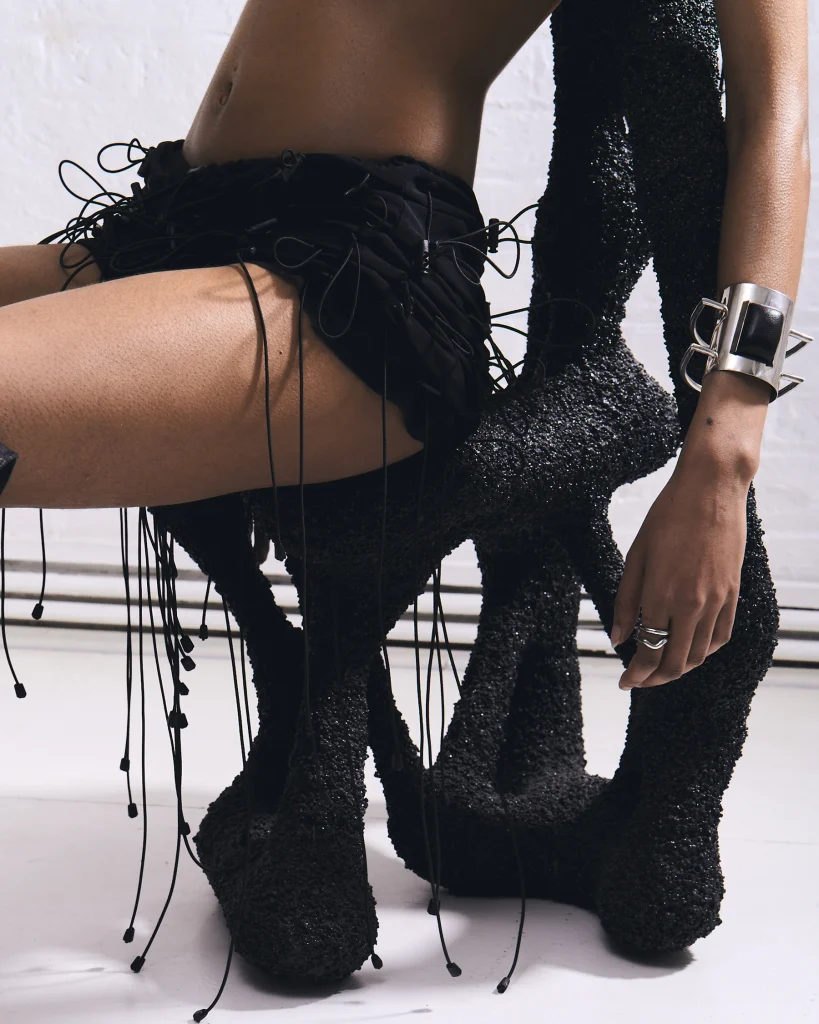
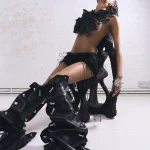
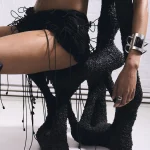
Chair-like structures support the model while retaining the appearance of independent sculptures. Other objects are carried or positioned against the body, creating compositions where it is not immediately clear whether the structure belongs to fashion, product design, sculpture, or architecture.
This ambiguity also introduces questions of scale. A branching structure attached to the body can be understood as an accessory, but the same geometric logic enlarged further could become furniture or potentially an architectural system. EXOFORM uses these transitions to examine how computational form-making can operate across disciplines without changing its underlying design language.
Body and Object in the Photographic Series
Photography plays an active role in communicating the project. The model does not simply stand beside the sculptures or present them as static objects. The images show physical interactions with the works through sitting, leaning, balancing, carrying, and moving among them.
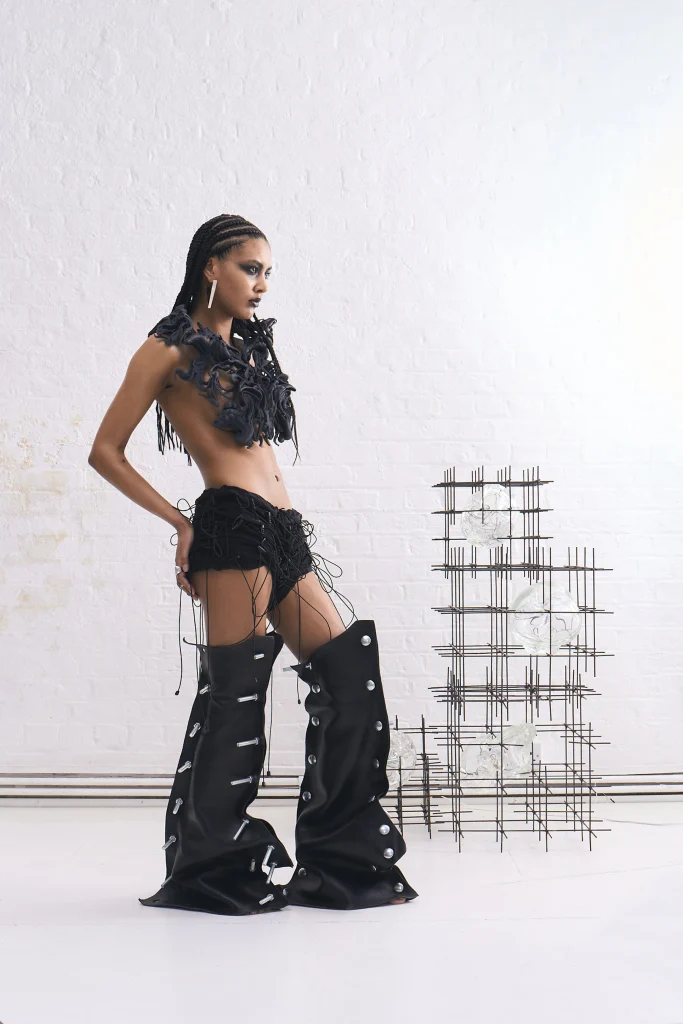
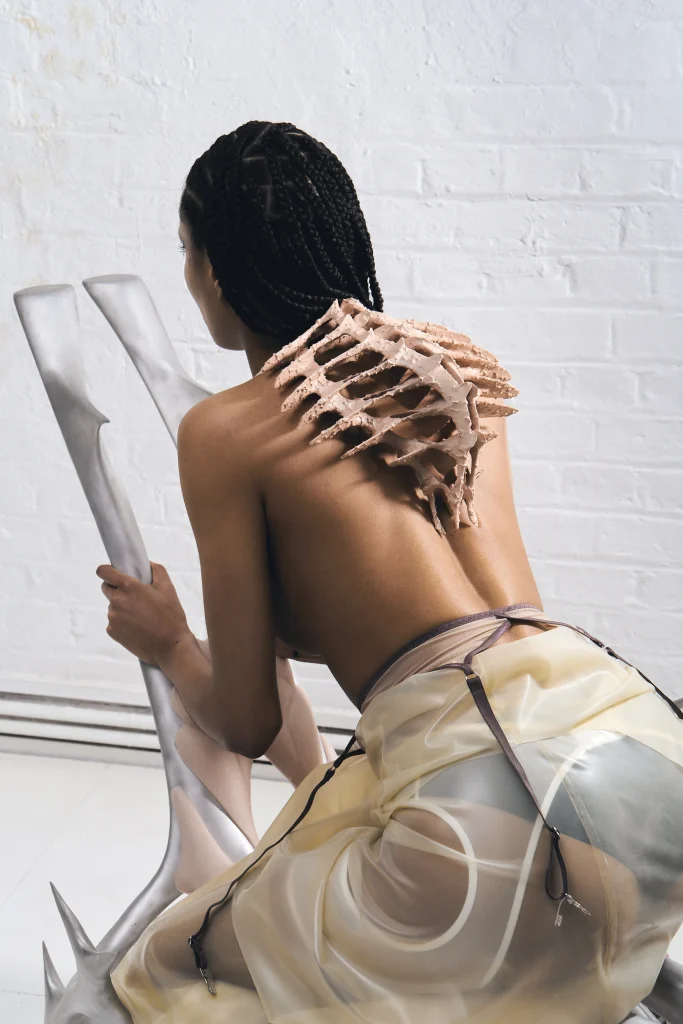
These actions make the relationship between anatomy and geometry more visible. The human figure provides a recognizable scale while also revealing how each object responds to posture and movement. In some photographs, the sculpture appears attached to the body. In others, the body seems to occupy or navigate a small spatial structure.
Through these compositions, familiar definitions of garment, furniture, sculpture, and architecture become less fixed. An object can be worn in one context, used in another, and observed as an autonomous sculpture in the next.
EXOFORM as a System of Body, Object, and Space
EXOFORM builds on Daniel Widrig’s broader work with computational design and digital fabrication across architecture, art, and design. The project applies these methods across several scales, beginning with forms closely connected to the human body and expanding toward furniture and spatial objects.
The series suggests that computational design can provide more than a method for producing complex geometry. It can also establish connections between fields that are usually approached separately. Anatomy becomes input for generating form, while the resulting objects move between wearable, functional, sculptural, and spatial roles.
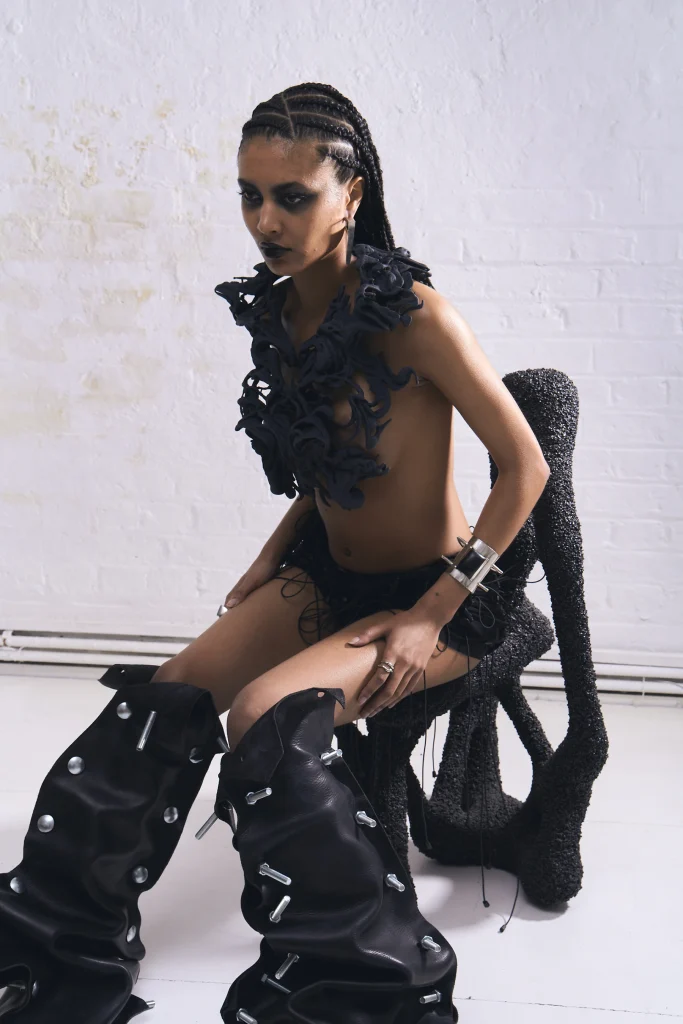
Through this progression, EXOFORM presents the body and the designed object as elements within the same evolving formal system, where changes in scale, geometry, and interaction can continuously reshape the relationship between them.
Credits
Sculpture Artist: Daniel Widrig
Creative Direction & Styling: Anastasiia Gerasymova
Photography: Morrigan Rawson
Model: Nosty
Make-up Artist: Natsu Tomonaga
Styling Assistant: Ki Tan