
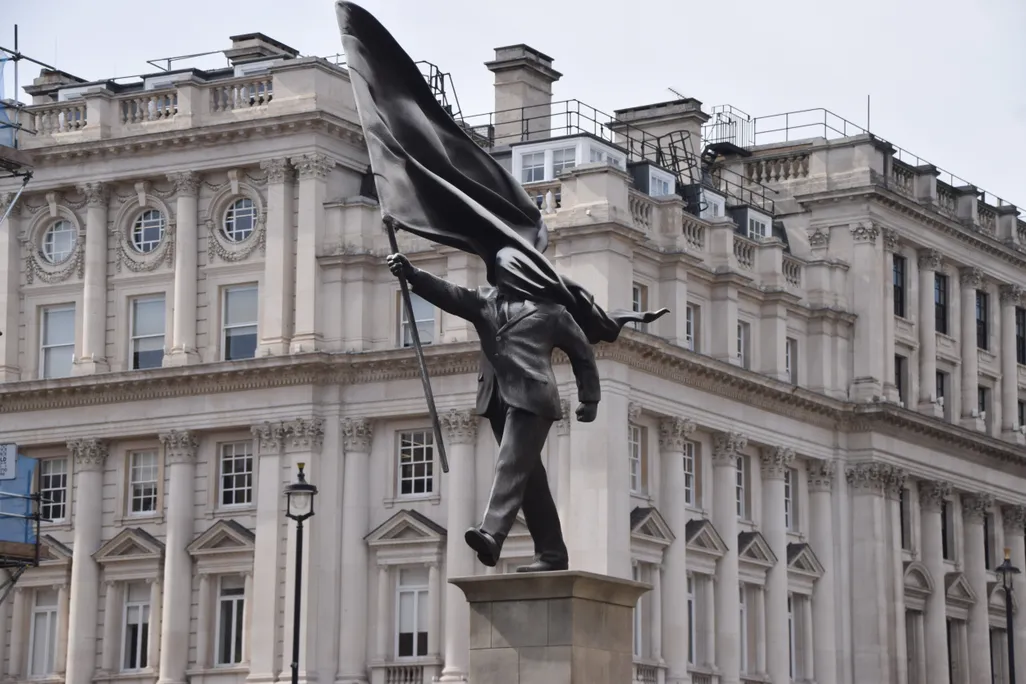


In this opinion piece, Ogulcan Yildirim interprets Banksy’s sculpture, installed in central London at St James’s Waterloo Place, is introduced through a deceptively simple yet highly charged image: a suited man, unable to see ahead because the large flag he carries covers his face, steps off the edge of a pedestal into the void. The flag shifts from a symbol of belonging, honor, or representation into a veil that obscures vision. The figure moves forward without knowing where he is going, and the motion reads less as a walk than as a political gesture poised on the brink of collapse. For this reason, the work extends beyond a critique of “blind patriotism,” intervening instead in a wider field of historical memory.
The Historical Significance of Waterloo Place in Terms of Britain’s Public Memory
Banksy’s placement of the sculpture in Waterloo Place is one of the fundamental elements that determine the meaning of the work. Beyond being an ordinary transit point in central London, this area functions as a public stage where Britain’s national, military, and imperial memory, that is constructed throughout the 19th and 20th centuries, is concentrated. Designed in the early 19th century as the southern extension of the Regent Street axis within John Nash’s London planning projects, Waterloo Place was shaped as a representational space connected to royal and state sites such as Pall Mall, Carlton House Terrace, The Mall, and St James’s Park.
The name of the area, referencing the Battle of Waterloo in 1815, directly defines this representational character: Waterloo symbolizes Britain’s victory over Napoleon and the prestigious military position it achieved within the balance of power in Europe.
For this reason, Waterloo Place can be read from its inception as a “site of victory.” It is a monumental plane within London’s urban form where the British state renders itself visible through historical continuity, order, discipline, and military success. The nearby Duke of York Column refers to the memory of military command in the context of the Napoleonic Wars; the Crimean War Memorial, along with the statues of Florence Nightingale and Sidney Herbert, connects to 19th-century narratives of war, health, sacrifice, and public service. The statue of Edward VII adds a dimension of monarchical continuity to this historical axis. Thus, at Waterloo Place, war, monarchy, public service, empire, and national pride converge within the same visual regime.
Banksy’s sculpture consciously situates itself within this visual regime. The artist places the work in a monument-saturated environment whose meanings are already established. This choice removes the piece from the status of an independent object and turns it into a counter-monument that engages in dialogue with the surrounding historical figures and inversely reads the values they represent.
Banksy’s Sculpture Amid Historical and Contemporary Political Climate
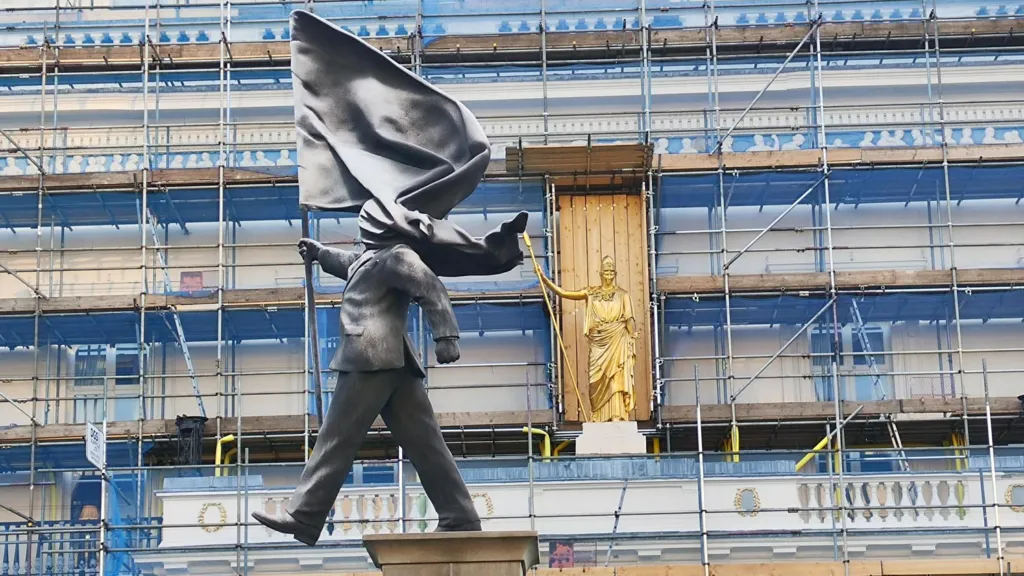
The contemporary geopolitical context in which Banksy’s Sculpture emerged further sharpens this reading. The war that began in 2026 with attacks by the United States and Israel on Iran, followed by Iran’s counterattacks, the closure of the Strait of Hormuz, debates over oil and energy security, and the subsequent fragile ceasefire diplomacy, has taken a central place in the global agenda. According to an assessment dated April 24, 2026, by the UK Parliament House of Commons Library, the United Kingdom and the European Union welcomed the ceasefire but called for a long-term agreement; among Prime Minister Keir Starmer’s priorities were the reopening of the Strait of Hormuz and ensuring freedom of navigation.
The same assessment reports that the UK, Germany, and France called on Iran to end its nuclear program, limit its ballistic missile program, and cease destabilizing regional activities. This reading becomes even heavier when considering Britain’s historical context in the Middle East. Contrary to common assumptions, Britain has not been an external observer in the history of Iran and the broader Middle East but an active historical actor.
Throughout the 20th century, issues such as oil politics, the legacy of the Anglo-Iranian Oil Company in Iran, the memory of Western intervention in the 1953 coup against Mossadegh, Gulf security, and the establishment of the post-colonial order cast a long historical shadow behind today’s crises. Therefore, the blind figure that Banksy places in a region of London loaded with imperial memory looks not only at today’s war but also at discourses of “civilization,” “order,” “security,” and the “right to intervene” carried from the past to the present.
At precisely this point, Banksy’s sculpture makes visible the tension between Britain’s diplomatic position in the face of war and its historical imperial reflexes. Even if the UK does not appear as the primary agent of the war, it is part of the Western security architecture, the NATO alliance, the politics of energy security in the Gulf, and the European line of pressure against Iran.
A Reading of Banksy’s Sculpture from the Perspective of Art History…
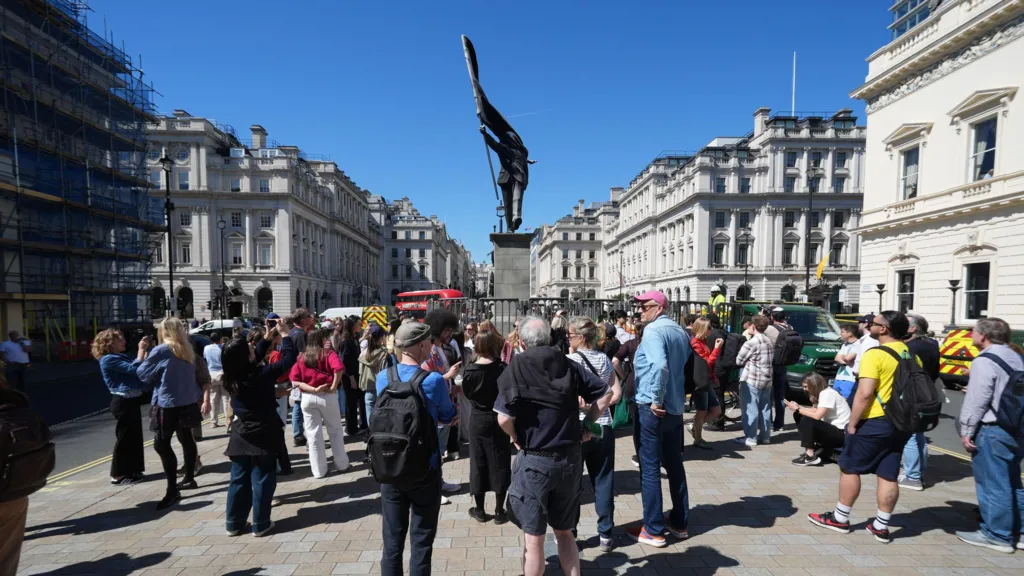
Rather than turning contemporary political events into direct slogans, Banksy’s Sculpture operates through condensed imagery. The figure at Waterloo Place likewise gathers the tension between war, diplomacy, nationalism, state reason, and historical memory into a single body. In this respect, the man in the suit can be read not as an ordinary nationalist figure but as an allegory of the Western political subject positioned between security discourse, diplomatic language, the idea of national interest, and a sense of historical superiority.
The suit is a decisive detail in this reading. The figure is not represented as a soldier, commander, or hero, but rather as an administrator, bureaucrat, diplomat, or decision-maker belonging to the sphere of civil power. In this way, the work implies that the politics of war are produced not only on the battlefield but also at negotiating tables, in official statements, in security documents, and in the language of international alliances. The flag, beyond being a symbol of belonging in the figure’s hand, becomes a political curtain that obscures his field of vision.
In Banksy’s Sculpture , each element carries a different layer of state representation. The flag represents national identity and the language of propaganda; the pedestal signifies the tradition of monumentality and the ground upon which power glorifies itself; the void represents the unpredictable outcome of war politics. Concepts such as “national interest,” “security,” “stability,” “freedom of navigation,” and “nuclear threat” circulate as powerful headings that produce legitimacy in decision-making processes. However, the intensity of these concepts often creates a field of abstraction that renders the human, historical, and geographical consequences of war invisible.
For this reason, Banksy’s Sculpture is both ironic and unsettling. It neither stands upright like a classical hero nor exhibits a determined forward movement. Its face is covered, its body moves forward, and its foot extends beyond the pedestal. This bodily arrangement demonstrates how steps taken with a flag, with security discourse, and with a sense of historical mission can turn into a loss of direction. The sculpture produces a powerful political allegory about how the modern state narrows its own field of vision through the very symbols it uses to glorify itself.
From an art historical perspective, Banksy’s intervention can be associated with the tradition of the anti-monument or counter-monument. Since the second half of the 20th century, public art has increasingly problematized the heroic language of monuments, especially in relation to war, genocide, colonialism, and state violence. Counter-monuments often generate unease instead of glorification, incompleteness instead of resolution, and ethical questions instead of historical certainty. Banksy’s Waterloo Place sculpture aligns with this trajectory, but does so not through abstraction or minimalism, rather through a popular and easily readable figurative irony. The accessibility of the work does not mean it is simplistic. In Banksy’s practice, political intensity often arises not from complex allegories but from visual contradictions that can be quickly recognized in public space.
Compared to Banksy’s earlier works, this sculpture continues the strategy observed in his transitions from wall surfaces to monumental forms. Although Banksy is best known for stencil, graffiti, and murals, sculptural and object-based interventions are not outside his practice. His 2004 work *The Drinker* reinterpreted Rodin’s *The Thinker* through alcohol, public placement, and parody. A similar method is present in the Waterloo Place sculpture: a familiar form from the repertoire of art history and public representation is taken and inverted in terms of the values it represents.
Personal Mystery or Public Representation?
At this point, recent debates about Banksy’s identity open a limited but necessary parenthesis. A March 2026 investigation by Reuters brought renewed attention, with new documents, to the long-circulating claim that Banksy is Robin Gunningham; Reuters also noted that Gunningham later used the name David Jones. Banksy’s lawyer, however, neither confirmed nor denied the artist’s identity.
This debate constitutes a secondary but interesting layer in interpreting the Waterloo Place sculpture. Banksy’s anonymity has long been part of the circulation of his works, their market value, and their media impact. Discussions about whether the artist’s identity has been revealed risk strengthening the tendency to explain his production through personal biography. By contrast, the Waterloo Place sculpture shifts the question of anonymity from the artist’s body to the level of national representation. Here, the person whose face is unseen is not Banksy; the figure whose face is covered by the flag is a political subject whose field of vision is occupied by a national symbol. For this reason, while the work does not entirely exclude contemporary curiosity about the artist’s identity, it shifts its main emphasis from the artist’s personal mystery to the blinding effect of public representation.
A critical distance toward Banksy’s Sculpture must also be maintained. While his works are associated with gestures against the market, media, and institutions, they also operate through high market value, global media circulation, and branded anonymity. This contradiction is a structural part of Banksy’s practice. The Waterloo Place sculpture carries the same duality: while criticizing the monumental language of the state, it is also produced as a Banksy event that will rapidly circulate through global media. However, this does not entirely negate the work’s art historical value; on the contrary, it indicates that contemporary public art cannot be fully independent from the very mechanisms of visibility and circulation it critiques.
Author: Ogulcan Yildirim