The U.S. Supreme Court on Friday temporarily cleared the way for construction of a new 90,000-square-foot ballroom at the White House to continue. The decision came after Chief Justice John Roberts issued a temporary administrative stay, preventing an earlier lower-court order from taking effect while the justices consider the Trump administration’s request to suspend it.
Senior U.S. District Judge Richard Leon had ordered a halt to above-ground construction, with his ruling scheduled to take effect at the end of Friday. Roberts’ brief order, however, keeps that ruling on hold and gives the Supreme Court additional time to review the government’s appeal. The justices did not specify when they would make a further decision.
Because Leon’s order has remained suspended throughout the appeals process, the Trump administration has been able to proceed with construction. In a filing last week, U.S. Solicitor General D. John Sauer said approximately 250 workers were operating 20 hours a day, seven days a week. He claimed the project was already 65 percent complete and progressing ahead of schedule and below its projected budget.
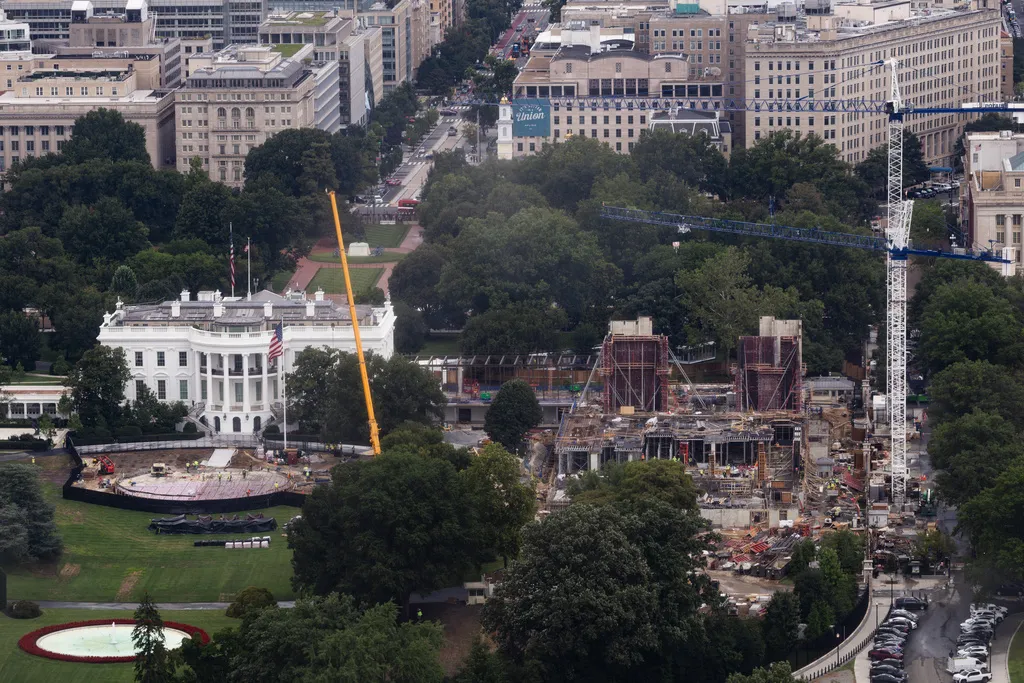
The legal dispute began last year after the Trump administration demolished the White House East Wing to make way for the proposed 90,000-square-foot ballroom. The facility is roughly equivalent to one and a half football fields in area. In December, the National Trust for Historic Preservation filed a lawsuit in federal court in Washington, D.C., seeking to suspend the project until the necessary federal approvals and congressional authorization had been secured.
Judge Leon subsequently issued an order restricting most above-ground construction. His ruling, however, allowed underground work connected to security infrastructure, including bomb shelters and bunkers, to continue. The order remained suspended as the administration appealed to the U.S. Court of Appeals for the District of Columbia Circuit.
On August 7, the appeals court upheld Leon’s ruling but gave the federal government 14 days to seek intervention from the Supreme Court. During that period, the lower court order remained on hold, allowing construction crews to continue working on the project.
The Trump administration formally asked the Supreme Court to intervene on August 14. Sauer argued that stopping construction would disrupt what the administration described as an integrated and highly secure complex at the White House East Wing. He maintained that the ballroom was necessary for national security and argued that the National Trust lacked legal standing to challenge the project.
The administration also rejected the appeals court’s conclusion that Congress needed to specifically authorize construction of the ballroom. According to the government, existing federal law already gives the president authority to make alterations and improvements to the White House, while broader legislation permits the executive branch to construct buildings within national parks.
National Trust for Historic Preservation
The National Trust for Historic Preservation offered a sharply different interpretation. In a filing submitted Tuesday, attorney Tad Heuer of Foley Hoag argued that the administration was accelerating construction in an effort to make judicial intervention practically impossible. The organization claimed that by rapidly advancing the project, the government could eventually argue that the construction had reached a stage where stopping it would be unrealistic.
The National Trust further argued that allowing construction to continue would effectively reward an attempt to bypass judicial review and undermine Congress’s authority over the project. It maintained that the administration should not be permitted to complete a ballroom that, in the organization’s view, lacked the necessary authorization when construction began.
Roberts had initially taken no action on the administration’s August 14 request for an immediate administrative stay. On Friday, however, he issued the temporary order. For now, the decision allows construction to proceed while the Supreme Court considers the broader legal dispute, leaving the future of the controversial White House project in the hands of the justices.