





Sabine Marcelis turns light, color and everyday objects into immersive rooms at Zurich’s Museum für Gestaltung. Her first museum exhibition runs until April 2027 and lets visitors walk through glowing tunnels, endless lava landscapes and captured sunbeams.
A single beam of sunlight striking a still pond can fracture into a dozen dancing colours, each one shifting with the smallest ripple. That quiet optical event sits at the heart of Sabine Marcelis’s first museum exhibition, where ordinary materials and familiar objects are tuned until light itself becomes the primary architecture.
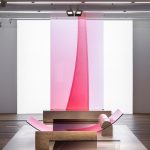
At the Museum für Gestaltung Zürich’s Toni-Areal venue, from 30 October 2026 to 4 April 2027, the Dutch designer presents Light and Color as a sequence of spatial encounters rather than a conventional retrospective. Visitors move through rooms where translucent resin, frosted glass, polished stone and mirrored surfaces capture, bend and multiply illumination until the boundary between object and atmosphere softens.
The show gathers key works from the past fifteen years alongside installations made specifically for these galleries, all arranged so that colour gradients, reflections and slow movement guide the experience more than labels or chronology.
Rooms Built from Movement and Reflection
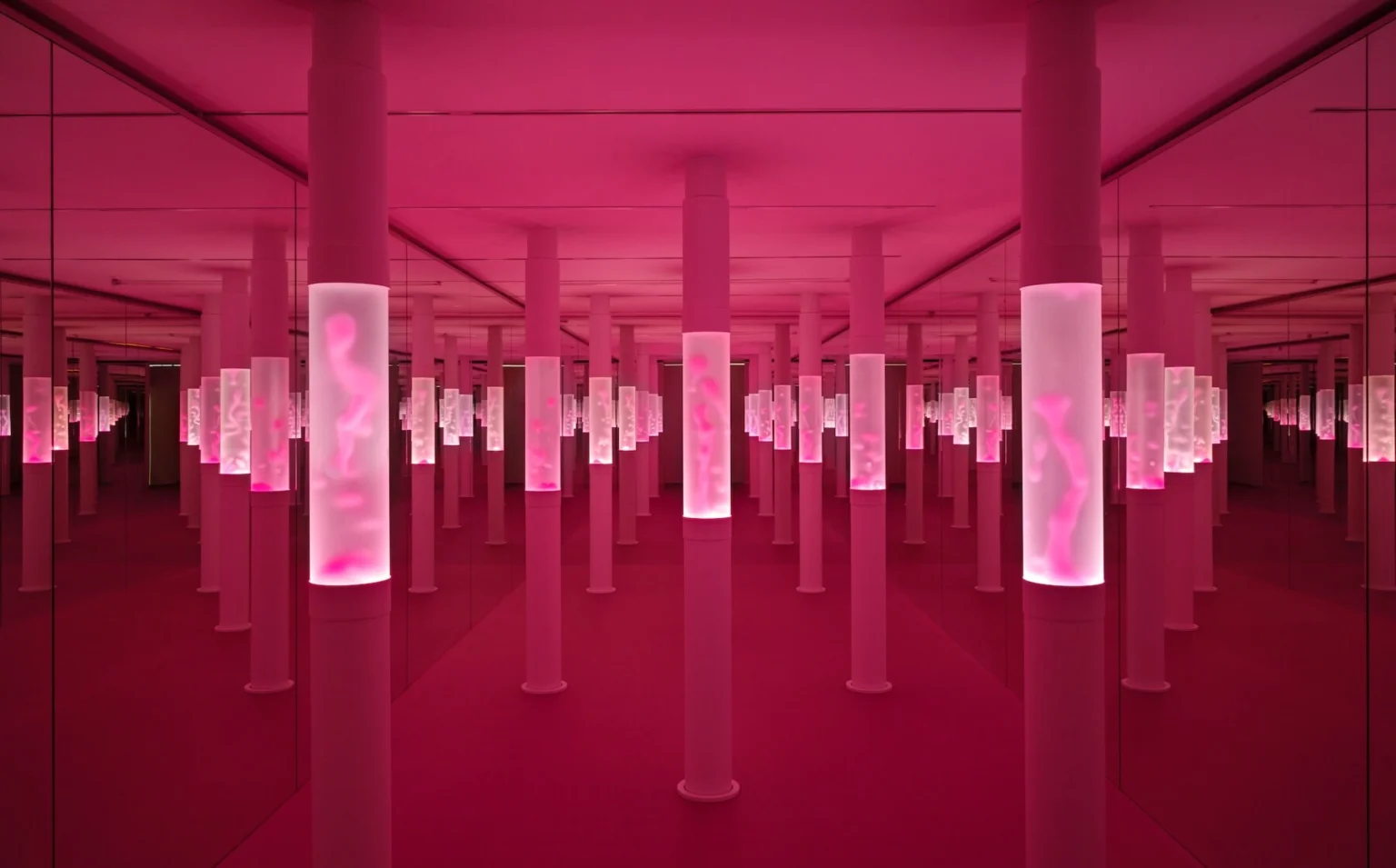
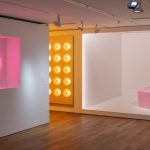
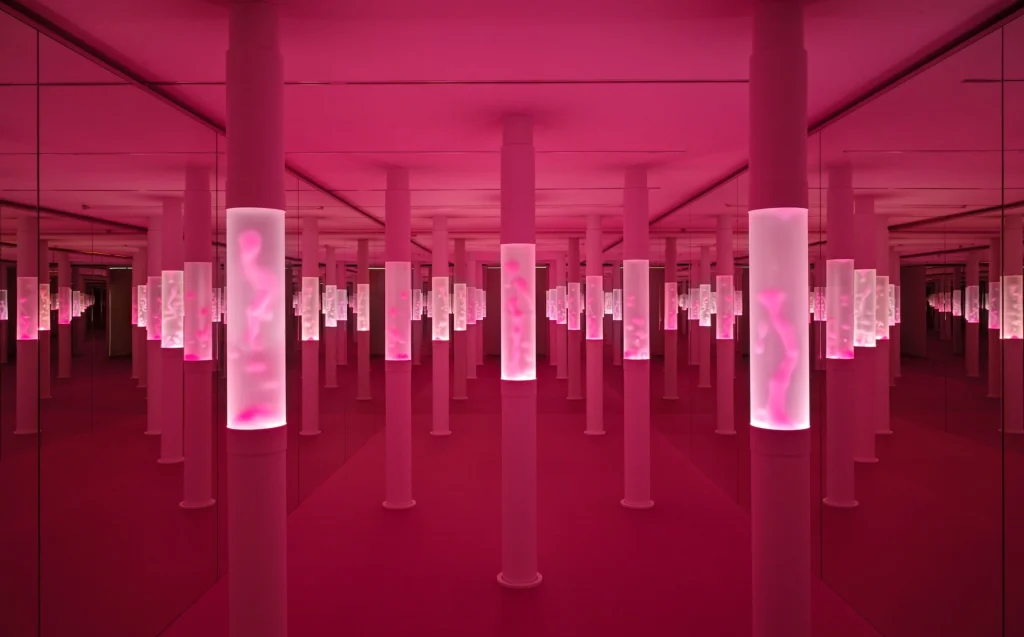
Two large-scale installations dominate the narrative. In one gallery, eight Mathmos Lava Columns rise nearly three metres, each a frosted glass vessel filled with soft Bubblegum-pink lava that rises, merges and falls in continuous slow motion. Mirrored walls multiply the columns into an apparently endless field. What began as a domestic novelty becomes a landscape of liquid light. Marcelis has long spoken of wanting to design a giant lava lamp; here the ambition is realised at architectural scale, with the manufacturer’s technical knowledge from its Dorset factory supporting the leap from tabletop to room-filling presence.
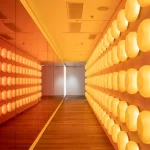
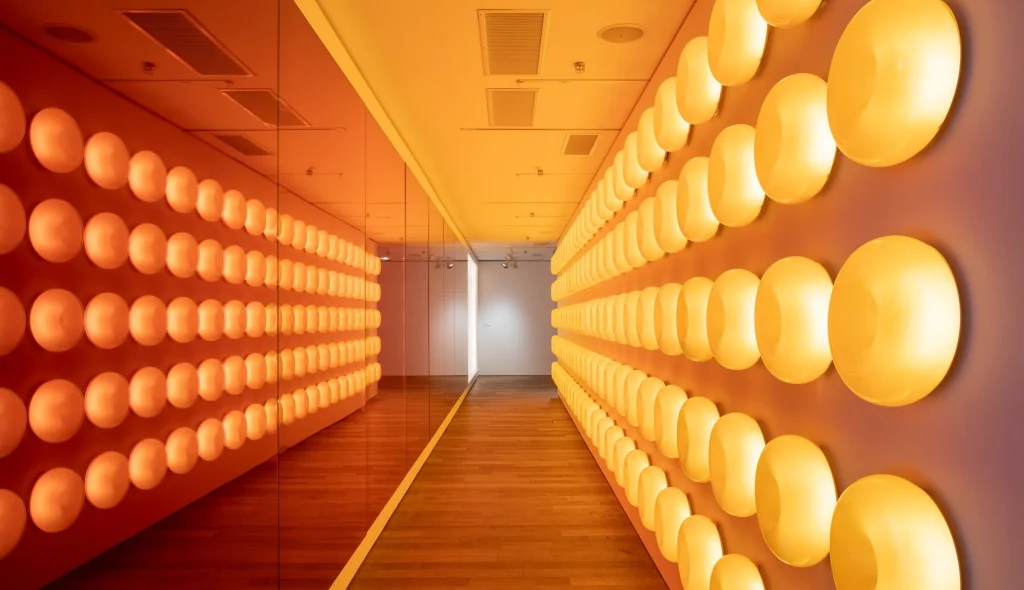
Nearby, 125 circular lamps from the VARMBLIXT collection developed with IKEA form an eleven-metre walk-through tunnel. A gradient mirrored wall extends the corridor visually, turning a mass-produced ring light into a rhythmic, glowing passage. Repetition does the heavy lifting. The same object that sits on thousands of living-room shelves now defines volume, depth and pace. Visitors walk through an environment that feels both familiar and estranged, the everyday elevated by pure spatial orchestration.
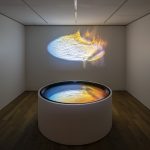
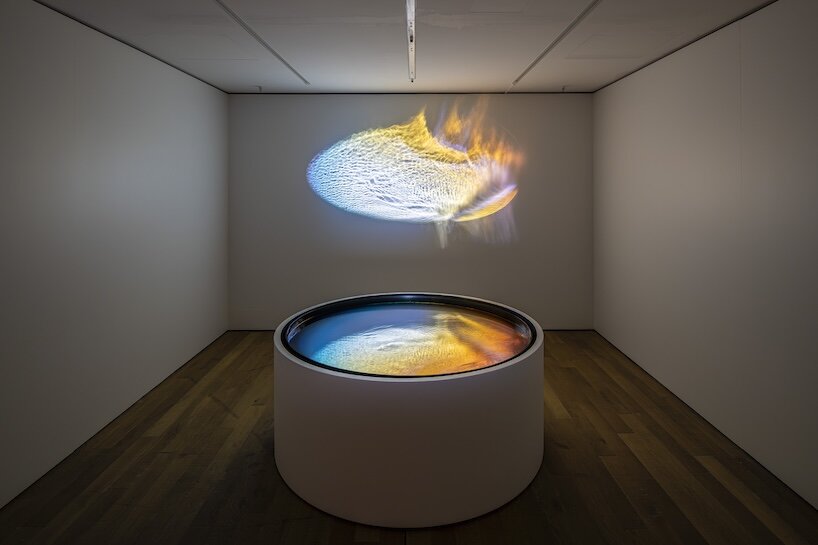
A third major work, Sunbeam Captured, made with artist Boris Acket, brings outdoor light cycles indoors. Mechanically generated waves travel across a shallow layer of water while a moving light source traces the sun’s path. Coloured reflections shift across surfaces and a gradient mirror that moves from cool blue to warm orange. Time becomes material. The installation does not illustrate sunlight; it re-stages its behaviour so that the gallery itself seems to breathe with changing colour temperature.
Material Studies and the Quiet Alchemy of Translucency
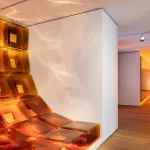
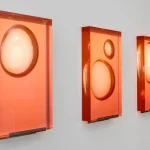
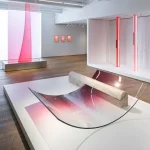
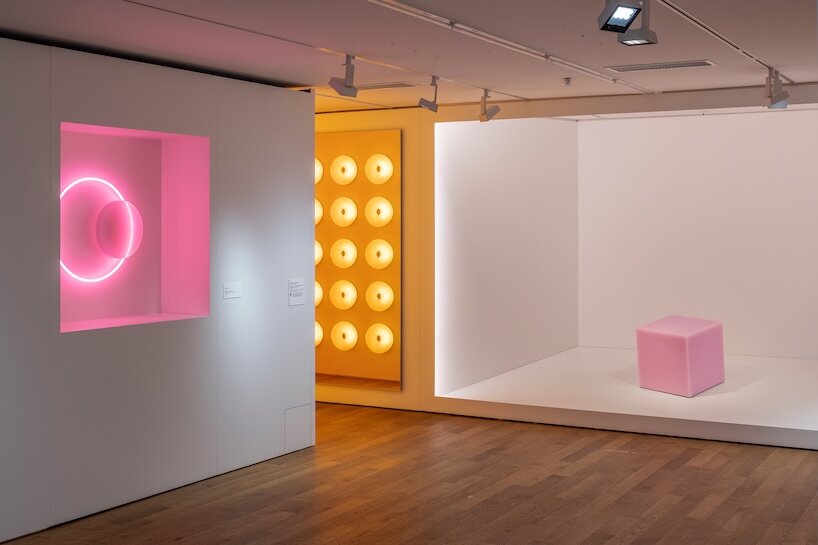
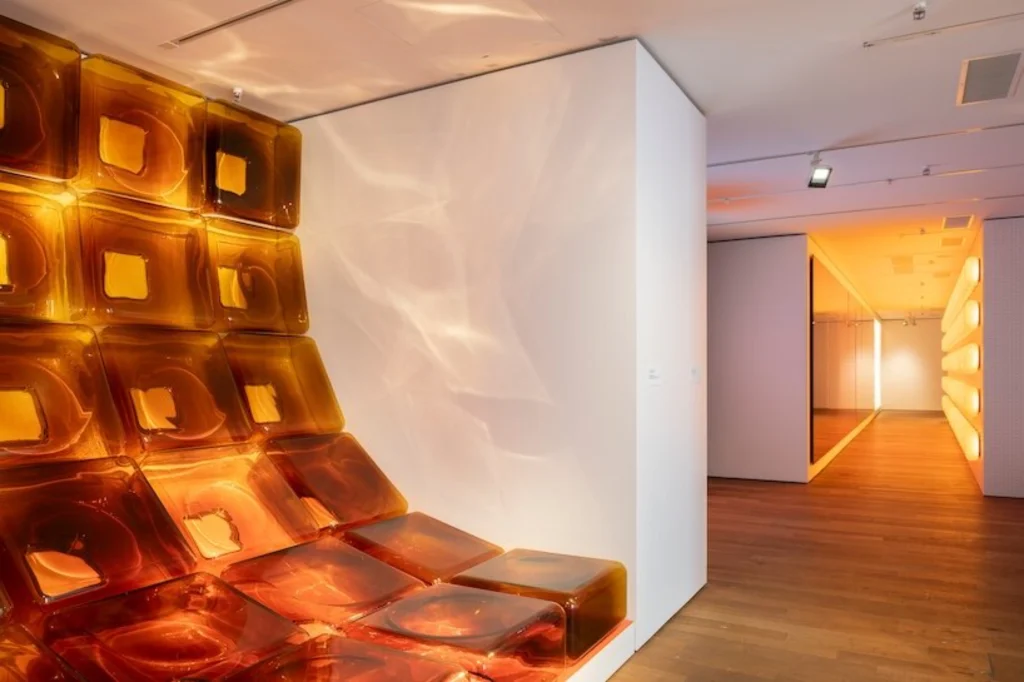
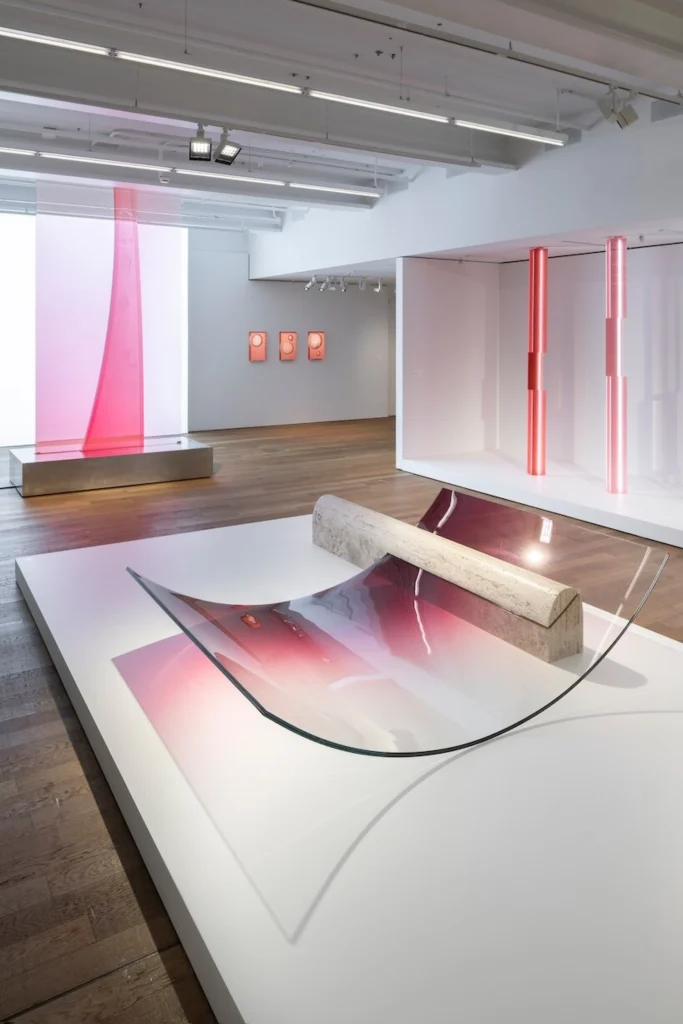
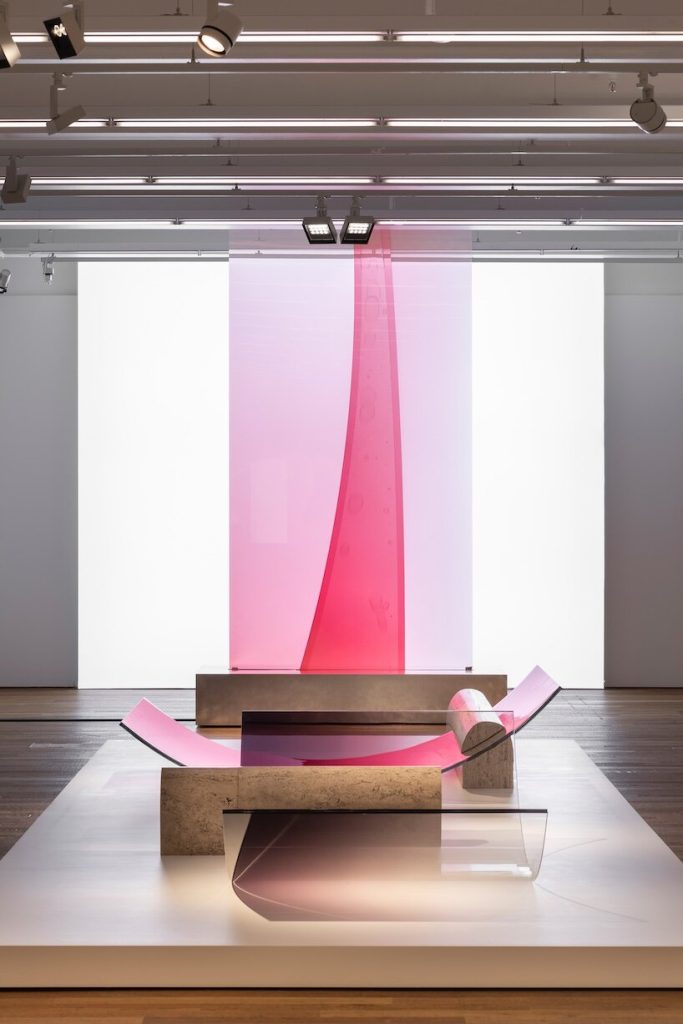
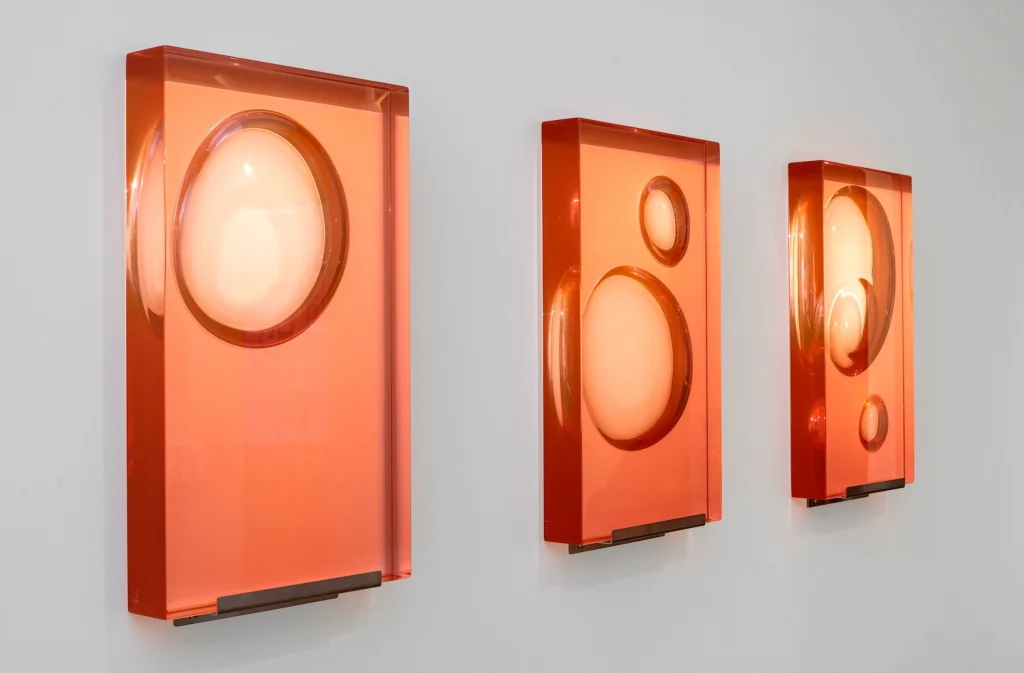
Scattered throughout the exhibition are smaller works and material samples that reveal the patient experimentation behind the spectacle. Candy Cubes in graduated resin hues, early mirrors such as Tall Stripe, stacked glass tables, stone elements and resin furniture demonstrate how Marcelis coaxes luminosity from density. Glass can appear weightless when edges catch light just so. Resin can hold color the way water holds pigment, soft at the centre and sharper toward the surface. Stone, when polished or left with subtle texture, becomes a muted reflector rather than a solid mass.
The scenography remains deliberately restrained. Walls and platforms recede so that optical effects take precedence. Lighting is calibrated to heighten gradients and to let shadows participate rather than merely define form. The result is an environment in which the visitor’s movement continually recalibrates the scene. A step to the left changes the reflection; a pause allows the lava to complete another cycle. Perception is never static.
Marcelis has described the exhibition as an insight into how her studio plays with light, material and color across scales rather than an archive of past projects. That intention is palpable. Objects are not presented as finished statements but as evidence of ongoing inquiry. Material studies sit alongside resolved pieces, inviting the eye to compare opacity, edge quality and color saturation. The show makes the working process visible without turning didactic.
Computational Design and Abstract Parametric Art Perspective
Although Marcelis’s practice is rooted in physical making and material intuition, the installations invite a computational and parametric reading. Consider the Mathmos columns. Each vessel follows a simple set of rules: height, diameter, wall thickness of the glass, viscosity and density of the internal fluid, and the temperature differential that drives the convection. Those parameters produce continuous, non-repeating variation within a stable formal envelope.
In digital terms, this is a classic generative system. Small changes in input yield rich formal and temporal output. The mirrored room then acts as a recursive function, multiplying the base geometry until the original count becomes indeterminate.
The VARMBLIXT tunnel operates through repetition and reflection as parametric operations. One lamp is the base unit. Arrayed at regular intervals along a linear axis and then mirrored, it generates a perceived depth far greater than the physical footprint. The gradient on the mirror wall introduces a continuous variable, color temperature shifting along a controlled spectrum. Viewers walking the length experience a parametric sequence: position along the path determines the visual density and chromatic temperature they encounter. The design is not scripted in code, yet it behaves like a rule-based spatial algorithm executed in hardware and light.
Sunbeam Captured is even more explicitly temporal and parametric. Wave amplitude, frequency, light path and color gradient are coordinated variables. The system maps the arc of the sun onto a controlled indoor environment. In computational design terms, it is a real-time simulation of a natural phenomenon, using mechanical actuators and calibrated optics rather than pixels. The gradient mirror functions as a continuous color map, translating time-of-day data into spatial atmosphere.
These works demonstrate that parametric thinking need not remain confined to digital modeling. Rules, constraints, iteration and feedback can be embedded in physical systems. The lava’s convection loop, the serial array of identical lamps, the synchronised wave and light path: each is a parametric construct realized through material behavior and careful calibration. Abstract parametric art often seeks to make systems visible and experiential. Marcelis achieves that without screens or projections. The parameters are felt in the body as one moves through changing reflections and slow chromatic shifts.
The approach also offers a quiet critique of purely digital parametricism. High-resolution computational form-finding can produce complex geometry, yet it sometimes loses the temporal and sensory richness that physical processes supply. Here the complexity is temporal and optical rather than geometric. The forms remain relatively simple so that the behavior of light and matter can remain the protagonist. In an era when design software can generate endless variation, Marcelis reminds us that variation already exists inside glass, resin and heated fluid if the conditions are tuned with enough care.
Process, Collaboration and the Dissolution of Boundaries
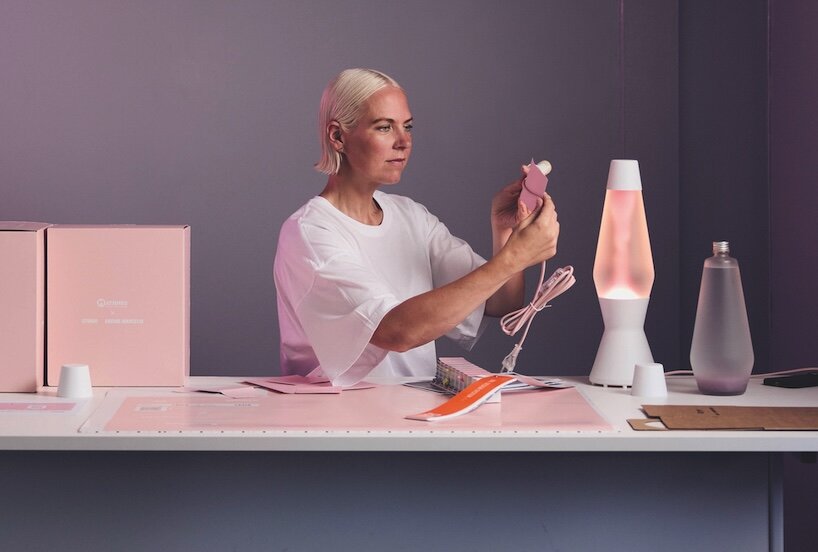
Material samples and process documentation throughout the galleries underline that none of this arrives by accident. Collaborations with Mathmos and IKEA are not merely brand partnerships; they are extended material research projects. Visiting the factory, approving prototypes, iterating color and translucency: these steps feed the final spatial effect. The same attention appears in the resin casting techniques that produce the soft internal gradients of the Candy Cubes and in the edge treatments of glass that catch and release light.
The exhibition dissolves habitual categories. Design objects become environments. Industrial products become immersive architecture. Scientific phenomena such as convection and reflection become aesthetic experience. Art, design and architecture meet without hierarchy. Visitors leave with a heightened sensitivity to the light that already surrounds them, whether filtering through a window or bouncing off a polished surface in an ordinary room.
Light and Color do not shout. It invites slow looking and bodily awareness. In the mirrored lava landscape, one loses track of exact numbers and simply watches pink forms rise and fall. In the tunnel, the repeated rings create a gentle pulse. In Sunbeam Captured, the moving reflections mark time more gently than any clock. The cumulative effect is a recalibration of attention. Ordinary optical events regain their capacity to astonish.
When the exhibition closes in April 2027, the physical installations will disperse, yet the underlying proposition remains. Materials can be tuned until they behave like living systems. Familiar objects can be scaled and arrayed until they define space. Light and color, treated with precision and patience, can become the primary structure of an environment. Sabine Marcelis has spent fifteen years refining that proposition. In Zurich, she gives it the room and the time it needs to unfold fully, one reflection, one gradient, one slow-rising bubble at a time.