



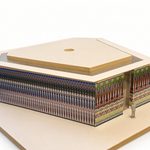

Gerhard Richter’s new Doha Pavilion is not simply a gallery designed to hold art. It is a rare example of an artist extending a lifelong visual language into architecture itself, transforming pattern, reflection, repetition, and perception into a permanent public structure.
Set to open on November 20, 2026, in MIA Park beside Doha’s Museum of Islamic Art, the pavilion has been conceived by the German artist in collaboration with Selldorf Architects. Titled Doha Pavilion: Gerhard Richter, the permanent structure will house a focused group of Richter’s paintings, mirrors, and sculpture, creating a complete environment in which the building and its contents operate as a single work.
Its hexagonal form is simple at first glance. Yet the pavilion carries a complex intellectual program. The six-sided geometry, printed façade panels, reflective interior, and centrally positioned Strip Tower each expand the central concerns of Richter’s practice: the instability of images, the relationship between order and chance, and the uncertain boundary between seeing and understanding.
A Pavilion Born From Painting
Gerhard Richter’s career has been defined by resistance to a single artistic method. His work has moved between photorealism, abstraction, blurred images, color charts, mirrors, glass works, and digitally developed compositions. Across these different formats, one question remains consistent: what does an image reveal, and what does it conceal?
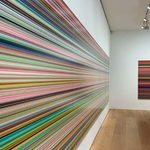
The Doha Pavilion grows from Richter’s celebrated Strip paintings, a body of work developed from 2011. These paintings began with an abstract source image that was digitally divided, mirrored, and reassembled into thousands of fine horizontal strips. In the process, a painting becomes both image and system. The viewer sees color, rhythm, and movement, but the original source remains fragmented beyond easy recognition.
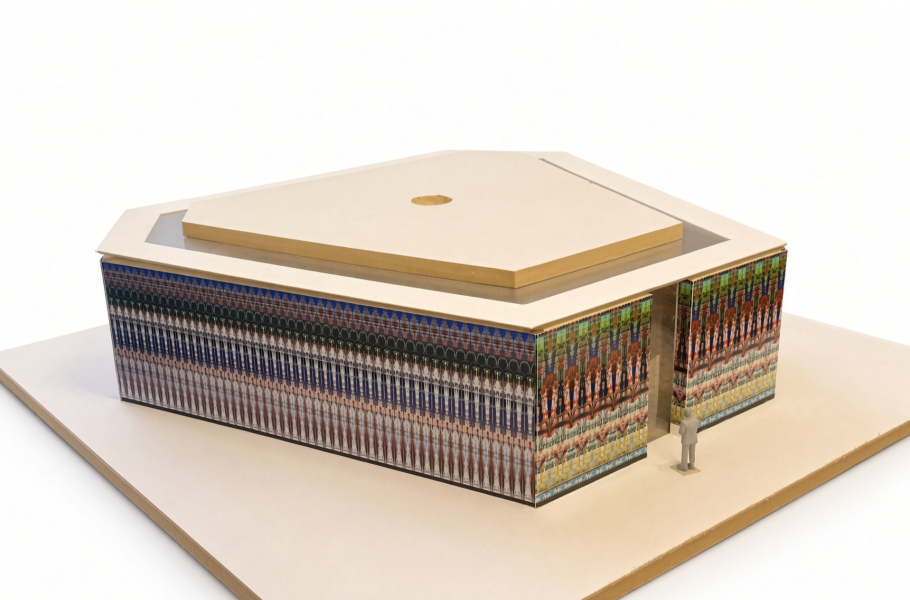
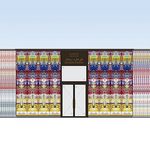
The pavilion takes this logic off the canvas and into public space. Its six exterior walls are clad with repeating printed patterns based on Richter’s Patterns, an artist’s book from 2011 that documented the digital process behind the Strip paintings. In architectural terms, the façade becomes a large-scale visual field, wrapping the simple geometry of the pavilion in an image system that appears orderly, vibrant, and continually unstable.
The result is not a building decorated with art. It is art operating as a building skin.
This distinction is important. Decorative architecture often applies images to a fixed form after the structure has been designed. Richter’s pavilion reverses that relationship. The visual pattern is not an accessory. It is the project’s conceptual engine, determining how the building is encountered, how it is recognized from the park, and how it communicates with Doha’s wider cultural landscape.
The Meaning of the Hexagon
The choice of a hexagon gives the pavilion a clarity that allows the patterned façade to remain central. Unlike a rectangular gallery, the hexagon has no obvious front or back. It creates six equal exterior conditions and encourages visitors to approach the pavilion from multiple directions.
This is particularly appropriate for a public setting such as MIA Park, where the building will sit outside the Museum of Islamic Art and within a landscape of movement, gathering, and expansive views across Doha. The pavilion does not assert itself through massive scale. Instead, it offers a concentrated architectural object, a compact structure that gains intensity through geometry, color, and visual precision.
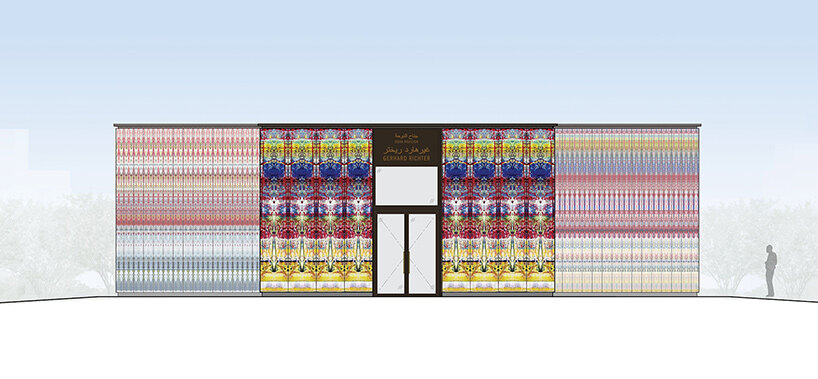
The hexagonal plan also resonates with the mathematical and repeating geometries found in Islamic art. Qatar Museums has noted that the calculated patterns on the six façades recall interlaced arabesques and repeating tile systems, which often use geometry to produce effects of visual depth, continuity, and contemplation.
This does not mean Richter is directly reproducing Islamic ornament. His source material remains his own digitally developed visual research. However, the project creates a meaningful dialogue between two systems of abstraction: Richter’s contemporary investigation into pixels, repetition, fragmentation, and perception; and the historical geometric traditions associated with Islamic art.
The connection is especially powerful in Doha. The pavilion’s pattern language becomes a bridge between the artist’s European modernist and postwar legacy and the regional visual culture represented by the nearby Museum of Islamic Art. It is an encounter between digital image-making and inherited geometric knowledge.
A Facade That Refuses Stillness
The pavilion’s printed exterior panels give the building a kaleidoscopic presence. Each of the six elevations presents a repeating pattern, allowing the structure to change through the viewer’s movement around it. From a distance, the façade may read as a unified field of color. Up close, its composition breaks into lines, fragments, and repetitions.
This shifting perception is central to Richter’s work.
The artist has long challenged the idea that an image can be fixed or fully understood. His blurred photo paintings question the supposed objectivity of photography. His abstract works create emotional intensity without a stable subject. His mirrors turn the viewer into part of the artwork, replacing a single image with an ever-changing reflection of bodies, light, and space.
The Doha Pavilion draws these interests together. It is a building designed to be viewed in motion. As visitors walk around its hexagonal perimeter, the patterned panels are not experienced as a static painting but as a sequence. The building’s surface performs differently under bright sun, changing weather, artificial evening light, and the varied positions of viewers in the park.
In this sense, the pavilion is closer to an optical instrument than a conventional gallery. It makes visitors aware of their own act of looking.
Inside the Architecture of Perception
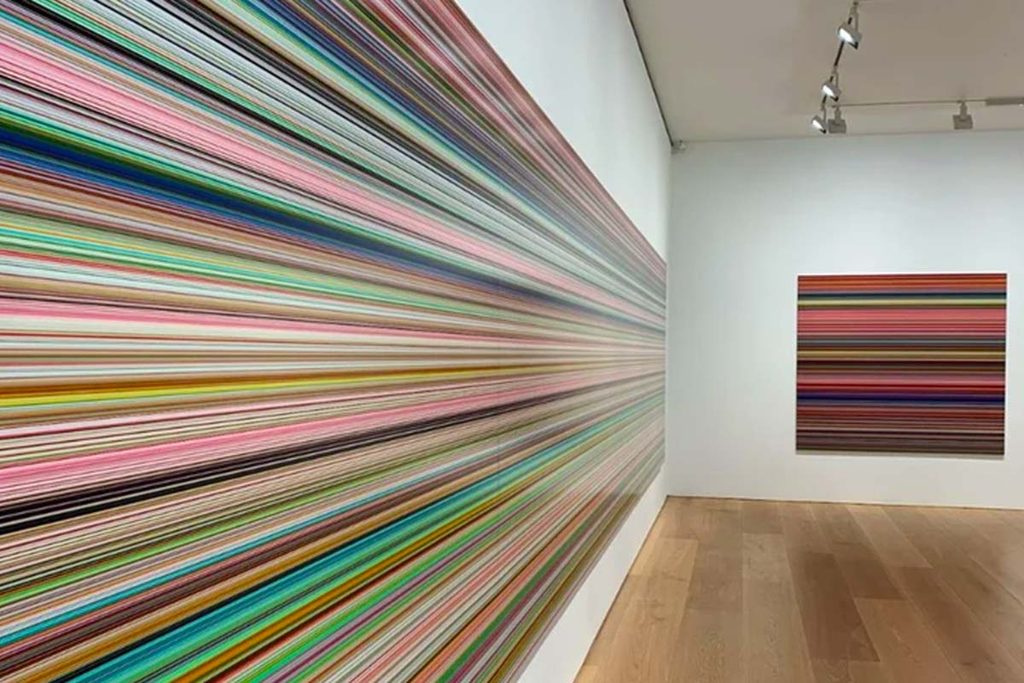
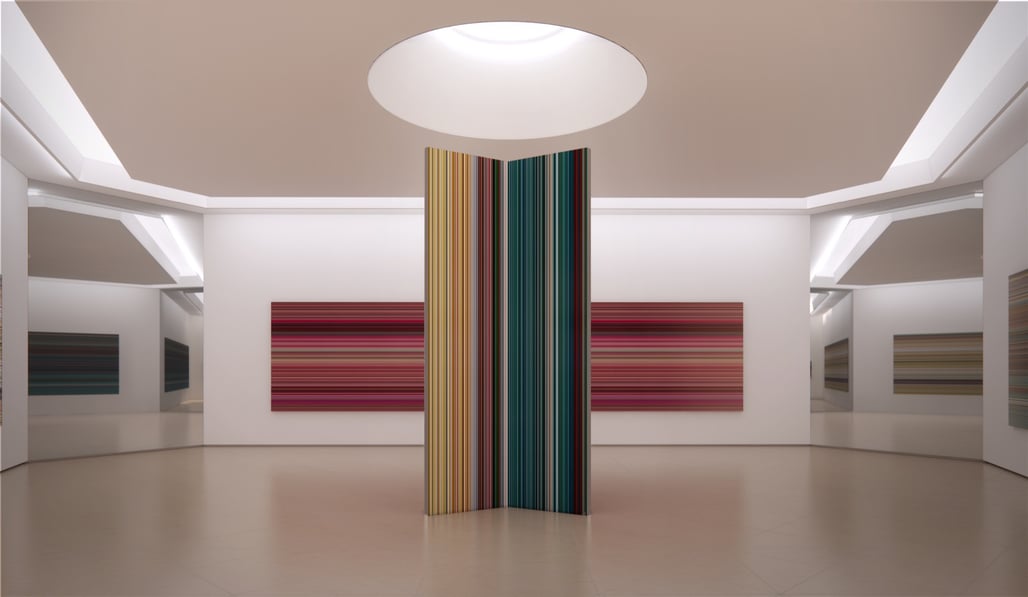
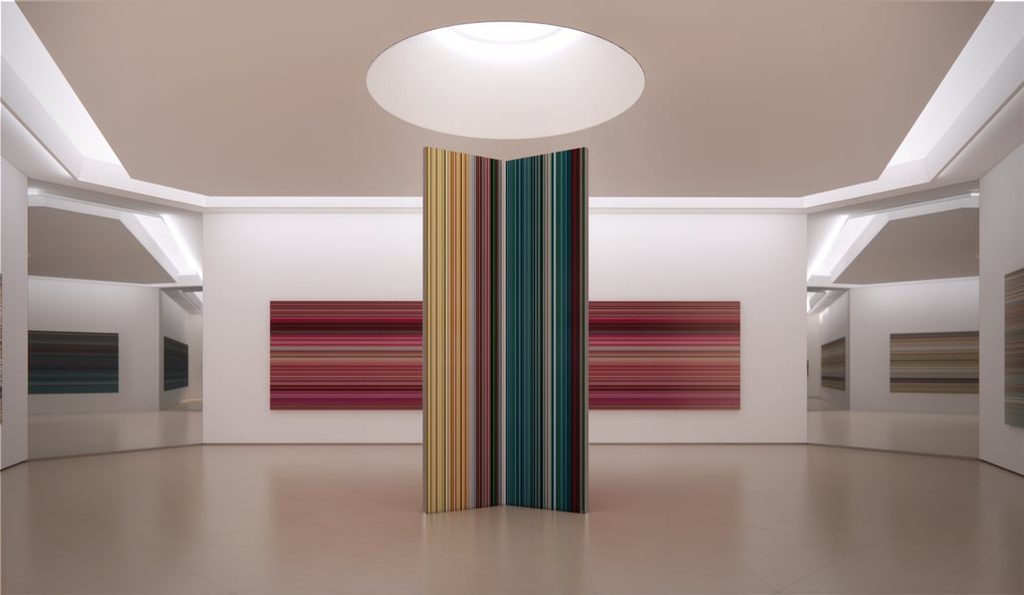
The interior continues Gerhard Richter’s exploration of image-making and reflection. Three large-scale Strip paintings will be installed on the pavilion walls. These paintings transform the source image into narrow horizontal bands, with each strip representing a slice of an original image only 0.08 millimeters wide. At this scale, the image becomes almost infinitely divisible, raising questions about when representation dissolves into pure visual information.
At the center of the pavilion, Richter will place a tripartite Strip Tower created specifically for the structure. This vertical sculpture translates the Strip paintings into three-dimensional form, turning an image process into an object that visitors can walk around. The tower gives the interior a spatial center, but it also prevents the room from behaving like a neutral white cube. The gallery becomes an environment organized around the movement of the body.
Two floor-to-ceiling Mirrors will be placed on the pavilion’s narrow interior walls. The mirrors belong to a series Richter began in the 1980s and operate as both objects and devices. They reflect the paintings, the Strip Tower, the visitors, and the space itself. They also expand the apparent dimensions of the pavilion, creating a sense of depth that is not physically present.
This is a carefully orchestrated experience. The visitor looks at the artwork, then sees it reflected. They see the pavilion, then see themselves within it. The separation between observer and object becomes uncertain.
The building therefore stages one of Richter’s most enduring concerns: an image is never only an image. It is also a condition of viewing, a record of mediation, and an invitation to doubt what appears stable.
Collaboration Without Compromise
The pavilion has been realized with Selldorf Architects, led by Annabelle Selldorf, acting as executive architect. Selldorf’s role is significant because translating an artist’s conceptual vision into a permanent public structure requires both sensitivity and technical discipline. A pavilion that appears formally simple must still resolve material performance, fabrication, lighting, climate, circulation, accessibility, construction, and long-term maintenance.
Selldorf Architects has extensive experience with cultural projects and museum environments, including work associated with the Frick Collection in New York, London’s National Gallery, and forthcoming work at the Louvre in Paris. In Doha, that expertise is directed toward making Richter’s idea inhabitable without weakening its visual precision.
This is not architecture in service of art as a neutral container. Nor is it an artist’s sculpture treated carelessly as a building. The collaboration works because both disciplines are necessary. Richter provides the visual and conceptual system. Selldorf Architects helps turn that system into a functioning public architecture.
Such collaborations are increasingly relevant in a global cultural landscape where institutions seek projects that are both architectural destinations and intellectual experiences. The Doha Pavilion will be relatively compact, but its ambition is large. It asks whether a pavilion can operate simultaneously as gallery, sculpture, urban marker, patterned surface, and perceptual experiment.
Doha’s Cultural Landscape
The pavilion will open on the eve of the inaugural Rubaiya Qatar, a new contemporary art quadrennial running from November 21, 2026, to April 30, 2027. The event will include exhibitions and public art installations across Doha, with a stated focus on global ecology, water, maritime heritage, and artistic perspectives beyond the Western Hemisphere.
Positioning the pavilion within this moment gives the project a broader cultural role. It is not only a permanent home for Richter’s work. It becomes part of Qatar’s continuing investment in public art, museums, international cultural exchange, and contemporary architecture.
Qatar Museums has described public art as a means of placing knowledge, dialogue, and new experiences in everyday public space. The MIA Park location makes this aspiration tangible. Visitors will encounter the pavilion outside a formal museum setting, in a public landscape where art can be approached casually, revisited, or discovered unexpectedly.
Richter himself has connected the project to his 2013 visit to Doha, which took place as he was developing the Strip paintings. He described the city’s architecture and history as the source of an idea for a pavilion capable of uniting themes within that body of work, adding that Doha was “the right place and the only place” for it.
That statement gives the structure a site-specific quality. The pavilion is not a traveling exhibition design or a generic artist-branded gallery that could be placed anywhere. It is intended for Doha, shaped by its setting, its institutional context, and its relationship to Islamic visual culture.
More Than an Icon
The word “iconic” is often used too easily in architecture. It tends to describe a building that is visually memorable, unusually shaped, or easily photographed. The Doha Pavilion offers a more thoughtful version of iconic status.
Its impact is not likely to come from height, spectacle, or extravagant complexity. The building is iconic because it condenses a major artist’s visual research into a precise and public architectural form. Its hexagon is instantly legible, while its patterned skin rewards prolonged looking. Its interior is limited in scale but expansive in perceptual effect.
The pavilion also demonstrates how architecture can emerge from an artistic methodology. Richter’s working process, involving division, repetition, transformation, and reflection, becomes spatial. The visitor not only sees the logic of the Strip paintings. They enter it.
This is the project’s most compelling architectural achievement. It makes visual thought inhabitable.
As the pavilion opens in MIA Park this November, it will offer Doha not merely another cultural destination, but a structure that asks viewers to slow down and question what they see. In an era dominated by instant images and rapid consumption, Richter’s hexagonal pavilion proposes an alternative: architecture as a patient instrument of perception.