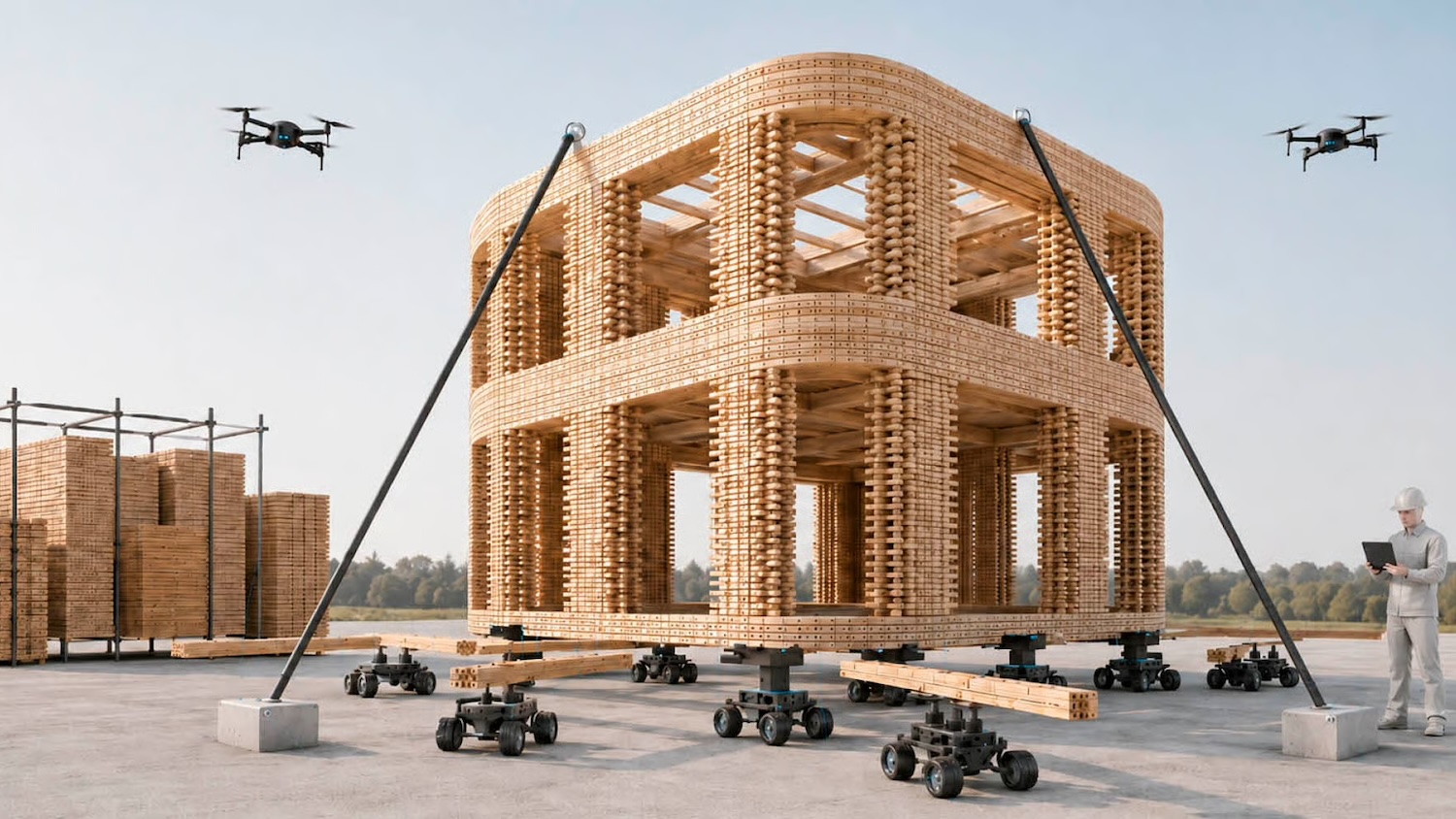

For decades, the mechanics of building have adhered to an unquestioned sequence: foundations anchor to the earth, vertical cores climb skyward, and floor plates stack sequentially from the bottom up. High-altitude assembly brings inherent site hazards, massive crane requirements, and substantial embodied energy losses.
A ground-breaking research initiative is turning that centuries-old architectural paradigm completely upside down.
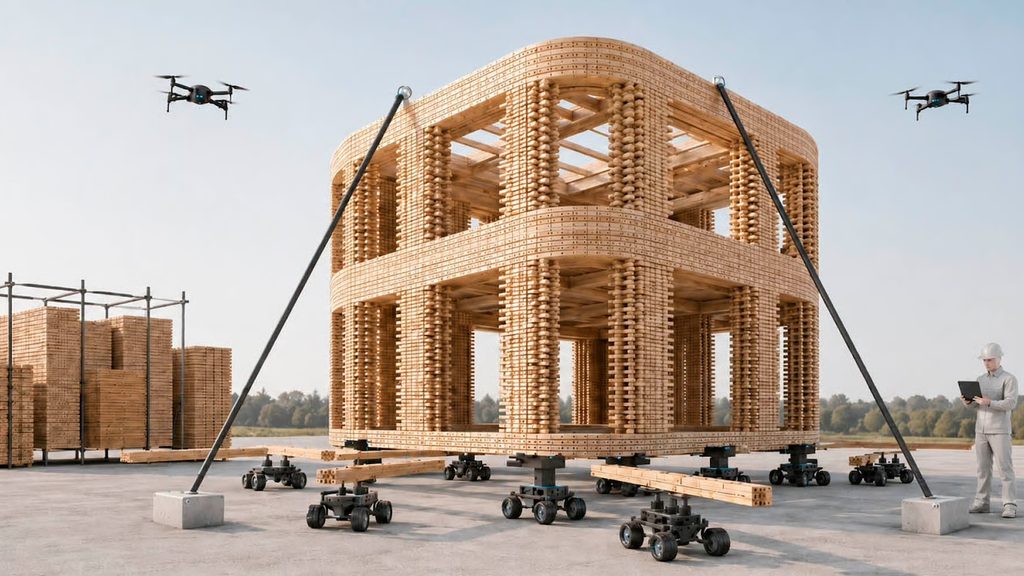
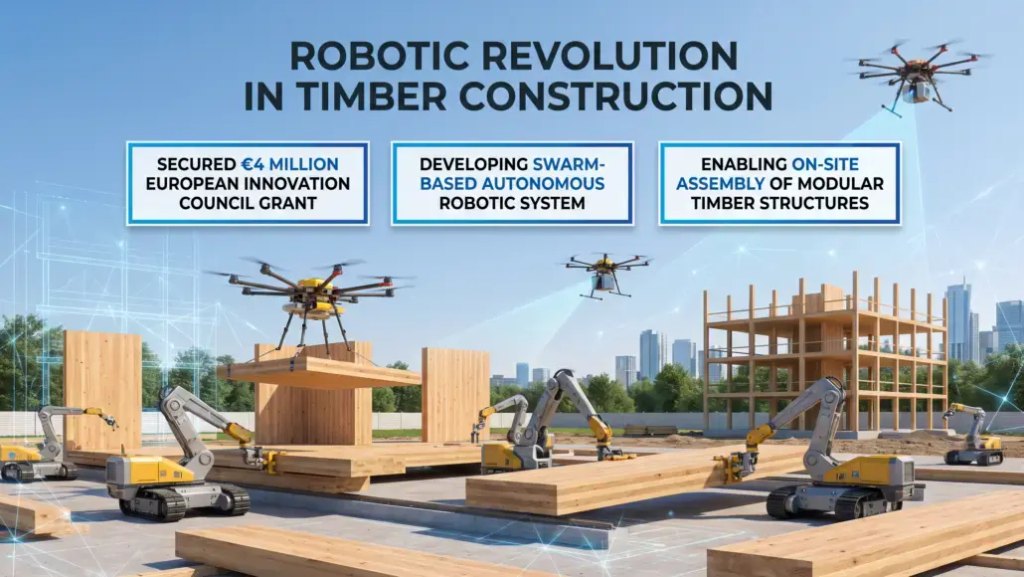
London-headquartered practice Foster + Partners has joined a European research consortium to launch SWIFT-Build (Swarm-based Inverted Fabrication for Timber Buildings). Backed by a €4 million research grant from the European Innovation Council’s Pathfinder programme, the three-year venture fuses artificial intelligence, autonomous robotic swarms, and mass timber engineering to pioneer a radically inverted construction methodology.
Rather than erecting buildings from the ground toward the sky, SWIFT-Build constructs multi-storey timber structures from the top down.
The Mechanical Inversion: Building Roof-First at Ground Level
The mechanical framework of SWIFT-Build eliminates high-risk elevated assembly by fabricating the uppermost roof level first.
Ground-based mobile robots assemble the roof plane and top floor module at human height. Upon completion of that upper tier, synchronized hydraulic lifting mechanisms elevate the assembled structure upward. This vertical displacement opens a clear assembly zone directly underneath, enabling ground units to construct the next storey at ground level.
Confining heavy joinery, panel handling, and structural fastening to ground level reduces scaffolding needs and eliminates tower crane reliance.
Human builders transition away from dangerous high-altitude labor, stepping into supervisory positions focused on digital twin monitoring, algorithmic parameter adjustments, and real-time site telemetry.
Swarm Intelligence and Aerial Spatial Monitoring
Executing top-down kinetic construction demands real-time computational orchestration. The SWIFT-Build framework replaces centralized computing hubs with a decentralized swarm intelligence network.
Serving as the exclusive industrial architecture partner, Foster + Partners collaborates alongside academic researchers from the University of Bristol, Technical University of Munich (TUM), Delft University of Technology (TU Delft), University of Southern Denmark, University of Pisa, University of Birmingham, and Ludwig Maximilian University of Munich.
Ground Assemblers and Lifting Units: Heavy-payload mobile robots maneuver timber panels across site grounds, apply structural fasteners, and operate coordinated hydraulic jacks.
Aerial Drone Fleet: Autonomous drones maintain aerial surveillance over active building zones. Using computer vision and photogrammetric sensors, these aerial units continuously verify structural tolerances against dynamic BIM digital models.
Peer-to-Peer Data Exchange: When timber elements exhibit minor organic warps or dimensional variations, the robotic swarm recalibrates assembly pathways autonomously without halting site progress.
Foster + Partners senior partner Irene Gallou notes that combining advanced robotics with embedded artificial intelligence allows the system to adjust across varying spatial scales, building geometries, and functional typologies.
Mass Timber and the Architecture of Reversibility
Beyond its mechanical execution, SWIFT-Build embeds circular design principles directly into the structural logic of buildings.
Standard reinforced concrete assemblies create rigid structures that end in destructive demolition. By deploying modular engineered timber, SWIFT-Build treats architectural structures as temporary arrangements of reusable organic assets. The three-year initiative culminates in a full-scale physical trial: an autonomous timber pavilion engineered for complete disassembly.
Robotic swarms will execute reversible mechanical connections instead of applying permanent chemical adhesives or wet concrete pours. Consequently, these same autonomous systems can reverse their assembly sequence, disassemble the timber members intact, log component data into material passports, and re-erect the structural elements in new spatial forms elsewhere.
Redefining the Future Construction Site
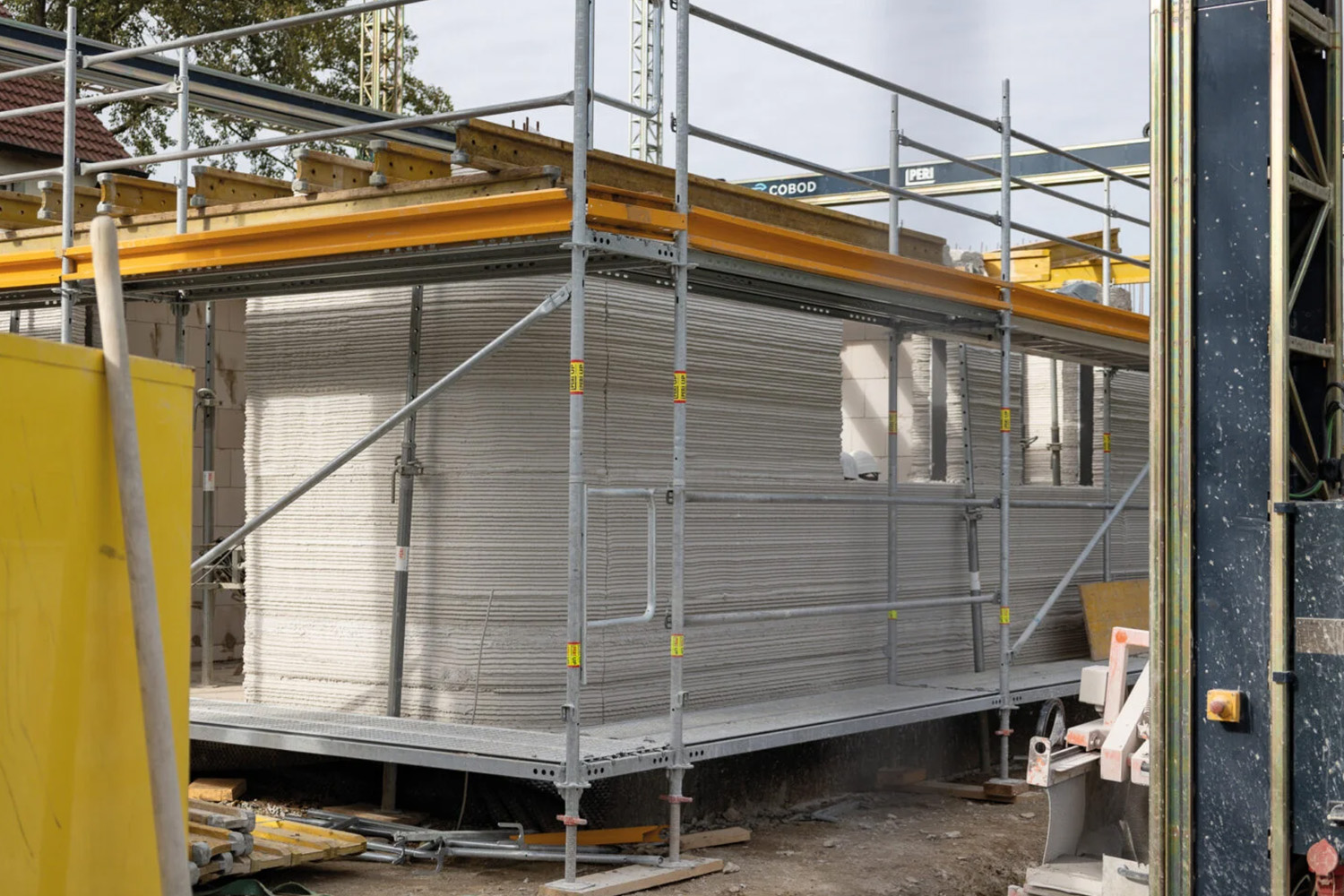
The SWIFT-Build venture demonstrates that architectural automation moves far beyond static factory arms or 3D mortar printers.
By unifying top-down physical assembly, spatial swarm computing, and carbon-storing mass timber, Foster + Partners and its university partners deliver an actionable paradigm for future urban construction.
This inverted framework curtails embodied carbon footprints, insulates human workers from high-altitude site dangers, and transforms circular architecture into an operational computational reality. As robotic swarms prepare to construct buildings roof-first, the global built environment opens a new chapter in scalable, sustainable design.