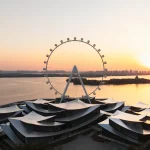
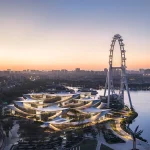
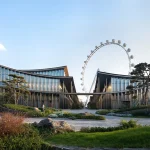
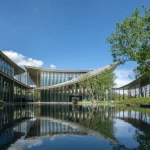
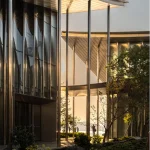
Designed by BIG – Bjarke Ingels Group, in collaboration with ARTS Group, VIA.inc, and SHUISHI, the 60,000-square-meter Suzhou Museum of Contemporary Art has officially opened its doors along the edge of Jinji Lake. The structure takes the form of a village composed of twelve pavilions, all sheltered beneath a flowing, ribbon-like roof.
As BIG’s first museum to be completed, the project debuts after a series of preview showings and now serves as a fresh hub for contemporary art, design, and public engagement in Suzhou. The museum continues to host BIG’s Materialism exhibition as part of its inaugural programming.
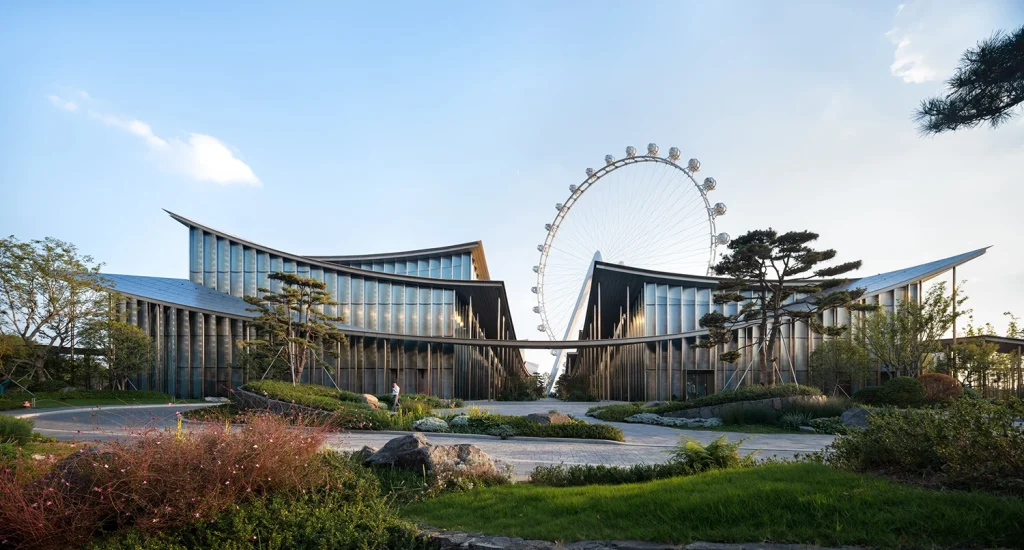
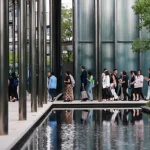
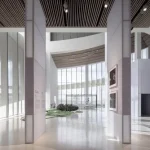
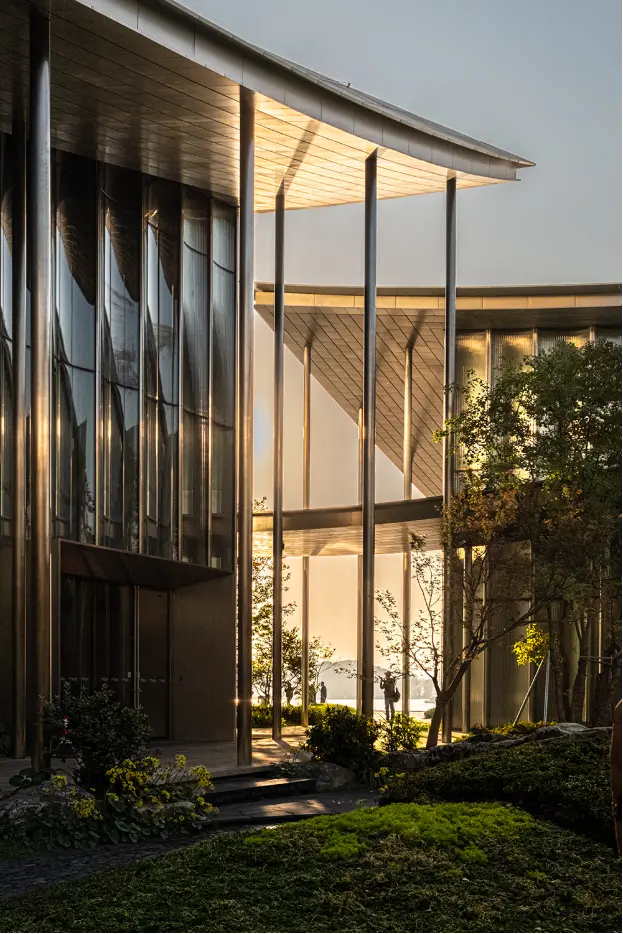
Drawing inspiration from the garden traditions of Suzhou, the museum reinterprets the lang, a covered walkway that meanders through a landscape, as an interconnected system of exhibition spaces. A continuous pathway winds through the pavilions, linking galleries, communal areas, and cultural venues, while inviting visitors to wander off along smaller routes between exhibits. With bridges and tunnels connecting spaces both above and below ground, the museum provides a flexible layout that adapts to shifting exhibitions and the changing seasons.
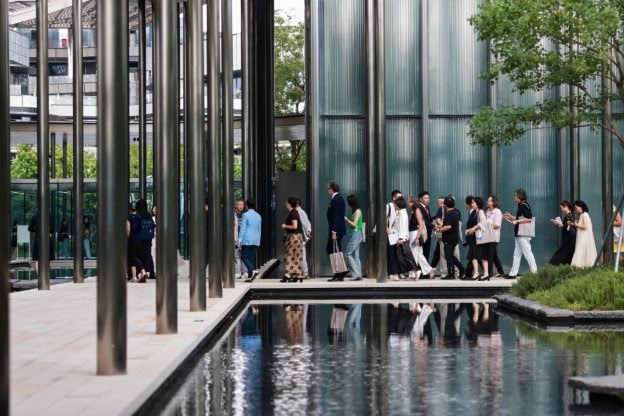
After many years of work and collaboration, it is a pleasure to finally welcome visitors to Suzhou Museum of Contemporary Art. We envision the museum as a place for discovery and exchange, where people can experience art in new ways and engage with ideas from across cultures and generations. Through its exhibitions and public programs, we hope to make the museum a lasting part of Suzhou’s cultural landscape and a destination for visitors from near and far. Wang Xiaosong, Executive Director, Suzhou MoCA
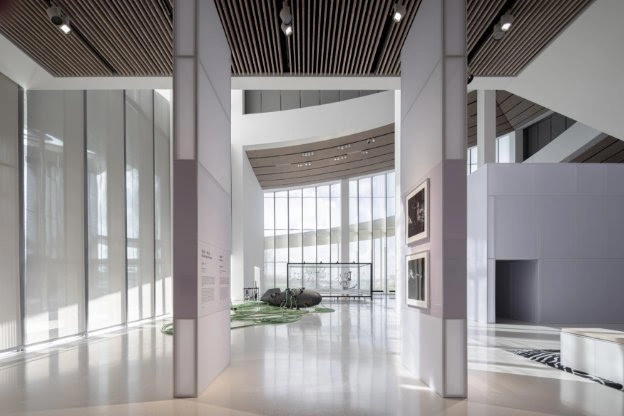
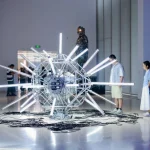
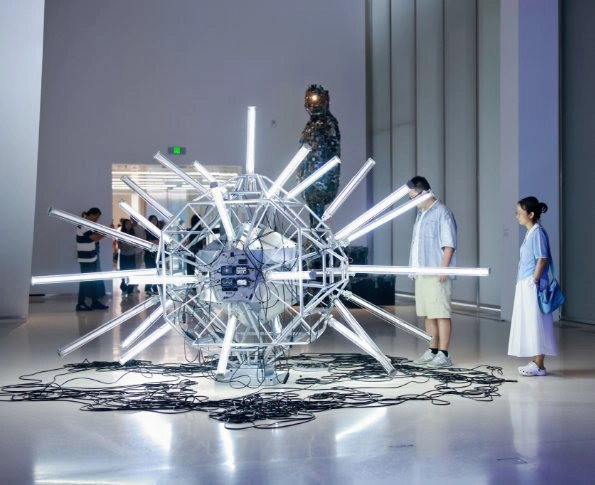
Prior to its formal opening, Suzhou MoCA had already begun welcoming guests through several preview exhibitions, including BIG’s Materialism, which continues to be on display. This exhibition guides visitors through a material narrative spanning stone to recycled matter, highlighting how ten distinct materials have influenced BIG’s designs via large-scale models and project mock-ups from across the globe.
The museum now launches with a diverse array of inaugural shows, covering modern and contemporary art, technology-informed creative practices, and cross-cultural exchanges between Eastern and Western artistic heritage, featuring a major Picasso exhibition alongside an extensive showcase of contemporary Chinese art.
If the historic city center is the cradle of the Chinese garden, the lake district is the cradle of a new Suzhou. The site of the Suzhou Museum of Contemporary Art is sandwiched between the city and the lake. A newly constructed Ferris wheel partially blocks the relationship with the water. By dissolving the museum into a Chinese garden of interconnected galleries, distributed across the site like pavilions in a park, the museum becomes a connection between the city and the lake, rather than an obstacle. Its urban porosity allows citizens to walk through sculpture gardens to the lakefront, while the water penetrates between the pavilions to reach the city. Bjarke Ingels, Founder & Creative Director, BIG
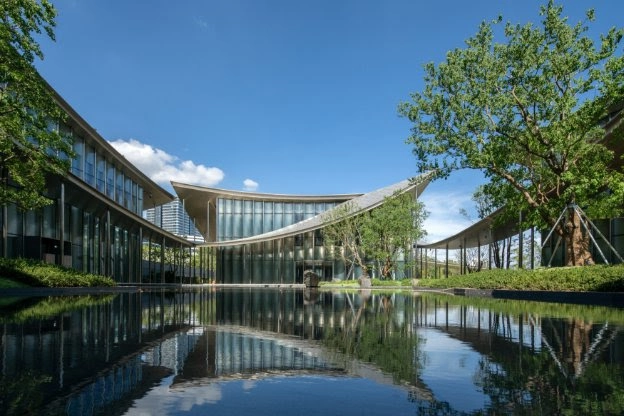
From above, the museum appears like a traditional infinity knot as it intertwines the legs of the Ferris wheel to reach all the way into the lake. With the vast number of visitors ascending the wheel above, the roof surface de facto becomes the true fifth facade of the art complex. Not only do I see our design as an homage to its local heritage, a sort of Scandinavian reinterpretation of a unique typology, the Chinese garden, but the result is in many ways a manifestation of the ancient future of Suzhou and a testament to the construction quality and technical sophistication that is becoming the rule rather than the exception in contemporary Chinese architecture. Bjarke Ingels, Founder & Creative Director, BIG
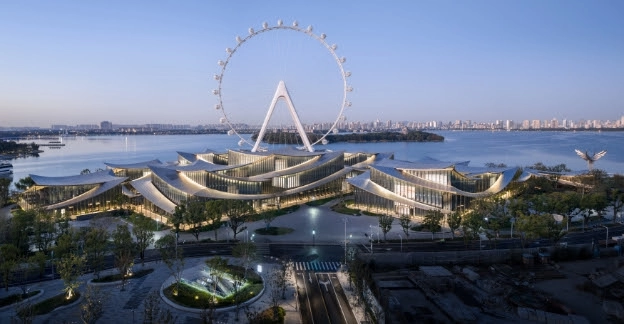
The museum reconciles Western and Eastern spatial traditions through a deliberate duality. From the sky, the museum reads like traditional craftwork: a series of papercut knots framing the gardens below, turning the heritage of Suzhou into artwork. But as one descends and enters the museum, the clarity of the figure-ground dissolves. The gardens begin to flow into one another, unfolding as sequences of spaces, views, art, and nature – transforming a composition that appears precise from above into an experience of exploration and discovery on the ground. Catherine Huang, Partner, BIG
Project Facts
Name: Suzhou Museum of Contemporary Art
Size: 60,000 m2
Location: Suzhou, Jiangsu, China
Owner: Suzhou Industrial Park Culture, Sports and Tourism Bureau [苏州工业园区文体旅游局]
Client: Suzhou Harmony Development Group Co. Ltd [苏州圆融发展集团有限公司]
Collaborators: ARTS Group Co., Ltd. [中衡设计集团股份有限公司], VIA.inc, Shanghai Shuishi Landscape Design Co.,Ltd [上海水石景观环境设计有限公司], Rdesign International Lighting [上海瑞逸环境设计有限公司]
Project Team
Partners-in-Charge: Bjarke Ingels, Catherine Huang
Project Manager: Molly Hsiao Rou Huang
Project Architect: Tyrone Cobcroft, Kekoa Charlot, Tseng-Hsuan Wei
Design Lead: Matteo Pavanello
Team: Aileen Koh, Amanda Lima Soares Da Cuncha, Arda Özker Cincin, Athena Morella, Chih-Han Chen, Christian Vang Madsen, Cris Guoyu Liu, Desislava Georgieva, Eddie Can, Eric Wen Tung Li, Federico Martínez De Sola Monereo, Filip Fot, Filippo Cartapani, Finn Nørkjær, Haochen Yu, Huiyao Fu, Izabella Banas, Jakub Kulisa, Jan Magasanik, Jana Semaan, Jason Cheuk Hei Lee, Jiaqi Yang, Jiawen Huang, Julia Wilkosz, Jurica Pajic, Mathis Paul Gebauer, Megan Nhat Xuan Dang, Narisara Ladawal Schröder, Ole Elkjær-Larsen, Oliver Steen, Paula Domka, Pei Huang, Philip Kaefer, Phoebe Cowen, Riad Tabbara, Romain Thijsen, Shu Du, Sol Anaid Chaocon Levin, Tarek Shater, Todor Todorov Rusev, Tomasz Jakubowski, Xavier Thanki, Yanis Amasri Sierra, Yihan Liu, Yingying Guan, Zahra Khademi, Zhonghan Huang, Zuzana Faskova
BIG Engineering: Andrea Hektor, Adele Scampoli, Alexander Gale Heiede, Andreas Bak, Bjarke Koch-Ørvad, Cristina Minguela, Ingrid Albina Oliva Lampa, Janis Bronka, Jens Max Jensen, Jesús Fernández Lindqvist, Jonathan Russell, Kannan Selvaraj, Konstantinos Koutsoupakis, Maria Capuozzo, Miles Treacy, Thomas Lejeune, Tim Christensen