



Rethinking architectural heritage through the dialogue between memory and contemporaneity. What if the restoration of a historic building did not simply consist of preserving its memory, but also of allowing it to embrace its own future?
Historic cities are the result of continuous layering. The buildings we recognize today as testimonies of the past rarely belong to a single historical moment. They are the product of transformations, additions, adaptations, and overlapping interventions that, over the centuries, have altered their appearance and sometimes even their function. Each era has left its mark, intervening in what it inherited from the previous one. In this sense, historic architecture has never been an immobile reality, but rather an organism in constant evolution.
Yet, when we approach the restoration of these buildings today, we are often confronted with a complex question: which language should we use to intervene in an architecture that belongs to another era? How can contemporary elements be introduced without compromising the historical value of the building? And, above all, is it really necessary for every intervention to choose between visual continuity and radical contrast?
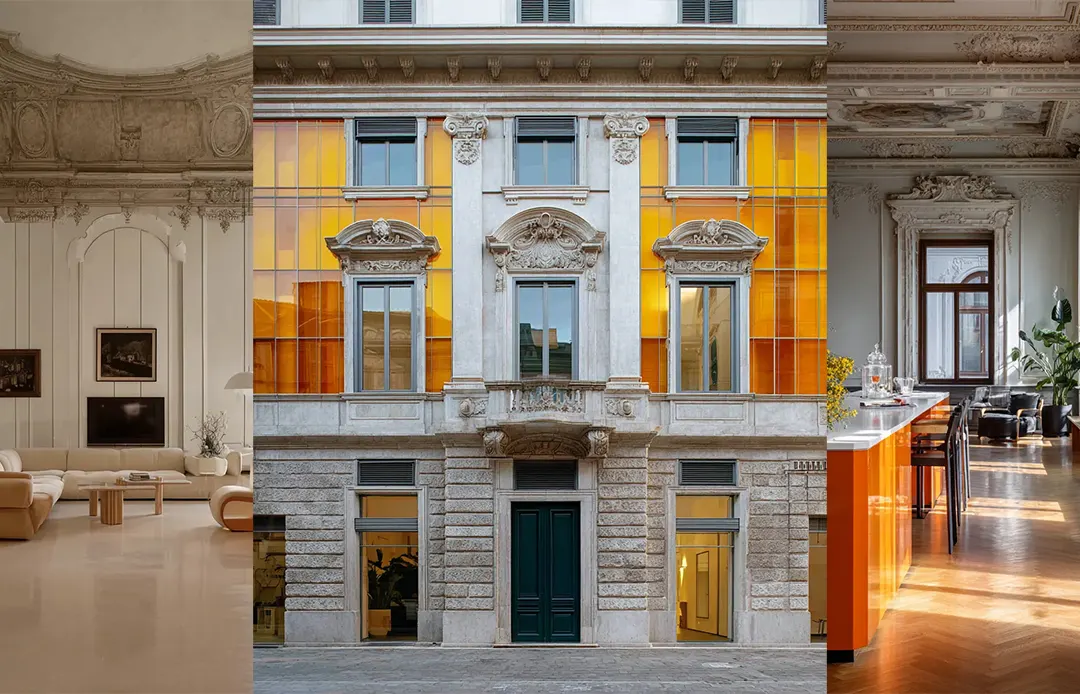
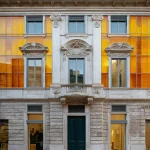
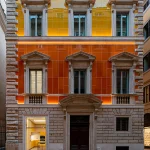
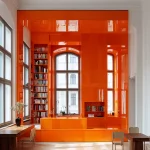
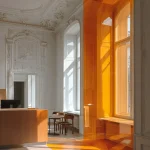
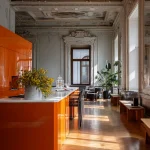
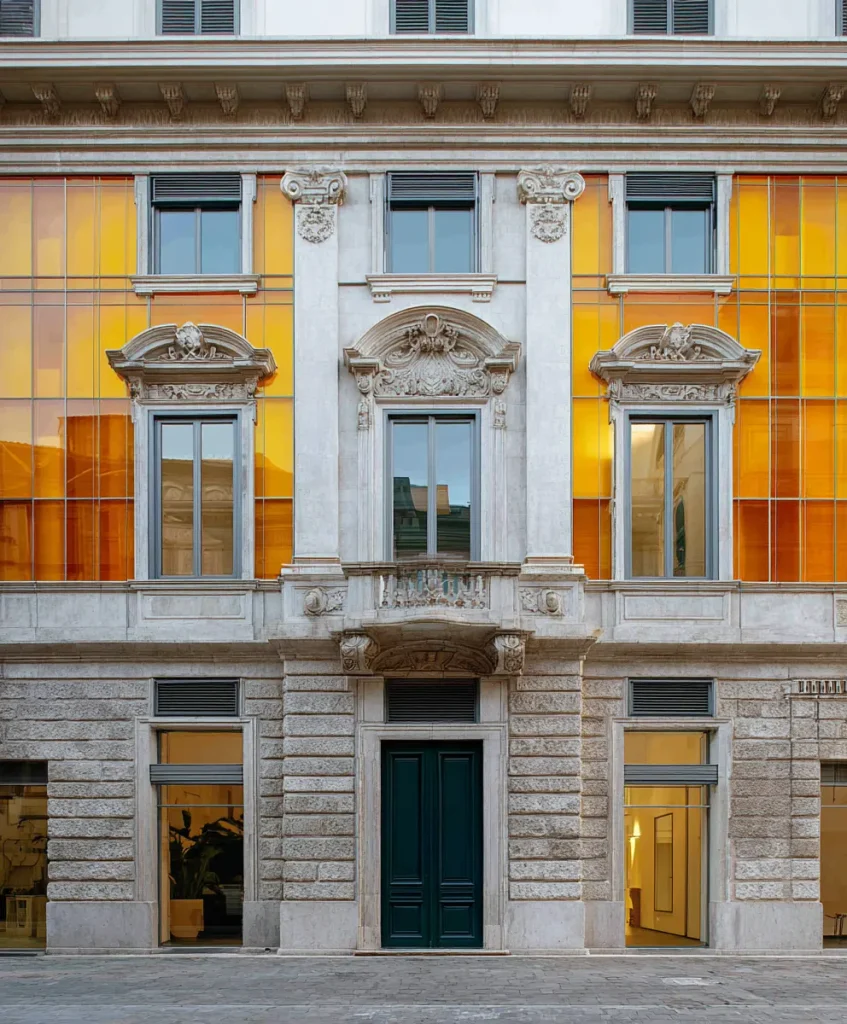
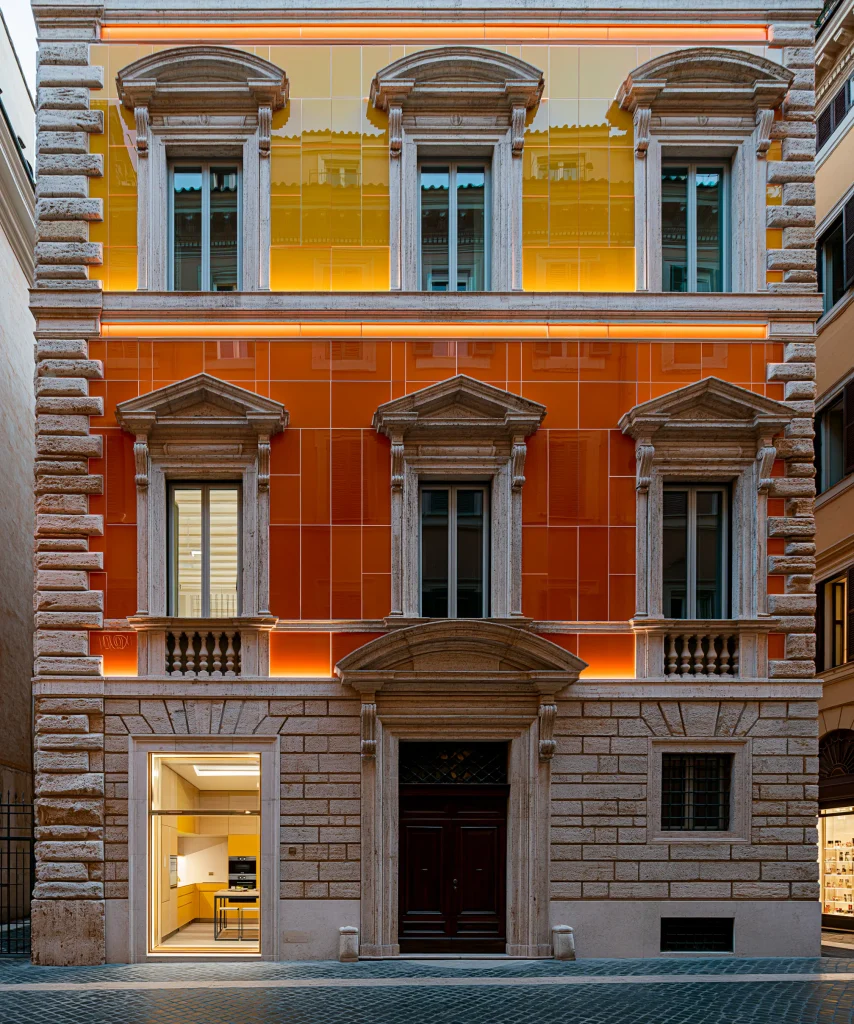
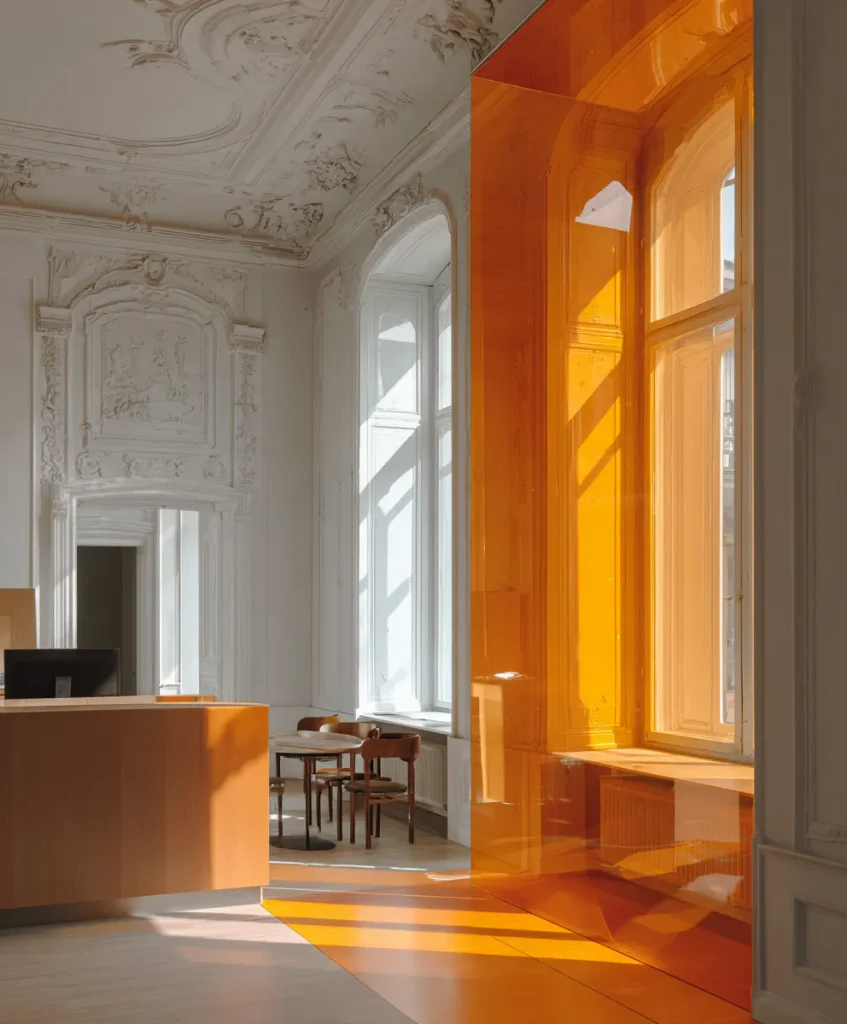
This project emerges precisely from these questions. It is a conceptual proposal set within the historic urban fabric of Rome, imagining the introduction of a new architectural surface onto a stone building with a strong historical identity. The materiality of the existing masonry is juxtaposed with, and at the same time complemented by, a new skin composed of orange reflective panels. A distinctly contemporary element, capable of transforming the perception of the building and the way it relates to its surroundings.
The intervention does not attempt to reproduce the language of the original architecture, nor does it seek to conceal its belonging to the present. On the contrary, it introduces an evident, almost provocative difference, making the encounter between two different moments in time immediately legible. The reflective surface captures fragments of the surrounding landscape, reflects light, and continuously changes its appearance in response to environmental conditions. The orange color emerges as an unexpected chromatic presence against the ancient stone, introducing a warm and distinctive visual identity that establishes a new relationship between the historic fabric and the contemporary intervention.
It is within this tension that the research takes shape: imagining a possible continuity between past and future without resorting to either imitation or complete separation.
Beyond the opposition between old and new
Within the debate on architectural heritage, two broad approaches can be identified. On the one hand, interventions that seek visual continuity with the existing building through materials, proportions, and architectural languages capable of integrating with the pre-existing structure. On the other, approaches that deliberately make the new intervention immediately recognizable through forms and materials that declare their historical and linguistic distance.
Both positions respond to legitimate questions and different design sensibilities. However, this opposition sometimes risks reducing the issue to a binary choice: preserving through similarity or intervening through contrast.
This project proposes exploring a third possibility. Not an intermediate solution understood as a formal compromise, but a different way of conceiving the relationship between historical periods.
Contemporary architecture can engage with historic architecture without necessarily adopting its vocabulary, while also avoiding the transformation of difference into a declaration of conflict. It can acknowledge the value of what already exists while asserting the legitimacy of a new language.
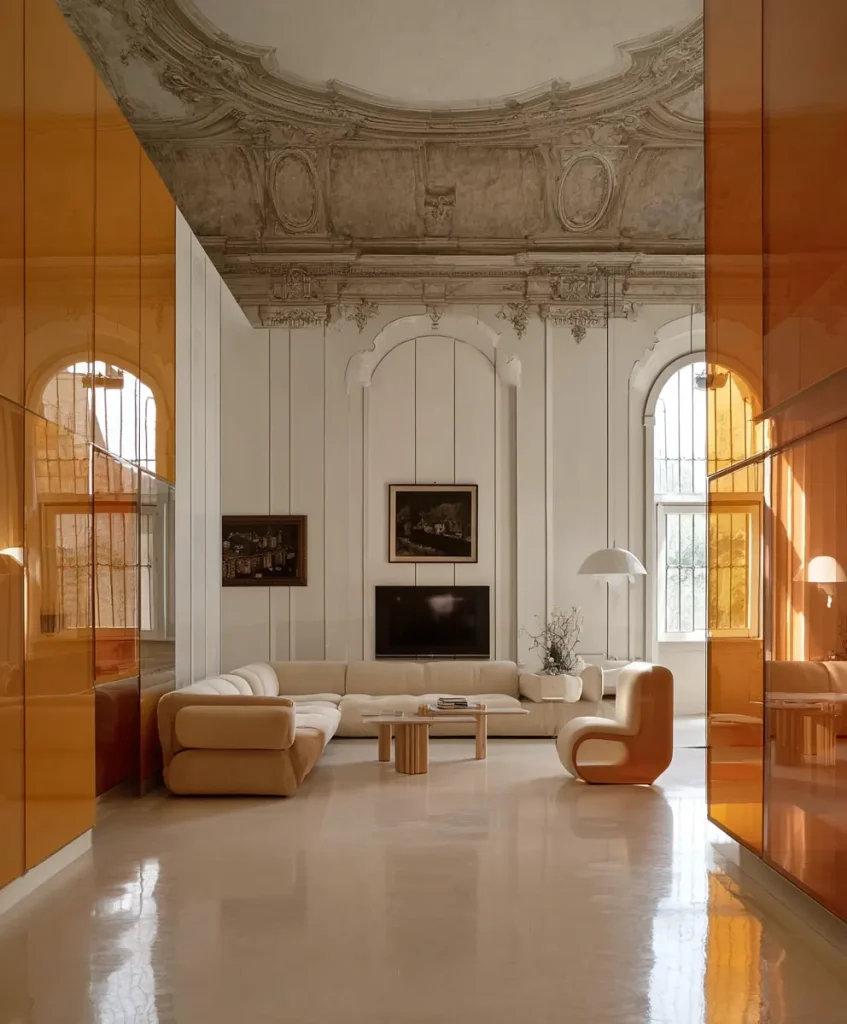
The reflective panels thus become an instrument of relationship. Their surface does not simply cover part of the building: it captures its surroundings, reflects the context, and returns it in a transformed form. The new architecture is therefore not presented as a completely autonomous body, but as an element that visually incorporates the urban landscape into its own image.
The contrast between the stone and the contemporary orange cladding does not erase the reading of the existing structure. Instead, it makes it even more evident. Historic and contemporary materials retain their individual identities, yet are perceived within a new composition. The building becomes a place where different periods of time meet, without either being required to disappear.
Decoration as a contemporary language: between memory and synesthesia
Another central aspect of this research concerns the role of decoration in contemporary architecture.
For a long time, particularly following the development of modernist culture, ornament was progressively pushed away from the center of architectural discourse. Decoration was often associated with a language belonging to the past, an accessory element, or an unnecessary addition to the form and function of a building. Yet, when observing historic architecture, it becomes evident how profoundly decoration has contributed to its identity: façades, cornices, moldings, reliefs, geometric patterns, and ornamental elements are not merely formal details, but testimonies of cultures, techniques, symbols, and worldviews.
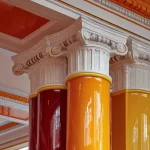
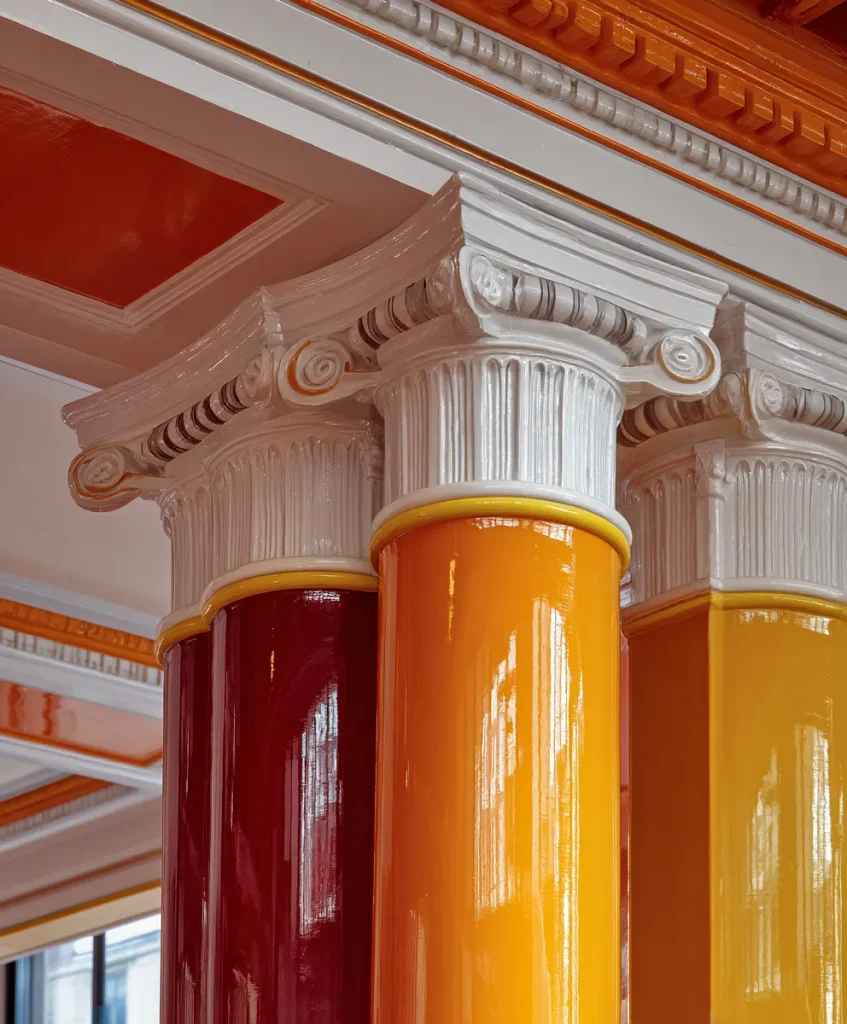
Today, the question should not be how to literally recover the ornaments of the past. Reproducing a capital, a cornice, or a historical decorative pattern does not necessarily mean developing a new language. The challenge is rather to understand the principles that made decoration a fundamental part of architecture and to imagine how they might be reinterpreted through contemporary possibilities.
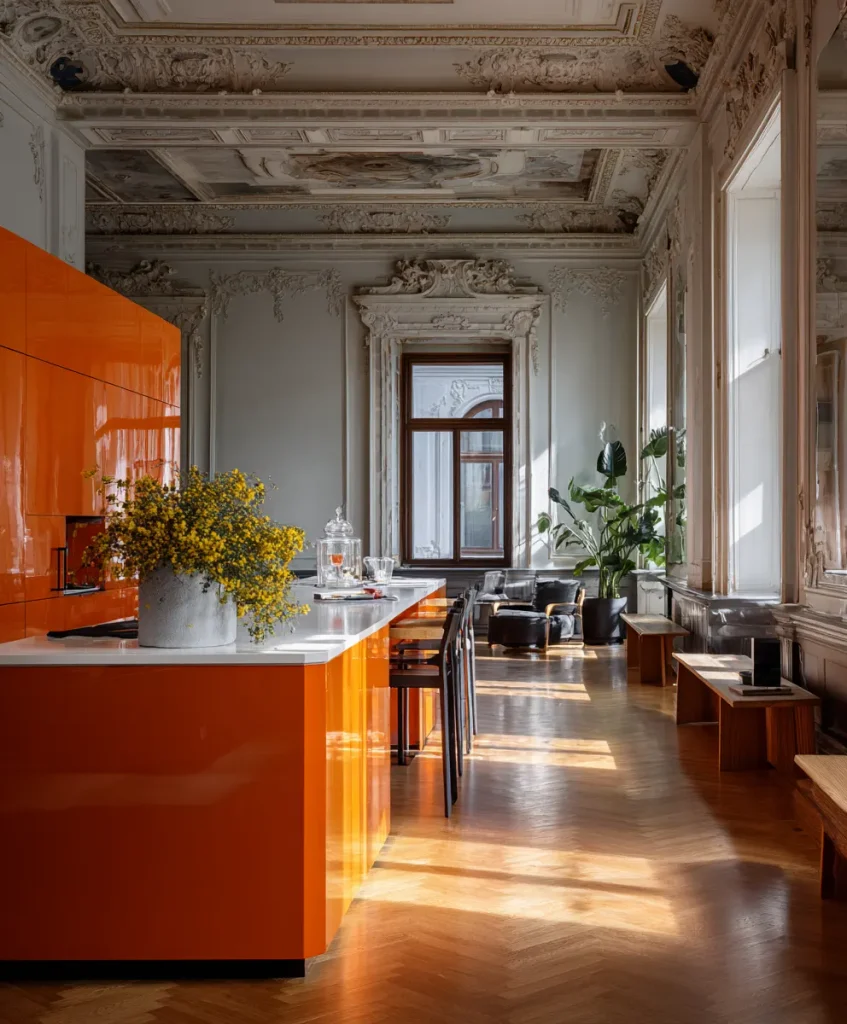
Contemporary decoration does not necessarily have to take the form of an ornament applied to a surface. It can emerge through color, material, light, reflection, texture, and the relationship between architectural elements. It can also draw upon the symbolic and formal heritage of the past, reinterpreting its references through a different visual language. Historical motifs, proportions, rhythms, and archetypes can become starting points for new expressions, without being reproduced literally. In this way, decoration becomes a means of connecting different periods: it preserves a relationship with historical memory while expressing itself through contemporary materials and technologies.
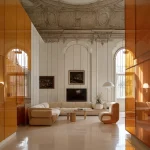
In this project, the orange reflective panels embody this possibility. Their color is not simply an aesthetic choice or a contrast with the existing stone. It becomes an architectural gesture that transforms the perception of the building, introduces a new visual identity, and evokes a different sensory experience. The reflective quality of the panels adds another dimension: the surface captures light and fragments of the surrounding city, making its appearance change according to the time of day, the weather, and the observer’s position.
This introduces a dimension of synesthesia into the architectural experience. Color, light, material, and reflection do not operate as separate elements, but interact to produce a perception that extends beyond the purely visual. The orange surface can evoke warmth, energy, and movement, while the ancient stone conveys permanence, material depth, and historical memory. Their coexistence creates a dialogue between different sensory and temporal associations.
Decoration thus becomes more than a formal addition. It becomes an instrument capable of activating memory, generating sensations, and establishing new relationships between the building and its observer. Rather than reproducing the decorative language of the past, the project seeks to recover its expressive role and translate it into a contemporary vocabulary.
Innovative materials, reflective surfaces, lighting systems, three-dimensional elements, and new production technologies make it possible to conceive decoration beyond its traditional forms. The surface becomes a space for experimentation, where color, light, material, and reflection help define architectural identity.
It is a form of decoration that does not seek to reproduce history, but to create a new layer within it.
The building as a succession of eras
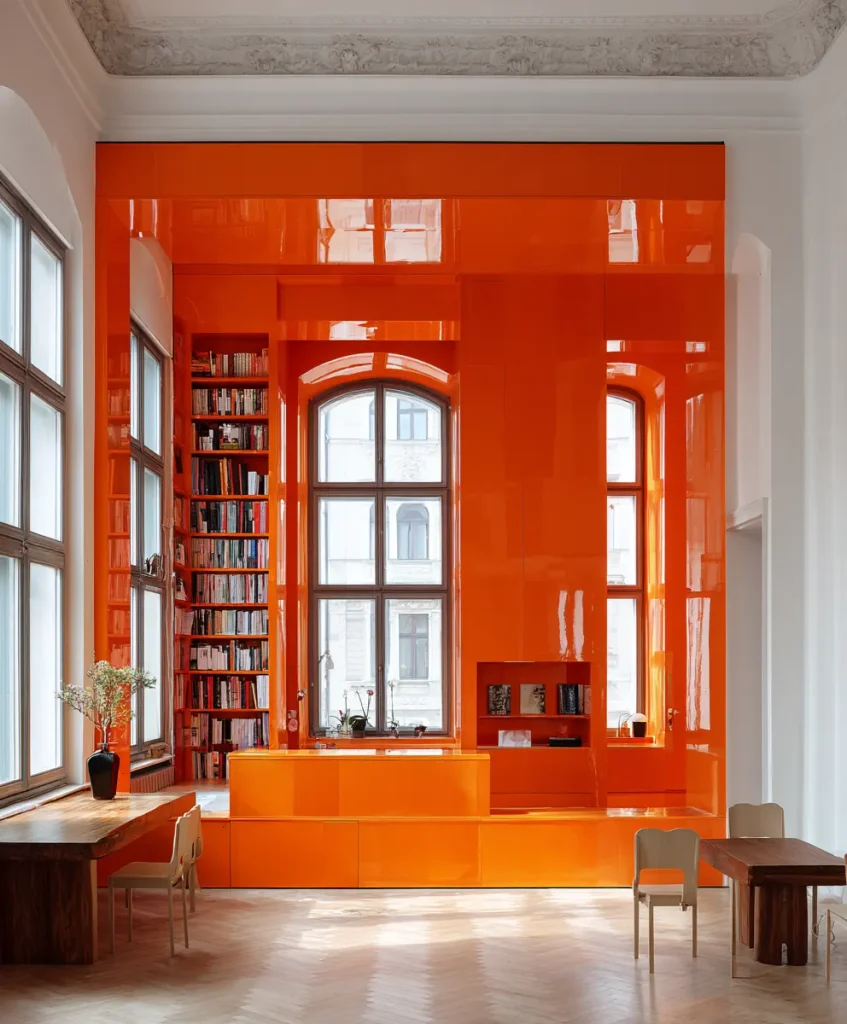
Considering a historic building as a succession of eras means recognizing that its identity does not necessarily coincide with the moment of its construction. What we observe today is the result of a process, a series of transformations that have contributed to defining its present form.
Every architectural intervention inevitably introduces a new relationship with time. Even the decision not to modify a building, to preserve it in its current configuration, represents a choice made in the present. Conservation, therefore, can never be entirely separated from contemporaneity: the present decides what to preserve, how to interpret it, and what value to attribute to it.
From this perspective, a question emerges: why should historical layering end precisely when a building is recognized as heritage to be preserved?
Naturally, this does not mean that every transformation is legitimate, nor does it disregard the requirements of protection, the compatibility of interventions, construction characteristics, or the historical value of existing structures. Rather, it means questioning the possibility of recognizing our own time as having a role in shaping architectural memory.
The project in Rome represents a visual provocation in precisely this sense. The orange of the reflective panels does not attempt to blend into the stone, nor does it reproduce a color or material already present. It introduces an unfamiliar element, making the distance between different eras visible while simultaneously bringing them into relation. The building is not imagined as a finished object, to be observed exclusively through its historical image, but as a structure capable of welcoming another moment in its evolution.
Contemporaneity is therefore not conceived as a temporary addition or an element external to the history of architecture. It becomes part of a possible future layer.
A vision for architectural heritage
The images in this project are not intended to represent an executable solution or propose a universal model for restoring historic buildings. Their nature is deliberately conceptual: through an unexpected material and chromatic juxtaposition, they seek to question some of the visual and design conventions that shape the relationship between old and new.
The objective is not to establish whether reflective panels are the most appropriate material for intervening in a specific building, but to use this choice to open a broader reflection on the expressive possibilities offered by contemporary materials and technologies. Every real intervention should, of course, engage with the specific characteristics of the existing structure, its conservation conditions, heritage regulations, and technical feasibility. Conceptual experimentation, however, can help expand the range of possibilities that precede these assessments.
This is precisely where visual research takes on an important role. The ability to rapidly imagine different materials, surfaces, configurations, and relationships with the surrounding context makes it possible to explore scenarios that might otherwise remain confined to intuition. Images thus become a tool for questioning architecture, rather than simply representing an already defined solution.
Generative artificial intelligence, within this process, makes it possible to develop and test visual hypotheses, experimenting with the encounter between historical languages and contemporary materials. It does not replace architectural design, nor the knowledge required to intervene in the built heritage. Instead, it offers a laboratory of possibilities, where an idea can be observed, transformed, and tested before becoming the subject of more in-depth design research.
Ultimately, the question is not only how we can restore a building, but also what we understand by architectural continuity. If cities are the result of centuries of transformation, why should we consider the present the last era in which we can intervene?
Perhaps preserving history does not necessarily mean bringing its course to a halt. It means recognizing its value and, precisely for this reason, finding the courage to imagine how it might continue.
The past should not become an immobile image to be protected from the future. It can become the material through which the future takes shape.