

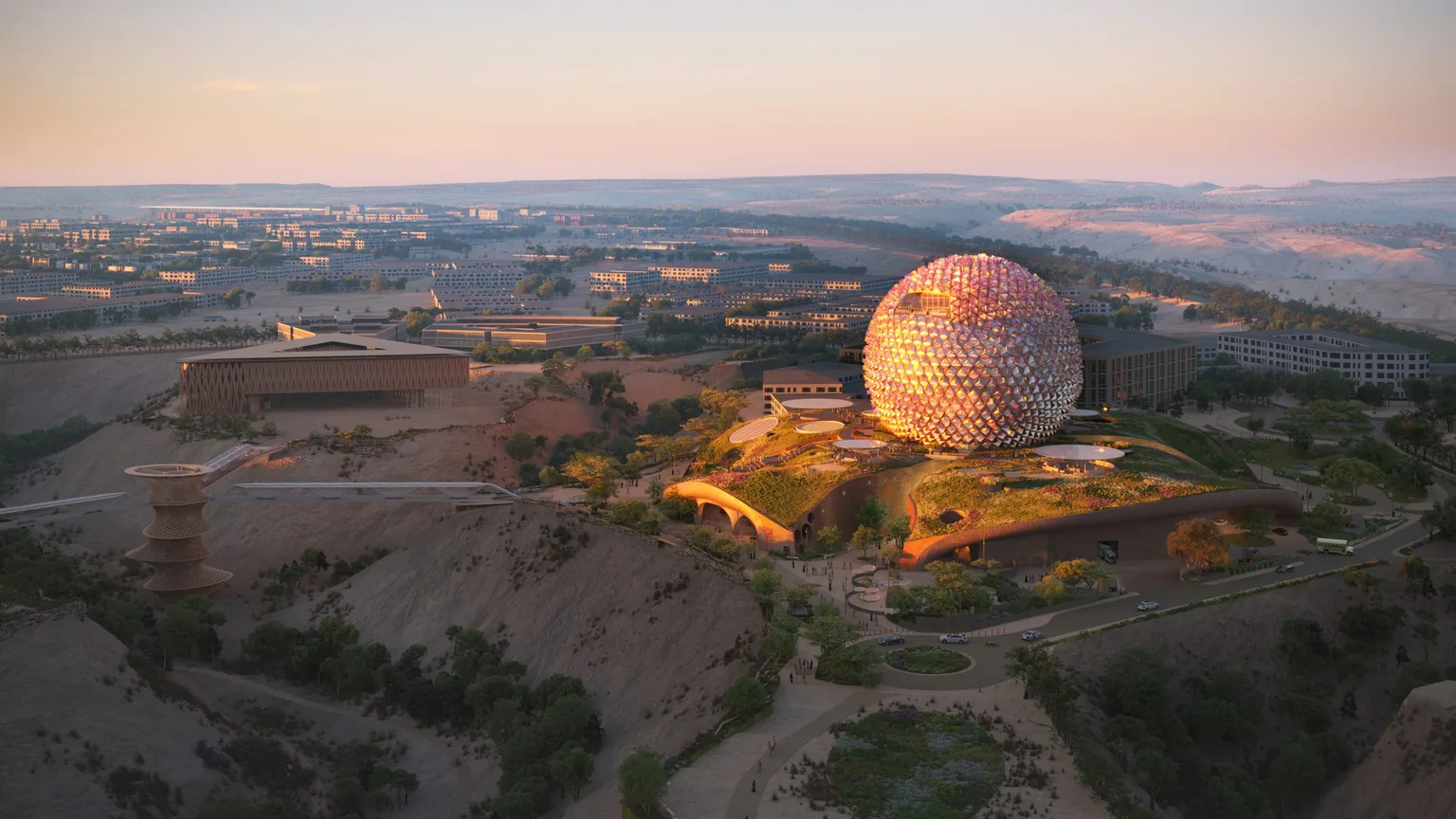


In the desert light of Riyadh, a new kind of landmark is taking shape — not a tower of glass and steel competing for the skyline, but a luminous sphere that seems to hover above a living landscape.
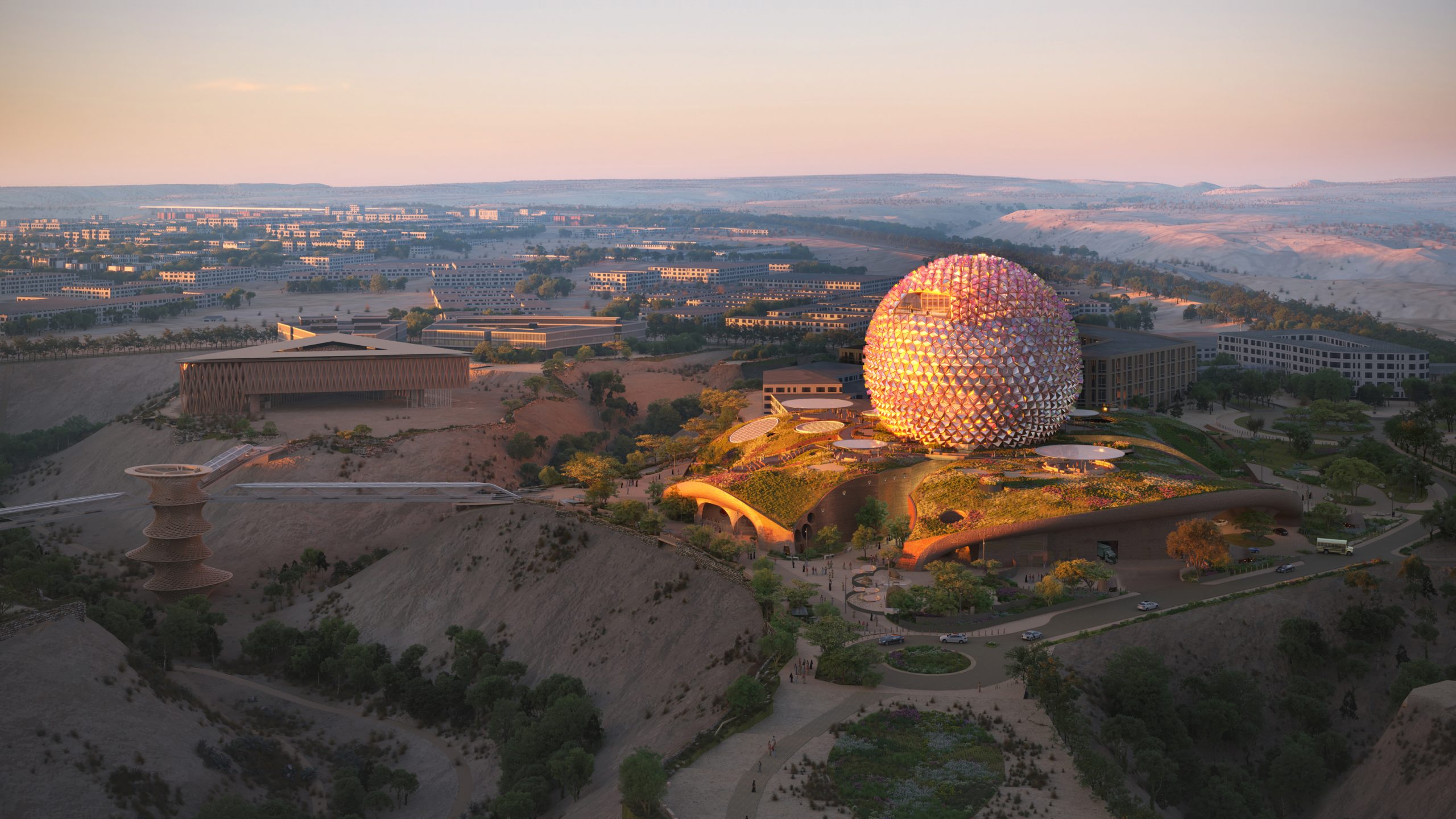
The ILMI Science Discovery & Innovation Center, rising inside Mohammed Bin Salman Nonprofit City, is designed to do something rarer than impress: it aims to make science feel personal, playful, and possible for every young person who walks through its doors.
A National Beacon for STREAM Learning
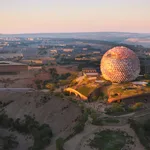
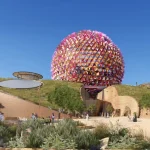
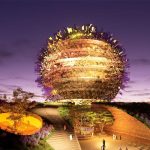
Think of the building as a giant question mark planted in the heart of the capital. Its form is an iridescent geodesic globe, roughly 55 meters in diameter, resting on a fully landscaped plinth that undulates like the surrounding wadi. The total height reaches about 73 meters across 11 floors. The sphere itself is clad in approximately 3,000 pieces of decorative glass that shift color with the sun, turning the entire structure into a living light sculpture.
Created under the vision of HRH Princess Sara Bint Mashhour Bin Abdulaziz Al Saud and supported by the Mohammed bin Salman Foundation “Misk,” ILMI is conceived as a non-profit destination for children aged 6 to 16, their families, and lifelong learners of all abilities. Its mission is straightforward yet ambitious: to make discovering science both fun and accessible, and to help prepare a generation for a future driven by science and technology.
Architecture Inspired by Desert and Flower
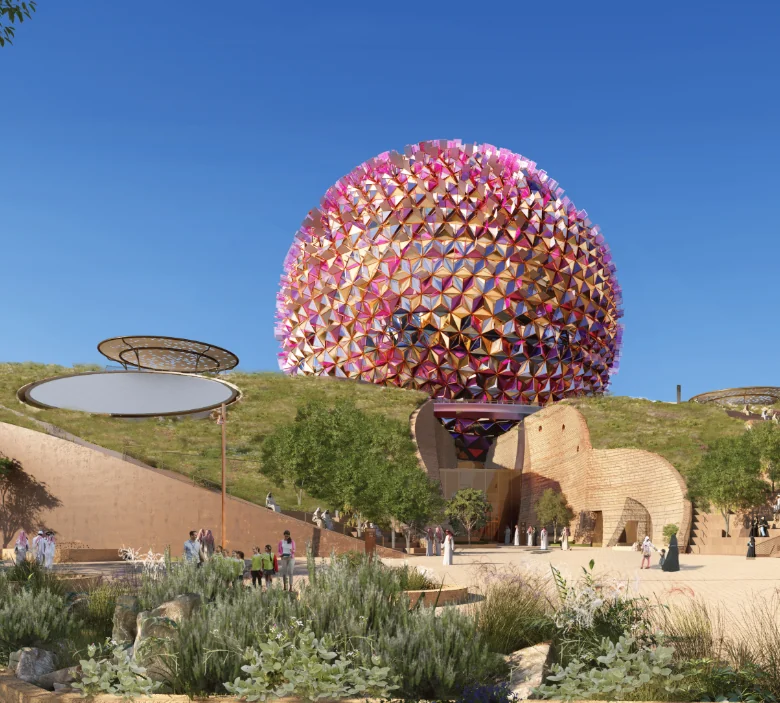
The design, by New York-based WHY Architecture with landscape by WILDING X, draws from two powerful local references. One is the renewable energy of the desert sun. The other is the lilac-coloured Echinops, or globe thistle — known locally in connection with the Shidq Al-Jamal flower — whose spherical form and radiating structure become the building’s primary metaphor.
The result is a massing that feels both futuristic and rooted. The globe sits above a continuous landscape of native plants and greenways covering more than 24,000 square meters. Visitors move between indoor galleries and outdoor gardens almost without noticing the threshold, dissolving the usual separation between learning space and nature.
The Parametric Logic of the Sphere
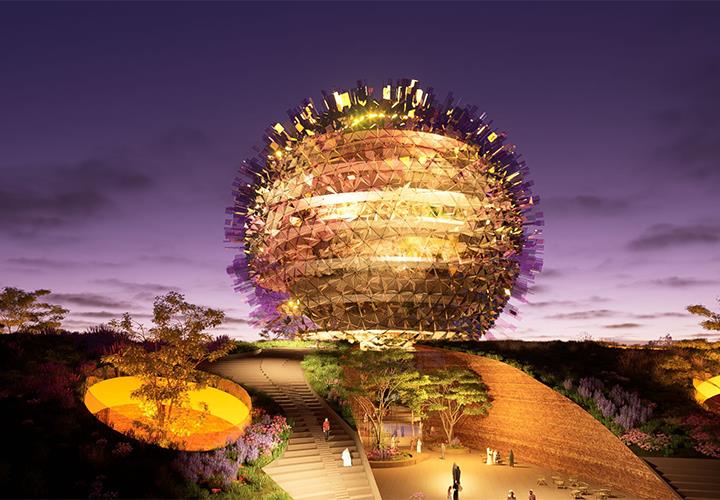
From a computational and systems perspective, the ILMI sphere is a sophisticated exercise in rule-based design. The facade functions as a large-scale mashrabiya. Materials, transparency levels, and shading fins are distributed according to solar exposure and the internal program of each zone. In high-sun areas, the skin becomes denser and more reflective; in other zones, it opens up to frame views or admit controlled daylight.
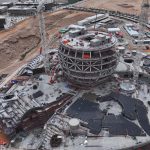
Structurally, the envelope relies on a single-layer inclined steel diagrid with a hierarchical system of nodes. Organic-shaped nodes handle areas of complex curvature, while more conventional nodes optimize repeated geometry. This hybrid approach allows the free-form sphere to be fabricated and erected with precision while remaining constructible at scale. The outer aluminum pyramid cladding panels and architectural fins create depth, texture, and a constantly changing play of light and shadow across the surface.
In essence, the building is a parametric object: a set of interdependent rules governing geometry, structure, climate response, and visitor experience. Change the solar angle or the required light level inside a gallery, and the system adjusts the density of the skin accordingly.
Learning Spaces Designed Around Curiosity
Inside, approximately 8,500 square meters of exhibition halls and learning spaces are organized around three core themes: Our World, Our Selves, and Our Inventions. These zones explore subjects ranging from space and ecosystems to artificial intelligence, always connecting abstract ideas to everyday life.
The approach is co-creative rather than didactic. Exhibits and programs are designed to respond to how young people actually engage with STREAM subjects — what excites them, how they explore, and how they might approach problems differently from previous generations. The center also plans an integrated digital platform with gamified challenges that link online exploration to real-world applications.
Accessibility is treated as a foundational requirement rather than an afterthought. Sensory zoning, multiple modes of circulation, and content designed for varied linguistic, physical, and cognitive abilities aim to ensure that the experience feels open to every visitor.
Progress Toward a 2027 Opening
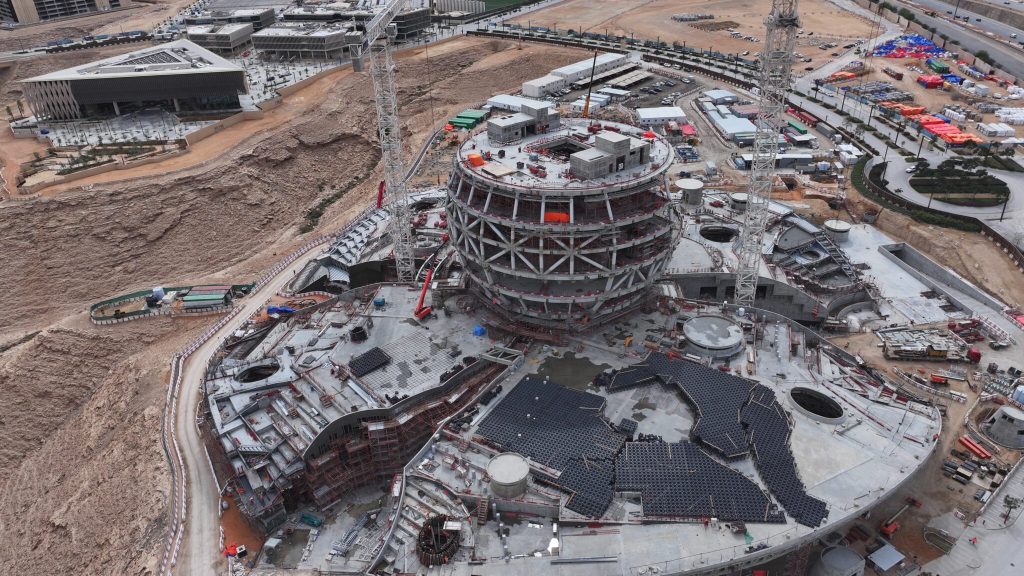
Construction has advanced steadily. The main structural framework was completed in February 2026. By late 2026, exterior cladding was nearing completion, with full project delivery targeted for the second quarter of 2027. The main contractor is ALEC Engineering & Contracting, working with consultants including WSP and AtkinsRéalis.
When it opens, ILMI will sit within the broader fabric of Misk City — itself conceived as a non-profit urban laboratory supporting education, innovation, and community life. In that context, the glowing sphere is both a landmark and a statement of intent.
A Building That Asks Questions
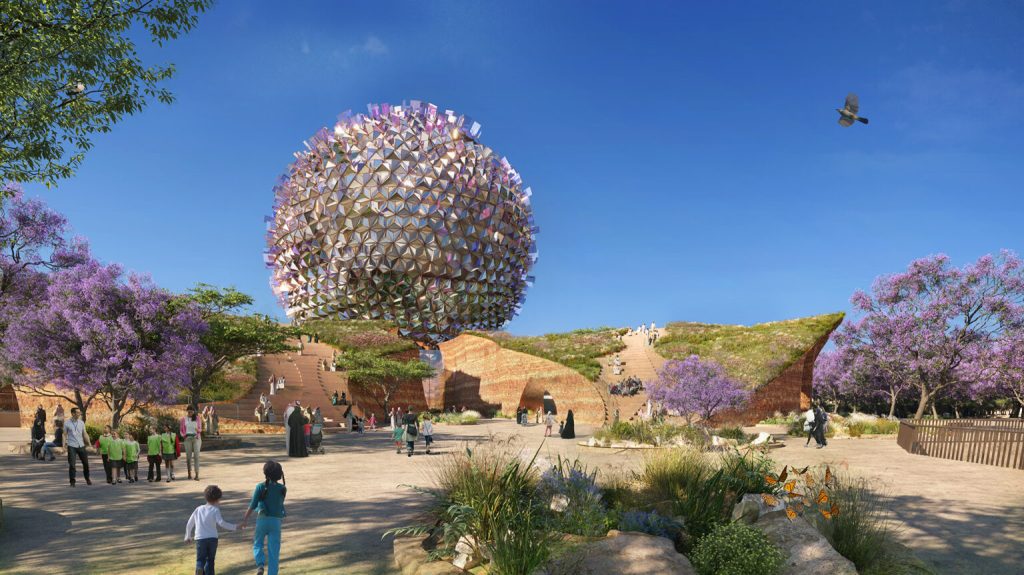
Architecture can celebrate power, wealth, or technical prowess. It can also celebrate curiosity. The ILMI Science Discovery & Innovation Center belongs to the second category. Its form is memorable, its engineering sophisticated, and its environmental performance carefully considered. Yet its real ambition lies in the quieter work of turning visitors into question-askers.
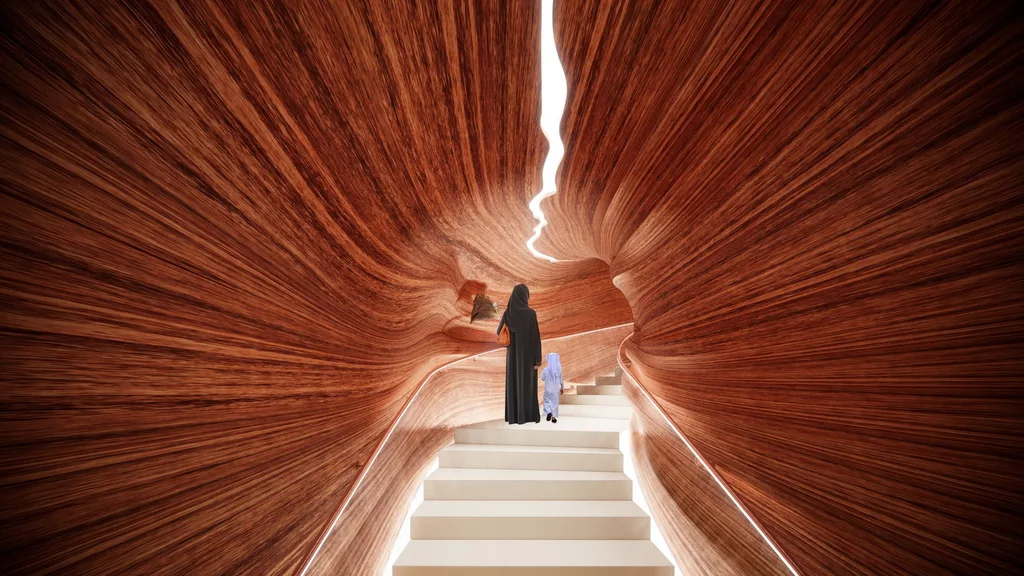
In a region rapidly reinventing itself under Vision 2030, this building suggests that the most valuable infrastructure may not be the tallest tower or the largest airport, but a place where young minds are invited to look closely, experiment freely, and imagine what they might invent next. When the lights inside the sphere finally switch on, and the first groups of children step into its galleries, Riyadh will have gained more than a new silhouette on the skyline. It will have gained a permanent invitation to wonder.