

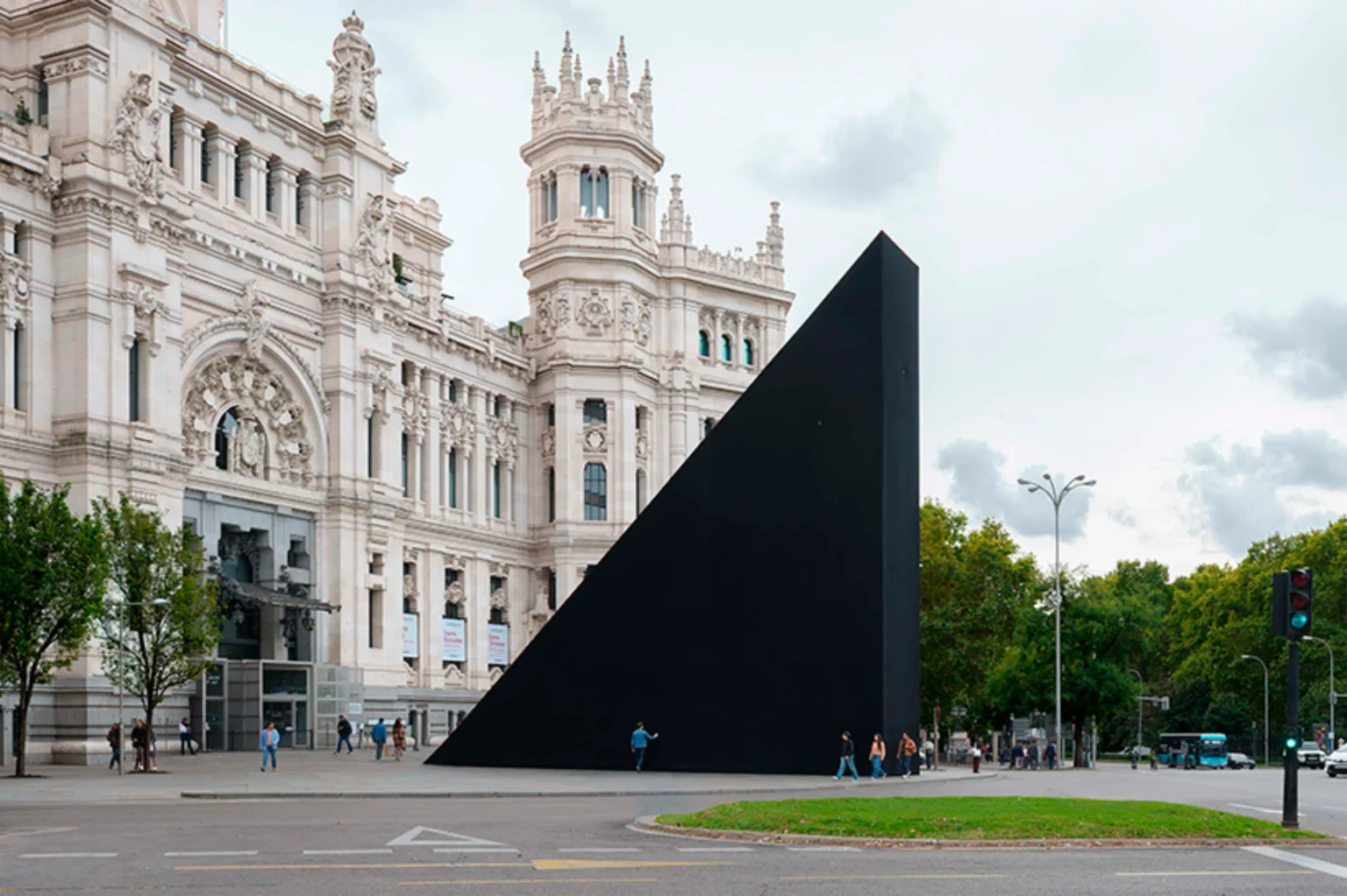


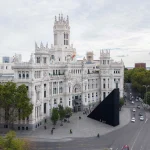
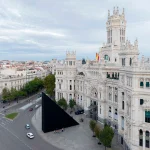
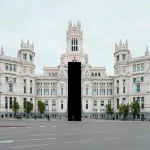

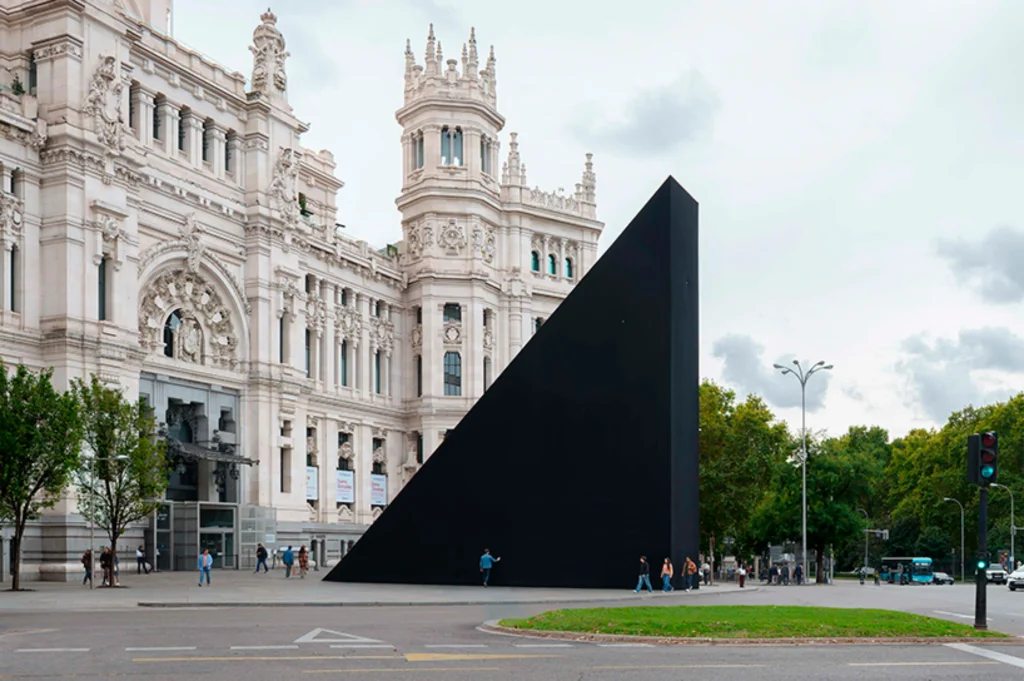
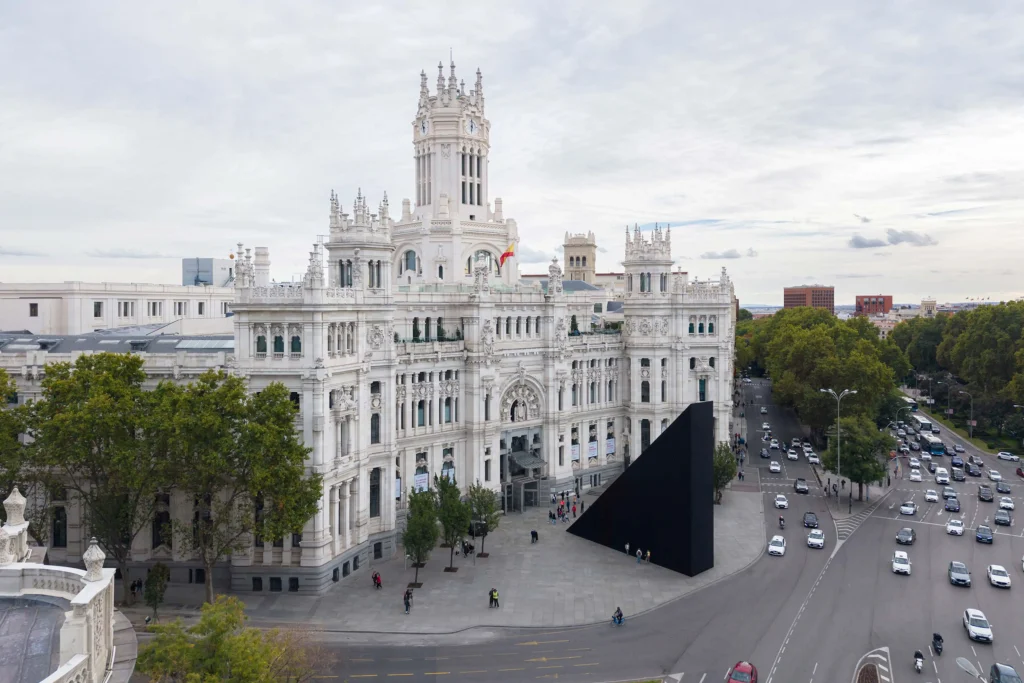
A giant matte-black equilateral triangle measuring 20 meters on each side has appeared in the center of Madrid’s Plaza de Cibeles. Created by Spanish urban artist SpY and titled PANOPTICON, the temporary structure uses concealed apertures and live CCTV feeds to reverse the usual relationship between the watcher and the watched.
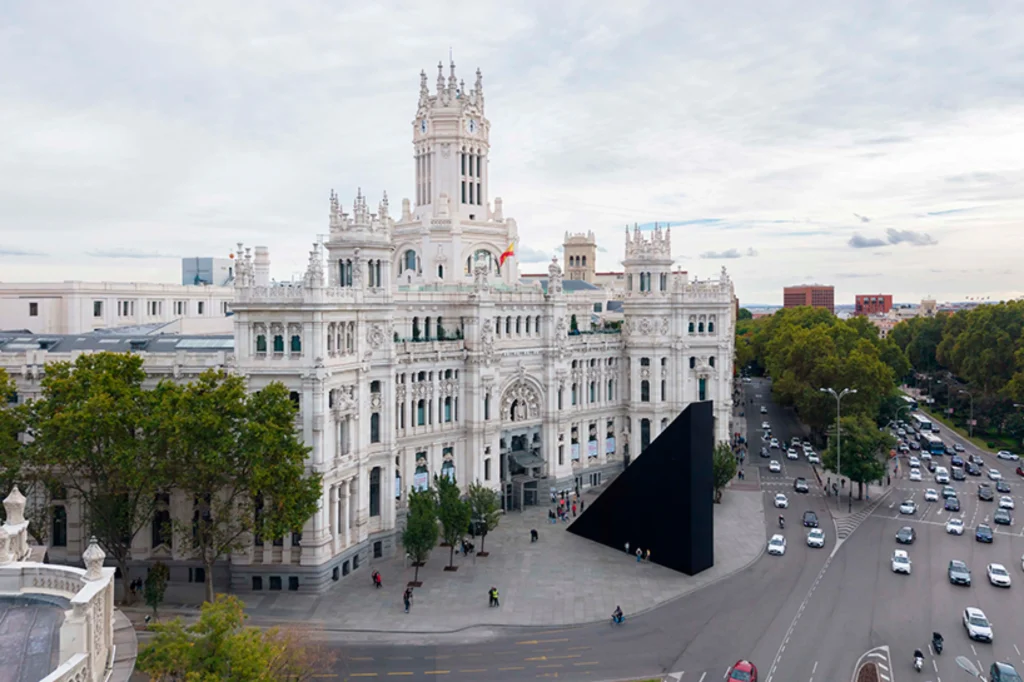
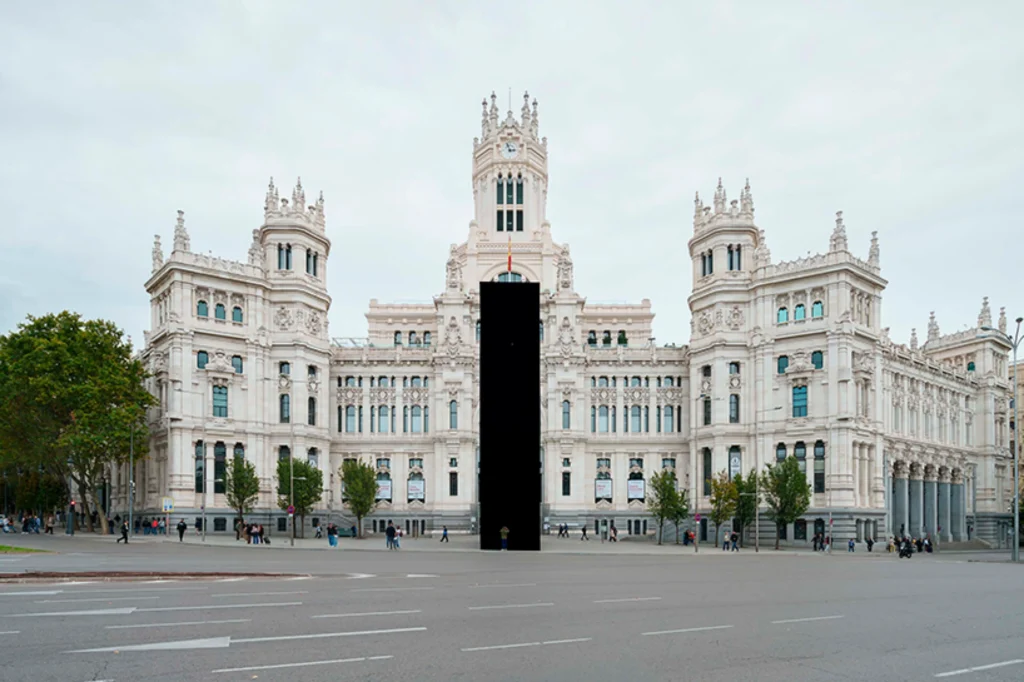
Imagine walking across a familiar public square and finding that a solid geometric mass has erased the view you expected. The ornate facade of the Palacio de Cibeles is partially blocked. Traffic and pedestrians continue around the obstruction, yet something about the space feels altered. That deliberate interruption of sightlines is the starting point of SpY’s latest work. The black triangle does not simply occupy the plaza. It reorganizes how people see and are seen within it.
A Monolith Against History
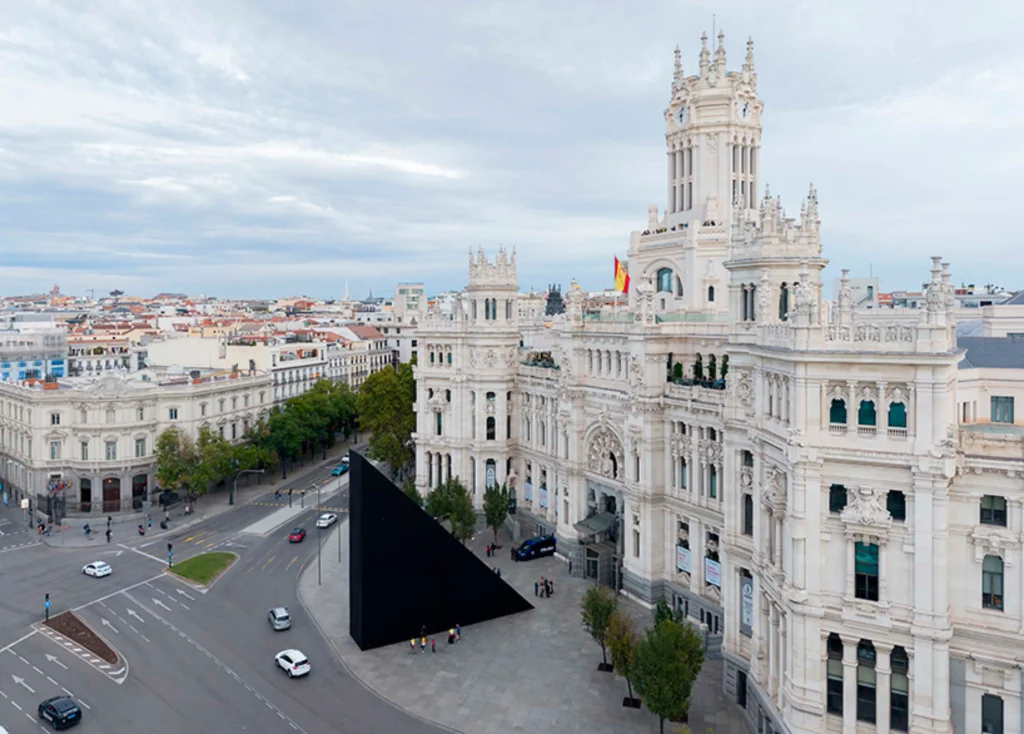
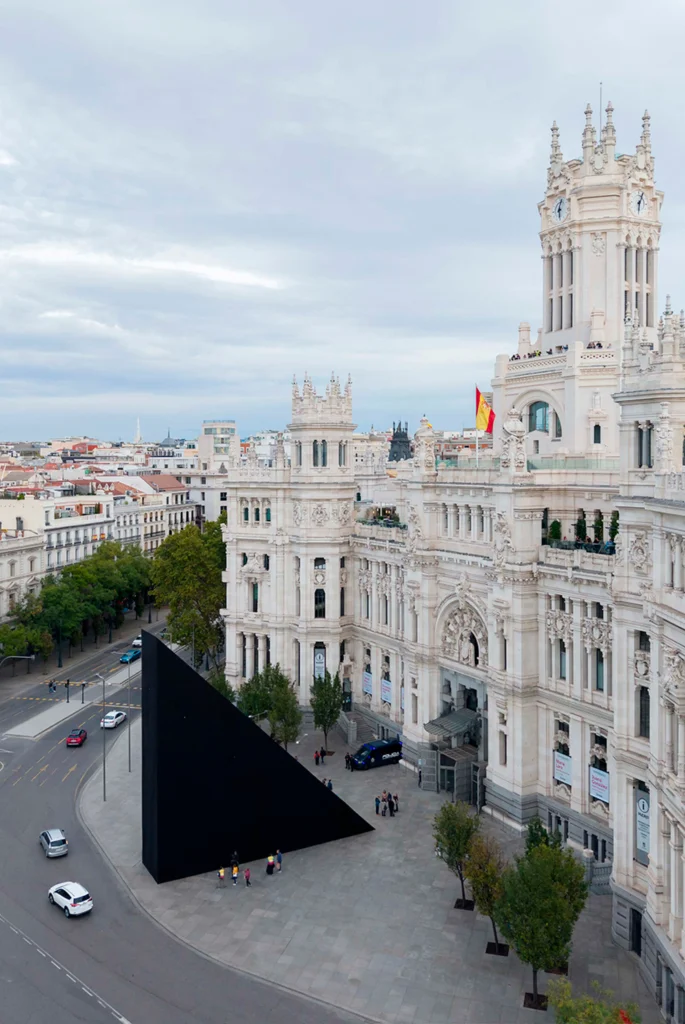
Plaza de Cibeles is one of Madrid’s most photographed civic spaces. The white stone of the Palacio de Cibeles, with its towers, balconies and sculptural detail, normally dominates the visual field. SpY’s triangle sits directly in front of the building, its flat black planes creating an abrupt formal contrast. The equilateral geometry measures 20 meters per side. Its matte finish absorbs light rather than reflecting it, turning the object into a void-like presence against the classical architecture.
The scale is human enough to feel approachable yet large enough to redirect pedestrian movement. People naturally circulate around the sharp corners. The structure becomes both landmark and barrier, forcing a momentary negotiation with the altered square.
Looking Through the Walls
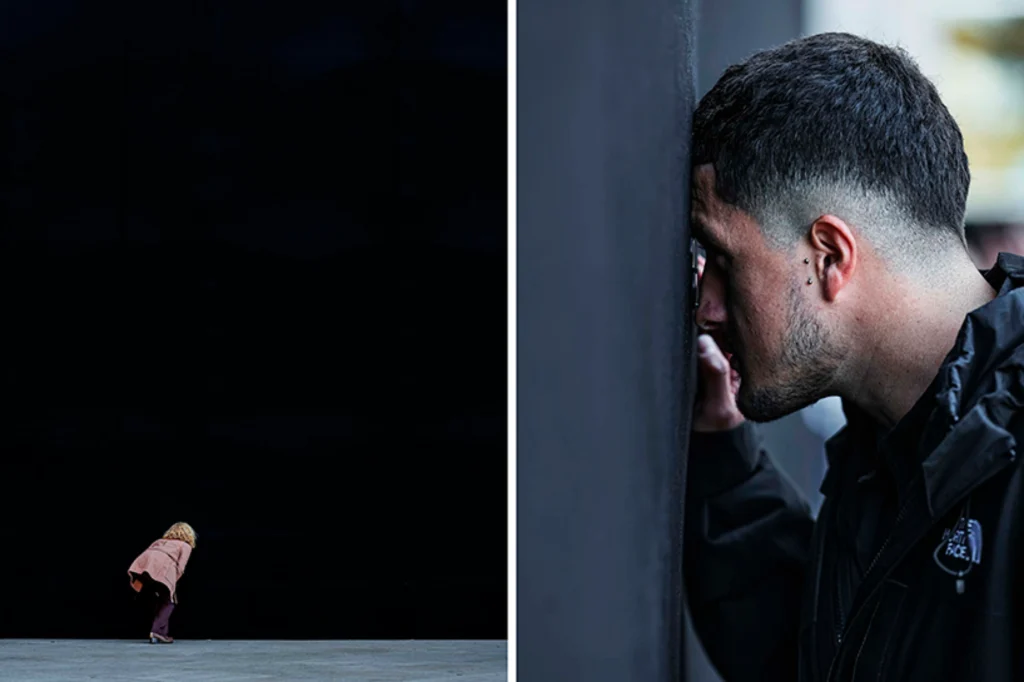
The conceptual core of the work lies in a series of discreet viewing apertures set into the lower perimeter of the triangle. Visitors who approach and peer inside discover small monitors. Each screen is linked to closed-circuit cameras mounted along the upper rim and at the apex of the structure. The cameras look outward and downward, capturing live, high-angle footage of the surrounding plaza: cars, walkers, cyclists, the facades of nearby buildings, and the very people who moments earlier stood outside the triangle.
What the visitor sees is not a curated image but a fragmented, real-time surveillance feed of the public space they have just left. The act of looking is inverted. Instead of being the subject under observation, the visitor becomes the observer, watching others through the same technological apparatus that usually watches them. The opacity of the black volume ensures that those outside cannot see the people looking out. The classic power dynamic of the panopticon is both referenced and reversed.
Bentham’s Model in the Digital City
Jeremy Bentham’s late-eighteenth-century panopticon proposed a circular prison in which a single unseen guard could observe every inmate. The architectural principle was less about constant watching than about the possibility of being watched at any moment. SpY’s installation translates that principle into the contemporary urban condition, where CCTV cameras, facial recognition systems and data tracking have become ambient features of public space.
By placing the surveillance apparatus inside an art object and inviting the public to operate it, PANOPTICON makes the usually invisible system tangible. The cameras do not record for an unseen authority. They feed images directly to the people standing at the apertures. The work asks whether the simple act of looking through a surveillance feed changes one’s understanding of privacy, movement and collective space.
Temporary Architecture as Critical Device
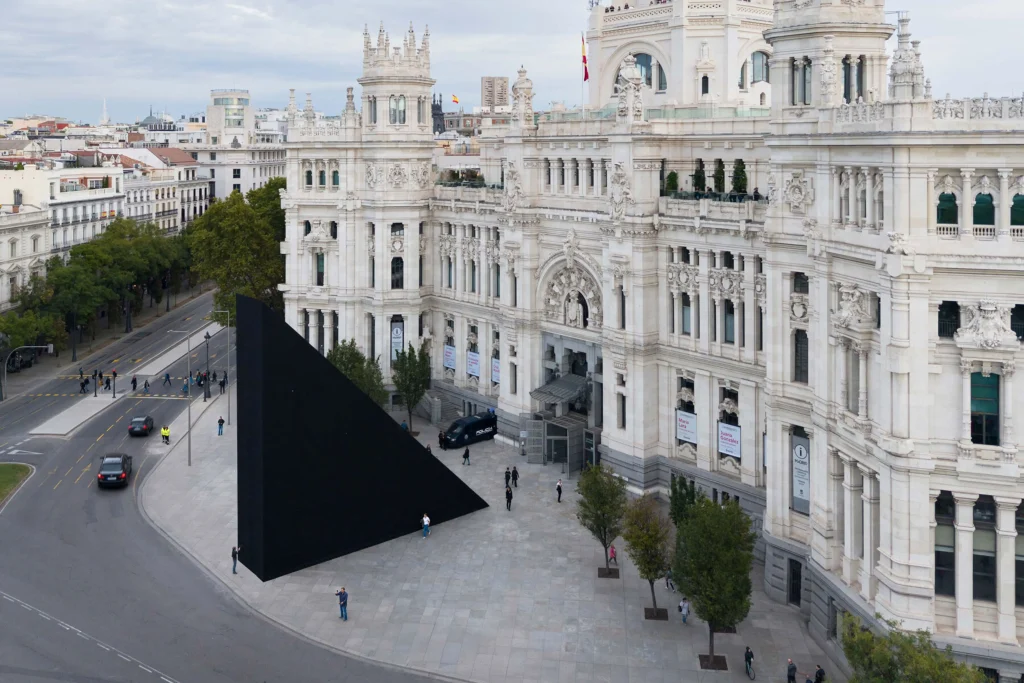
The installation is temporary, which intensifies its impact. For a limited period, the familiar square is occupied by an object that is simultaneously a sculpture, a viewing device, and a conceptual instrument. Its presence is not permanent infrastructure but a provocation that can be experienced, discussed, and then removed, leaving the memory of the altered sightlines and the inverted gaze.
SpY has long worked at the intersection of urban intervention and social commentary. Previous projects have used light, kinetic elements and large-scale geometric forms to interrupt everyday perception. PANOPTICON continues that trajectory by treating the language of surveillance hardware itself as material. The CCTV cameras and monitors are not decorative additions. They are the functional and conceptual heart of the piece.
Parametric Thinking in Public Art
Although the triangle appears as a pure geometric solid, its design involves careful calibration of scale, aperture placement, camera angles and internal viewing positions. The height and angle of each aperture must allow comfortable viewing while maintaining the external opacity of the volume. Camera positions at the apex and upper edges are chosen to produce legible yet fragmented views of the square. The equilateral geometry itself is parametric: any change in side length would alter the relationship between human scale, visual obstruction and circulatory impact on the plaza.
In this sense the work operates as a temporary parametric system. Inputs include the dimensions of the square, the height of surrounding architecture, pedestrian flow patterns and the technical constraints of live video transmission. Outputs are the specific experiences of obstruction, discovery and mediated looking that visitors encounter. The black surface functions as a constant, while the internal network of cameras and screens introduces controlled variability.
What Remains After the Triangle Leaves
PANOPTICON does not offer solutions to the expansion of urban surveillance. It stages a brief, physical encounter with the mechanisms that already shape public life. By turning the plaza into both subject and viewing platform, SpY makes visible a condition that is usually ambient and therefore easy to ignore. Visitors leave with the memory of having looked through the same technological eye that looks at them every day.
In a city increasingly layered with cameras, sensors and data capture, the black triangle stands as a temporary monument to the act of looking itself. Its power lies not in spectacle alone but in the quiet inversion it performs: for a few days in Madrid, the watched become the watchers, and the square becomes a mirror held up to its own systems of observation.