
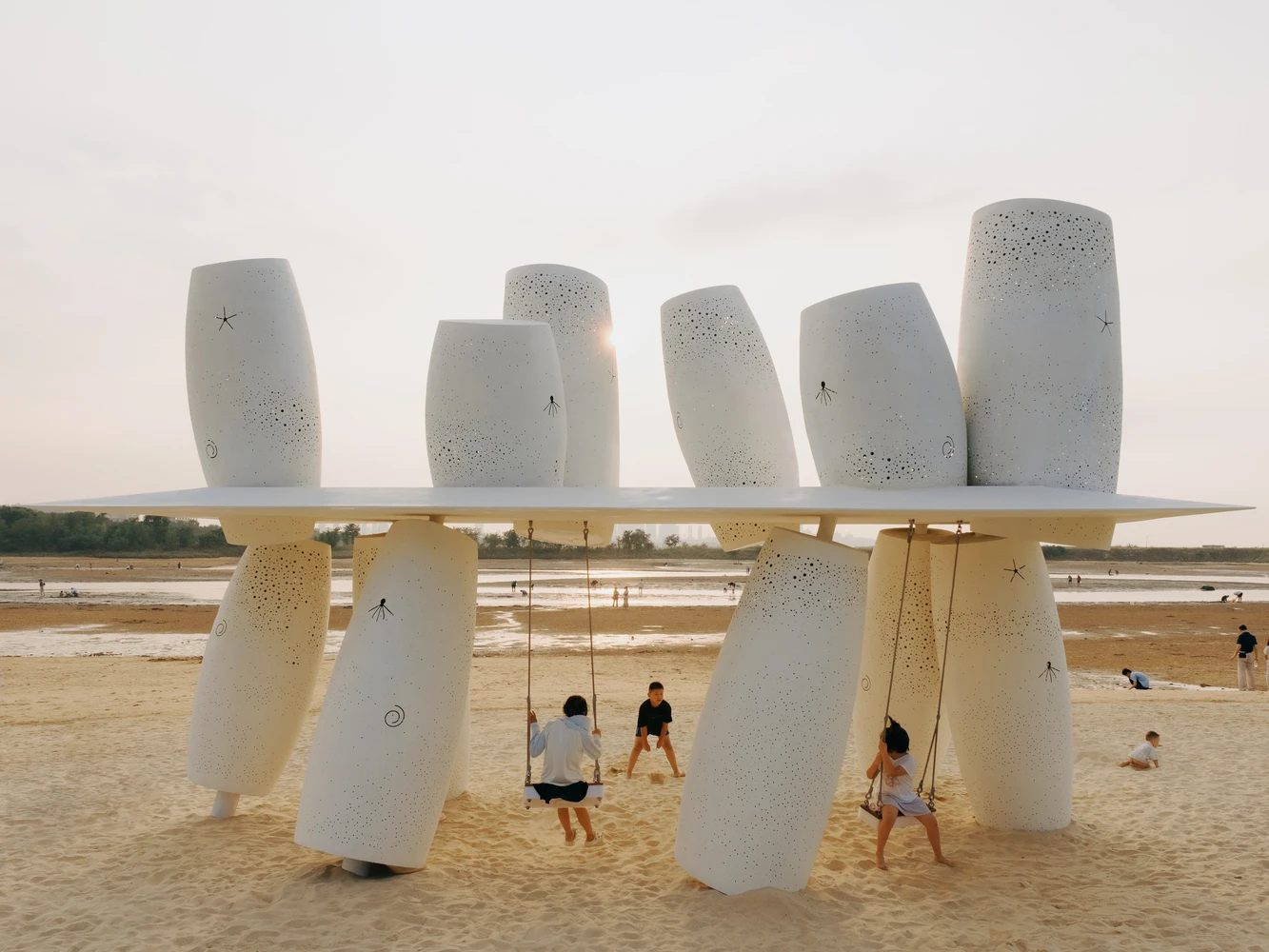

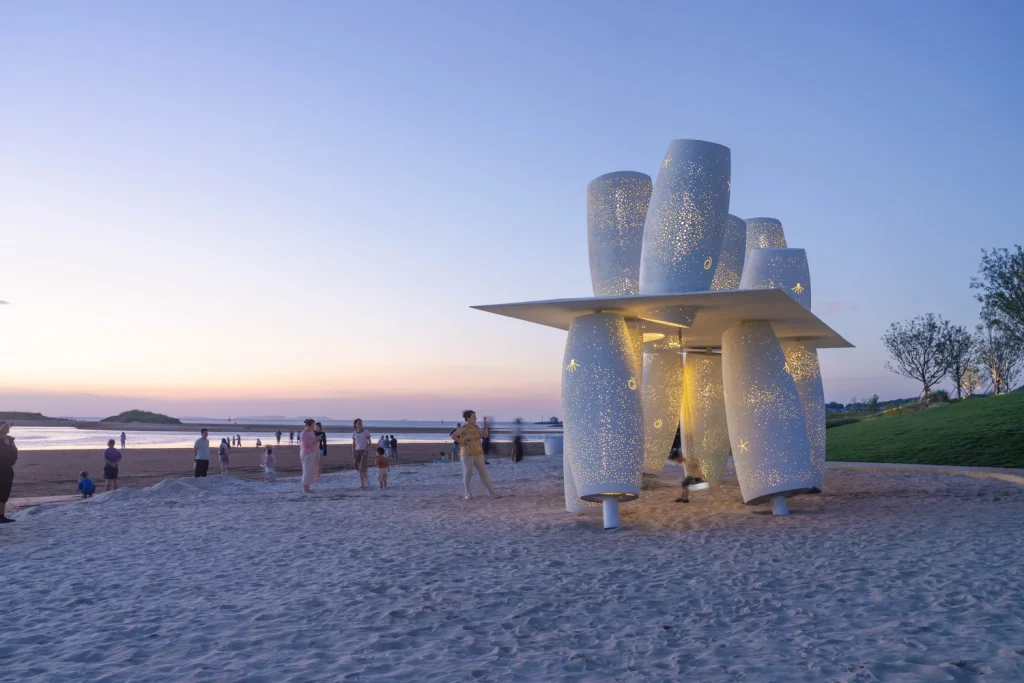
At the northwestern edge of West Park on Yantai’s Longfor Puti Peninsula, 12 white cylinders stand like an unfamiliar marine species that has surfaced from the ground. They lean, overlap, split into clusters, and hold a thin horizontal plane above two swings. From a distance, the installation reads as a piece of coral enlarged to urban scale. From within, it becomes a room without walls, a playground without prescribed routes, and a coastal frame for looking outward.
Named Coral, the installation by XBTW Office brings twelve oversized white stainless-steel cylinders to Yantai’s waterfront. Each cylinder is perforated with between 2,000 and 4,000 openings, ranging from 4 to 25 millimeters in diameter. The pattern density shifts across the surfaces, creating a porous visual field inspired by the aggregation and dispersal of deep-sea fish schools.
Coral is a reminder that a computational idea does not need to look complicated. It needs to organise experience.
12 white cylinders, infinite readings
The cylinder is one of architecture’s oldest geometric forms. It can operate as a column, pipe, tower, chimney, vessel, bollard or structural core. It is stable, easy to repeat and immediately understood. XBTW Office takes that familiar form and makes it less predictable.
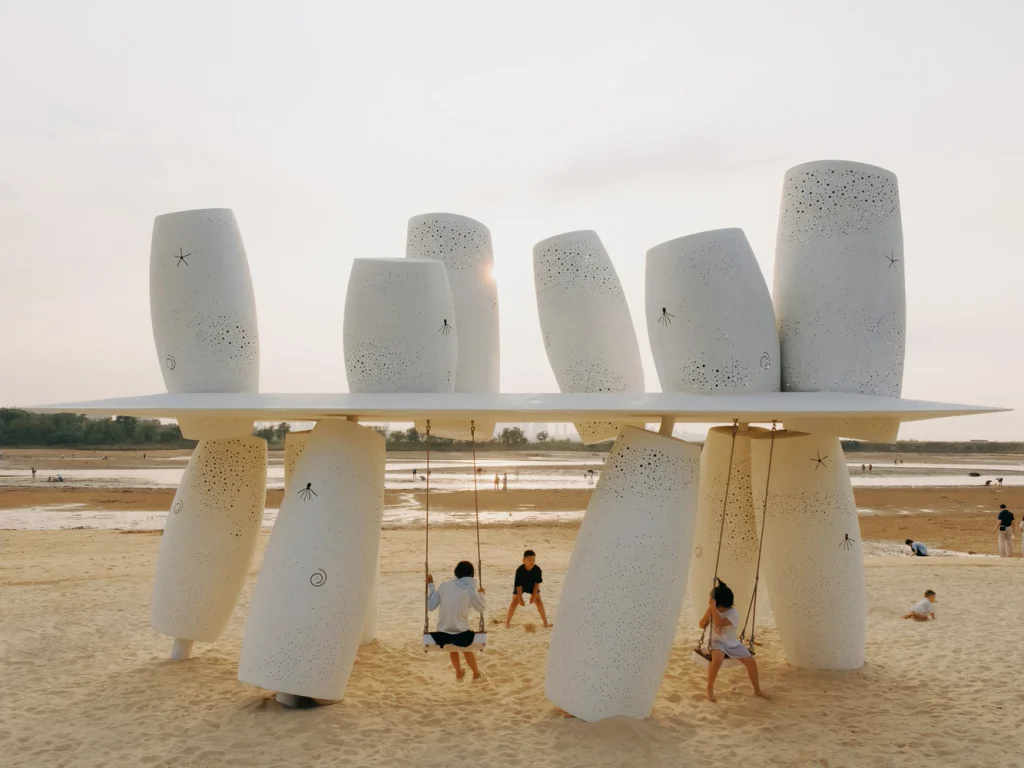
The 12 cylinders are arranged in two groups, above and below a thin roof plane. They stand at different heights and angles, shifting from vertical to inclined positions. Their overlaps create cavities, narrow passages, and pockets of shade.
This is a simple rule system with a complex spatial result.
The project does not rely on a single iconic silhouette. Its identity changes with movement. From one side, the cylinders appear dense and almost solid. From another, their perforations align to reveal the sky, sea or figures beyond. A visitor walking through the installation constantly recalibrates their position, reading the structure as object, shelter, screen and landscape marker.
That is one of the most enduring lessons of parametric design. Variation creates experience when it is tied to the body. A field of repeated components becomes meaningful when it changes the way a person enters, pauses, looks and moves.
Coral as an urban landscape device
Urban installations are often expected to perform too many tasks at once. They must be photogenic, culturally legible, durable, safe, interactive and capable of attracting visitors. Coral takes a more focused route. It creates a small public landscape around three basic actions: swinging, sitting and looking.
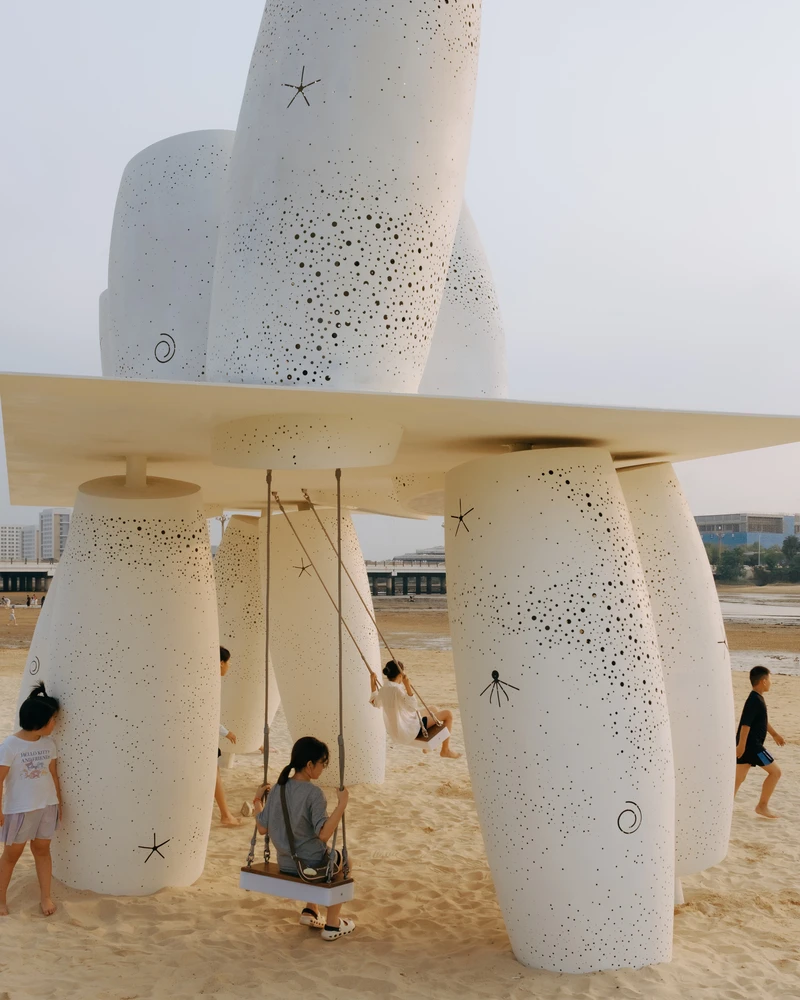
Two west-facing swings hang beneath the horizontal roof plane, positioning visitors toward the sea and the evening light. That directional decision is important. It transforms a simple piece of playground equipment into an observational device.
The swing is usually understood through motion. Here, it also frames stillness. A person can move gently beneath the perforated roof, watch the changing sky through the cylinders and become part of the installation’s shifting composition.
This creates a public space without the usual urban furniture vocabulary. There are no benches lined along a path, no enclosed pavilion, no rigid boundary between object and activity. The cylinders define the space indirectly.
For coastal urban design, this is a useful strategy. Waterfronts often struggle between two extremes: open promenades that feel exposed and large buildings that interrupt views. Coral occupies a middle ground. It creates enclosure while maintaining visual permeability.
The perforation field as environmental texture

The most computational aspect of Coral lies in its perforation pattern. The holes vary in size from 4 to 25 millimetres, with approximately 2,000 to 4,000 perforations on each cylinder. Rather than applying a uniform screen, the design creates gradients of density.
The visual reference is the movement of fish schools. Dense clusters loosen into sparse zones, turning the white stainless-steel skin into a field that appears to gather and disperse. This is not biomimicry in the literal sense. The cylinders do not attempt to imitate coral or fish anatomically. Instead, they borrow an organisational principle from marine life: aggregation through variation.
For computational designers, this is a familiar yet powerful method. A base geometry remains stable, while a parameter such as hole diameter, spacing, density or orientation changes according to a local rule.
A perforation field can respond to view direction, solar exposure, privacy, airflow or structural requirements. In Coral, the system appears to be used primarily for visual and atmospheric effect. Light passes through the openings in a diffuse pattern, while the surface gains depth without losing its basic cylindrical identity.
The project shows how a parametric surface can stay materially direct. The holes are not an ornamental afterthought. They alter transparency, scale and the relationship between the object and the coastal environment.
White stainless steel against sea and sky
The choice of white stainless steel gives Coral a strange dual quality. It is industrial in material, yet soft in appearance. Stainless steel suggests durability, fabrication precision and public infrastructure. White makes the cylinders feel closer to ceramic, coral or marine foam.
Against the blue-grey horizon of Yantai’s coast, the structure becomes a bright marker. On clear days, it likely reflects intense daylight. Under overcast conditions, it may blend into the muted palette of sea, mist and sky. At sunset, the west-facing swings turn the installation into a viewing apparatus.
Coastal installations face demanding environmental conditions. Salt spray, moisture, wind-driven particles and ultraviolet exposure can rapidly damage unsuitable finishes and fasteners. The long-term performance of the project will depend on the specific stainless-steel grade, connections, coating system and maintenance plan, details that have not been publicly disclosed.
That uncertainty is worth noting. In installation architecture, visual impact is immediate, but durability is architectural. A coastal object must remain safe, cleanable and structurally stable after thousands of visitors, repeated weather cycles and corrosion exposure.
For architects, this is where design expression meets specification discipline.
A non-digital project with digital logic
Coral does not announce itself as a computational project. There are no visible robotic toolpaths, immersive screens or algorithmic diagrams on site. Yet its design thinking is close to computational practice.
The installation begins with a repeated module. It introduces controlled variation in height, orientation and perforation density. It tests how a population of identical forms can produce spatial difference. It works through local effects rather than a single total form.
This is the language of agent-based systems, field conditions and parametric assemblies, translated into an accessible public structure.
The project also avoids a common trap in digital design: treating visual complexity as proof of sophistication. Coral uses twelve cylinders and a roof plane. The geometry is easy to describe. Its impact comes from how these simple elements are composed.
That is a valuable lesson for young designers. Scripts, parametric models and simulation tools should help clarify design intent, not bury it beneath formal noise.
The playground as civic infrastructure
Coral belongs to a growing group of installations that blur the boundary between public art, landscape architecture and play infrastructure. This hybrid condition deserves attention.
Play is often confined to designated zones with brightly coloured standard equipment. Public art, meanwhile, is frequently treated as something to look at rather than touch. Coral mixes these categories. Its swings invite use, its clustered forms create a spatial experience, and its perforated geometry supports visual discovery.
This hybrid model can make public space more inclusive. Children read the cylinders as a place to explore. Teenagers may use it as a meeting point. Adults can sit on the swings or photograph the changing view. Passers-by may simply move through the structure on the way along the coast.
Its success will depend on whether it remains welcoming once its novelty fades. A good public installation must continue to work after the social-media moment. The fact that Coral provides shade, seating-like opportunities, movement and a view gives it a stronger chance than a purely sculptural landmark.
Complexity through restraint
Coral by XBTW Office proves that urban installations do not need to be massive, expensive or geometrically extravagant to create a memorable public experience. Twelve perforated cylinders, a slim roof and two swings are enough to produce a small landscape of movement, light and coastal observation.
On Yantai’s coastline, Coral does not attempt to compete with the sea. It works as a porous threshold between city and water, structure and play, digital logic and physical encounter.