


Architecture has a peculiar relationship with time. The profession designs schedules, sequences construction, coordinates complex systems, and calculates the duration of everything from material installation to building occupation. Yet inside many architecture practices, time remains one of the least controlled resources. Late nights, weekend work, unpaid hours, and last-minute deadlines are frequently treated not as failures of management but as ordinary features of professional life.

The persistence of overtime in architecture is not simply a consequence of demanding projects. It is the result of a professional culture that has gradually transformed excessive working hours into evidence of commitment. The architect who stays until midnight can appear more dedicated than the colleague who leaves at six. The employee who answers messages over the weekend can be perceived as more reliable than someone protecting their private time. In this environment, exhaustion becomes professional currency.
The problem is deeper than long working hours. When overtime becomes normalized, it changes how architectural work is valued, how offices are managed and how the next generation understands professional success.

The Myth of the Architect Who Never Stops Working
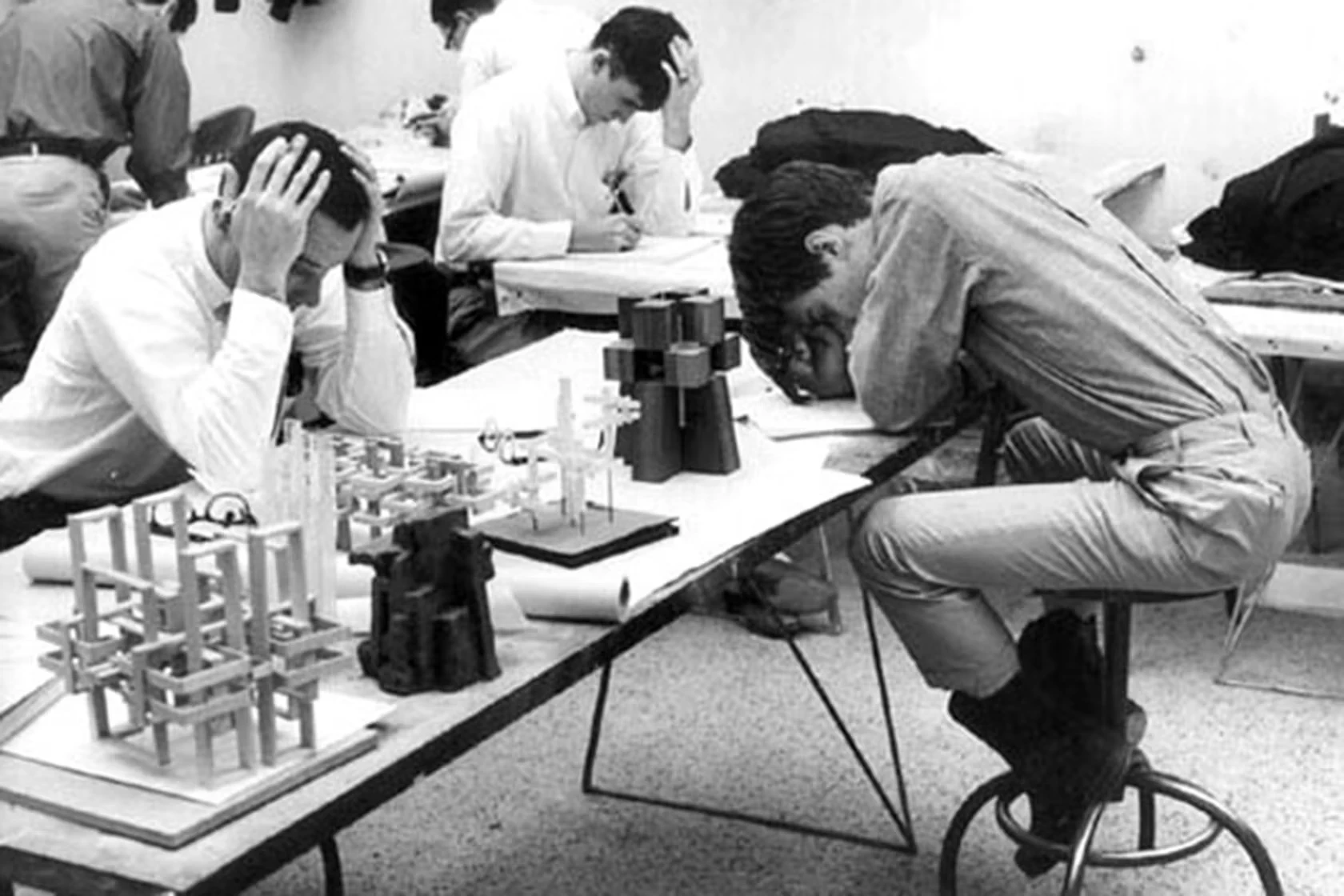
The image of the architect working late is deeply embedded in architectural culture. Studio education has historically reinforced this mythology. Students are often expected to spend long nights developing drawings, models, diagrams and presentations, particularly before reviews and final submissions.
The transition from architecture school to professional practice can therefore be surprisingly seamless. The deadline-driven studio becomes the deadline-driven office. What was once described as dedication to a project becomes a supposedly necessary professional habit.
This culture is reinforced by the mythology surrounding celebrated architects. Stories of intense studio environments, obsessive attention to detail and extraordinary personal commitment have contributed to the idea that significant architecture requires extraordinary sacrifice.
There is an uncomfortable assumption hidden inside this narrative: if architecture matters, then architects should be willing to sacrifice their time for it.
That assumption deserves scrutiny.
Exceptional design does not automatically require excessive working hours. A complex project requires coordination, expertise and sustained concentration, but none of these conditions necessarily improves when employees are physically present in the office for fourteen hours a day.

Why Architecture Is Particularly Vulnerable to Overtime
Architecture has structural characteristics that make excessive working hours unusually easy to normalize.
First, architectural projects are highly dependent on deadlines. Planning approvals, client presentations, tender packages, construction documentation and contractor coordination all operate within interconnected schedules. A delay in one phase can produce pressure throughout the project.
Second, architectural work is often difficult to measure. A drawing can take thirty minutes or six hours depending on the complexity of the problem, the information available and the number of revisions required. Creative and technical thinking do not fit neatly into conventional productivity metrics.
Third, projects frequently involve multiple stakeholders. Architects are positioned between clients, consultants, contractors, authorities and suppliers. When another participant changes a decision late in the process, architectural teams may absorb the consequences.
The profession consequently develops a dangerous habit: instead of redesigning the workflow, it extends the working day. Overtime becomes the pressure-release valve for poor coordination.
The Economics Behind the Long Night
There is also a financial explanation. Architecture has traditionally operated under tight fee structures. Clients may expect extensive services without corresponding increases in fees, while competitive bidding can encourage practices to reduce prices to win commissions.
When revenue per project is constrained, offices have limited options. Hiring additional staff increases costs. Extending deadlines may be impossible. Increasing fees may make a practice less competitive. The remaining variable is often labour.
If a team can complete a project using ten employees working longer hours instead of twelve employees working normal hours, the economic incentive can become obvious. The unpaid or underpaid overtime of employees effectively subsidizes the project. This is one reason why discussions about architectural work culture cannot be separated from the economics of practice.
The problem is not simply that some architects have poor time management. It is that certain business models can depend upon workers compensating for inadequate fees or unrealistic schedules with their own time.
The Deadline Is Not Always the Problem
Architects often describe overtime as unavoidable because projects inevitably reach critical moments. Some overtime genuinely is difficult to eliminate. A planning submission may have a fixed date. A competition may close at midnight. A client may suddenly request substantial changes before a presentation.
The problem occurs when the exceptional becomes routine. If every week contains an emergency, there is no longer an emergency. There is a system.
Repeated overtime often indicates deeper organizational problems: insufficient staffing, unrealistic programming, weak project management, inefficient communication, excessive revisions or poorly defined responsibilities.
The important question therefore should not be, “Why didn’t the team work harder?” It should be, “Why did the project require the team to work beyond sustainable capacity?”
That shift in language is significant because it moves responsibility away from individual endurance and toward organizational performance.
The Cultural Value Attached to Exhaustion
Architecture also has a status problem.
Because architecture is often presented as a vocation rather than simply a profession, personal sacrifice can acquire moral value. Employees who work late may be described as passionate. Those who establish boundaries can sometimes be perceived as less committed.
This creates a subtle hierarchy. The person who stays longest becomes visible. The person who quietly completes their work efficiently may become invisible. Such a culture rewards performative availability rather than actual productivity.
Digital communication has intensified this problem. Email, messaging applications, cloud-based drawing platforms and remote collaboration systems have made architectural work technically possible from almost anywhere. The office no longer needs to remain open for work to continue. Instead, work follows employees home.
A message received at 10:30 p.m. may require only two minutes to answer, but its psychological effect can last considerably longer. The boundary between professional and private time becomes increasingly porous.
Technology has therefore solved one problem while creating another: architecture can now operate continuously. That does not mean it should.
The Productivity Paradox
One of the strongest arguments against normalized overtime is productivity itself.
Longer working hours do not produce a simple linear increase in output. As fatigue accumulates, concentration declines, errors become more likely and decision-making becomes less reliable.
This is particularly important in architecture because many tasks require sustained cognitive attention. Coordinating drawings, identifying conflicts, reviewing specifications and making design decisions are not purely mechanical activities.
A tired architect may technically remain at their workstation, but their capacity to detect a coordination problem or challenge a flawed assumption can deteriorate.
The consequences can become expensive. A few additional hours gained through overtime may generate errors that require days of correction later. In other words, overtime can create the illusion of productivity while quietly generating rework.
The profession therefore faces an obvious contradiction: architecture seeks precision while maintaining working conditions that can systematically undermine precision.
The Hidden Cost of Unpaid Overtime
The most problematic form of overtime is not necessarily the occasional late evening. It is invisible overtime. Employees may arrive early, stay late, work through lunch, answer emails from home or spend weekends preparing presentations without recording those hours.
Because this labour disappears from project accounting, management may conclude that the project required fewer resources than it actually did. This creates a feedback loop.
The office underestimates the labour required for future projects because historical overtime has hidden the real cost. The next project is therefore priced and staffed using unrealistic assumptions. Employees compensate again through longer hours.
Eventually, the practice can become dependent on unpaid labour simply to maintain its business model. At that point, overtime is no longer an individual choice. It is embedded within the economics of the organization.
Who Pays the Price?
The consequences are not distributed equally.
Junior architects often have the least negotiating power and the strongest incentive to demonstrate commitment. They may accept excessive workloads because they believe difficult conditions are part of professional development.
This is particularly damaging because early-career architects are also forming their understanding of what a professional life should look like. If their first years in practice teach them that success requires exhaustion, the profession reproduces the same culture indefinitely.
There is also a broader issue of retention. When talented architects discover that career progression appears inseparable from chronic overwork, some leave practice altogether. Others move into adjacent fields where their design, management, digital or analytical skills can be used without the same expectations of permanent availability.
Architecture then loses precisely the people it spent years training.
Can Better Management Replace Longer Hours?
A more sustainable architectural practice does not require eliminating every period of intense work. It requires distinguishing between genuine project peaks and permanent operational dysfunction.
Better project management can make a significant difference.
Projects should be scheduled according to realistic labour requirements rather than optimistic assumptions. Design revisions should be tracked. Responsibilities should be clearly allocated. Consultant information should arrive at defined milestones. Client changes should have consequences for fees and programme.
Most importantly, overtime should become measurable. If a project consistently requires substantial additional hours, those hours should appear in project accounting. Once they become visible, management can determine whether the problem lies in staffing, scope, fees, scheduling or workflow.
What gets measured can finally be managed.
Rethinking Professional Commitment
The architectural profession does not need less ambition. It needs a different definition of ambition.
Commitment should mean producing rigorous work, communicating clearly, solving difficult problems and taking responsibility for decisions. It should not automatically mean being available at every hour of the day.
This distinction matters because architecture is ultimately a knowledge profession. Its principal resource is not simply labour time. It is expertise.
An exhausted employee is not necessarily a more committed employee. Often, the opposite is true: sustained exhaustion gradually reduces creativity, attention and professional judgment.
A practice that protects concentration may therefore produce better architecture than one that celebrates endurance.
From Heroic Overtime to Sustainable Practice
The normalization of overtime is not inevitable. It is a cultural and organizational choice.
Some late nights will always exist in architecture. Complex projects will encounter unexpected problems. Competitions will continue to create compressed schedules. Construction will generate emergencies. Human beings, unfortunately, have not yet persuaded deadlines to become flexible.
But permanent overtime should not be confused with professional seriousness.
The more important transformation is cultural. Architecture needs to stop treating exhaustion as evidence of passion and start treating time as a design resource.
After all, architects routinely argue that every square metre, material, circulation path and structural element should be carefully considered. The same discipline should be applied to the working conditions under which architecture is produced.
If an office cannot deliver its projects without systematically consuming evenings and weekends, the problem may not be that its architects are insufficiently dedicated. The problem may be that the practice has designed an unsustainable system.
And perhaps that is the architectural question worth asking: if we are capable of designing better buildings, why should we accept workplaces that are badly designed?