



NUS Creates First Washable Touchscreen Woven Into Clothing
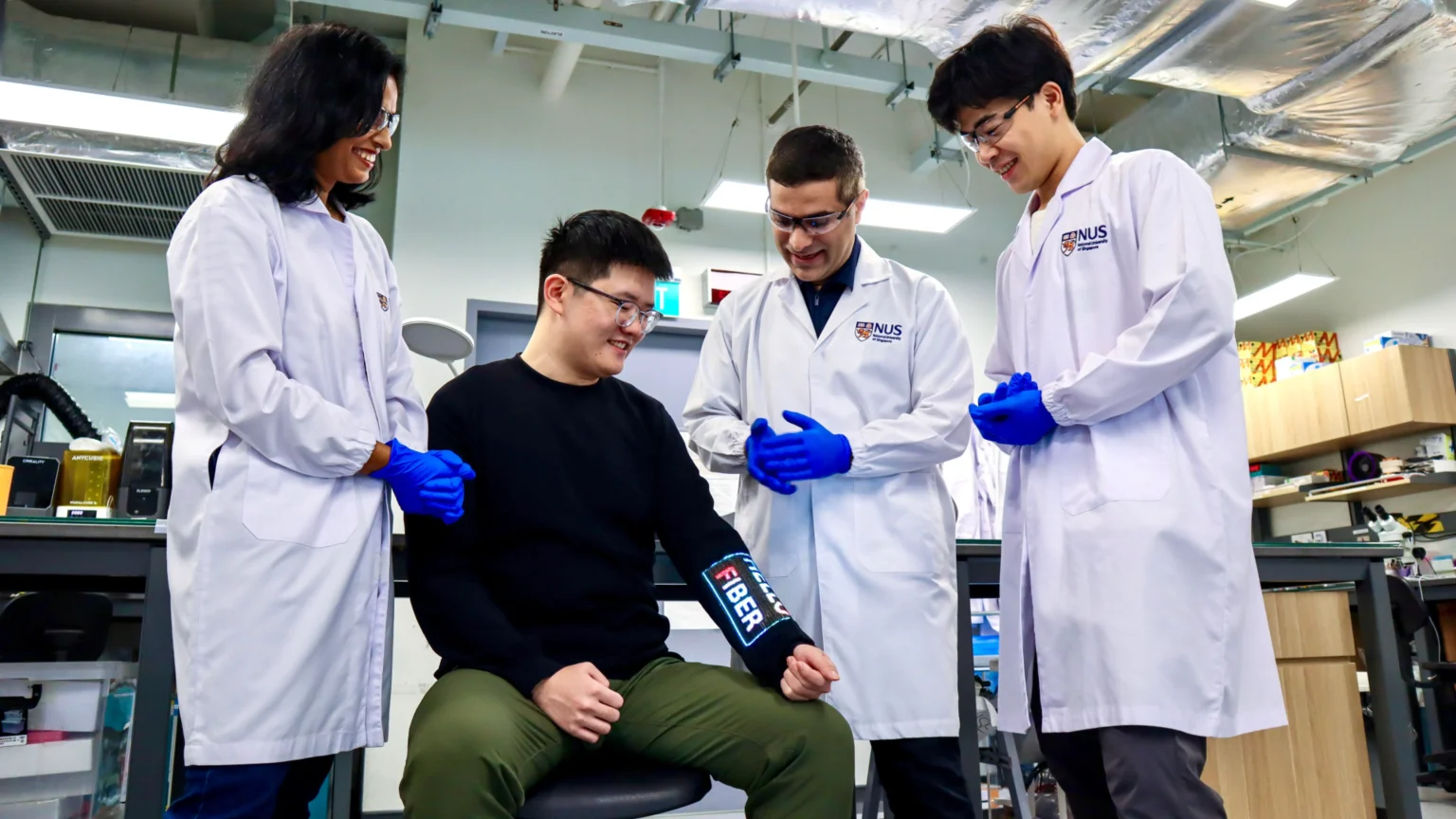
Researchers at the National University of Singapore have threaded a working touchscreen directly into a piece of clothing. The display is soft, flexible, and survives repeated machine washing. It is the first time a full interactive screen has been built into fabric itself rather than attached to it.
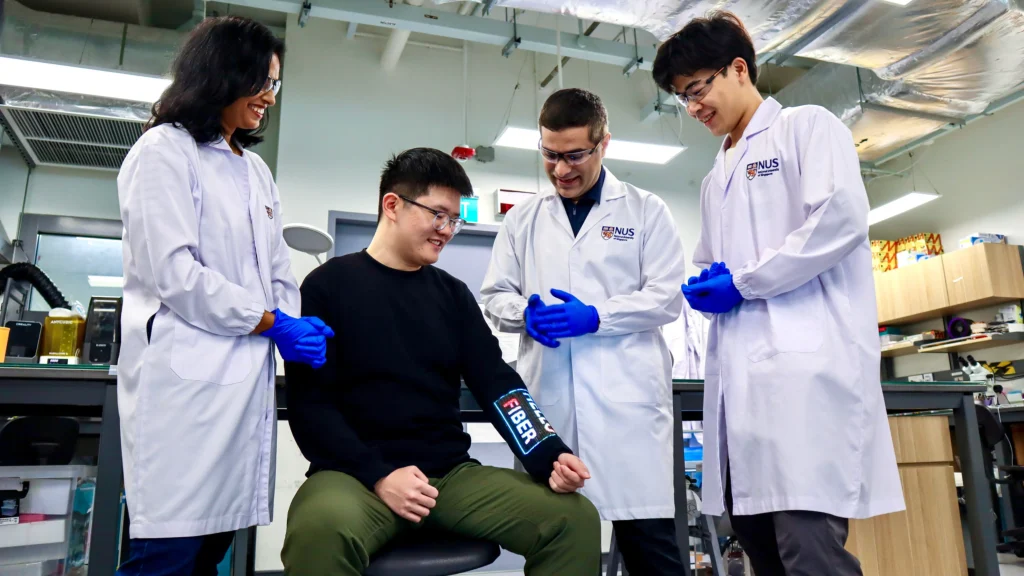
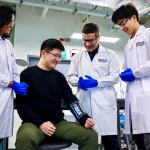
For years, wearable technology meant strapping hard devices onto soft bodies. Smartwatches, fitness trackers and rigid patches all followed the same logic: electronics stay rigid, the body adapts. The NUS team led by Assistant Professor Tural Khudiyev took the opposite approach. They built the electronics into the thread.
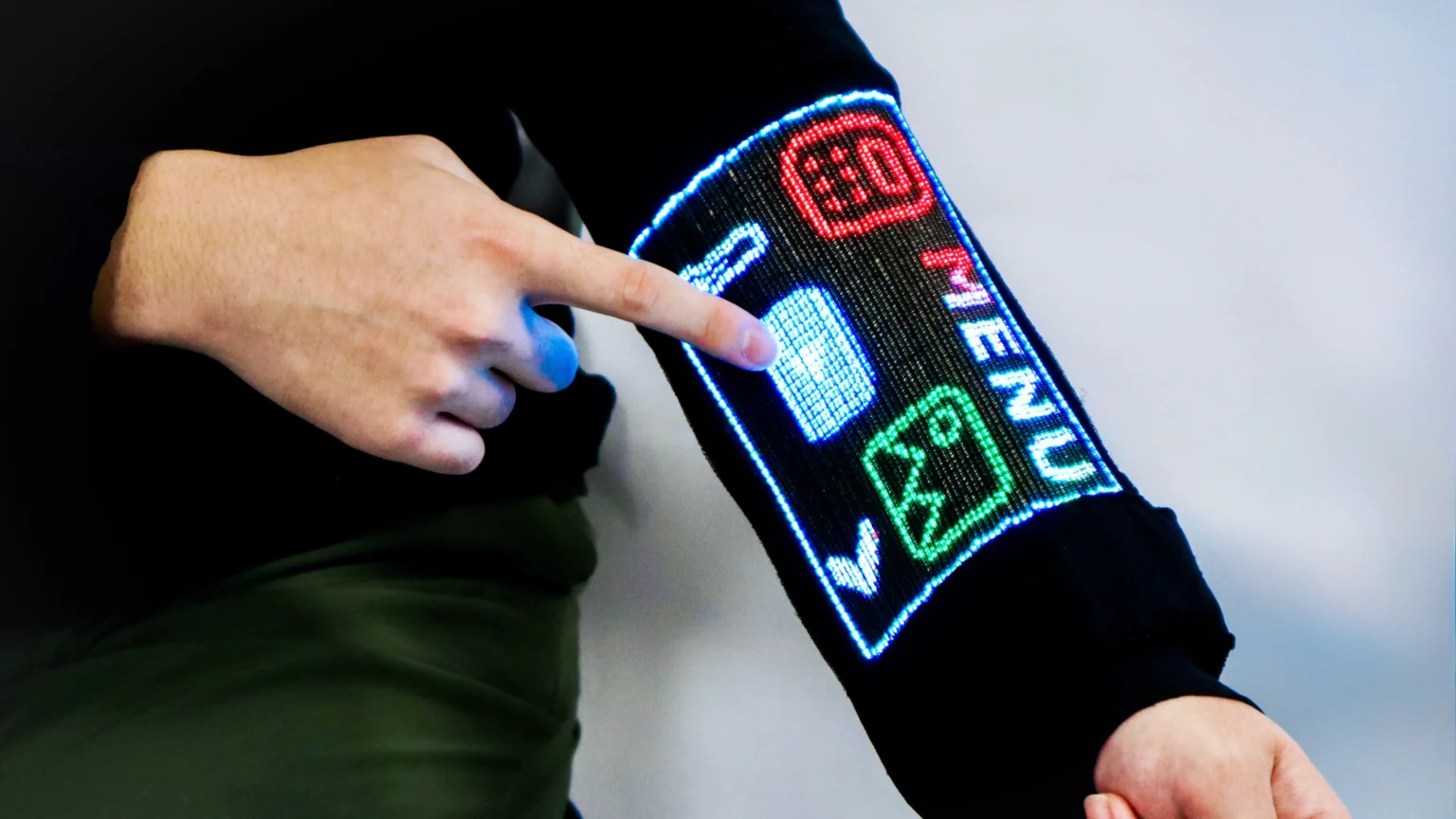
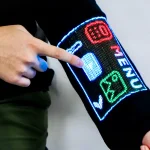
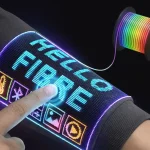
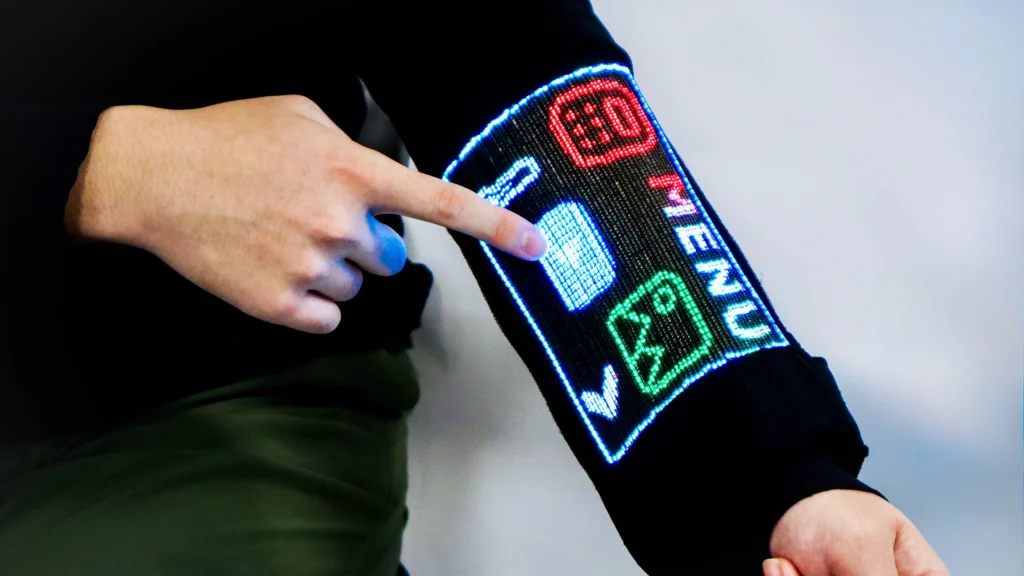
Each fiber is roughly one millimeter thick and carries 96 light-emitting diodes along its length. Fifty-four of these fibers were woven into the forearm of a sleeve, creating a 96-by-54-pixel display measuring 168 by 105 millimeters. The screen refreshes at 30 frames per second with 8-bit color. It can show images, play video, run a calculator, function as a compass, respond to voice commands, and receive images over Bluetooth. A temperature-sensing fiber placed under the arm can also display body temperature.
The fibers behave like ordinary yarn. The garment remains breathable and flexible. After 50 detergent washes in a standard machine and after 1,000 bends around a five-millimeter radius, both light output and touch response stayed nearly unchanged.
Solving the One-Dimensional Problem
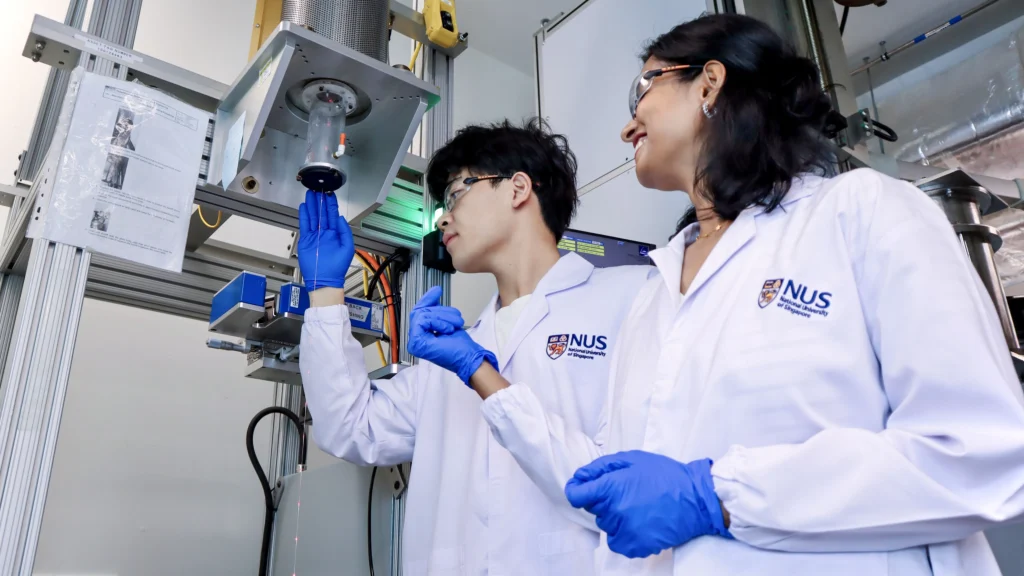
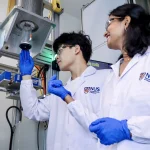
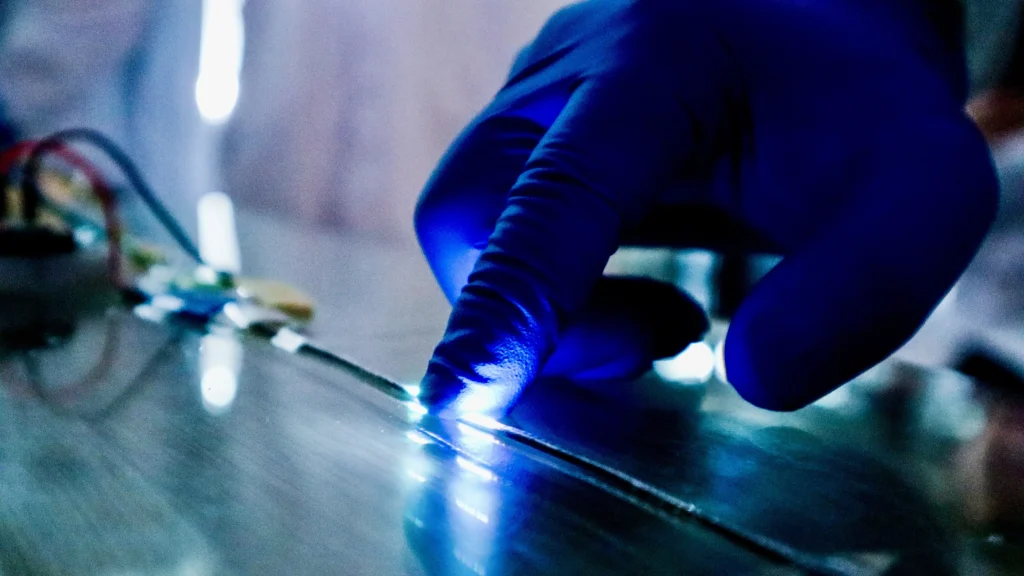
Building circuitry inside a fiber is not straightforward. A fiber is essentially a one-dimensional object. Conventional circuit boards rely on two-dimensional space to route connections. Khudiyev’s team developed a new interconnection method. Tiny insulated wires are prepared with precise connection points exposed by laser. Controlled surface wetting then guides molten solder only to those points. This allowed the researchers to integrate more than 5,000 chips and over 20,000 electrical connections along the fibers.
Each fiber carries its own control channel. If one line fails, the others continue to function. The result is a display that is both dense enough to be useful and robust enough to survive everyday textile conditions.
What the Electronic Fiber Sleeve Can Actually Do
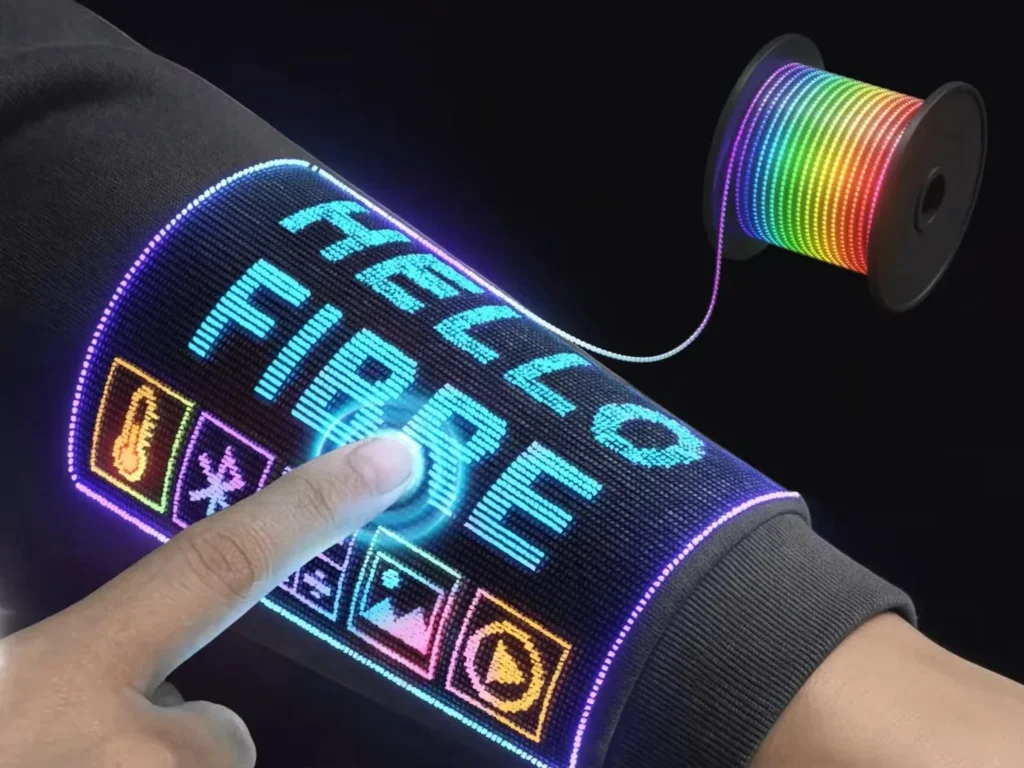
In demonstrations, the electronic fiber sleeve ran simple applications that early smartphones once offered. Large icons suited the relatively low resolution. Users could swipe through a photo gallery, perform basic calculations, watch short video clips, and navigate with a digital compass. Multi-touch worked. The screen could rotate and adjust brightness automatically.
The temperature-sensing capability points toward more practical uses. Clothing that monitors and displays physiological data without requiring a separate device could matter in healthcare, sports, and outdoor work. The wireless connection means the sleeve can act as an extension of a phone rather than a replacement for it.
Durability as the Real Threshold
Many laboratory textile electronics look impressive until they meet water, detergent or repeated folding. The NUS prototype crossed that threshold. Performance after 50 washes remained almost the same. The fabric stayed soft. Skin-contact safety limits were met. Breathability matched ordinary cotton, polyester and denim.
These results move the technology closer to something manufacturers can take seriously. Clothing that must be washed cannot carry fragile electronics. By solving the washing problem, the team removed one of the largest barriers between research prototypes and real garments.
Looking Ahead
The researchers plan to increase resolution and explore additional sensing and on-device processing. Higher pixel density would expand the range of useful interfaces. Integrating more sensors could turn clothing into a continuous health-monitoring surface. The fundamental architecture, electronic building blocks arranged along fibers rather than on rigid boards, opens possibilities beyond the current sleeve.
The work was published in Nature on 21 October 2026. It arrives at a moment when wearable technology is searching for forms that feel less like gadgets and more like clothing. By making the screen itself into fabric, the NUS team has shown one clear path forward. The sleeve does not look like a device attached to a body. It looks like fabric that happens to think.