“Architecture begins with the things people already do.”
That simple observation sits at the heart of Sun the Quilt, the project that took the global prize in the 2026 Light of Tomorrow by VELUX competition. Designed by six students from Xi’an University of Architecture and Technology, XU Qicheng, LUO Jun, GAO Rui, RUAN Guoqiang, ZHANG Xuanyi, and CAI Kunhong, under the guidance of teacher HAN Qingsong, the proposal turns one of the most ordinary domestic acts into a complete architectural system.
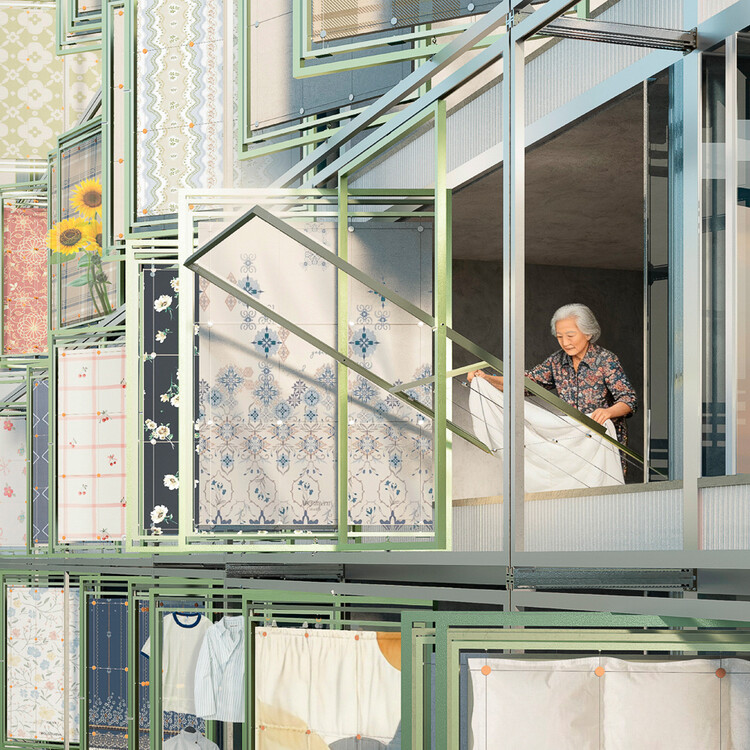
In dense Chinese cities, people still hang quilts, clothes, and food outside windows to dry in the sun and air. The practice is practical, cultural, and climatic all at once. It sterilizes, removes moisture, provides shade, and encourages air movement. Sun the Quilt starts exactly there. Instead of treating this habit as something architecture must ignore or tidy away, the students made it the generator of the facade itself.
From Daily Ritual to Building Skin
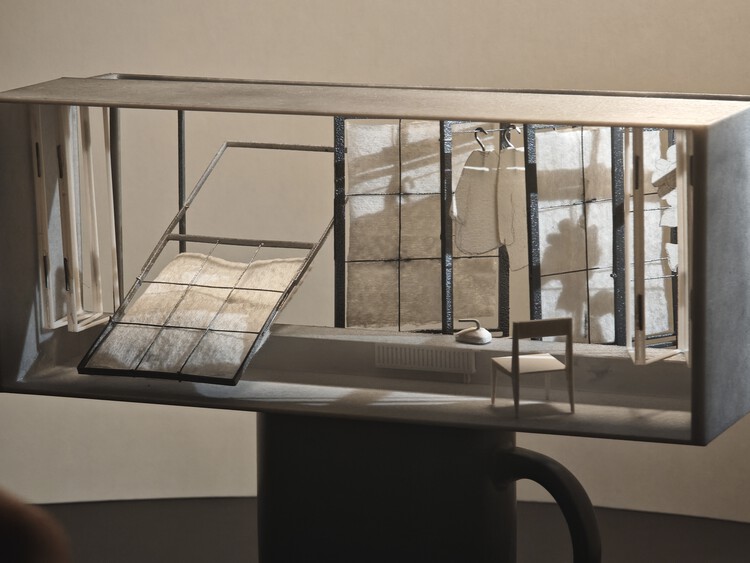
The project proposes a deployable facade unit that replaces the conventional window. An integrated steel module combines opening, drying surface, shading and light control in one element. A fully openable folding window creates a usable threshold zone roughly 450 mm deep, enough space for ironing, folding, placing objects or simply sitting.
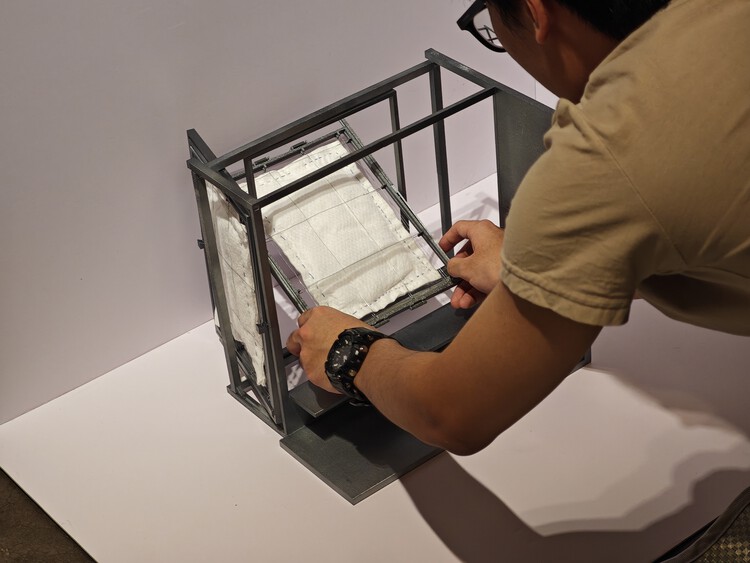
Four nested frames extend up to one metre outward. Their movements are carefully considered: in-and-out sliding responds to solar altitude, vertical rotation follows solar azimuth, horizontal rotation allows interior access, drawer-like sliding eases handling, and dual-sided clamping holds quilts or textiles securely. The result is a facade that changes throughout the day according to both the sun’s path and the household’s needs.
When the frames are extended, textiles become temporary shading devices. When retracted, the opening returns daylight and ventilation to the room. The boundary between inside and outside is no longer fixed. It becomes an active, adjustable filter shaped by daily life.
Why the Jury Responded
The international jury, including James Carpenter, Liene Jākobsone, Níall McLaughlin, Oya Atalay Franck, Doris Wälchli, and Elena Arregui Jaeger, selected Sun the Quilt as the global winner after live presentations at the UIA World Congress of Architects in Barcelona.
What impressed them was not technological complexity for its own sake. It was the depth with which the students pursued a real, lived problem and turned it into something that could actually work. The jury noted that the project “begins with a lived and valued experience and shows architecture that makes poetry out of the everyday.” They also highlighted its potential to become a genuine living solution rather than a conceptual exercise.
In a competition that received hundreds of entries from schools across every continent, this grounded approach stood out. Daylight is treated not as an abstract resource but as something already present in the rituals of ordinary households.
Responsive Design Without Excess
The system is responsive, yet it remains low-tech in spirit. Movement is manual or simply assisted rather than dependent on sensors and motors. The logic is clear enough that residents can understand and operate it. This matters. Many high-performance facades fail because they demand specialist maintenance or behave in ways users cannot predict. Sun the Quilt keeps agency with the people who live behind it.
At the same time the geometry is precise. The nested frames create a series of adjustable planes that can fine-tune solar gain, glare and airflow. In summer the extended textiles provide shade and encourage stack ventilation. In cooler months the frames can be positioned to admit low-angle sun while still allowing drying. The same element serves climate control and domestic necessity.
This dual purpose is the project’s quiet strength. It does not add a separate layer of “sustainable technology.” It reorganises an existing practice so that environmental performance and daily use reinforce each other.
A Lesson for Dense Urban Housing
Chinese cities, like many others, face the pressure of high density, limited outdoor space and the need for better daylight and air quality in housing. Balconies are often too small or restricted. Windows become the only connection to sun and air. Sun the Quilt accepts that reality and works with it.
By turning the window zone into a productive, adaptable thickness, the project expands the useful space of the apartment without increasing its footprint. The act of drying, once a source of visual clutter or neighborly tension, becomes part of a coherent architectural language. The facade records the rhythms of the household, quilts out in the morning, brought in by evening, while simultaneously managing light and climate.
There is something hopeful in that. Architecture does not always need to invent new behaviors. Sometimes it only needs to notice the ones that already exist and give them better form.
Poetry Made Practical
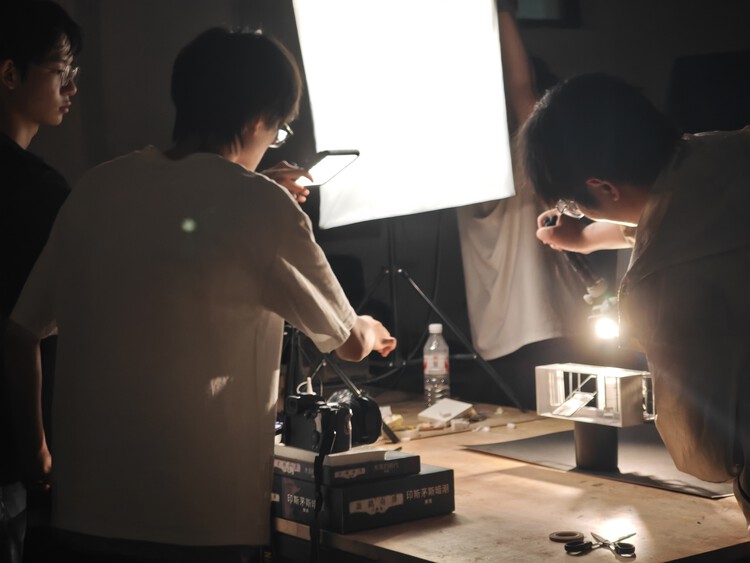
Sun the Quilt received the global prize of €4,000 for the student team and €1,000 for their teacher. More important than the award is the clarity of its argument. Daylight is not only a technical performance metric. It is also the medium through which ordinary life meets the weather, the seasons and the city.
The project reminds us that the most lasting innovations often begin close to home. A quilt hung in the sun is already an act of environmental intelligence. By making that act architectural, six students from Xi’an have shown how carefully observed daily life can still produce fresh and useful form.
All in All
What remains after the prize is the simplicity of the idea itself. A facade that works because people already know what to do with it. No complicated instructions, no hidden systems that fail without specialists. Just nested frames, sun, air, and the quiet rhythm of hanging something out to dry. In an age of technical excess, Sun the Quilt offers a different measure of intelligence: the ability to see value in what is already there and to give it lasting architectural shape.