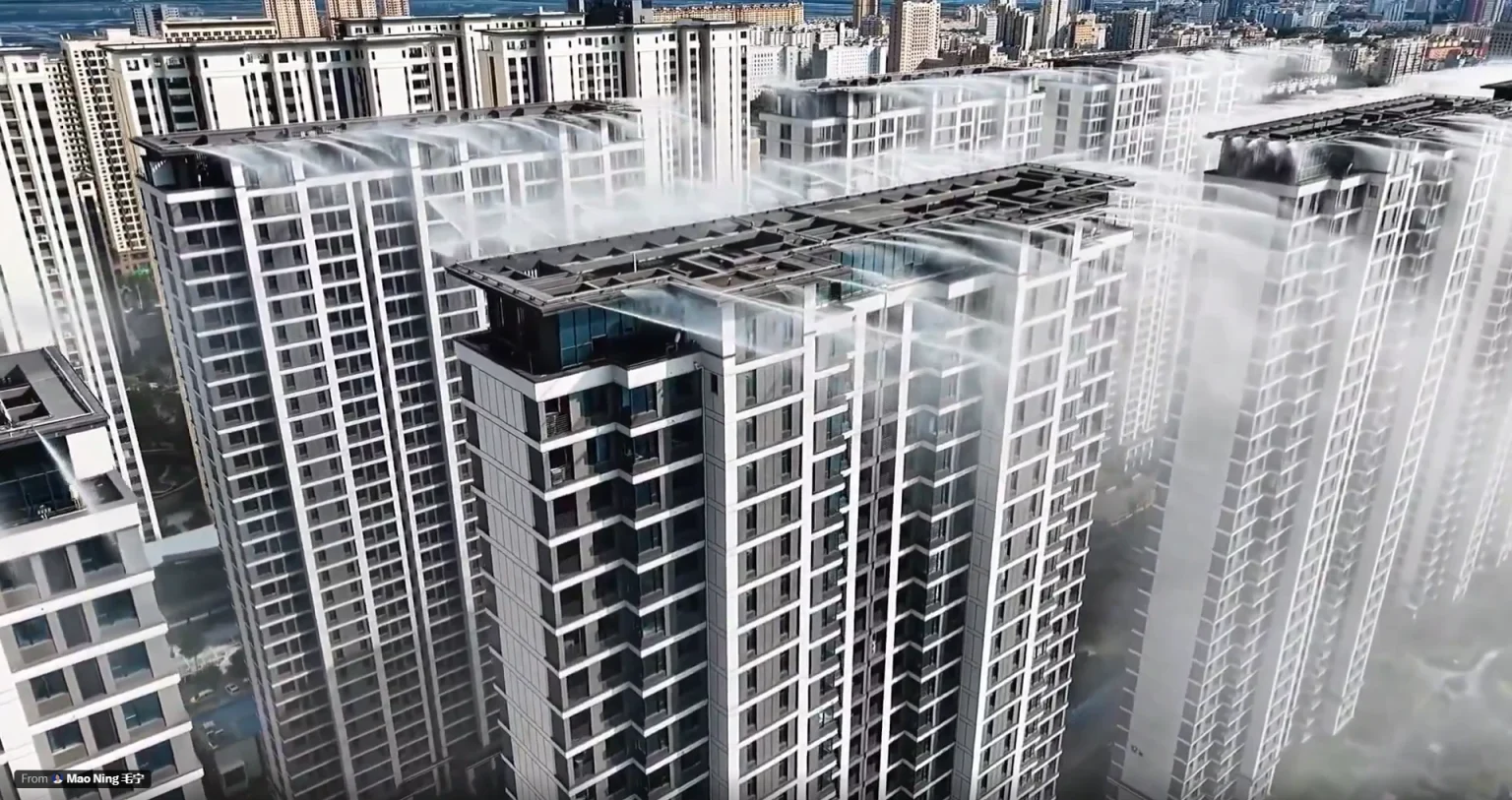

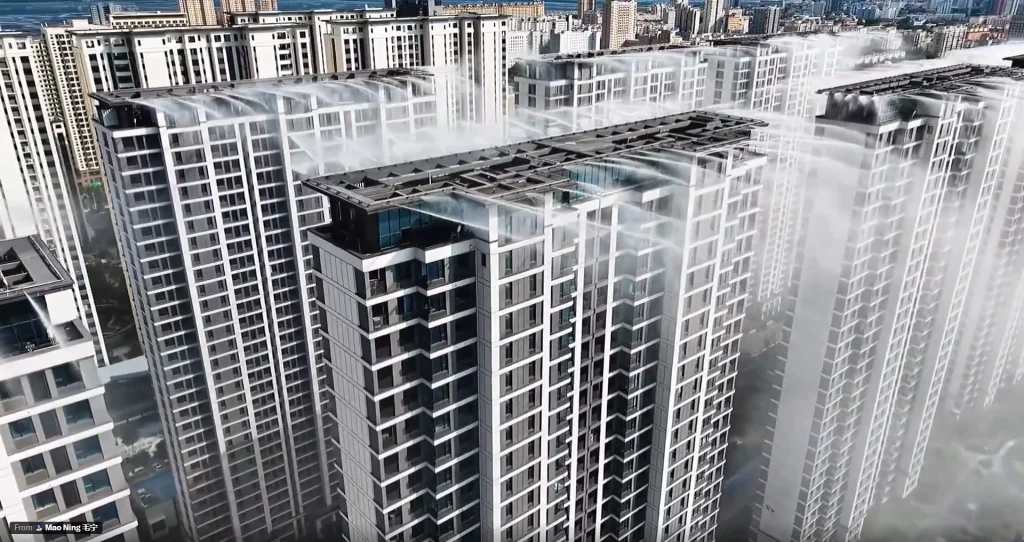
As record-breaking temperatures continue to reshape cities worldwide, one cooling technology from China has unexpectedly become the internet’s latest obsession. The “Outdoor AC” is not an air conditioner in the conventional sense. Instead, it is a high-pressure mist cooling system that uses the science of evaporative cooling to lower outdoor temperatures without enclosing a space.
The viral videos, showing residential towers and public spaces releasing fine clouds of mist during extreme heat, have sparked discussions far beyond social media. For architects, urban planners, and environmental designers, the technology raises a more important question: Could cooling infrastructure become as essential to city design as shading, ventilation, and landscaping?
Not an Outdoor Air Conditioner: A Different Approach to Cooling
Despite the name, the system does not function like a traditional air conditioner. Instead of refrigerants and compressors, it relies on evaporative cooling. High-pressure pumps force water through specialized nozzles that atomize it into ultra-fine droplets, often measuring less than 10 microns in diameter. These microscopic droplets evaporate almost instantly after entering the air.
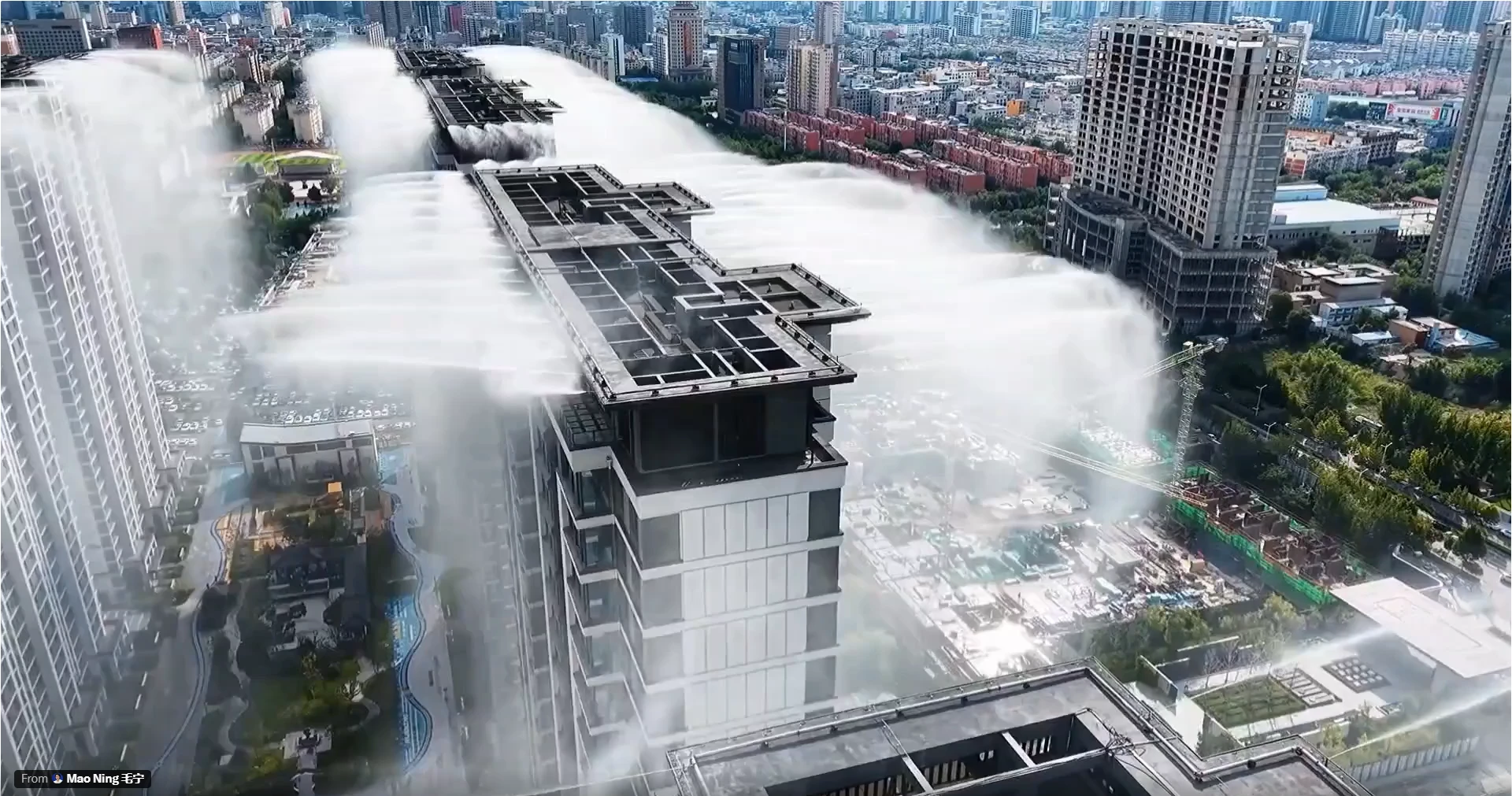
During evaporation, water absorbs heat energy from the surrounding environment, lowering the ambient air temperature before the droplets can settle on nearby surfaces. The result is a cooler outdoor microclimate. Reports suggest that the technology can reduce surrounding temperatures by approximately 3–6°C, depending on weather conditions and humidity.
How the Mist Cooling System Works
The engineering behind the system is relatively straightforward but carefully calibrated.
- Water is delivered through a high-pressure pumping network.
- Ultra-fine mist nozzles atomize the water into microscopic particles.
- These particles evaporate rapidly before reaching the ground.
- Evaporation absorbs latent heat from the surrounding air.
- Continuous airflow distributes the cooled air across outdoor spaces.
Unlike conventional air conditioning, the technology does not cool a room. It cools the air immediately surrounding people, making plazas, courtyards, pedestrian streets, residential compounds, cafés, sports venues, and waiting areas significantly more comfortable during heatwaves.
Why China’s Outdoor AC Has Captured Global Attention
China has experienced another intense summer marked by prolonged heatwaves, prompting cities and residential communities to adopt outdoor cooling strategies. Viral videos shared online show mist systems integrated along rooftops, building edges, landscaped walkways, and community open spaces, creating visible clouds that quickly disappear into the atmosphere.
What initially appeared futuristic has resonated because it addresses a growing global challenge: keeping outdoor public spaces usable during extreme heat without dramatically increasing electricity consumption.
An Architectural Shift Toward Climate Adaptation
For architects, the technology represents more than a viral gadget.
For decades, buildings have primarily focused on creating comfortable indoor environments. However, rising urban temperatures are forcing designers to rethink the spaces between buildings—courtyards, plazas, transit stops, parks, commercial streets, and residential landscapes.
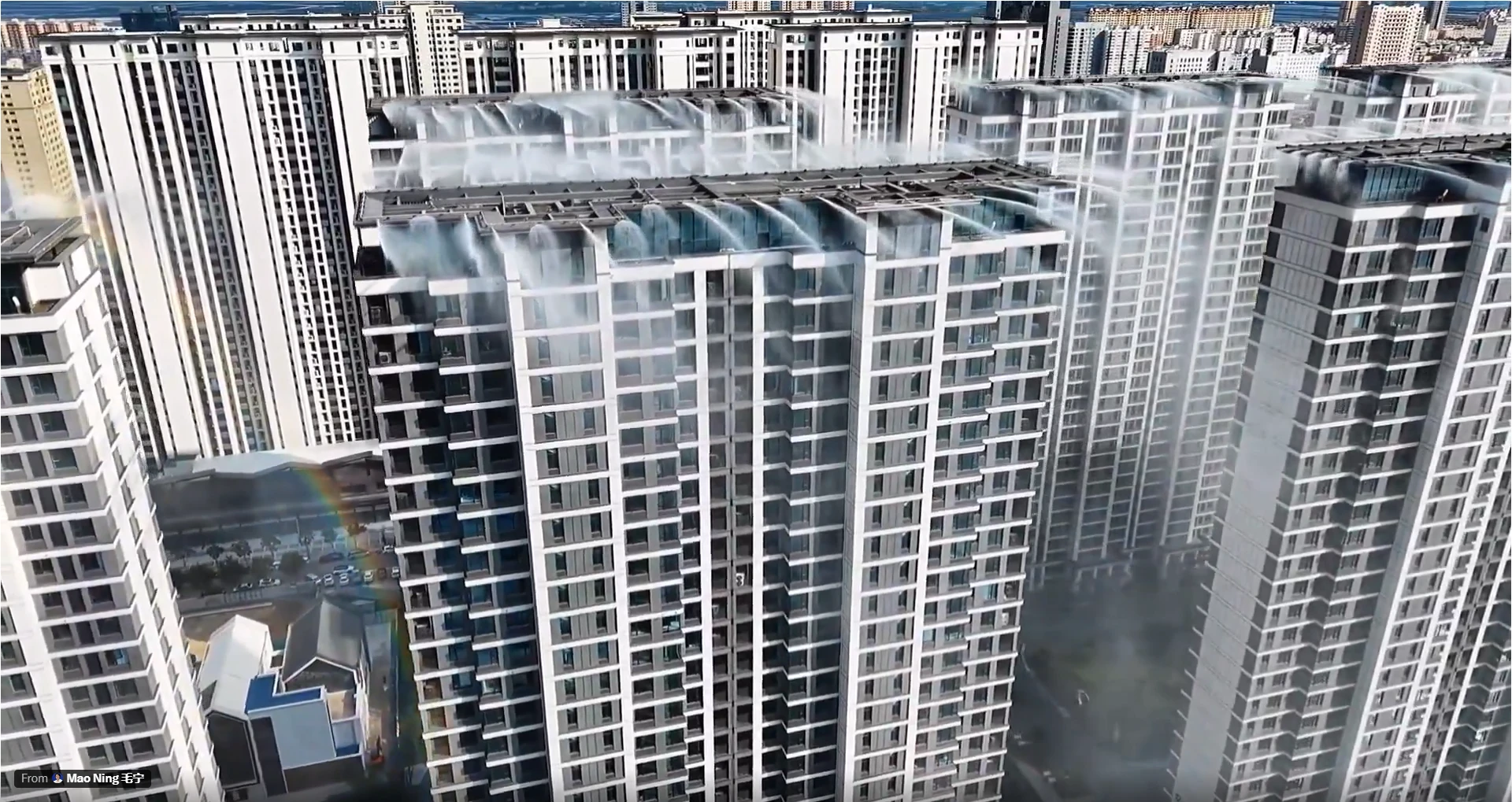
Mist cooling systems can become one layer within a broader climate-responsive strategy that also includes
- Passive shading structures
- Tree canopies
- Water-sensitive landscape design
- Natural ventilation corridors
- Reflective paving materials
- Green roofs and vertical planting
Mist systems complement these strategies by targeting periods of extreme thermal stress.
Where Mist Cooling Works Best
The technology performs most effectively in hot and relatively dry climates, where evaporation occurs rapidly.
Its efficiency naturally decreases in regions with very high humidity because the surrounding air already contains significant moisture, slowing evaporation. This means designers must evaluate local climatic conditions before integrating the system into public projects.
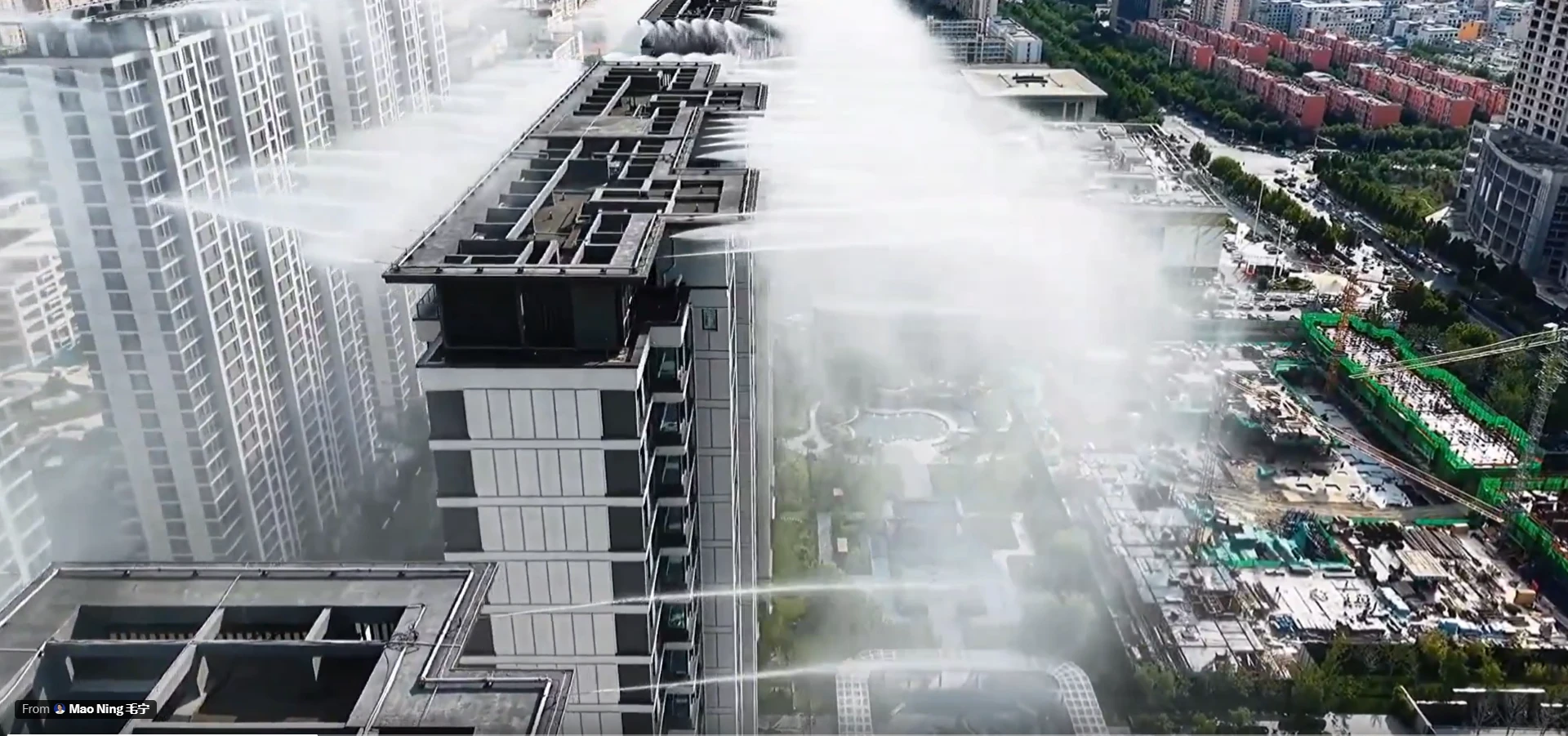
Researchers studying urban mist cooling have found that evaporative systems can significantly improve outdoor thermal comfort when deployed under suitable environmental conditions, making them a promising adaptation tool for increasingly frequent heatwaves.
Beyond Cooling: Additional Urban Benefits
Apart from lowering temperatures, mist systems offer several secondary advantages.
They can suppress airborne dust in dense urban environments, improve pedestrian comfort, enhance outdoor commercial spaces, and encourage longer use of parks, public plazas, cafés, and community gathering areas during peak summer months. Their relatively low energy demand compared with large-scale outdoor mechanical cooling also makes them attractive where electricity consumption is a growing concern.
A Small Technology With Bigger Urban Implications
China’s viral “Outdoor AC” may not replace conventional air conditioning, but it reflects a broader transformation in climate-responsive design. As cities confront longer, hotter summers, thermal comfort is becoming an urban design challenge.
For architects, the question is no longer how to cool interiors alone. It is how to design streets, courtyards, and public spaces that remain livable when temperatures continue to rise. In that context, mist cooling systems may represent one of many emerging tools shaping the future of resilient urban environments.
Image Source: @GlobeEyeNews/X (Screenshots)