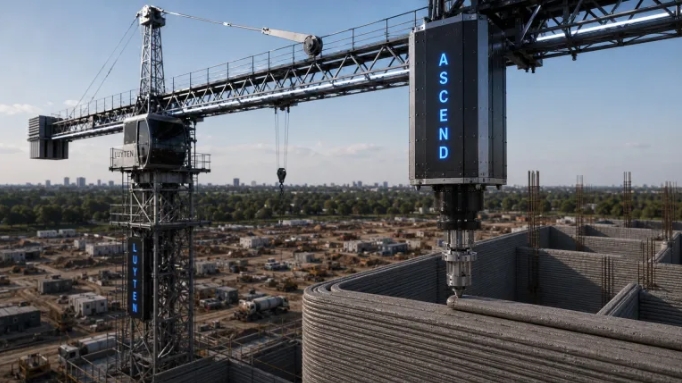
Australia has taken a significant step in construction technology with the unveiling of ASCEND, the world’s first 3D-printed tower crane platform that transforms a conventional tower crane into a large-scale 3D concrete printer. Developed by Melbourne-based Luyten, the system is designed to print concrete structures up to 100 meters (328 feet) tall, bringing 3D printing into the realm of high-rise and vertical construction.
Unlike most existing construction-scale 3D printers, which rely on gantries or robotic arms and are generally limited to low-rise projects, ASCEND integrates directly with tower crane infrastructure already used on urban construction sites. The innovation could redefine how skyscrapers, apartment towers, and large-scale infrastructure are built in the coming decades.
Turning a Tower Crane into a Construction Robot
For more than a century, tower cranes have primarily served as lifting equipment, moving materials around construction sites. ASCEND reimagines that role by embedding robotic concrete-printing technology, automation systems, and digital construction workflows into the crane itself. The result is a machine capable of translating digital building models directly into printed concrete structures.
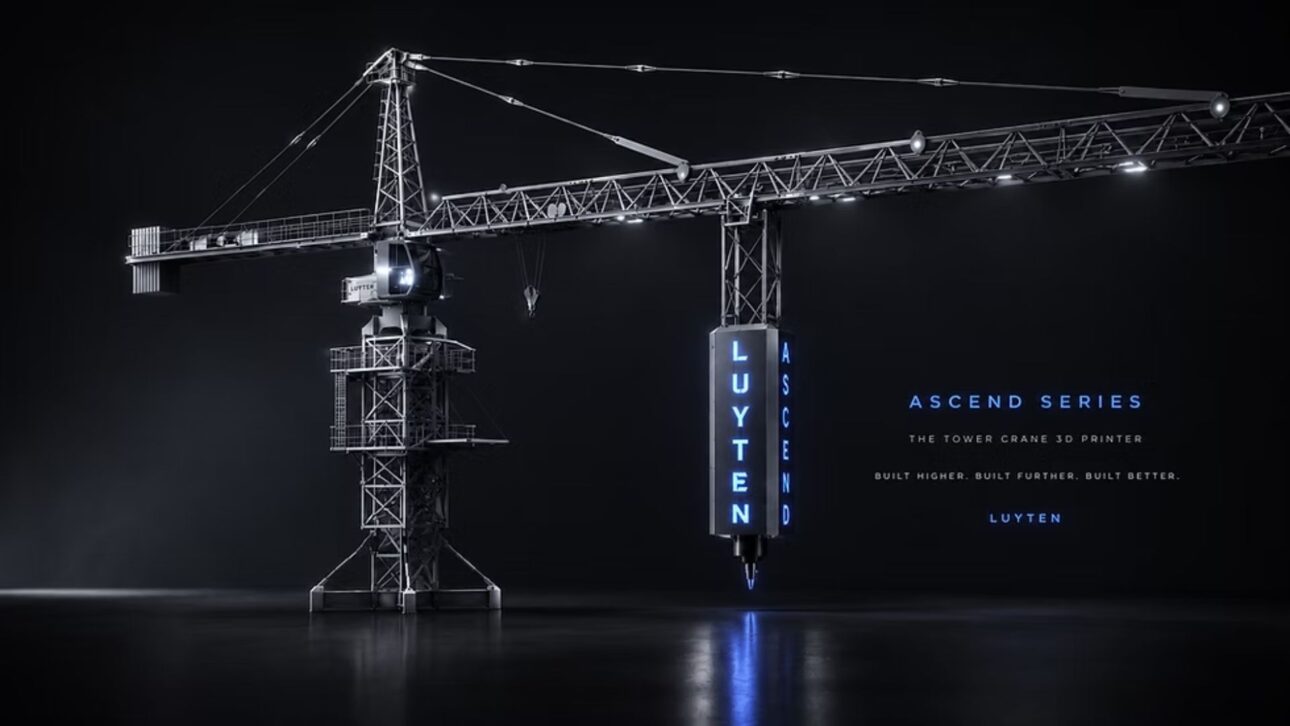
According to Luyten, the platform can be attached to standard tower cranes and converted into a robotic printing system within days rather than requiring the installation of entirely new printing infrastructure. The system combines AI-assisted path planning, automated material deposition, and real-time monitoring to create a continuous construction process from digital design to physical structure.
The company states that the printer can operate within a radius of approximately 45 meters (148 feet) while reaching heights of up to 100 meters, opening possibilities for multi-storey residential buildings, commercial towers, and large infrastructure projects that have remained beyond the reach of conventional construction 3D printing technologies.
From 3D-Printed Houses to Vertical Cities
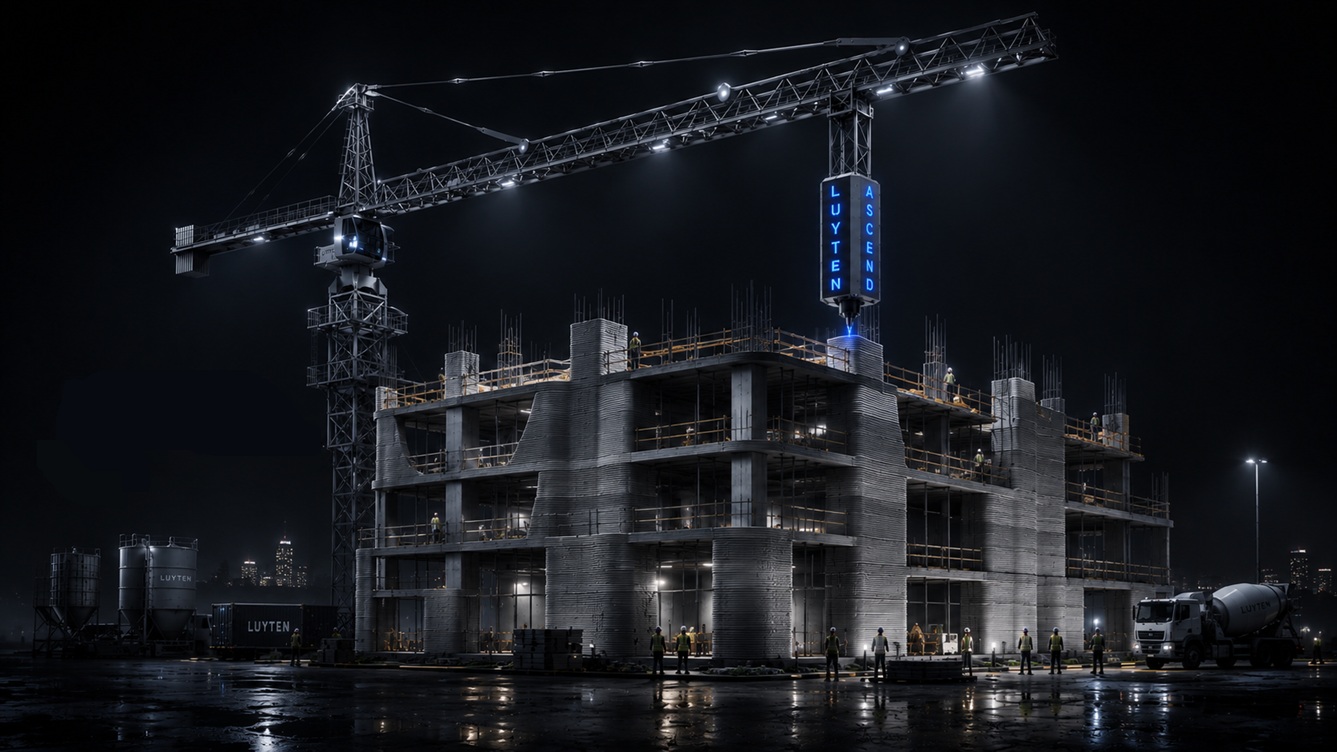
The launch of ASCEND builds on Luyten’s earlier work in large-scale concrete printing. The company previously developed the PLATYPUS series of concrete printers and participated in several landmark projects, including Australia’s early 3D-printed housing initiatives. The firm’s technology has been used to demonstrate faster construction methods, reduced material waste, and lower labor requirements compared to conventional concrete construction.
While 3D-printed homes have become increasingly common across parts of Europe, the Middle East, and North America, scaling the technology for vertical construction has remained a major challenge. Most existing systems are constrained by the size of their printing frames or robotic arms. By leveraging the height and reach of tower cranes, ASCEND attempts to overcome these limitations and extend additive manufacturing into dense urban environments.
Industry observers view the development as an important milestone in the evolution of digital construction, particularly as cities face housing shortages, rising construction costs, labor shortages, and increasing pressure to improve productivity. Community discussions following the announcement have highlighted the technology’s potential to shorten construction schedules and improve project predictability if it proves viable at commercial scale.
A New Chapter for Construction 3D Printing
The unveiling of ASCEND signals a shift in how the construction industry may approach automation. Luyten’s strategy repurposes equipment already present on high-rise construction sites, potentially lowering barriers to adoption.
Although regulatory frameworks and structural standards for 3D-printed high-rise buildings are still evolving, the technology introduces a new possibility: using robotic tower cranes to manufacture buildings directly from digital models at heights previously unattainable for construction 3D printing. If successfully deployed at scale, Australia’s new 3D-printed tower crane could mark the beginning of a new era in vertical construction.
Image credit: Luyten