

The UAE is shifting its planned 5-gigawatt AI campus from a single Abu Dhabi site to a distributed network of hardened data centers after Iranian attacks highlighted Gulf infrastructure vulnerabilities. A design and parametric look at the new approach.
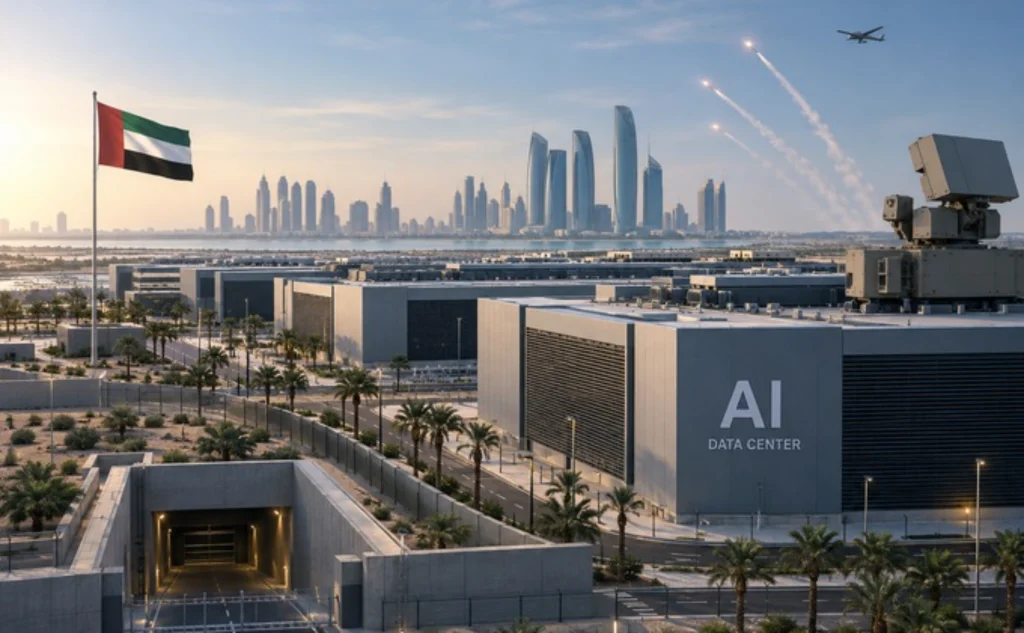
Architecture has always responded to threat. Castles rose on high ground. Cities built walls. Power stations went underground. The latest example is unfolding in the United Arab Emirates, where plans for one of the world’s largest AI computing campuses are being quietly rewritten.
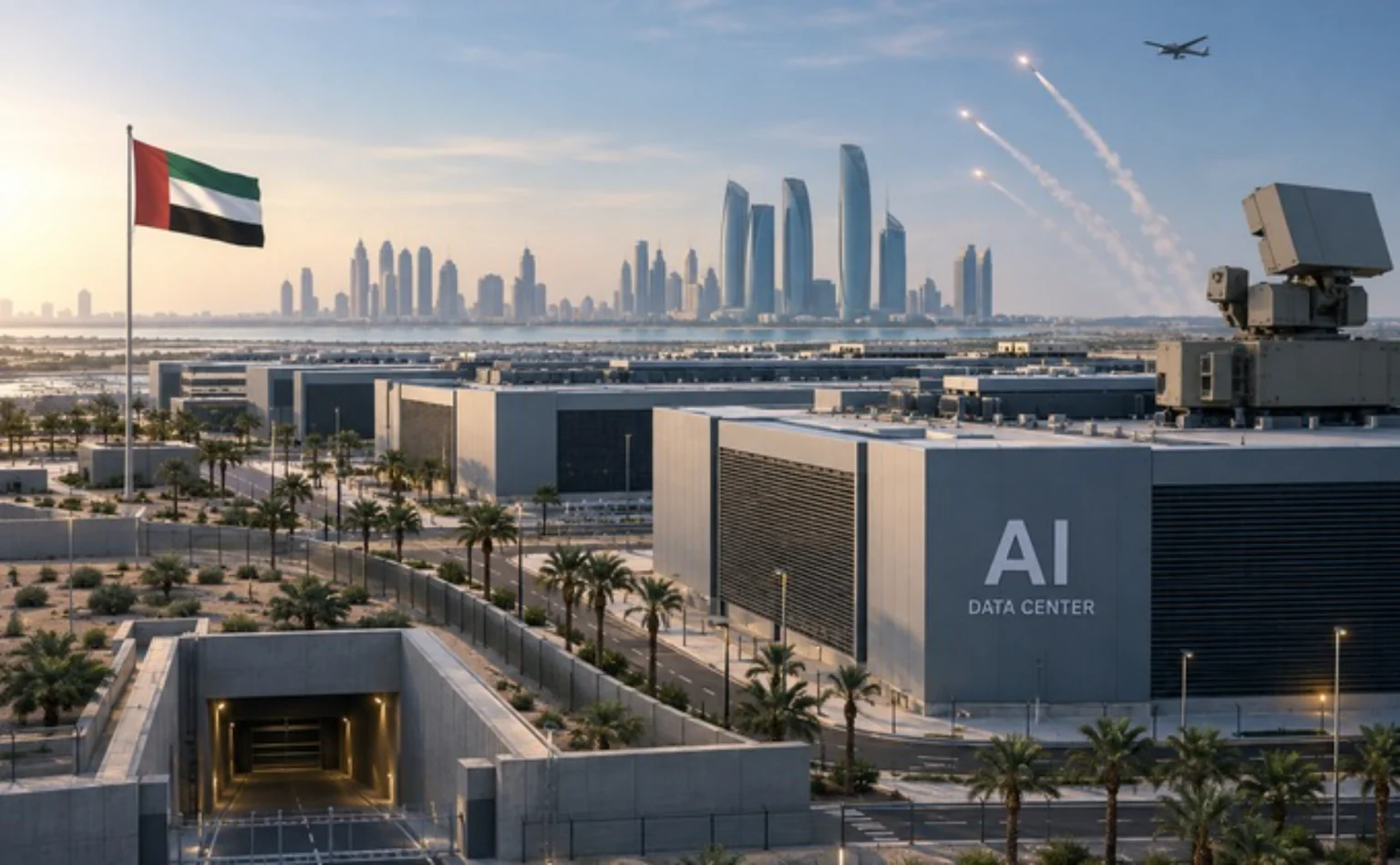
What began as a single, monumental 10-square-mile (26-square-kilometer) campus outside Abu Dhabi is now likely to become a network of smaller, more protected data centers spread across the country. The change follows Iranian missile and drone attacks that damaged regional cloud facilities and publicly named the UAE project as a potential target. Security has moved from an operational concern to a primary design driver.
The Original Vision and Why It Changed
The project, often linked to the Stargate UAE initiative led by G42 in partnership with U.S. firms including Nvidia, OpenAI and Oracle, was conceived at a scale rarely seen outside the United States. Five gigawatts of AI-ready capacity would have concentrated enormous computing power, power infrastructure, and cooling systems in one highly visible location.
That concentration created efficiency. It also created a single point of failure. Once facilities in the Gulf were hit and the site itself was publicly identified, the calculus shifted. Sources familiar with the discussions indicate the first phase continues with added protective measures, while the remainder of the capacity is expected to be distributed. Locations under consideration include mountain areas in the northern emirates of Ras Al Khaimah and Fujairah, as well as underground or semi-buried constructions.
Air defenses, electronic countermeasures, blast-resistant envelopes, and fully redundant power and cooling loops are now part of the conversation. These are no longer afterthoughts. They shape the architecture from the first sketch.
Design Implications of Distribution
A single campus allows clear axial planning, shared infrastructure, and a coherent architectural image. A distributed network demands a different logic. Each site must be self-sufficient yet interoperable. Latency, power availability, cooling potential, and physical security must be balanced simultaneously.
This is where computational and parametric methods become practical rather than theoretical. Site selection can be modeled against multiple weighted criteria: elevation and rock cover for passive protection, distance from existing critical infrastructure, access to renewable or redundant power, thermal performance of the local climate, and network connectivity. Variables that once sat in separate specialist reports now sit inside the same generative model. Changing the relative importance of security versus energy cost immediately produces new candidate locations and massing strategies.
Building form itself adapts. Instead of large, low-slung halls optimized only for cooling efficiency, designers explore compact, partially buried volumes, earth-bermed envelopes, and modular data halls that can be repeated and hardened. Structural systems must resist blast loads as well as the usual equipment weights. Facade and roof assemblies shift from lightweight cladding to multi-layer systems that combine thermal performance with fragment resistance.
The aesthetic of the “AI campus”- open, futuristic, highly visible- gives way to something quieter and more defensive. Visibility itself becomes a liability.
Parametric Thinking Under Constraint
Parametric design is often associated with formal exuberance. Here it serves resilience. The same digital models that generate complex geometry can also test redundancy. How many independent power feeds are required before the probability of simultaneous failure drops below an acceptable threshold? What is the optimal spacing between modules so that a single strike cannot cascade? How should cooling loops be zoned so that loss of one plant does not take down an entire hall?
These questions are quantitative. They can be scripted, simulated, and iterated. The resulting architecture is less about signature form and more about controlled performance under extreme scenarios. The building becomes a system of systems whose relationships are defined computationally long before concrete is poured.
Distribution also changes the urban and landscape presence of the project. Instead of one dramatic concentration of infrastructure, the UAE may end up with a quieter constellation of facilities integrated into different terrains. Some may disappear into mountainsides. Others may sit low behind protective berms. The monumental campus gives way to a more diffuse, harder-to-target pattern.
What This Means for Future Critical Architecture

The redesign of the UAE’s 5-gigawatt ambition is not an isolated technical adjustment. It signals a broader shift in how high-value digital infrastructure is conceived. Concentration maximizes efficiency and minimizes cost. Dispersion maximizes survivability. When the geopolitical risk rises high enough, the second logic prevails.
Architects and engineers working on data centers, energy hubs, or any other strategic facility will increasingly design for scenarios that once belonged only to military planners. Parametric tools already used for daylight, energy, and structural optimization will expand to include threat modeling, redundancy analysis, and multi-site coordination.
The UAE project remains ambitious. The first phase continues. Capacity will still be built. What has changed is the shape of that ambition. One vast campus is becoming many smaller, tougher nodes. The architecture of artificial intelligence is learning, under pressure, to look less like a landmark and more like a resilient network.