
Google has introduced Gemini 4 Argon, its most capable model to date. Early results show it leading or matching the strongest competitors on most of the tests the company chose to highlight.
According to Google’s published comparisons, Argon beats or ties GPT-6 Astra and Claude Opus 5.5 on 14 of 19 benchmarks. The clearest advantages appear in professional knowledge work: multi-step financial research, legal research and drafting, and end-to-end business automation. Coding results are more mixed. Argon sets a new high mark on DeepSWE v1.1, a long-horizon software-engineering suite, yet trails on certain terminal and systems-level tests. The model can generate responses up to one million tokens long, giving it unusual room for extended reasoning and document handling.
For the moment access is tightly controlled. Trusted testers and cybersecurity teams have early entry. Paid API customers and Google AI Ultra subscribers are expected to follow.
Where Argon pulls ahead
The strongest signals come from tasks that resemble real professional workflows rather than pure academic puzzles. On AutomationBench, which measures a model’s ability to complete multi-step business processes, Argon scores 51.3 percent, several points clear of the next-best systems. On Vals Finance Agent v2 it reaches 65.4 percent.
On Harvey’s Legal Agent Benchmark the margin is even larger, with Argon well ahead of both Astra and Opus 5.5.
These numbers matter because they sit closer to the work companies actually pay for: analyzing filings, drafting research memos, chaining tools, and producing usable outputs across long contexts.
Pure coding benchmarks remain competitive and sometimes favor rivals, yet the pattern across knowledge-work suites suggests Argon has been optimized for sustained, tool-using professional labor.
Long-context performance is another stated strength. The ability to sustain coherent generation and reasoning across a million tokens opens practical possibilities for reviewing large contract sets, multi-hour video, or sprawling codebases in a single pass. Google also reports leading results on long-video understanding and visual analysis of professional charts and documents.
Coding and the mixed picture
On DeepSWE v1.1, which tests realistic, multi-step software engineering, Argon posts 77.9 percent and claims a new state of the art. That result is meaningful for teams that want models capable of planning, editing and verifying code over extended sessions. At the same time, other coding and systems benchmarks show tighter or reversed rankings. Terminal-bench style evaluations and certain migration or infrastructure tasks still favor competitors in the numbers Google released.
The divergence is useful. It suggests that “best coding model” is no longer a single title. Different architectures and training mixtures excel at different slices of the software lifecycle. Argon’s profile leans toward long-horizon agency and professional tooling rather than pure competitive programming speed.
Cybersecurity as early proving ground

Image credit: News from Google
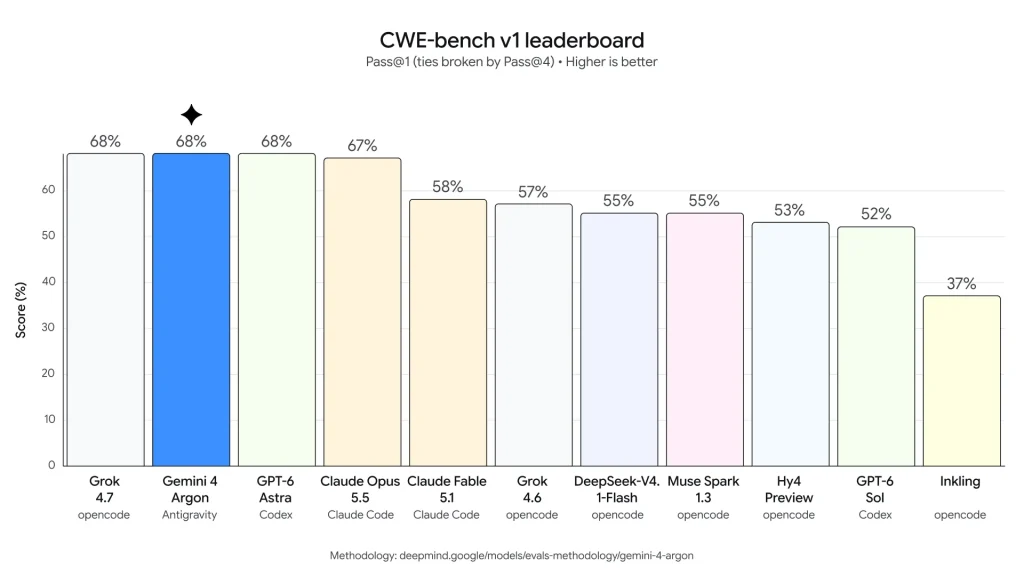
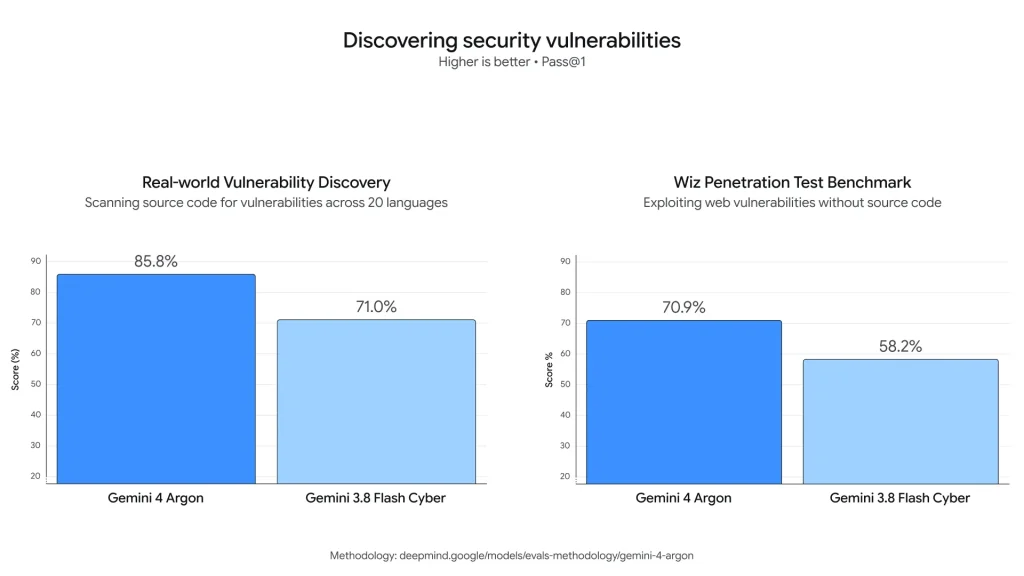
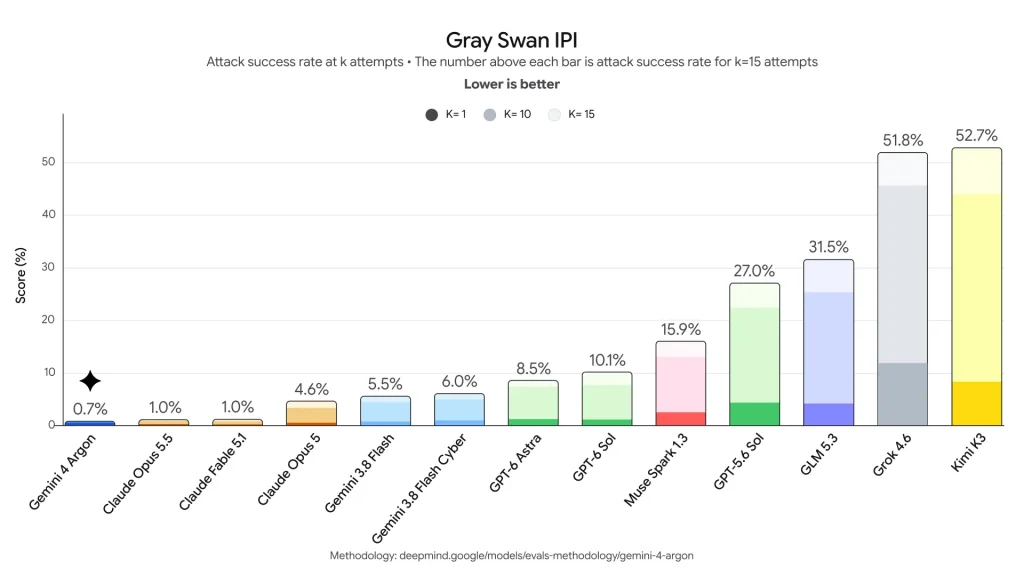
Google has given early access to cybersecurity defenders, and the company highlights at least one concrete result: the model identified a critical vulnerability in widely used healthcare software that earlier frontier systems had missed. On CWE-bench style vulnerability remediation tests, Argon ties for the top score.
“Importantly Argon has frontier safeguards and we are rolling it out responsibly – it’s with the US gov’t and going to a set of trusted cyber defenders through our Fairwind Program today. We’re going to make it available as soon as we can and as safely as we can. So hold tight, lots more coming, and you’re going to see us iterating rapidly.“, said Sundar Pichai, CEO, Google and Alphabet | Source
This early deployment choice is strategic. Security teams operate under high stakes and generate clear feedback loops. Success or failure in that domain will shape how quickly the model moves into broader enterprise use.
Controlled release and what comes next
Restricting initial access to trusted testers and security practitioners is consistent with the pattern of recent frontier releases. The risks of powerful models are no longer theoretical, and staged rollout gives both the developer and external experts time to observe failure modes before wider exposure. When paid API and Ultra subscribers receive access, the practical test will shift from benchmark tables to daily workflow integration: latency, tool reliability, cost per useful output, and the quality of long-context reasoning under real document loads.
Reading the leaderboard with care
Benchmark leadership is always provisional. The set of 19 tests Google chose emphasises the areas where Argon performs best. Independent evaluations on different suites, different agent harnesses, or adversarial conditions may paint a more varied picture. Absolute scores on several of the knowledge-work benchmarks remain modest even for the leader, which indicates that the tasks themselves are still hard for every current model. The gap between first and second place is informative, yet the distance from current performance to reliable autonomy is larger still.
What the results do show is a shift in emphasis. The competitive frontier is moving from general language fluency toward measurable economic utility: the ability to research, plan, use tools, and produce work product that professionals can trust or quickly revise. Argon’s reported strengths align with that shift.
A quieter kind of progress
Gemini 4 Argon does not arrive with claims of artificial general intelligence. It arrives with a table of numbers and a controlled access list. In the current phase of the field, that restraint is itself a form of progress. The model appears strongest where the work is structured, multi-step, and grounded in professional domains. It is less dominant where the tasks are narrower or more systems-oriented. That unevenness is honest. It gives users a clearer map of where to apply the system first and where to keep human oversight tight.
As the model moves from limited testing into paid hands, the decisive measurements will be less about which name sits at the top of any single leaderboard and more about whether the outputs shorten real work, surface real risks, and hold up under the messy conditions of daily use. For now, Google has put a new contender on the board, one that leads where professional knowledge work is measured and remains competitive elsewhere. The next chapters will be written by the people who actually put it to work.