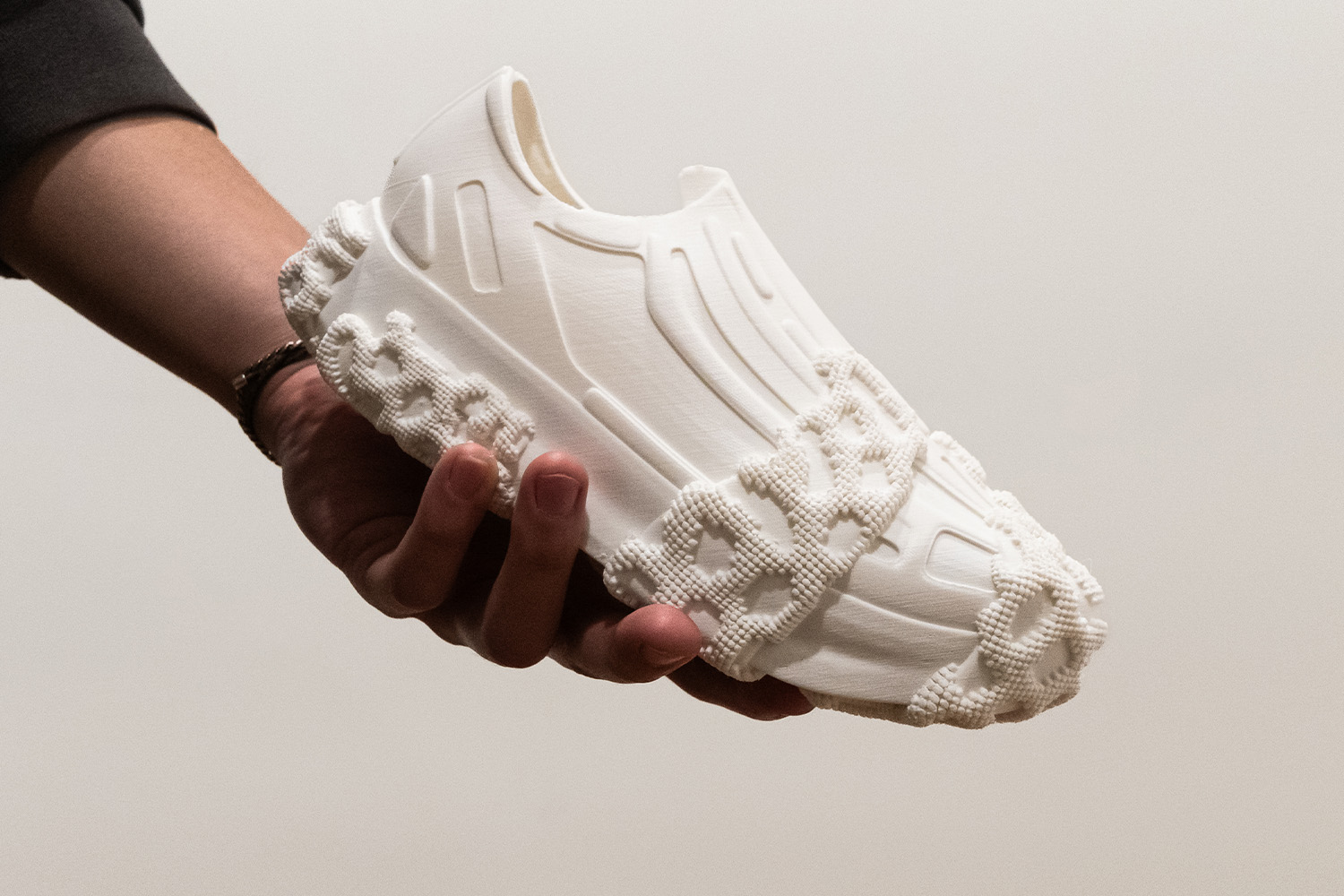

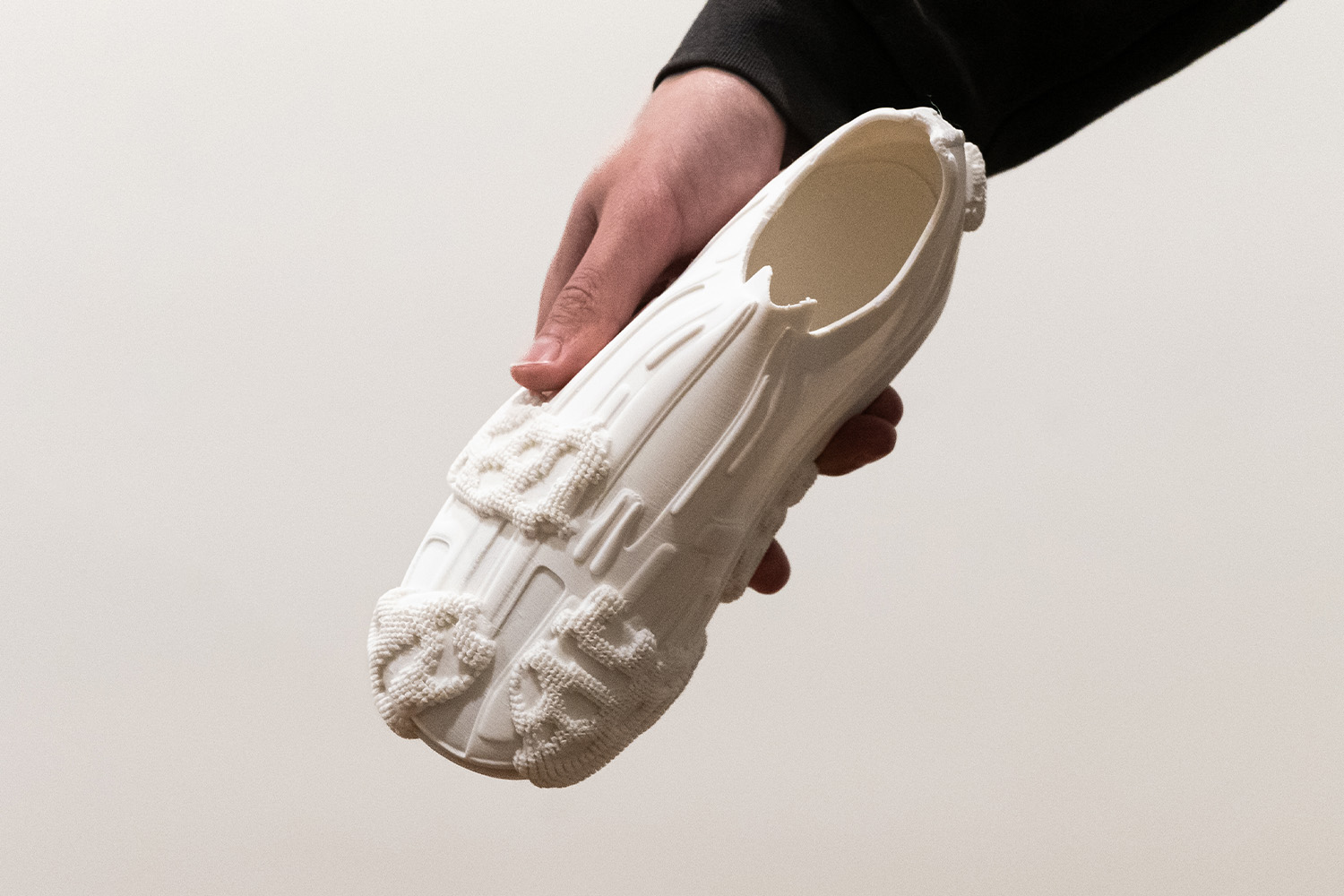
Delta Diffuse, designed by Nolan Kim, is the design and development of an outsole that Reaction-Diffusion configures. Reaction-diffusion systems simulate the progressive interaction between two reactive chemicals. Nolan also 3d printed Delta Diffuse as a prototype.
Simple adjustments to the initial conditions can produce a wide range of spatial patterns. Each variation serves as a framework for understanding biological pattern formations (e.g., fish scales, reptile skin, coral growth, leopard spots, and zebra stripes). The Gray-Scott Diffusion Model is a mathematical equation that emulates Reaction-Diffusion patterns. The equation is recursive, meaning it uses the previous value to inform the subsequent value. This allows the growth behavior to evolve over time.
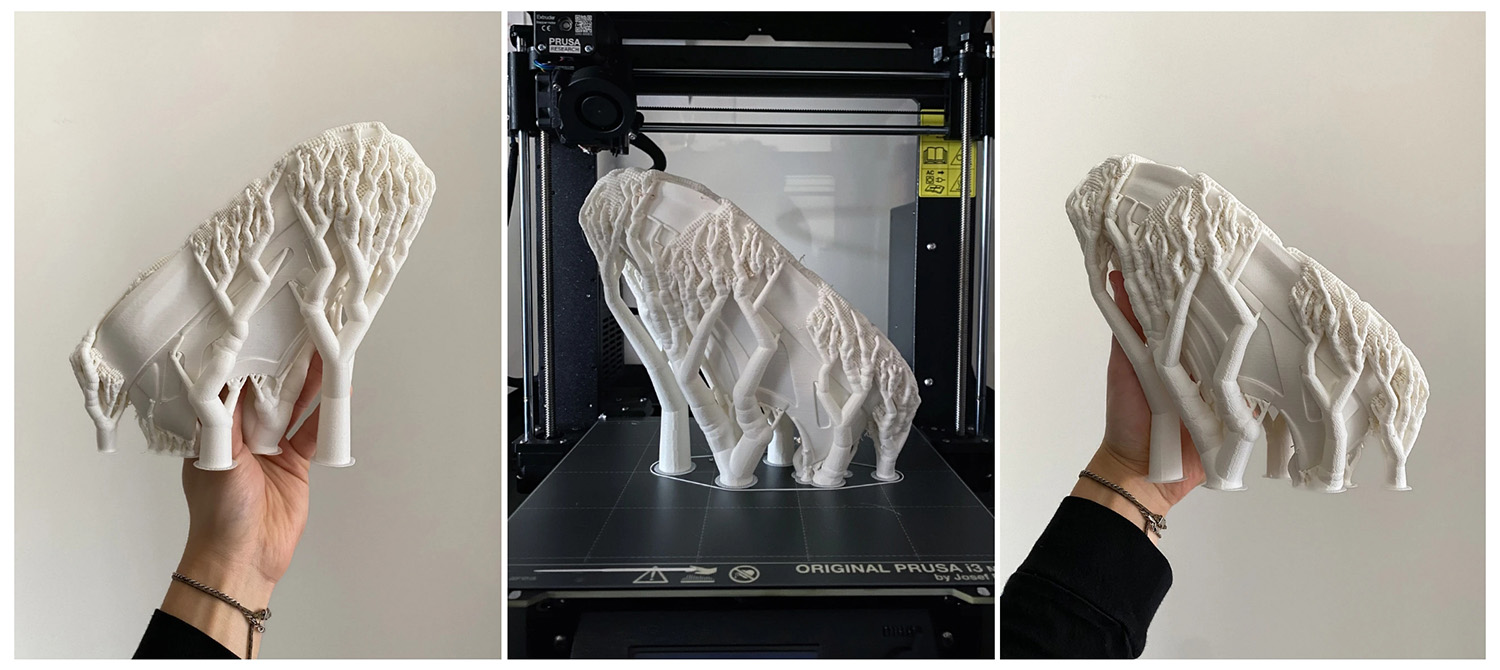
The main variables that influence the type of pattern that emerges are the diffusion rates of chemicals ‘A’ and ‘B,’ the feed/kill rates of each chemical, and a Laplacian function. The Laplacian function drives the diffusion part of the reaction, as it returns the difference between a particular cell and the average of its adjacent cells. This is done by applying a blur or noise function to the starting chemicals.
By adjusting the values of the ‘feed’ (f) and ‘kill’ (k) rates, it’s possible to unlock a wide range of patterns, from circular spots to oscillating stripes. Pearson’s Classification of this relationship is a useful tool that categorizes the expected types of formations when using certain input ‘f’ and ‘k’ values.