
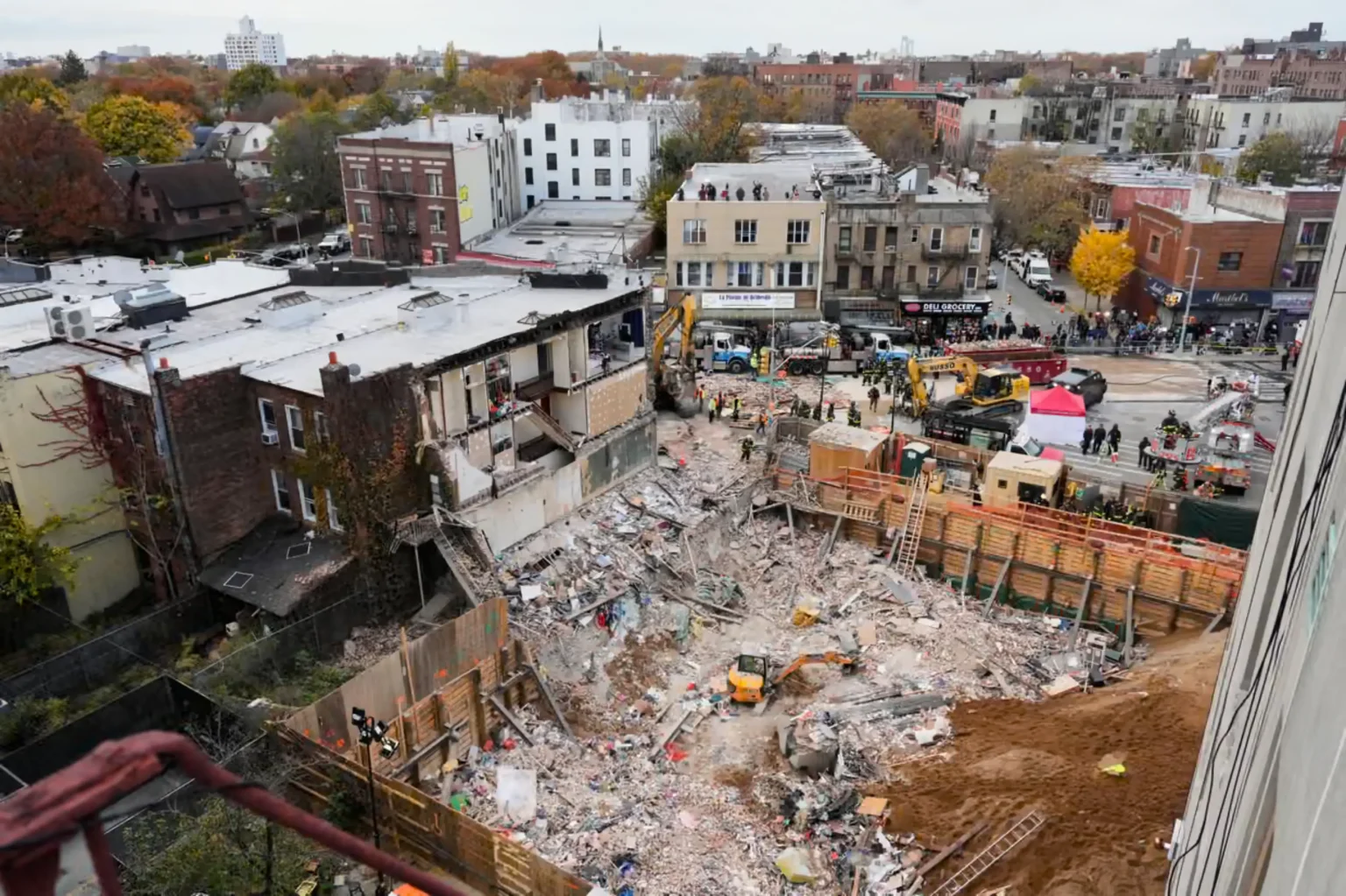

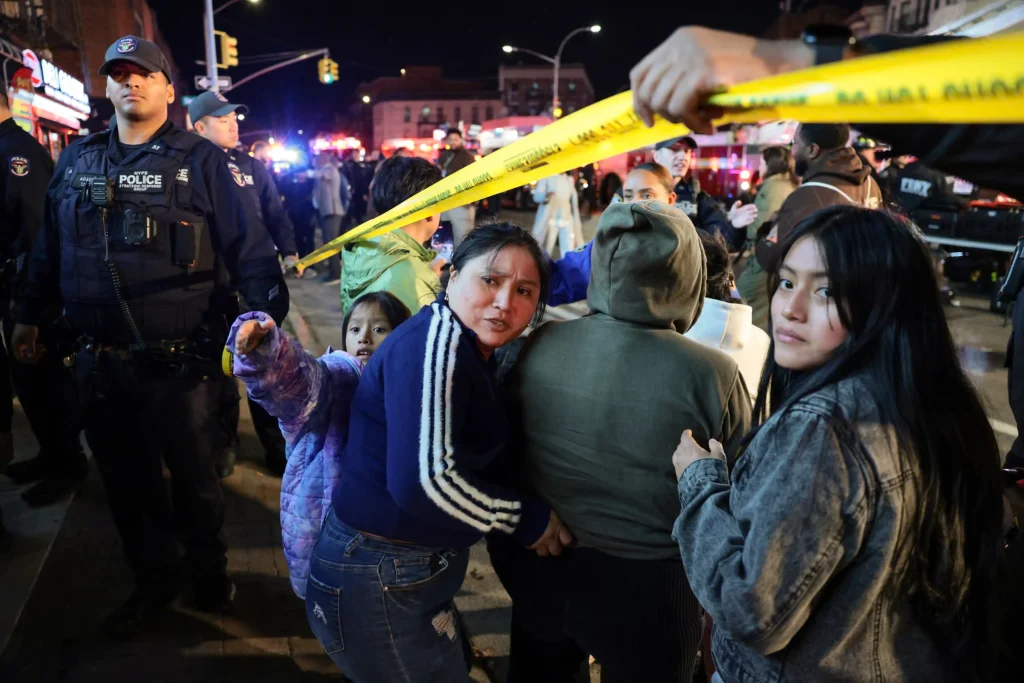
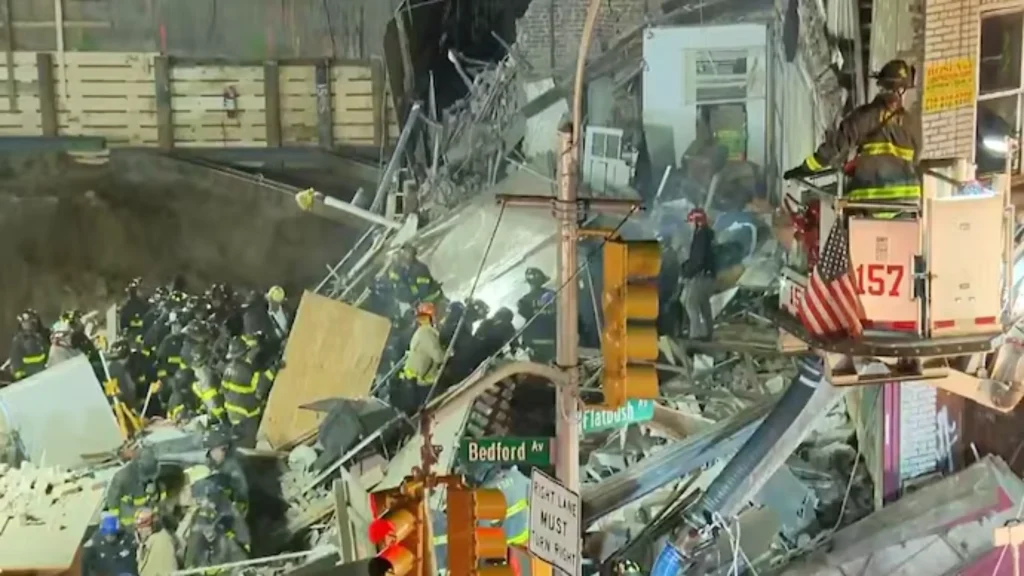
A three-story mixed-use building at 1321 Flatbush Avenue in Brooklyn collapsed into an open excavation pit next door on the afternoon of 11 November 2026. Eight people died, including two children and two construction workers. Eighteen others were injured. Beyond the immediate human tragedy, the failure raises pointed questions about how older urban fabric interacts with contemporary excavation and foundation work, and where architectural, structural, and regulatory systems broke down.
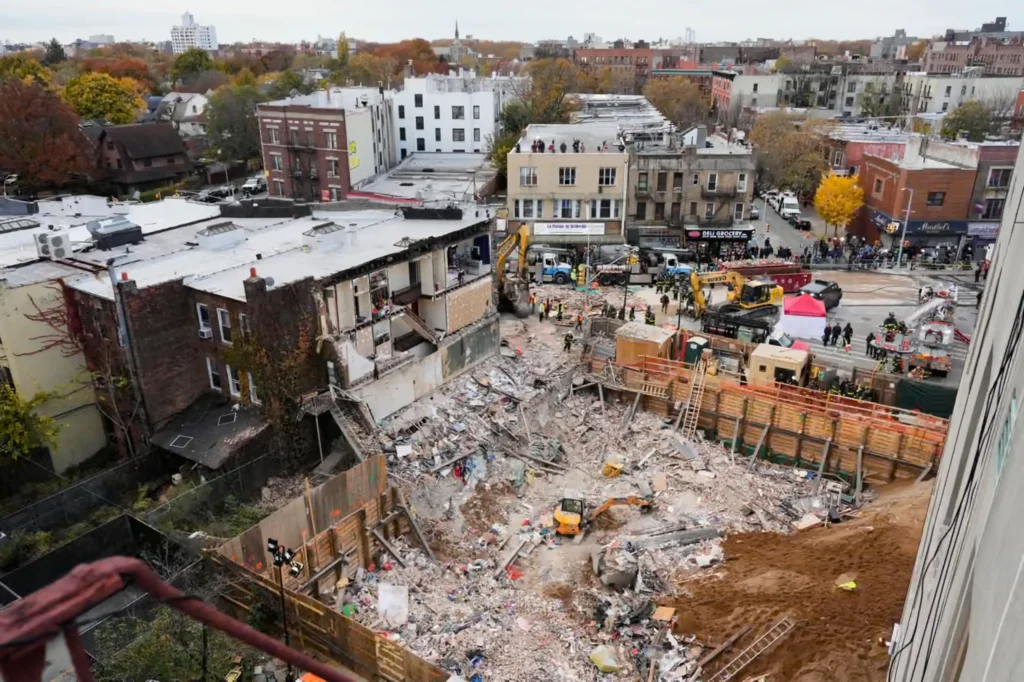
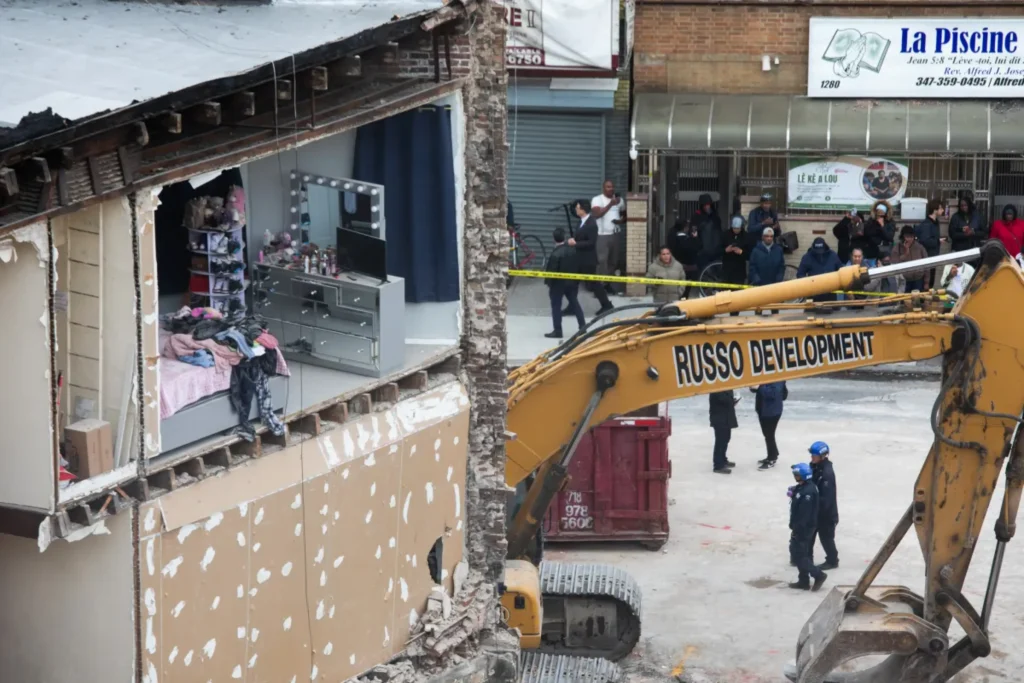
The building, dating to the 1930s, contained ground-floor commercial space and residential apartments above. It failed and slid into the excavation at 2625 Bedford Avenue, where foundation work for a new residential development was under way. A party wall shared with the neighboring building at 1323 Flatbush Avenue was sheared away, exposing intact interiors and underscoring the suddenness of the failure.
Residents had reported weeks of noticeable vibration and noise from the adjacent site. Such feedback is often an early indicator that soil movement, underpinning, or lateral support systems are affecting neighboring structures. In dense historic neighborhoods, these signals are critical design and monitoring inputs. Their apparent under-response points to a breakdown in the feedback loop between construction activity and structural observation.
Excavation Design and Neighboring Structures
Modern deep excavation adjacent to existing buildings requires carefully engineered temporary works: soldier piles, lagging, tiebacks, underpinning, and continuous monitoring of settlement and lateral movement. When these systems are under-designed, poorly executed, or inadequately monitored, the risk transfers directly to the older buildings that rely on continuous lateral support from the soil mass.
The Flatbush collapse appears to sit at this interface. The older masonry or mixed construction of 1321 Flatbush Avenue was never intended to stand unsupported beside a deep open cut. Once the soil that provided passive resistance was removed, any insufficiency in temporary support would have placed the building in a progressively unstable condition. The fact that the structure ultimately translated into the pit suggests a loss of both vertical and lateral capacity.
Regulatory and Procedural Failures
The Department of Buildings has confirmed that the construction site had previously been subject to a stop-work order. Records indicate enforcement activity earlier in the year related to demolition and excavation, followed by the lifting of restrictions. The existence of prior violations, combined with the eventual catastrophic failure, points to weaknesses in the continuity of oversight.
In New York City, as in many dense urban jurisdictions, the regulatory system relies on a combination of permits, inspections, and self-certification. When stop-work orders are issued and later lifted without sustained monitoring, the regulation’s protective intent is diluted. The subsequent decision to inspect approximately 100 other sites linked to the same entities acknowledges that the problem may not be isolated.
From a design-management perspective, this sequence reveals a gap between the paper trail of compliance and the physical reality of an active excavation next to occupied, aging structures.
Lessons for Architectural and Structural Practice
The collapse underscores several persistent challenges in urban densification:
- Interface design between new excavation and existing buildings remains one of the highest-risk phases of construction. Temporary works are often treated as contractor means and methods rather than integral design elements requiring the same rigor as permanent structures.
- Monitoring protocols must be continuous and independent when vibration, settlement, or cracking is reported by occupants. Resident observation should trigger formal instrumentation and review, not merely documentation.
- Older building stock in neighborhoods such as Flatbush frequently lacks modern structural redundancy. Masonry and early-20th-century construction can tolerate limited movement, but sudden loss of lateral support is often catastrophic. Design teams working next to such buildings must assume lower tolerance thresholds.
- Regulatory continuity after a stop-work order is lifted is as important as the initial enforcement action. The system must verify that corrective measures remain effective throughout the duration of high-risk work.
These are not abstract professional concerns. They are the difference between a controlled construction process and an uncontrolled structural failure that ends lives.
Accountability and the Path Forward
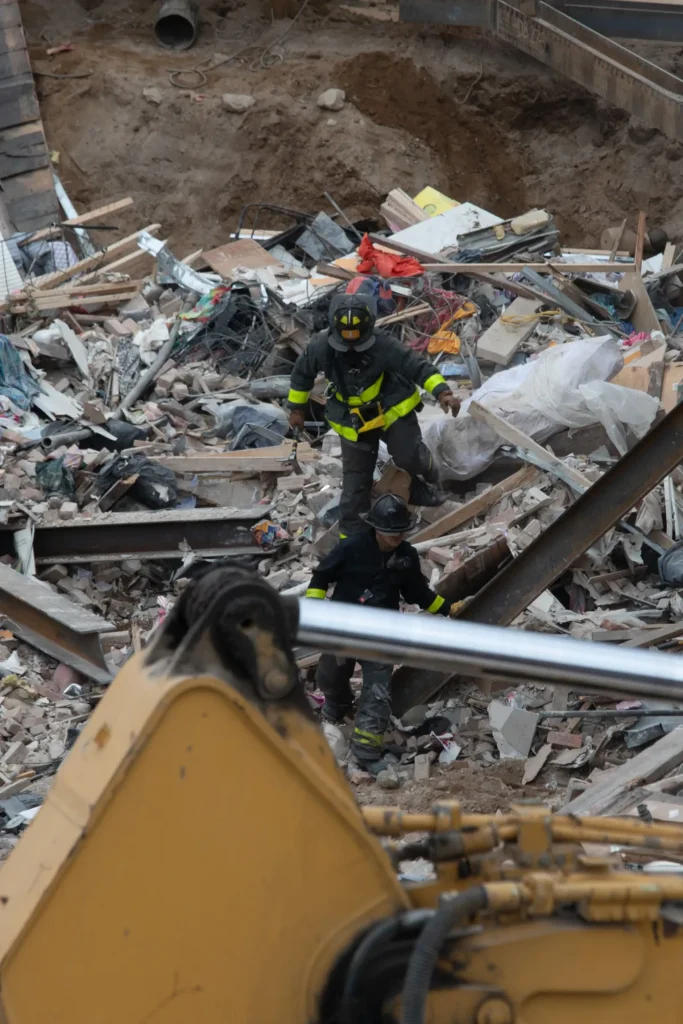
Investigations by the Department of Buildings, the Brooklyn District Attorney’s office, and other agencies are ongoing. The focus will necessarily include the design and execution of the temporary support systems, the adequacy of monitoring, the history of violations at the site, and the condition of the collapsed building itself.
For the architecture and construction fields, the event is a stark reminder that density, speed, and economic pressure cannot be allowed to erode the fundamental responsibility to protect neighboring structures and the people who occupy them. Excavation is not merely a site-logistics problem; it is a structural design problem with public-safety consequences.
The eight people who died in Flatbush — including two children — paid the highest price for whatever combination of design, procedural, and enforcement failures occurred on that site. The professional response must be equally serious: tighter integration of temporary works into the design process, independent monitoring when risk is elevated, and regulatory systems that do not treat the lifting of a stop-work order as the end of scrutiny.
Until those standards are consistently met, older urban buildings standing beside active excavations will remain more vulnerable than they should be.