

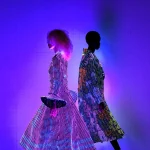
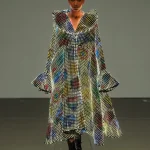
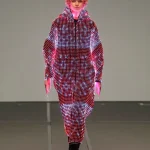
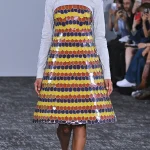
Clothes usually keep the same face from morning to night. Kunihiko Morinaga has never accepted that limit. For Anrealage’s Spring/Summer 2027 collection, shown in Paris at the Maison de la Radio et de la Musique, he treated the surface of a garment the way a living creature treats its skin: something that can be shed, rewritten, and renewed while the body underneath stays the same.
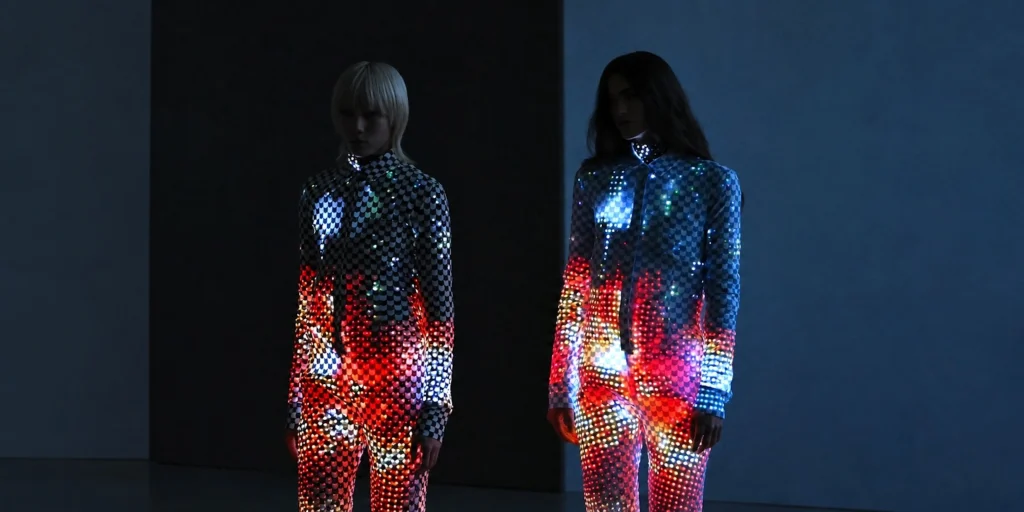
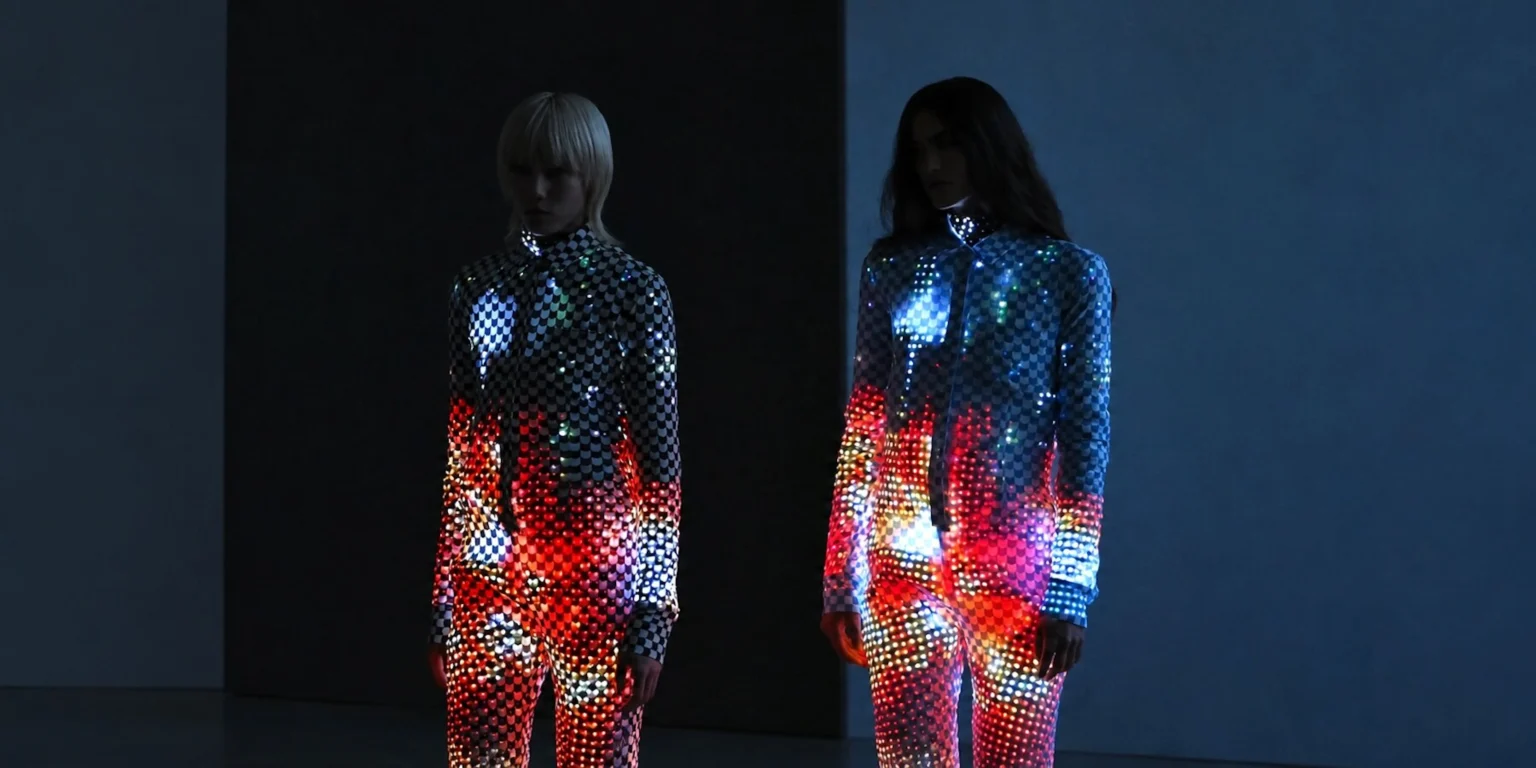
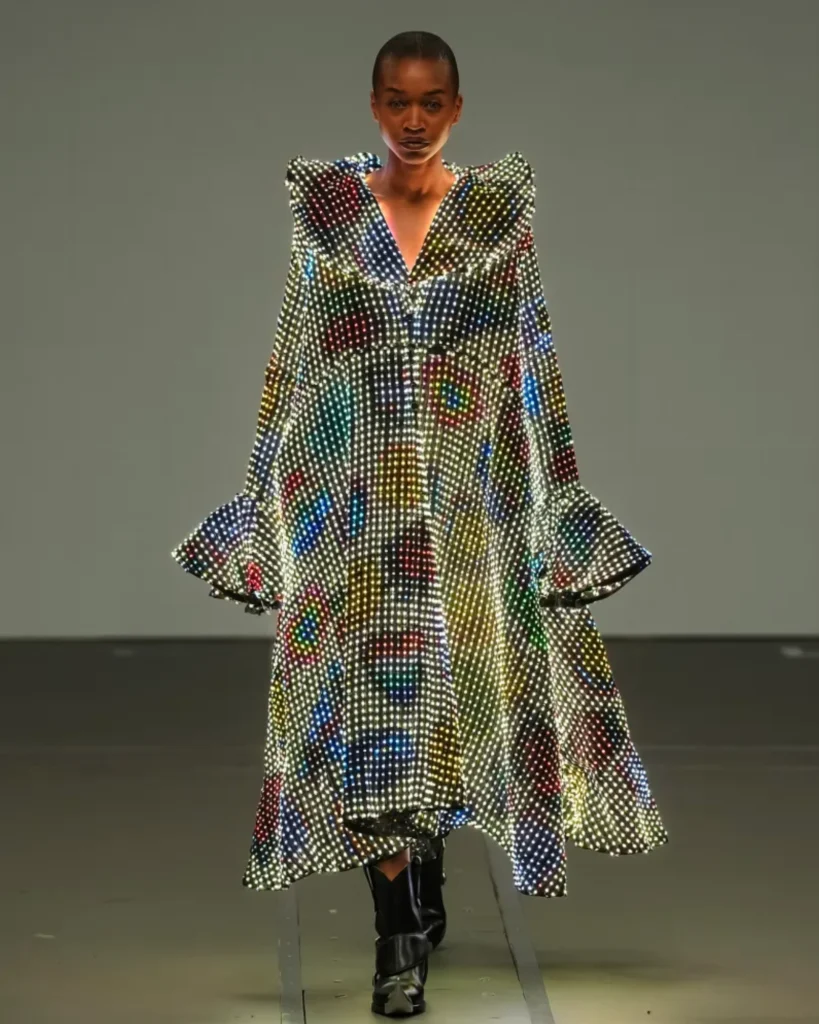
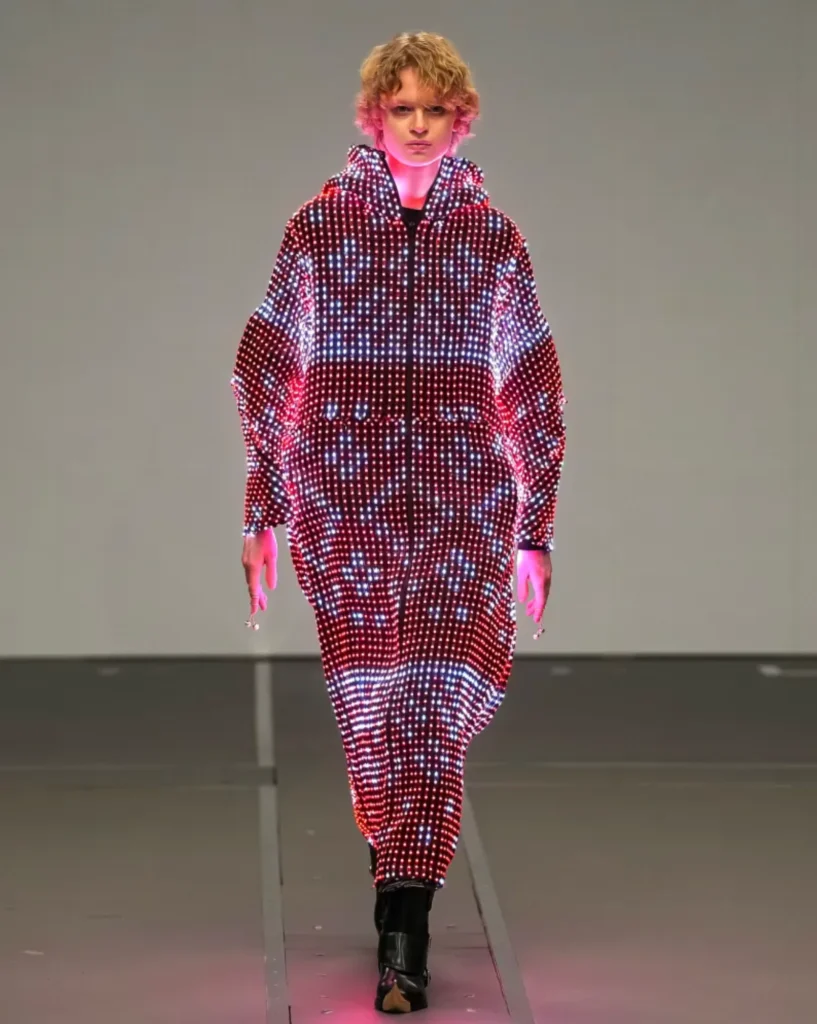
The collection is called Skin. It moves from quiet second-skin bodysuits to armor-like evening dresses whose surfaces actively change color. The climax arrives when six cocktail and evening pieces, each covered in between 1,000 and 2,000 individually controlled electronic-paper scales, begin to shift. Pigment appears, drains to ash gray, then reforms into new patterns. Unlike LED garments that glow, these scales use e-ink technology. The material itself changes color. No light is emitted. The dress simply becomes something else while you watch.
A surface that refuses to stay still
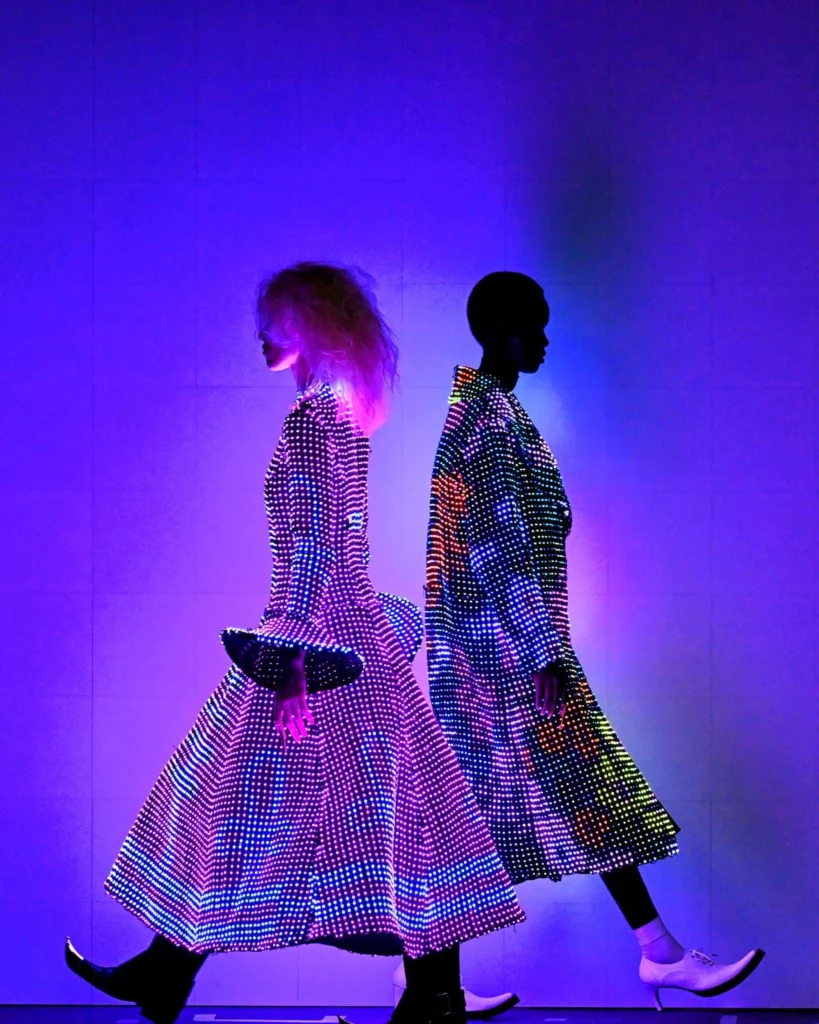
Morinaga has spent years making clothes that behave like optical puzzles or digital screens. Blank fabrics that bloom under ultraviolet light, transparent layers that turn opaque, LED pieces that act as moving displays, garments that seem to dissolve into their background. Skin continues that investigation but brings it closer to the body. The reference point is both biological and mythic: the shifting colors of animal skin and the phoenix of Osamu Tezuka’s manga, a creature of continuous rebirth.
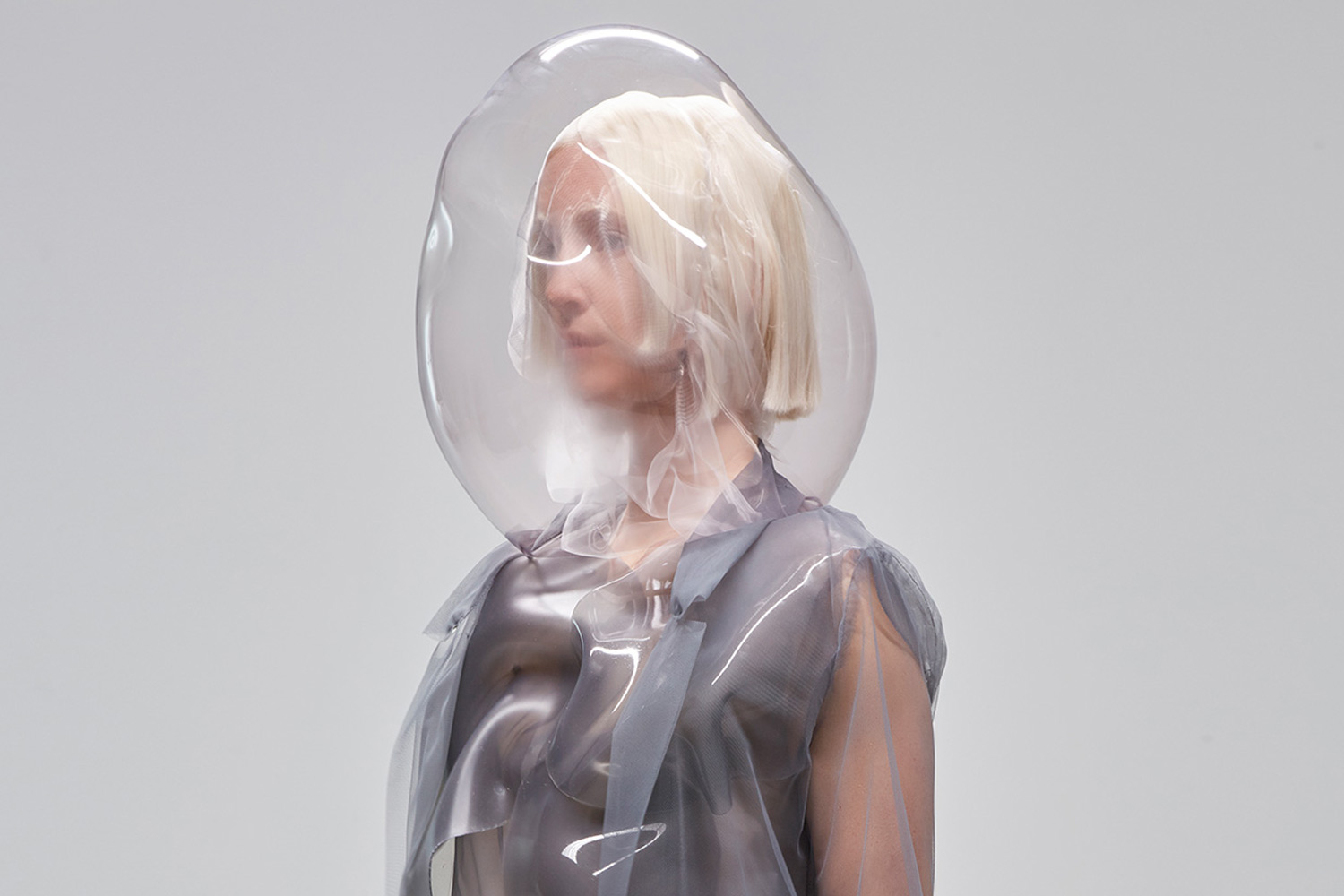
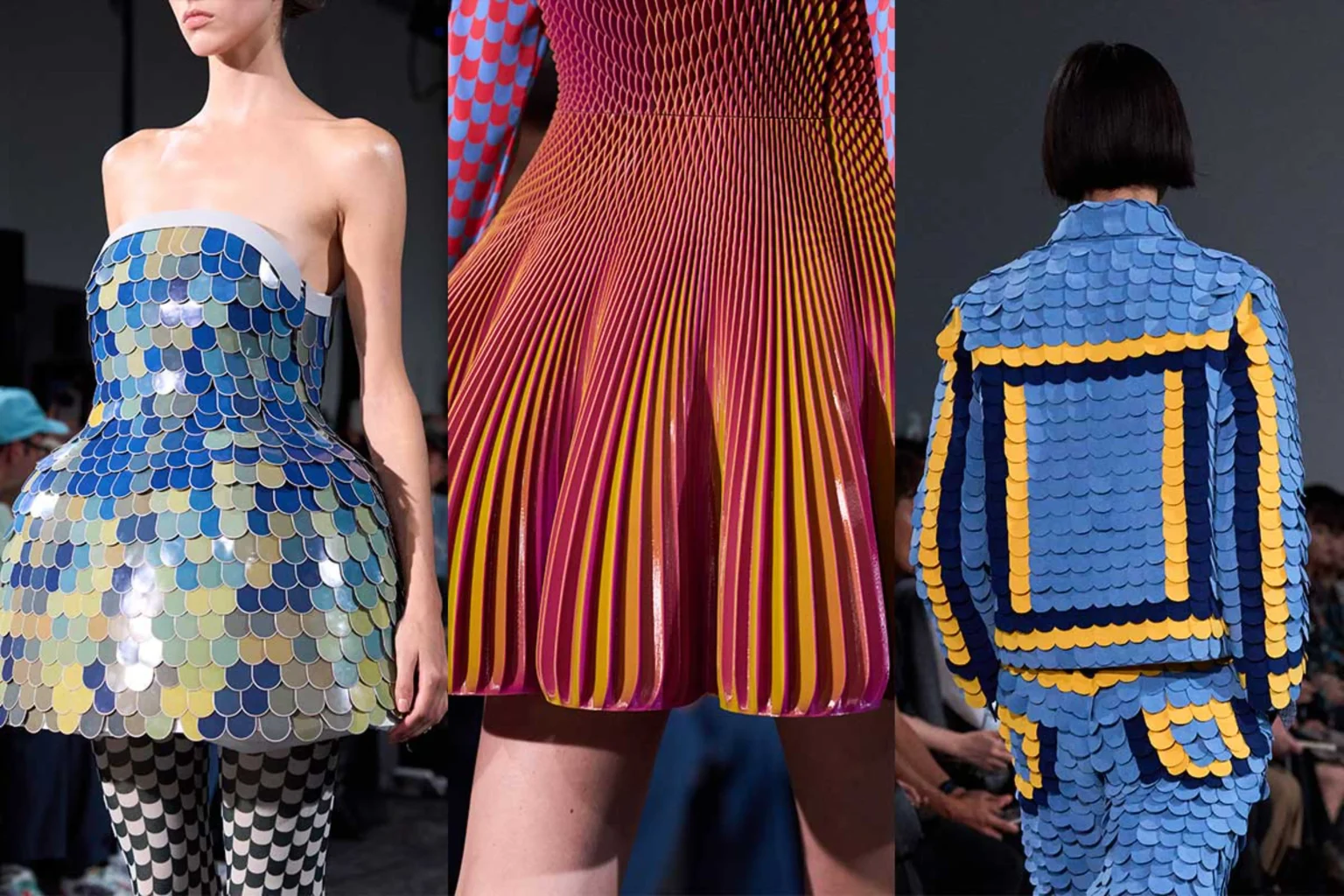
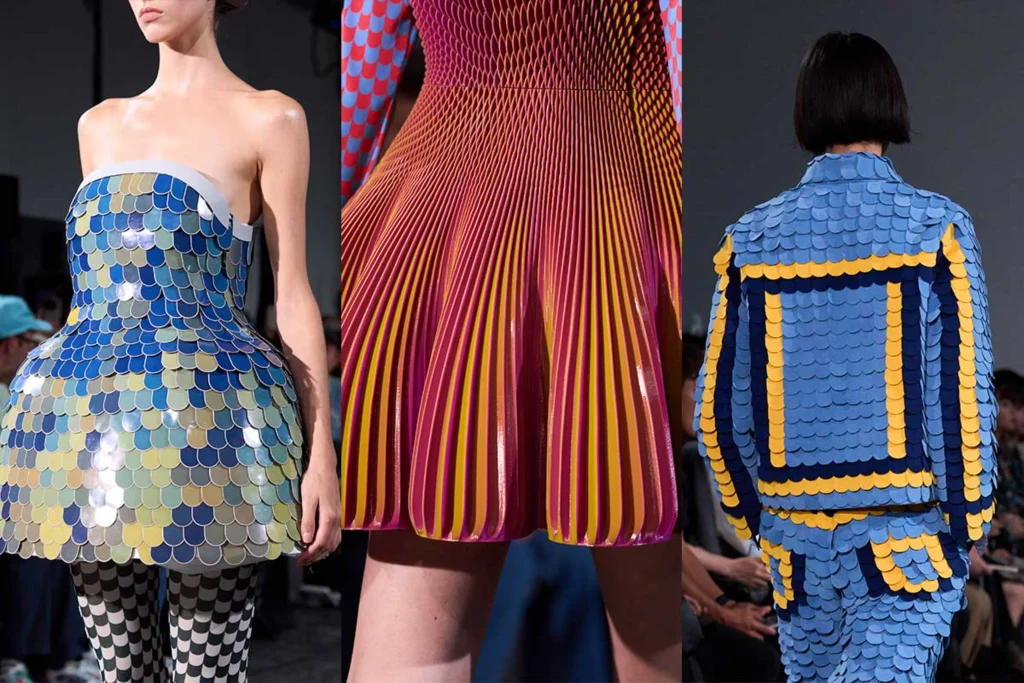
The show builds the idea gradually. Early looks stay analog. Bodysuits carry pixelated graphics and trompe-l’œil versions of ordinary clothes. Scalloped forms begin to lift away from the surface and become physical scales. Materials move between Toray Ultrasuede, Japanese washi, translucent sequins, and digitally printed textiles produced with Kyocera’s water-saving FOREARTH technology. The clothes already feel like interfaces rather than simple coverings.
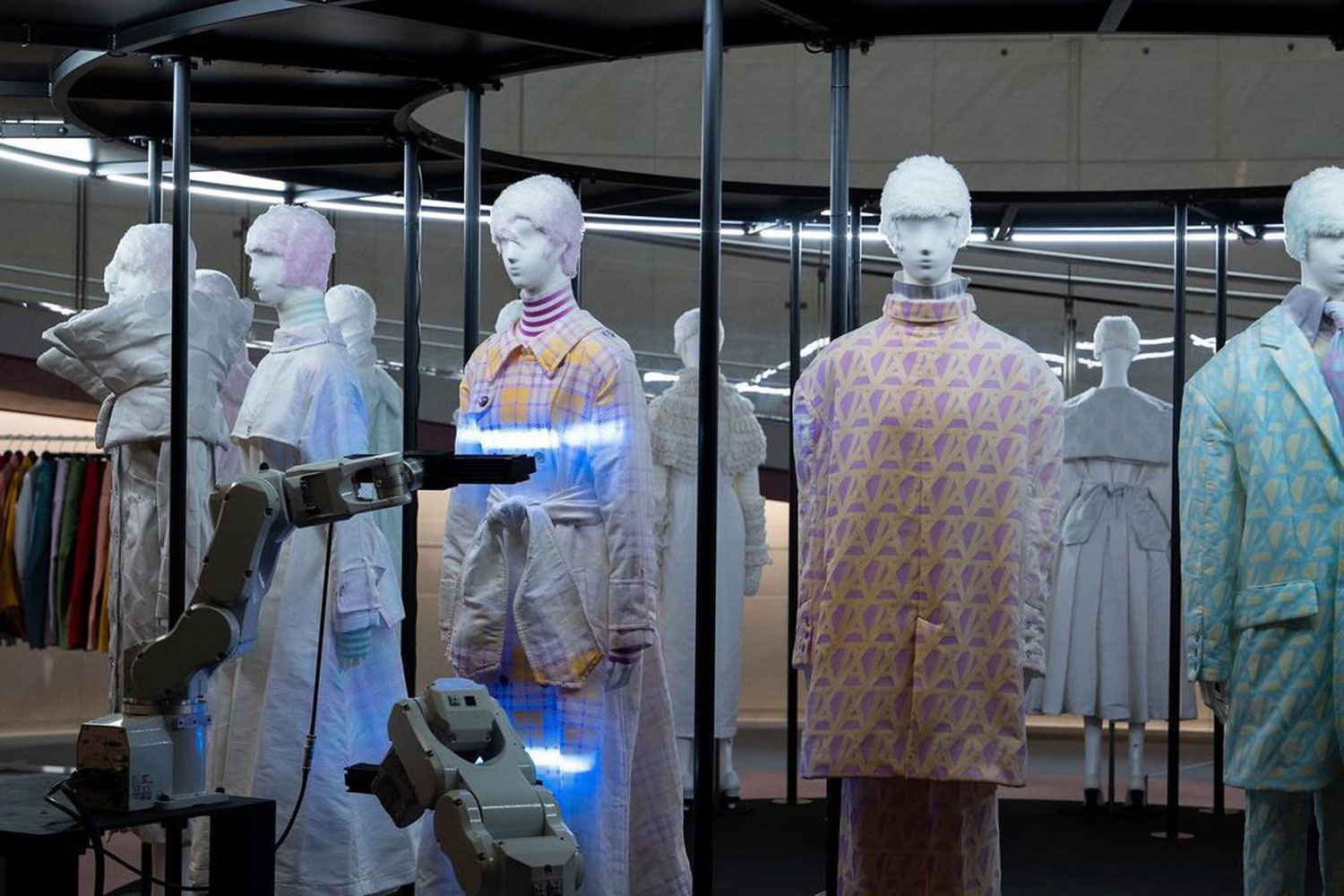
Then the three-dimensional scales arrive. Using SEKISAI’s Effective Skin technology, 3D-printed elements are colored so their appearance changes with the viewing angle. As models walk, the skirts register different shades depending on how light hits the ridges. The effect is quiet but unsettling, like watching a surface develop its own metabolism.
E-ink as second skin
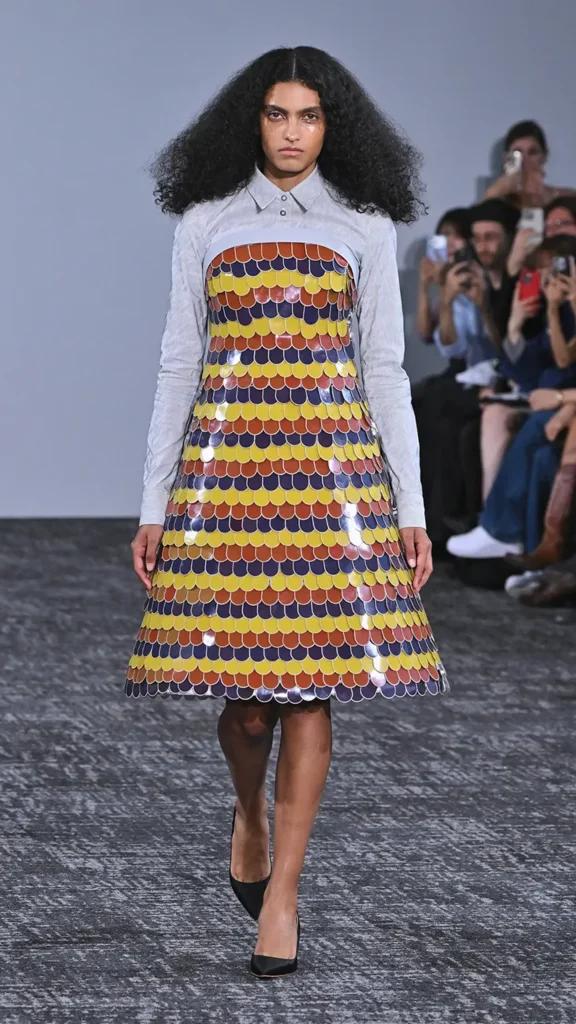
The electronic dresses form the collection’s emotional center. Each scale is a small piece of electronic paper, the same broad family of technology used in e-readers. Arranged across the body like armor or overlapping feathers, they are individually addressable. A dense network of wiring sits beneath, mapped with the help of AI so that patterns can travel, dissolve, and reassemble across the garment.
Because the scales do not emit light, the color change feels closer to natural pigment than to a screen. Vivid hues flicker into existence, fade, and return in more complex formations. During the finale, the dresses moved in conversation with a live performance of the 1919 version of Stravinsky’s The Firebird. The music and the shifting surfaces seemed to share the same nervous system.
This is not the first time fashion has played with responsive surfaces. What distinguishes Morinaga’s approach is the refusal to treat technology as decoration. The e-ink scales are not appliqués on an otherwise conventional dress. They are the dress. The silhouette remains strong and architectural, but the identity of the piece is fluid. One garment can hold several different looks without the wearer changing clothes.
Fashion that thinks in layers
Anrealage has always operated at the edge where fashion, design and engineering meet. The house’s Paris presentations have become known for moments that reward close attention and reward the camera at the same time. Skin continues that tradition while feeling more intimate than some earlier experiments. The clothes do not disappear into their surroundings or announce themselves with bright light. They simply refuse to remain fixed.
The idea of clothing as an outer layer that can be rewritten has obvious digital parallels. Video-game avatars change skins with a click. Online identities are edited daily. Morinaga brings that logic into physical fabric without losing the tactile pleasure of fashion. The e-ink dresses still have weight, structure and presence. They are not dematerialized. They are simply capable of more than one appearance.
There is also a practical poetry in the choice of e-ink. The technology is low-power and readable in ambient light. It does not compete with the room; it cooperates with it. In an industry often criticized for spectacle that exists only under controlled lighting, the decision feels deliberate. The dresses work because the material itself changes, not because stage lights force the change.
Beyond the runway moment
Collections like this raise the usual questions about wearability and commerce. Anrealage has previously made smaller LED pieces available to clients who want programmable surfaces. Whether the full e-ink dresses will move beyond the show remains open. What matters more is the direction they point. Fashion has spent years talking about personalization and responsiveness. Most solutions still require buying another garment. Morinaga proposes that the garment itself might be the variable.
The technical achievement is real. Coordinating one to two thousand individual scales so that patterns move coherently across a moving body is not trivial. The aesthetic achievement is equally clear. The dresses do not look like prototypes wearing clothes. They look like finished pieces that happen to possess an extra dimension of behavior.
A different kind of luxury
In a season full of beautiful static garments, Skin offers something rarer: the sense that clothes can still surprise us after they leave the atelier. The phoenix imagery is apt. The surface burns away and reforms. The body continues. Identity, at least the visible kind, becomes a temporary state rather than a permanent fact.
Morinaga has never been interested in fashion as pure nostalgia or pure futurism. He is interested in the moment when the two meet and produce a third thing. The e-ink dresses of the Skin collection are that third thing: part animal, part interface, part eveningwear. They change color the way skin changes under emotion or light, except the change is deliberate, programmed, and shared with everyone watching.
For a few minutes in Paris, the runway stopped being a place where clothes are shown and became a place where clothes perform their own transformation. That is still a rare and valuable event. Anrealage did not simply decorate the body. It gave the body a surface that knows how to begin again.