

Robotic arms have long promised to free additive manufacturing from the limits of fixed gantries. They can reorient parts, reach larger volumes and deposit material along complex paths.
The difficulty has always been planning. Turning a design file and a set of goals into a collision-free, kinematics-aware, extrusion-ready sequence is still largely a specialist task. A new research framework called A-RAM aims to close that gap by placing an agentic AI system between human intent and robot execution.

Published in September 2026, the work by Jingzhan Ge, Ruimin Chen, Azadeh Haghighi, Jiong Tang and Farhad Imani introduces agentic robotic additive manufacturing. The system takes a natural-language description of manufacturing objectives together with an STL geometry file and produces a complete, traceable process plan that a six-axis robotic arm can execute.
From language to executable plan

A-RAM is structured as an agent-specialist-tool pipeline. A large language model first interprets the user’s stated goals and constraints. It identifies which planning variables are already prescribed and which must be searched. That reasoning is encoded in a schema-constrained request.
A deterministic Planning Agent then launches the appropriate search workflow. Domain-specific tools supply quantitative evidence for slicing strategy, part placement, inverse kinematics, trajectory timing, Joint-6 jerk and extrusion paths.
The result is not a black-box suggestion but a documented sequence of decisions that can be inspected, compared and, if necessary, overridden. Traceability is built into the architecture rather than added afterwards.
Why kinematics matter in Agentic AI
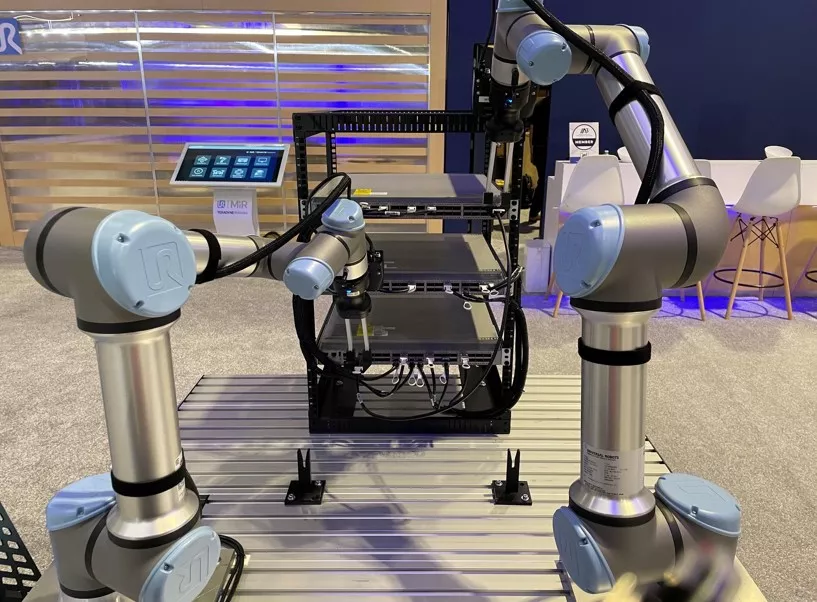
On a robotic arm the same geometry can produce dramatically different joint motions depending on orientation and placement. High jerk on the wrist joint, for example, stresses the mechanism, increases vibration and can degrade surface quality. A-RAM evaluates candidate plans against these robot-specific metrics before any material is deposited.
In the reported case studies the selected plans achieved up to 53.5 percent lower maximum Joint-6 jerk and 48.3 percent lower mean absolute Joint-6 jerk compared with the least favourable valid alternatives. When the objective was speed, objective-specific infill screening produced motion-plan completion times up to 40.1 percent shorter and extrusion paths up to 12.7 percent shorter than the corresponding least favourable patterns.
These numbers matter because they demonstrate that the framework is not merely translating language into conventional slicer settings. It is searching a robot-dependent design space and ranking solutions according to measurable kinematic and process criteria.
Three modes of use
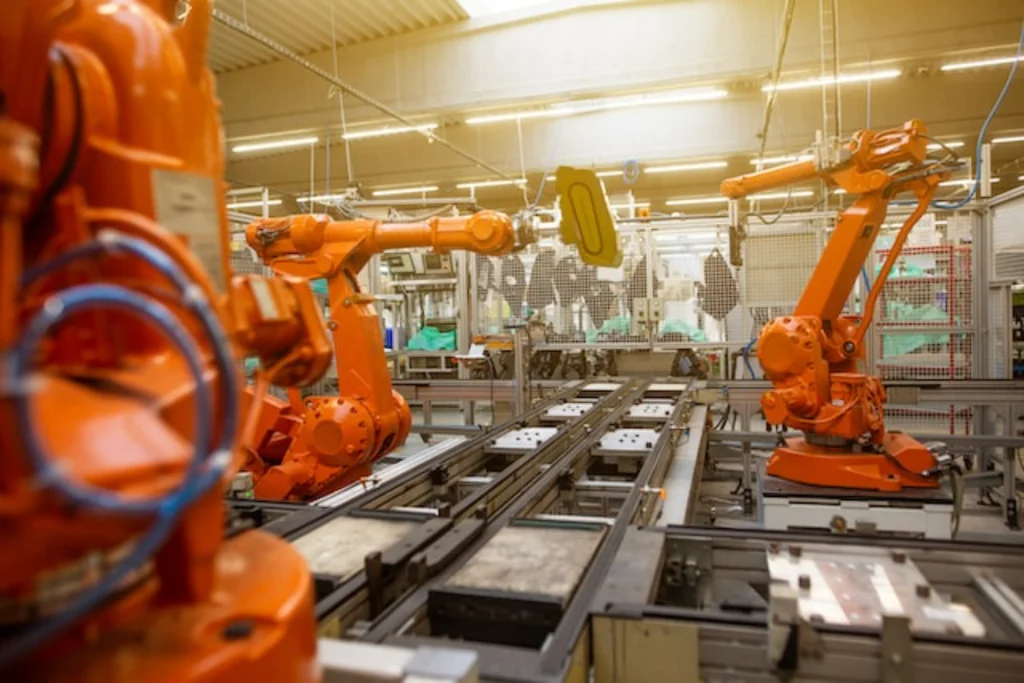
The researchers tested A-RAM in three complementary scenarios. In expert-specified planning, a human still defines many of the variables; the system fills in the rest and verifies feasibility. In goal-only planning the user states high-level objectives and leaves the search entirely to the agents. A third mode focuses on screening alternative infill patterns or orientation-placement combinations against a chosen performance metric.
This flexibility is important. Not every user wants full autonomy. Some need an intelligent assistant that respects existing shop-floor preferences. Others want to explore options they would never have time to evaluate manually. A-RAM supports both ends of that spectrum within the same architecture.
The limits of previous approaches
Conventional AM software assumes gantry kinematics. LLM-based decision-support tools can discuss process parameters but rarely produce robot-ready trajectories.
Digital-shadow systems can simulate a known plan but do not generate and rank alternatives from high-level intent. A-RAM’s contribution is the closed loop: language understanding, structured search, quantitative evaluation and executable output, all grounded in the actual kinematic constraints of the robot cell.
The framework does not eliminate the need for domain expertise. It redistributes it. Human knowledge is encoded in the tools and in the evaluation metrics; the agents handle the combinatorial search and the bookkeeping that would otherwise consume hours of specialist time.
Implications for practice
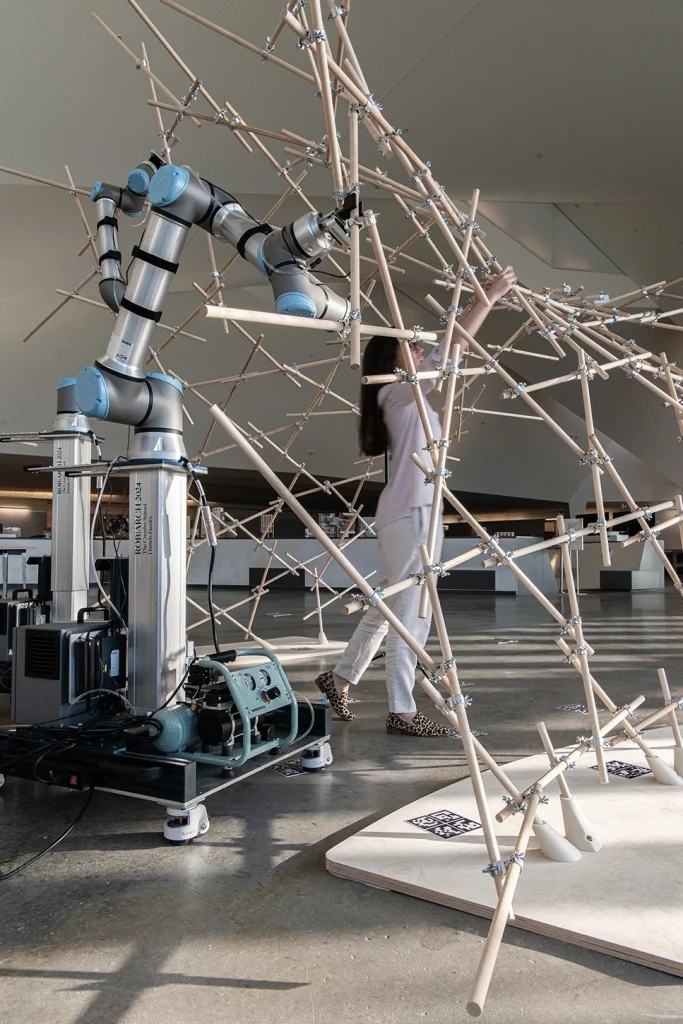
If the approach scales, the practical consequences are clear. Designers and fabricators could specify performance goals in ordinary language, minimise cycle time, keep wrist acceleration below a threshold, prefer certain orientations for strength, and receive ranked, robot-specific plans complete with the quantitative evidence that justifies the ranking. Iteration would become faster because the cost of evaluating an alternative drops dramatically.
The same structure could later incorporate additional tools: thermal simulation, support-volume estimation, multi-robot coordination or in-process sensing feedback. Because the Planning Agent is deterministic and the tool interfaces are explicit, new capabilities can be added without redesigning the entire system.
A step toward agentic fabrication
A-RAM is one of several recent efforts to give manufacturing systems higher-level agency. What distinguishes it is the tight coupling to robotic kinematics and the insistence on pre-execution quantitative evaluation. The plans it produces are not merely plausible; they have been scored against the physical limits of the machine that will execute them.
The work was demonstrated on a six-axis robotic-arm cell. Extending the same logic to multi-robot cells, hybrid additive-subtractive workflows or larger industrial manipulators is a natural next direction. The core insight remains the same: when the planning system understands both the user’s goals and the robot’s body, the distance between design intent and physical part shrinks.
For now the framework remains a research prototype. Its value lies in showing that agentic AI can move beyond conversation and recommendation into the generation of concrete, kinematics-aware fabrication plans. In a field where the robot’s motion is as important as the material path, that capability is a meaningful advance.