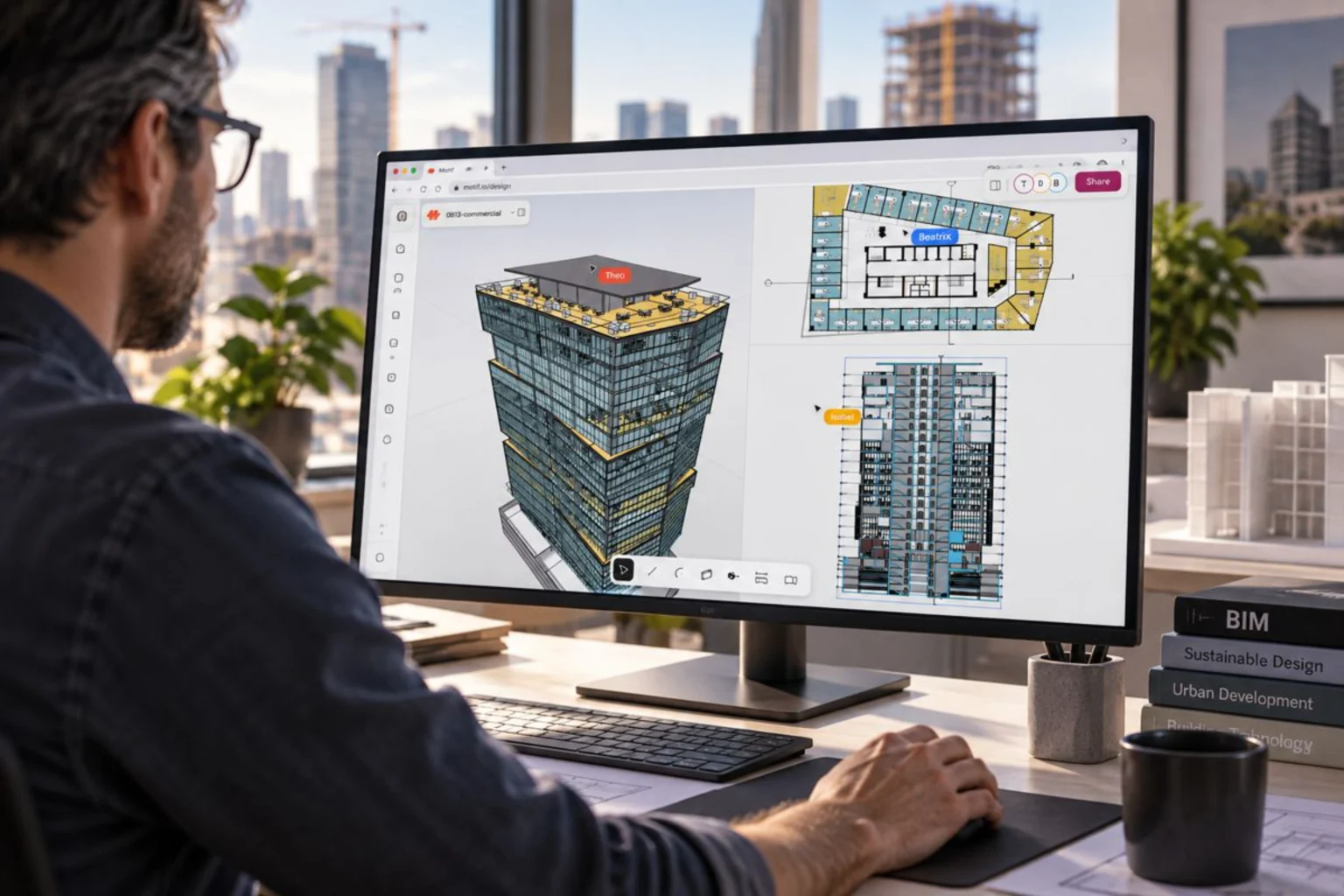

Motif Design’s launch is more than another announcement in the rapidly expanding universe of AI design tools. It proposes a different future for building information modeling: one in which the model is not simply a digital container for geometry, drawings, and schedules, but a living workspace shared by architects, consultants, computational systems, and AI agents.
Introduced on September 8, Motif Design is a browser-based building-design platform created by a team that includes former Autodesk leaders. The platform brings together parametric modelling, documentation, visualization, real-time collaboration, and AI capabilities in a shared project environment. Motif describes this model as “agent-native,” a phrase that may become increasingly important in the architecture, engineering, and construction industry.
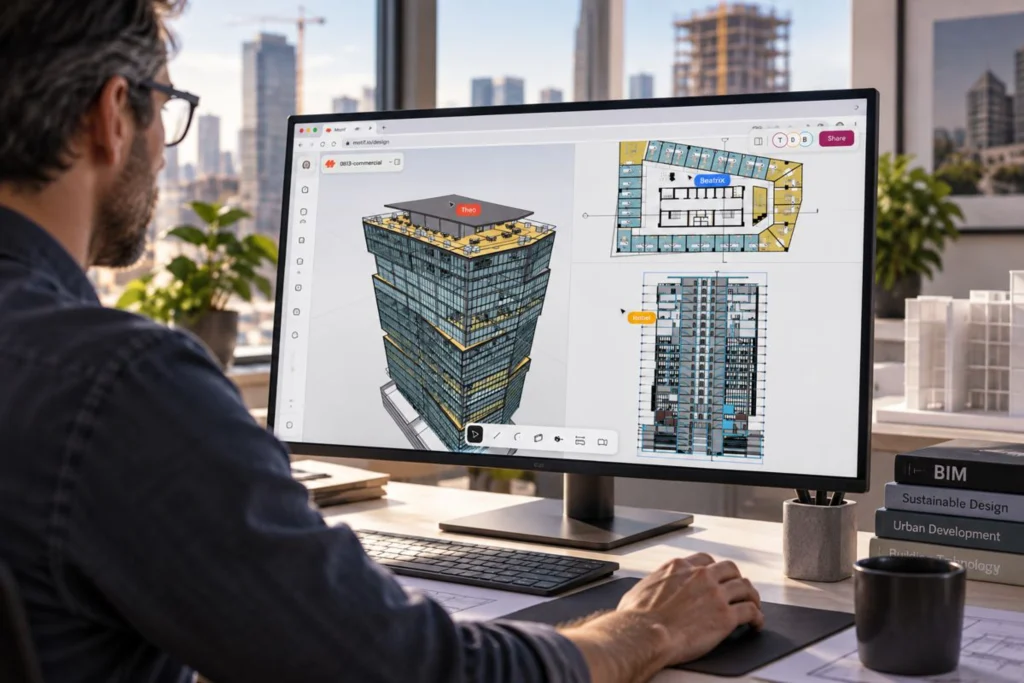
The term suggests that AI does not merely sit beside architectural software as a chatbot, a plug-in, or a distant analytical service. Instead, AI agents are intended to work directly with the same live project information used by designers. This distinction may sound technical, but it has deep implications for how architects think, collaborate, and make decisions.
BIM Has Reached a Turning Point
For decades, BIM has been presented as the central digital foundation for modern architectural practice. It has allowed teams to coordinate building geometry with information about materials, schedules, room data, quantities, and technical requirements. In theory, this has made buildings easier to document, analyse, construct, and manage.
Yet the daily reality of BIM remains fragmented.
Architects often move between modeling tools, spreadsheets, visual-programming platforms, render engines, collaboration systems, and document-management software. Engineers, contractors, fabricators, and specialist consultants may all work in separate applications, with models exchanged through files, exports, revisions, and coordination meetings.
The result is a paradox. The industry has more building data than ever, but that information is not always available at the moment it is most needed.
The BIM model can become a record of decisions already made, rather than an active environment in which decisions are tested and developed. Motif’s central proposition is that the model should do more. It should be live, accessible, responsive, and capable of supporting both human expertise and machine intelligence.
Motif states that its platform enables real-time collaboration, parametric building elements, coordinated documentation, visualization, and detailed change history through a browser-based environment. It also supports the import or streaming of models from established platforms including Revit, Rhino, and IFC-based workflows.
This does not mean that traditional BIM workflows disappear overnight. It does suggest, however, that the familiar boundaries between authoring, coordination, documentation, and computational analysis may begin to weaken.
From AI Assistant to Project Participant
Most architects have already encountered AI in some form. It may generate a mood image, summarize a client brief, propose a code snippet, organize notes, or help draft an email. These applications can be useful, but they often remain disconnected from the actual building model.
An AI tool may know general information about design, but it may not know the dimensions of a specific site, the area schedule for a particular project, the approved material palette, or the relationship between a door, a fire compartment, and an accessible circulation route.
This is where the idea of agent-native BIM becomes compelling.
According to Motif, designers and AI agents can work in the same shared project environment, with agents able to interact with live project data rather than operating as external tools disconnected from the model. In principle, this could allow an AI agent to support meaningful architectural tasks: checking whether a developing design aligns with a client brief, identifying incomplete information, helping generate project assets, evaluating requirements, or assisting in the preparation of documentation.

The change is subtle but important. Instead of asking an AI system to comment on architecture from outside the project, designers could invite an AI agent to work within the logic of the project itself.
That logic is complex. A wall is never only a wall. It has a location, height, specification, material, cost, thermal value, acoustic performance, structural relationship, fire classification, and connection to other building elements. A room has an area, program, occupancy, daylight condition, furniture requirement, servicing need, and relationship to the rest of the building.
For AI to become genuinely useful in architecture, it must work with these relationships. It must understand that a change in one decision can create consequences elsewhere. This is where a shared, live information environment has the potential to become more valuable than a conventional collection of disconnected software tools.
Parametric Design Finds a Wider Role
For computational designers, Motif Design’s proposition is particularly interesting because parametric thinking depends on relationships.
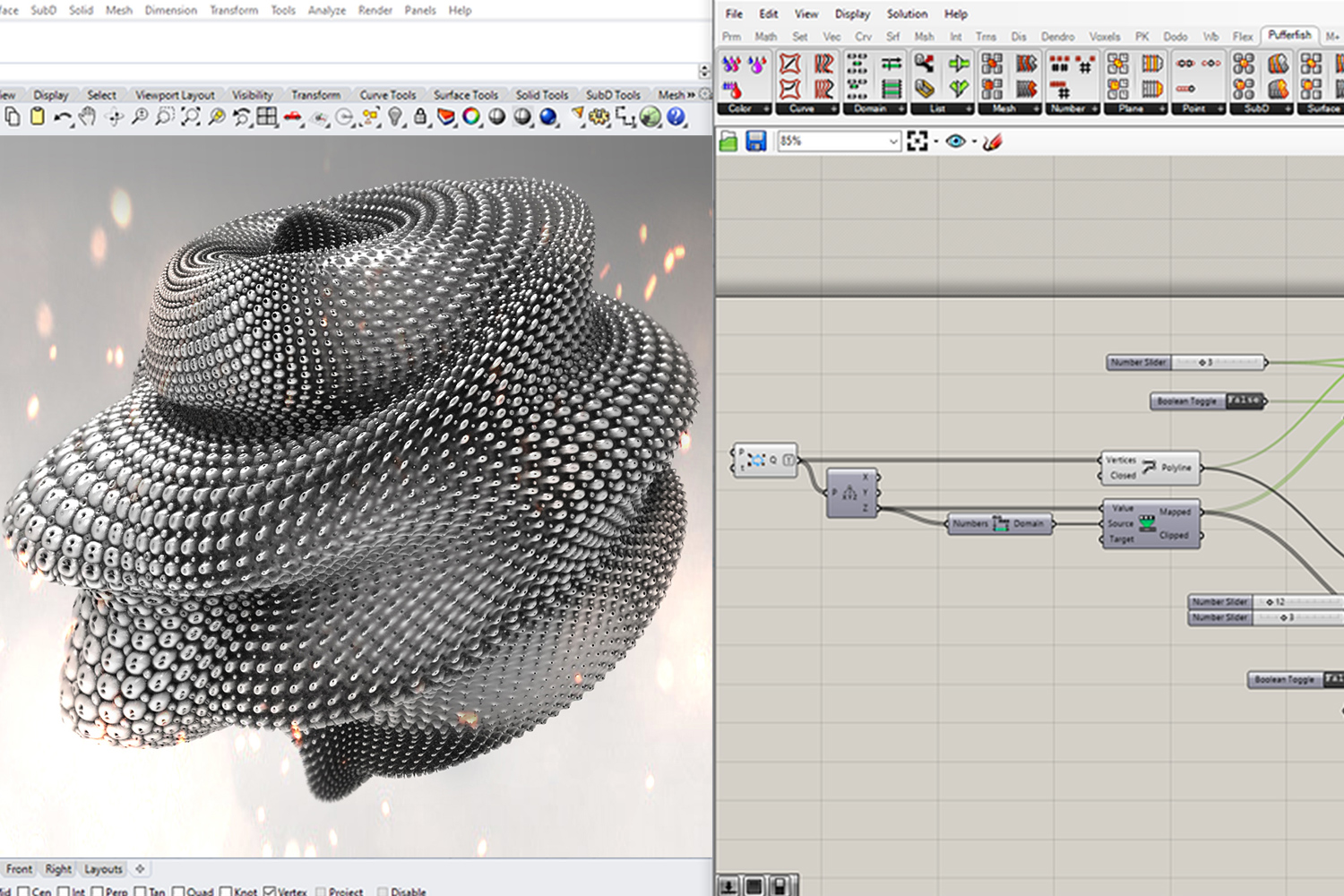
Parametric architecture is not simply about fluid forms, complex surfaces, or visually expressive geometry. At its core, it is a way of establishing rules and dependencies. A façade may respond to solar orientation. A structural system may adapt to span and loading. A floor plate may adjust to site boundaries, views, program requirements, or environmental performance.
When one parameter changes, other parts of the design can respond.
This is powerful, but it is also often difficult to maintain across a full architectural workflow. Parametric studies can be developed in specialist environments, then simplified, rebuilt, or manually translated into the BIM model that supports technical coordination and documentation.
Motif’s approach suggests that parametric relationships can be embedded more directly into the live building environment. The company describes its platform as supporting genuine parametric elements while combining modelling and documentation in the same collaborative workspace.
Imagine an architect developing a façade system with adjustable shading depth, glazing percentage, panel dimensions, and material options. A computational workflow could allow the façade to respond when the building orientation changes or when structural constraints are revised. An AI agent, informed by the same project data, could potentially help compare alternatives, identify conflicts, or flag where a design moves outside defined performance targets.
The purpose should not be to create more complicated buildings for their own sake. The real potential is to make complex decisions easier to understand.
Good computational design reveals relationships. It helps architects see the consequences of changing a span, rotating a building, increasing glazing, altering a room size, or selecting one material over another. AI may make this process faster, but its deeper value will depend on whether it makes those relationships more transparent.
Architecture Cannot Be Automated Into Meaning
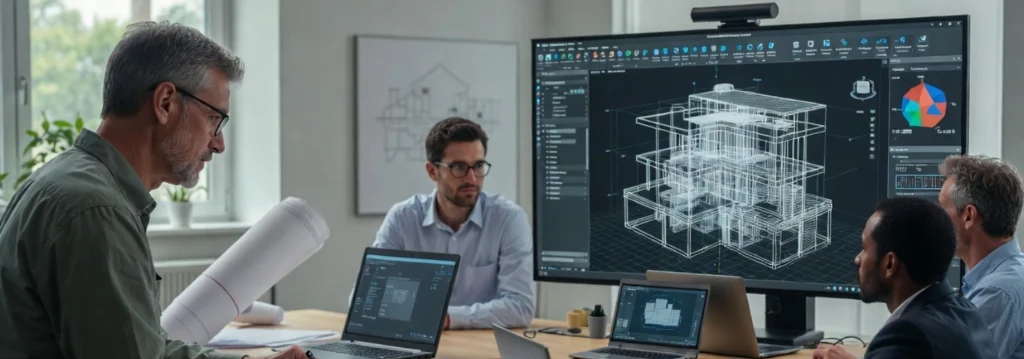
The excitement around AI should not distract from a central truth: architecture is more than a problem-solving exercise.
A system can optimize a plan for efficiency and still fail to create a meaningful place. It can meet daylight metrics yet overlook comfort. It can generate numerous options but not understand cultural memory, local identity, social ritual, or emotional atmosphere.
The architectural value of a courtyard, a threshold, a public stair, or a carefully framed view cannot be fully measured through data alone. These decisions require interpretation. They require an architect to understand clients, communities, climate, history, construction, and human behaviour.
This is why the best future for agent-native BIM is not one that seeks to remove architects from the process. It is one that allows architects to spend less time on repetitive coordination and more time on judgment.
An AI agent may help identify an inconsistent room schedule or missing project data. It may evaluate thousands of combinations faster than a human team. It may help organize a large and complicated model. But it should not be mistaken for the author of architectural meaning.
The architect remains responsible for defining the problem, setting the priorities, challenging the brief, interpreting the context, and deciding which trade-offs are worth making.
Trust, Accountability, and Design Control
The introduction of AI agents into BIM also raises essential professional questions.
If an agent changes a model, who approves that change? If it produces a drawing, who verifies its accuracy? If it identifies a compliance issue, how does the team know which information it used? If an AI-generated option appears efficient, has it also considered construction feasibility, local regulation, accessibility, maintenance, and long-term use?
These questions are not obstacles to innovation. They are the basis of responsible innovation.
Motif’s emphasis on collaborative workspaces and change history is therefore significant. In a live model, teams need visibility into authorship, permissions, review stages, and project decisions. A reliable platform must allow architects to see what has changed, understand why it changed, and retain authority over what is issued or approved.
This is especially important as architectural projects become more distributed. A designer may be working in Mumbai, a façade consultant in London, a structural engineer in Singapore, and a contractor in Dubai. Browser-based collaboration can help reduce the delays and friction of file-based workflows, but only if it strengthens project clarity rather than creating new layers of complexity.
The most useful AI systems will not hide their workings behind automation. They will make reasoning, sources, and changes easier for people to review.
A More Connected Global Practice
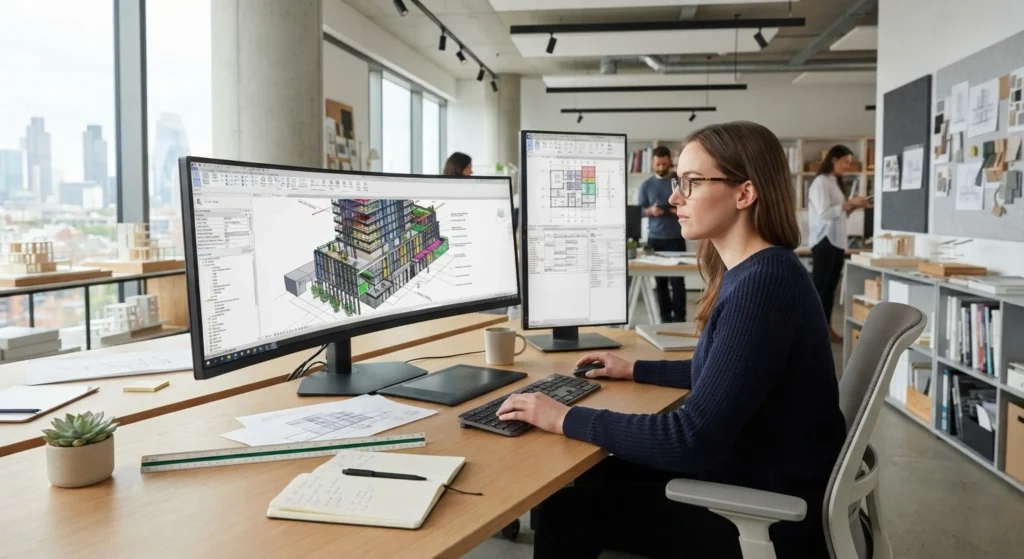
Motif Design enters the market at a moment when global architectural practice is under pressure to do more with greater precision. Buildings are expected to be lower carbon, more adaptable, more technically coordinated, and more responsive to changing client and regulatory demands.
At the same time, firms are working across borders, time zones, disciplines, and digital ecosystems.
Motif positions its platform as open and connected to existing design and collaboration tools, including Revit, Rhino, IFC, Slack, Microsoft Teams, email, Notion, OneDrive, and SharePoint. This is important because the future of architecture is unlikely to be built around one closed software environment. It will depend on systems that can exchange information reliably while respecting the diverse tools already used by the industry.
For small studios, an agent-native workflow could make computational support more accessible without requiring an extensive in-house technology team. For large international firms, it could help formalize design standards, coordinate knowledge across offices, and make lessons from one project more usable on the next.
However, the test will be practical. Architects will judge Motif not by the ambition of its language, but by whether it can handle real project complexity: large models, changing client requirements, difficult coordination conditions, detailed documentation, and the unpredictable realities of construction.
The Building Model as a Living Medium
Motif Design is not important simply because it brings AI into BIM. Many tools are attempting that.
Its more ambitious idea is that AI can become part of the living logic of the building model. Geometry, material data, design rules, project history, documentation, and collaborative decision-making could exist in a common environment rather than being scattered across disconnected applications.
For parametric and computational architecture, this could be a meaningful evolution. The model would no longer be only a representation of a future building. It could become an active medium for exploring alternatives, understanding constraints, and coordinating the many decisions that shape the built environment.
The promise is substantial, but so is the responsibility. Architecture needs AI that is transparent, reliable, interoperable, and answerable to human judgment.
If Motif Design can meet that standard, agent-native BIM may shift the discipline beyond BIM software as we know it. Not by replacing architects, but by giving them a more intelligent, connected, and responsive medium through which to design.