
As generative AI enters architectural workflows, the profession is moving from drawing every line toward defining constraints, evaluating alternatives and taking responsibility for spaces produced through computational systems.

From authorship to orchestration
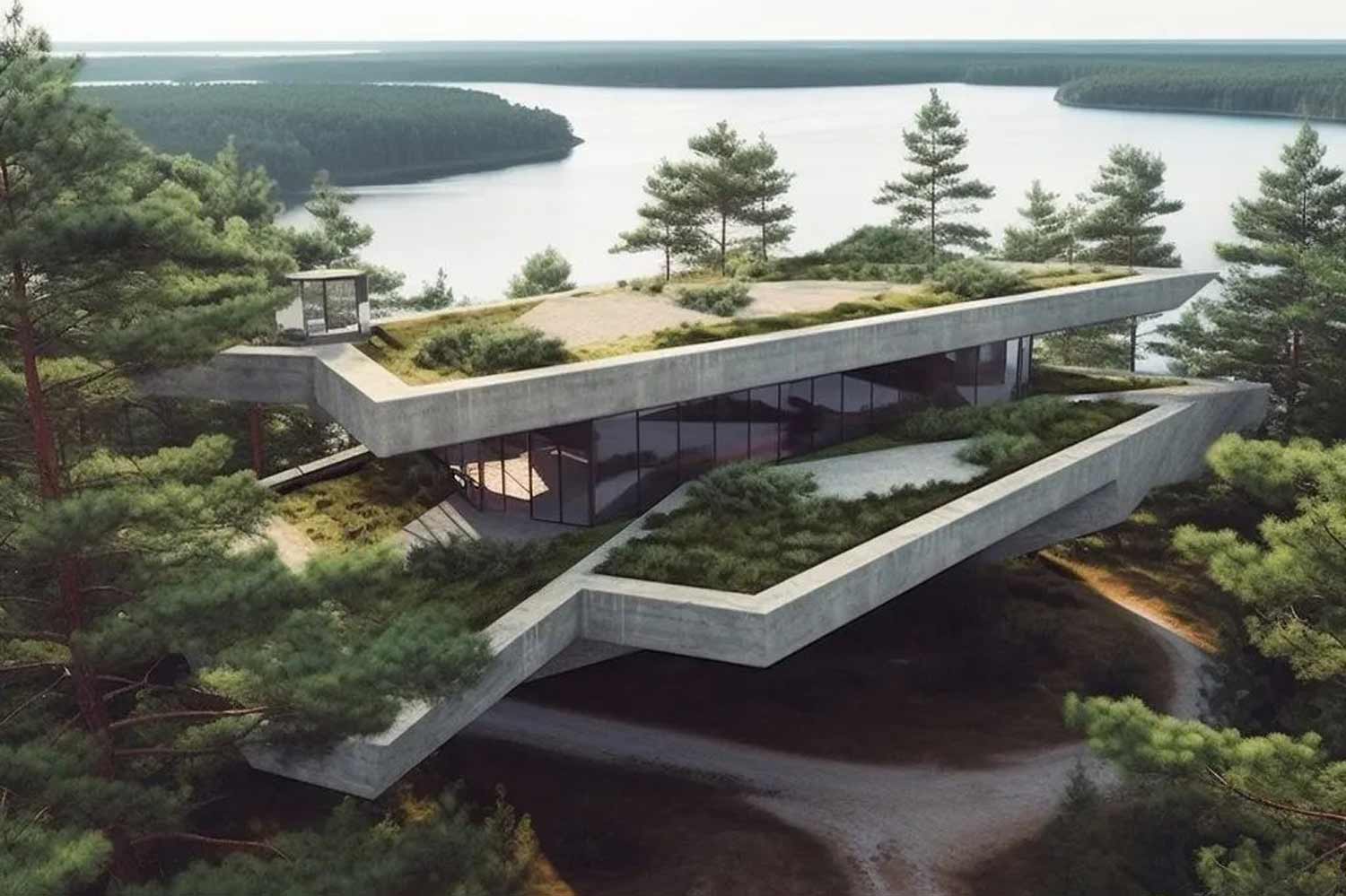
The question facing architecture is no longer whether machines can generate buildings. They already generate plans, facades, structural configurations, energy models and visual environments. The more important question is whether architects will become curators of machine-generated space, selecting, editing and governing the outputs of systems that can explore more options than a human team could produce manually.
This shift is arriving through several overlapping technologies. Generative AI can convert written instructions into images, diagrams, and early spatial studies. Parametric modeling defines relationships between design variables, allowing a change in one parameter to update an entire geometry. Optimization engines then test alternatives against criteria such as solar exposure, embodied carbon, structural mass, daylight autonomy, circulation efficiency, and cost.
The resulting workflow is different from conventional drafting. An architect may set the floor area, height limit, structural grid, facade orientation, daylight target and material palette. A computational system can generate hundreds of options, score them against the chosen criteria and present a field of possible solutions. The architect’s role shifts toward framing the problem, interpreting the results and deciding which values deserve priority.
Recent adoption data shows that the profession is moving in this direction, though at uneven speed. The Royal Institute of British Architects reported that 74 percent of UK practices were using AI on at least some projects in 2026, compared with 59 percent in 2025 and 41 percent in 2024. The same report found that the share of practices using AI on most or all projects had risen to 31 percent.
The figures describe broad use rather than full automation. Many firms are applying AI to visualization, research, administrative tasks, and written specifications. Fewer are allowing machine-generated systems to influence construction documents, structural design, or detailed building performance. A 2025 American Institute of Architects study found that 8 percent of firm leaders had integrated AI into their practice, while 20 percent were implementing it and 35 percent were considering adoption.
This gap between experimentation and institutional deployment is where the role of the architect and Machine-Generated Space becomes more complex.
The new design intelligence

Parametric architecture has already prepared the profession for machine-assisted authorship. Tools such as Rhino, Grasshopper, Dynamo and Revit’s computational functions allow designers to build rule-based systems rather than isolated forms. A facade can be described through panel dimensions, solar angles, structural limits and fabrication rules. A roof can respond to drainage, span, daylight and material availability. The geometry is produced by relationships.
Generative AI introduces a less predictable layer. Instead of requiring every relationship to be explicitly scripted, machine-learning models can infer patterns from datasets and propose new configurations. This creates a powerful design space, yet it also creates a problem of explainability. A Grasshopper definition can be inspected node by node. A neural model may produce a convincing result without offering a clear account of why that result was selected.
For professional practice, this distinction matters. Architecture is governed by building codes, planning conditions, accessibility standards, fire regulations, procurement rules and professional liability. A visually impressive output has limited value if its geometry cannot be documented, fabricated, approved or maintained.
The most effective workflows are therefore likely to combine generative AI with explicit parametric constraints. A text-to-image model might generate a broad formal direction. A rule-based system can then rebuild the proposal as editable geometry. Performance simulations can test daylight, thermal comfort, glare, wind and structural behavior. Building information modeling can connect the result to quantities, specifications, schedules and construction data.
This is where computational design becomes more than a form-making technique. It becomes a governance structure for design decisions. The model records relationships between geometry and performance, while the architect decides which variables are negotiable and which remain fixed.
A 2026 systematic review of digital construction research identifies AI, generative design, building information modeling and physics-informed models as significant tools for material optimization, early-stage life-cycle assessment and energy analysis. It also points to persistent problems, including the energy consumption of large AI systems, limited transparency and inconsistent performance metrics.
These constraints suggest that the future architect will need a wider technical vocabulary. Understanding prompts will be insufficient. Designers will need to understand datasets, model bias, interoperability, geometry kernels, simulation fidelity, carbon accounting and the limits of optimization.
Who curates the machine-generated space?
Calling architects curators can sound like a reduction of authorship, as if design judgment were being replaced by selection. In practice, curation can become a more demanding form of authorship. The architect may produce fewer individual drawings while taking greater responsibility for the system that generates them.
A curator defines the field of attention. In computational architecture, that field is established through parameters, objectives, exclusions and feedback loops. Changing the objective function can change the building. Prioritizing operational energy may favor compact massing and controlled openings. Prioritizing material reuse may produce irregular grids and variable spans. Prioritizing public access may reorganize circulation around ramps, courtyards and shared thresholds.
The critical issue is who defines those priorities. If a developer’s dataset rewards maximum floor area, the system may optimize yield at the expense of public space. If a model is trained on existing building types, it may reproduce familiar spatial hierarchies while presenting them as novel. If carbon calculations exclude maintenance and replacement, the optimization may produce a misleadingly efficient result.
Architects will therefore need to curate inputs as carefully as outputs. This includes choosing training data, checking environmental assumptions, testing edge cases and communicating uncertainty to clients and communities. The design process will require a transparent chain of decisions from brief to algorithm, simulation to fabrication and construction to post-occupancy performance.
The construction sector is already moving toward this connected workflow. Autodesk reports that early AI adopters are seeing operational improvements, with energy optimization and resource management emerging as practical applications. Robotics, digital twins, drone surveys and automated fabrication are extending the computational model from the screen to the job site.
This connection could transform parametric design. A building may be designed as a live data environment, with sensors feeding information back into the model. Facade shading could be adjusted through operational data. Maintenance schedules could respond to material performance. Robotic fabrication systems could use the same geometric data that shaped the initial concept.
Yet a machine-generated space still requires human accountability. Architects remain responsible for public safety, ethical judgment, cultural context and the consequences of construction. Curation cannot mean passive approval. It must involve critique, verification and the ability to reject a technically optimized proposal when it produces a poor civic or environmental outcome.
The architect of the near future may therefore be less like a solitary author and more like the director of a complex design ecology. Their work will involve setting parameters, balancing competing performance targets, coordinating specialists and making machine-generated possibilities legible to clients, regulators and the public.
Machine-generated space will expand the territory of design. It will not remove the need for judgment. The profession’s value will depend on how architects shape the systems behind the forms, who those systems serve and whether their decisions produce buildings that perform well in real life.
The Architect’s New Responsibility
As machines generate more spatial possibilities, architects will define the values that guide these machine-generated spaces. Their responsibility will extend beyond selecting compelling forms to verifying performance, protecting public interests and translating complex systems into meaningful places. The future of architecture will belong to practices that combine computational precision with cultural awareness, material intelligence and human judgment.