

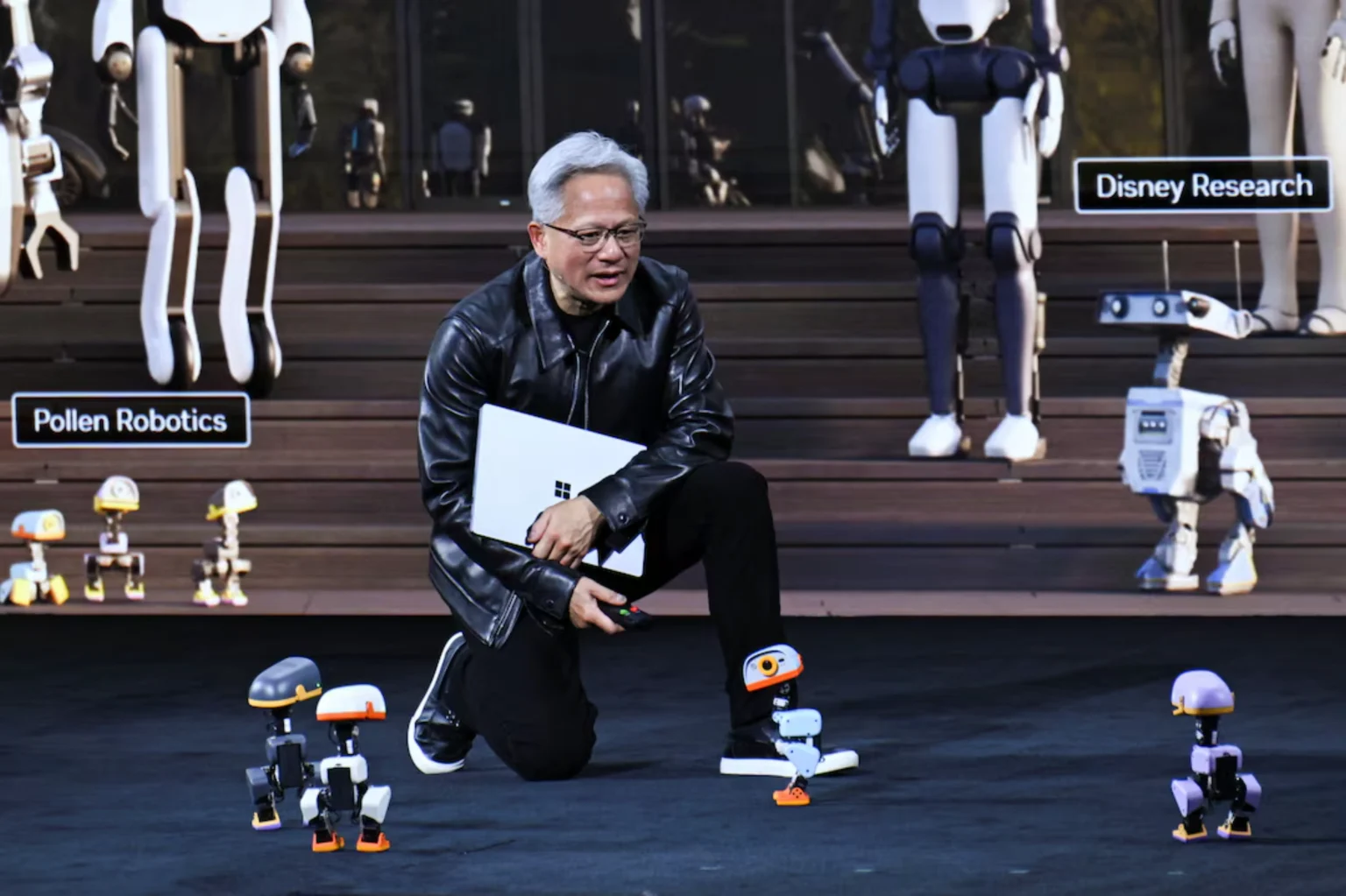


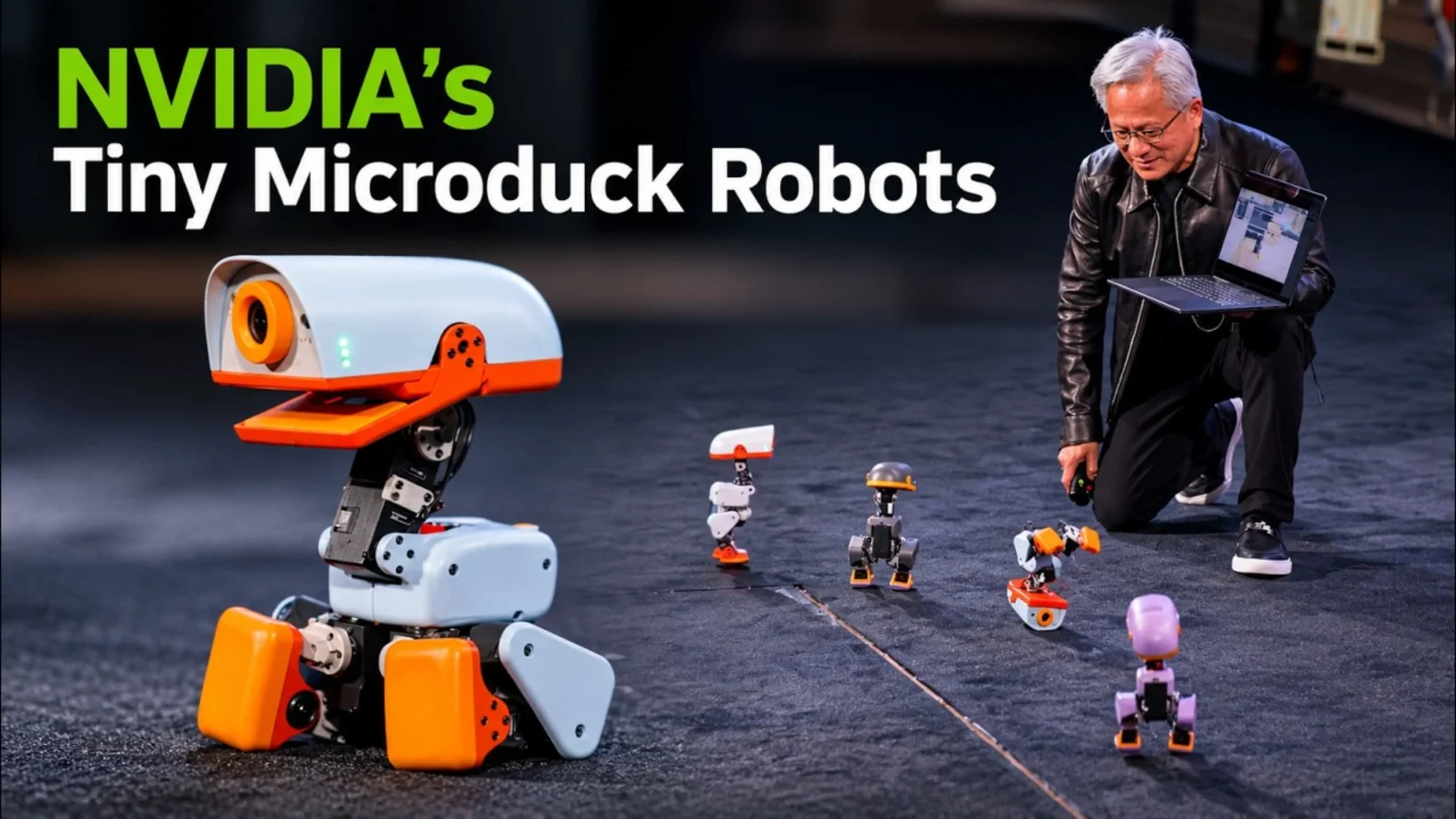
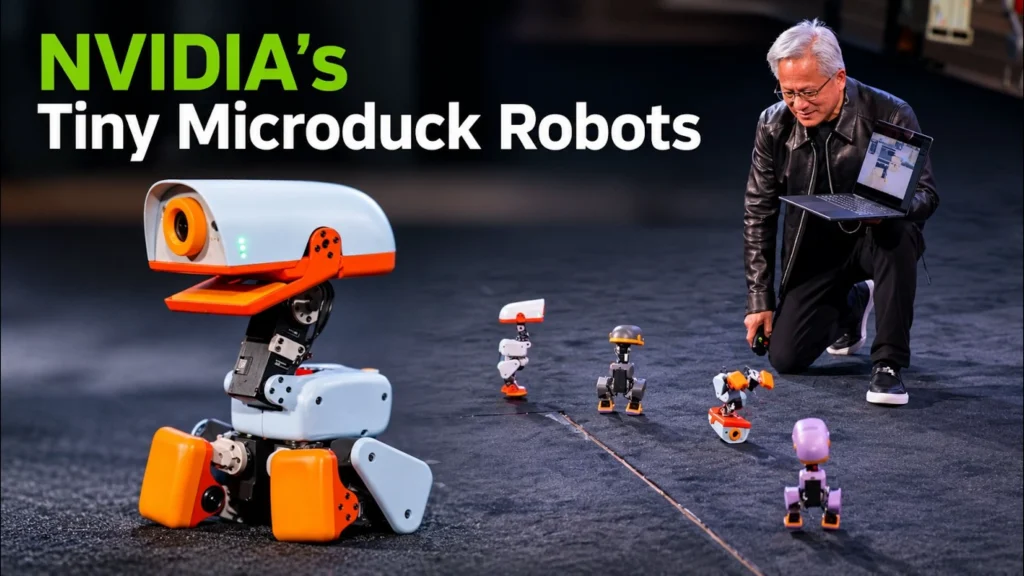
At GTC Berlin on 21 October 2026, NVIDIA CEO Jensen Huang brought four small bipedal robots onto the stage and asked one of them to somersault. The request was playful, but the computing pipeline behind it pointed to a larger shift in how robots learn.
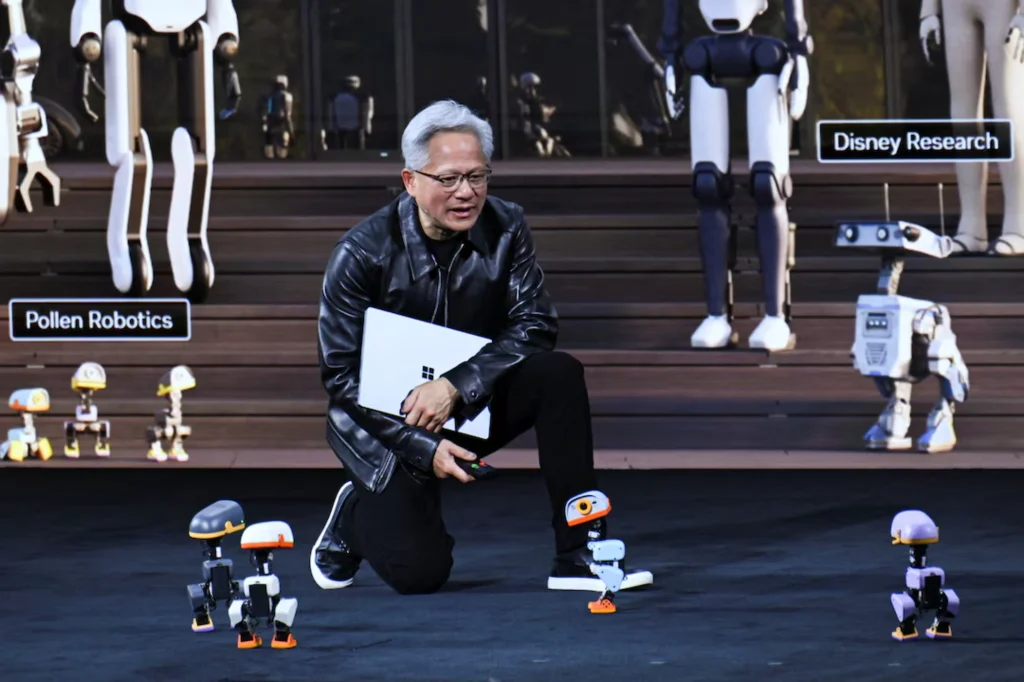
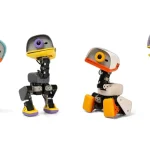
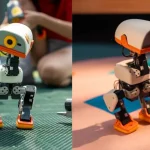
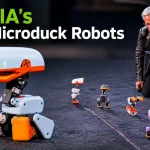
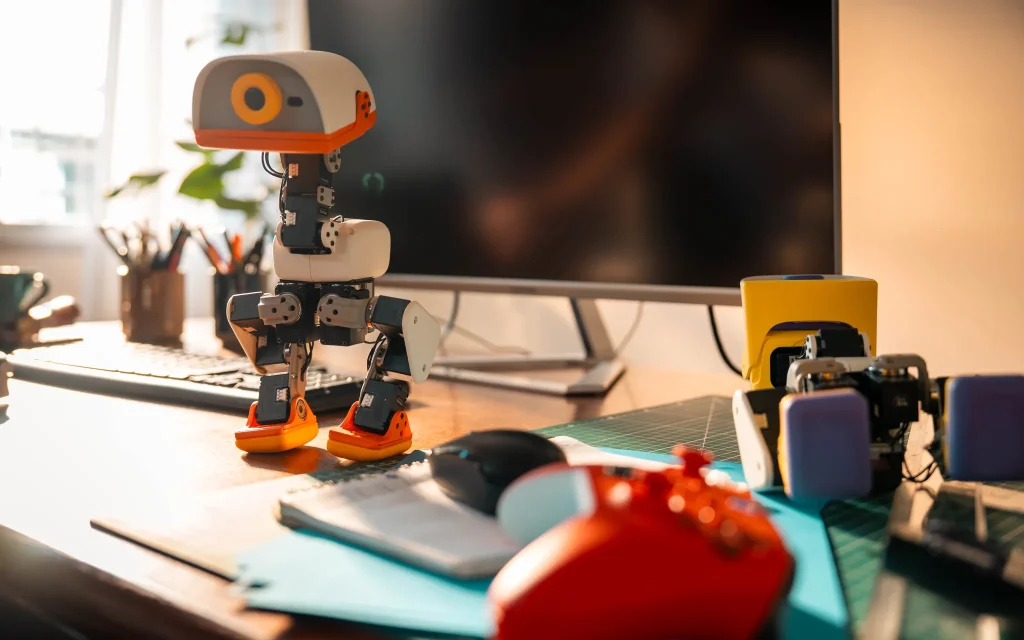
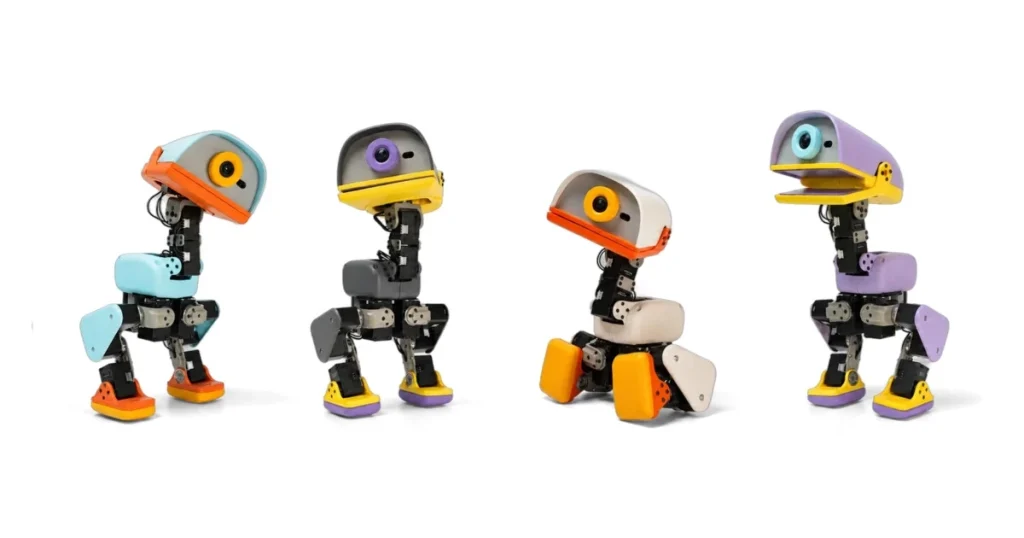
The robots were Microducks, 25-centimeter bipeds developed by Pollen Robotics, the robotics arm of Hugging Face. Each weighs under 800 grams, carries 15 motors, a camera, a depth sensor and two inertial measurement units, and sells for $399 before tax and shipping. On stage they walked, sat, stood, pretended to sleep, stumbled, recovered and, at Huang’s request, attempted rolls and somersaults. Some succeeded. Others fell and got back up. The audience laughed. The technology behind the performance was more deliberate.
From Simulation to Stage
Huang told the robots they had been created on RTX Spark, trained in the cloud on NVIDIA supercomputers, and had learned their skills inside an Omniverse digital twin. The workflow followed a three-computer model NVIDIA has been refining for physical AI: a local machine for agent orchestration and evaluation, large-scale cloud training, and on-robot inference.
RTX Spark, NVIDIA’s new class of Windows laptops with up to 1 petaflop of AI performance and 128 GB of unified memory, ran the AI agents that set up the simulated environment. Hermes Agent coordinated the tasks. Nemotron 3.5 Bolt helped plan the workflow. Isaac Sim built the virtual scene. Isaac Lab trained thousands of simulated Microducks in parallel. Every fall in simulation improved the movement policy. Once the behavior stabilized, it was evaluated on RTX Spark and then transferred to the physical robots.
The point was not that a laptop alone taught a duck to tumble. The point was that a developer-facing machine could orchestrate a pipeline that used to require specialized robotics labs and months of trial-and-error on hardware.
Computational Design of Movement
From a computational design perspective, the demonstration sits at the intersection of parametric control and reinforcement learning. The Microduck’s body is a fixed mechanical system: fixed limb lengths, fixed motor limits, fixed mass distribution. What changes is the policy that maps sensor readings to motor commands. That policy is itself a parametric object. It is optimized across thousands of parallel simulated instances until the parameters produce stable walking, recovery from falls, and eventually more complex sequences such as a somersault.
Digital twins allow the geometry and physics of the robot to be varied systematically. Designers can test different friction coefficients, slight changes in centre of mass, or alternative motor torque curves without building new hardware. The same computational logic that architects use to explore façade geometries or structural forms is here applied to the dynamics of a small biped. The result is a movement repertoire that can be iterated far faster than physical prototyping alone would allow.
The open-source nature of the Microduck platform extends this further. Developers can inspect the software stack, retrain policies, and share new behaviors. The robot becomes a shared parametric model rather than a closed product.
What the Demo Actually Proved
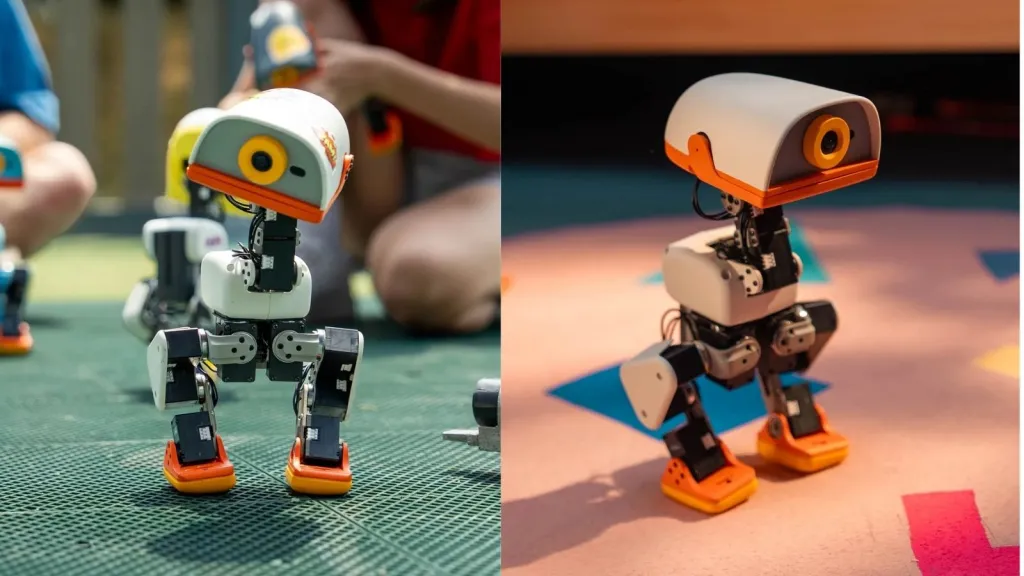
The stage performance mixed success and failure. Some robots completed rolls. Others needed prompting. One wandered off and had to be called back. That unevenness is useful. It shows that transferring a policy from simulation to hardware still involves gaps in friction, sensor noise and balance. Simulation reduces the cost of early exploration. It does not eliminate the need for real-world validation.
Huang’s request for a somersault made the gap visible and entertaining. The underlying claim was more measured: AI agents running on accessible hardware can now participate in the full loop from scene creation to policy training to physical deployment. For NVIDIA, RTX Spark is the local node in that loop. For Hugging Face and Pollen Robotics, Microduck is a low-cost, open platform that lets more people experiment with the same loop.
Why It Matters Beyond the Stage
Physical AI is the term NVIDIA uses for systems that perceive the world, decide and act through machines. Most public attention still focuses on language models and image generators. The Microduck demonstration pointed to a different application: using agents and large-scale simulation to teach robots how to move. The same tools that help an architect explore complex forms can help a roboticist explore complex behaviors.
The $399 price and open-source stack lower the barrier to entry. A student or small studio can now own a robot that was trained with the same class of tools previously reserved for well-funded labs. That does not make reliable, general-purpose robots imminent. It does make the process of teaching robots new skills more accessible and more iterative.
What the Duck Leaves Behind
Huang asked for a somersault and received a mixture of success, failure and laughter. The more lasting result is the visible connection between a local AI workstation, cloud-scale training and a physical machine that can stand up after falling. The Microduck is small enough to sit on a desk. The computational pipeline that taught it to move is not. That pipeline is what the demonstration was really selling.