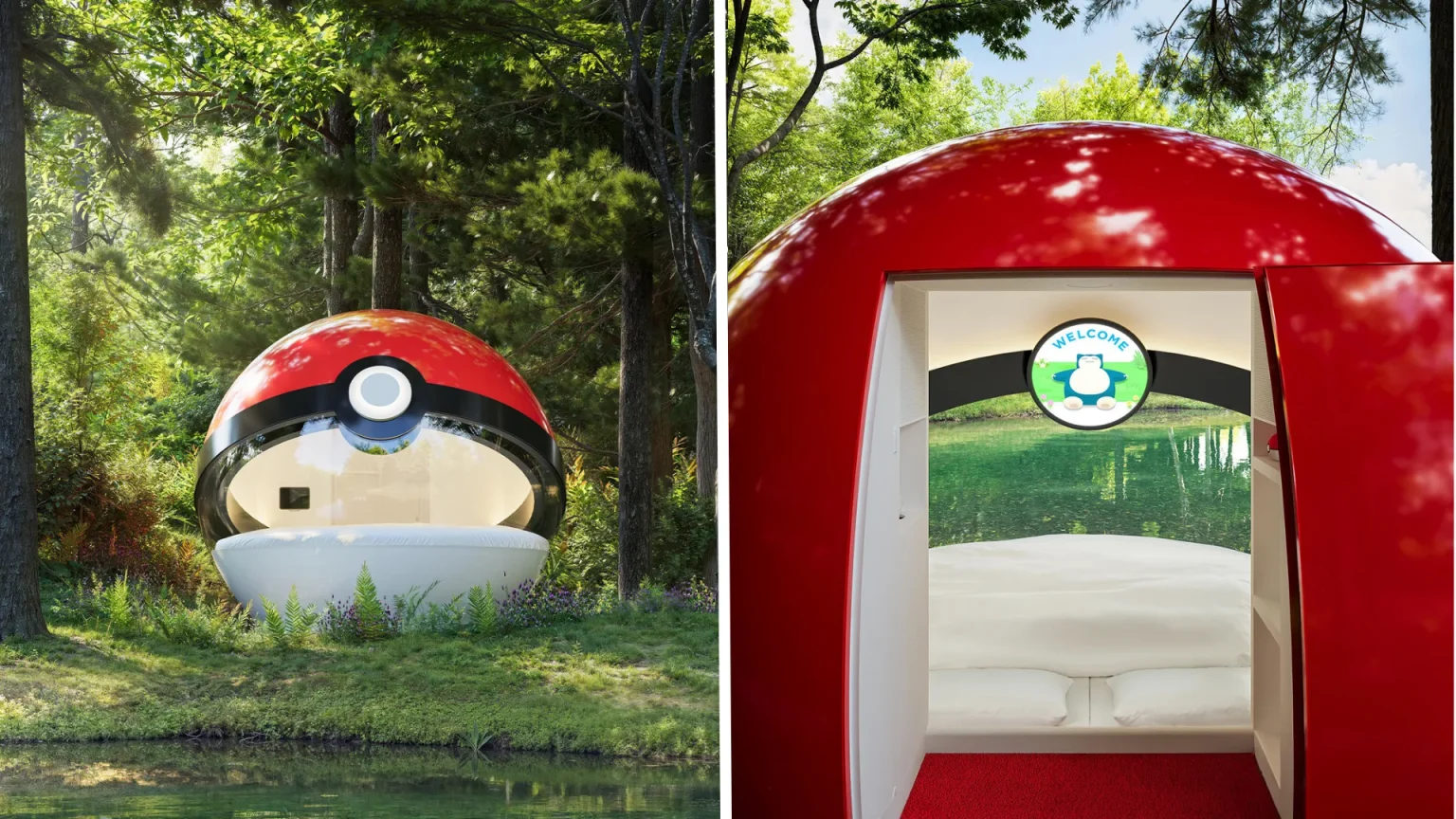

A Giant Poké Ball, a red-and-white sphere, has landed in the Hokkaido landscape, its familiar graphic geometry scaled beyond toy, screen, and souvenir. Inside, the Pokémon Poké Ball becomes a room: a place to sleep, look out at the forest, and temporarily occupy the logic of a fictional world.
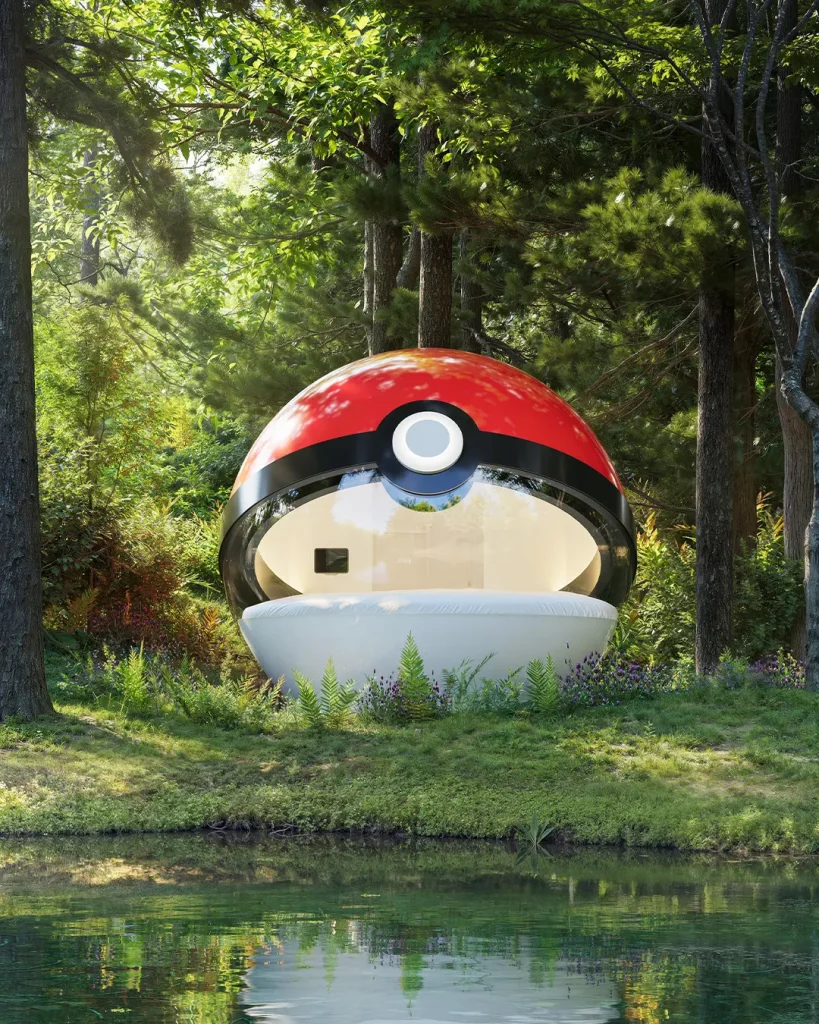
Created through a collaboration between Pokémon Sleep and Japanese hospitality company NOT A HOTEL, the Poké Ball-themed hotel turns one of pop culture’s most recognizable objects into a human-scale retreat. Planned for Hokkaido, Japan, the project will be fully revealed on September 15, 2026, while stays will be offered through a limited campaign rather than conventional bookings.
For parametric architects, AEC professionals and computational designers, the interest lies far beyond fandom. This spherical pod offers a compact case study in semantic architecture: a building whose shape is immediately legible, whose spatial experience grows from a single icon, and whose value is inseparable from narrative.
When an icon becomes enclosure
The Poké Ball is a remarkably efficient object. It is a sphere split by a horizontal seam, organised around a circular button, and defined by a high-contrast red-and-white surface. Its geometry is simple enough for a child to sketch from memory. Its cultural meaning is equally immediate.
The challenge of turning it into hospitality is architectural, not graphic. A scaled-up symbol can easily become a hollow marketing object: a giant shell with a generic interior. The early images point to a more deliberate move. The pod appears as a partially open sphere, with a large circular bed occupying much of the interior and a broad glazed opening facing Hokkaido’s wooded scenery.
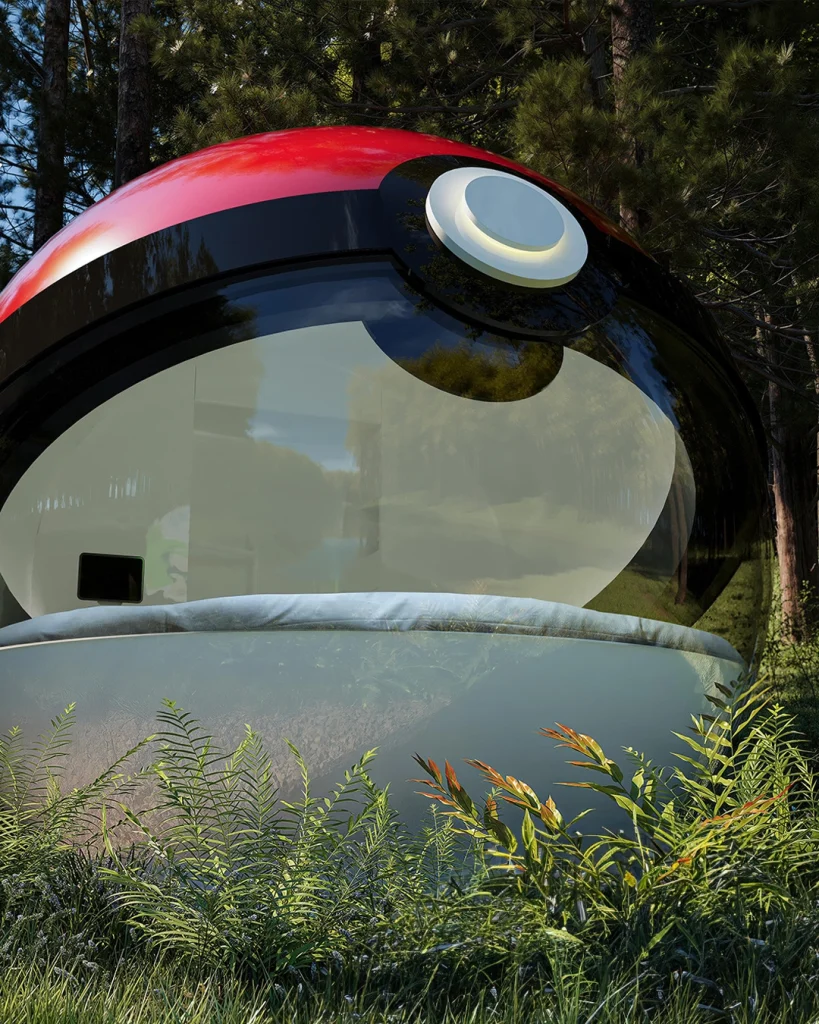
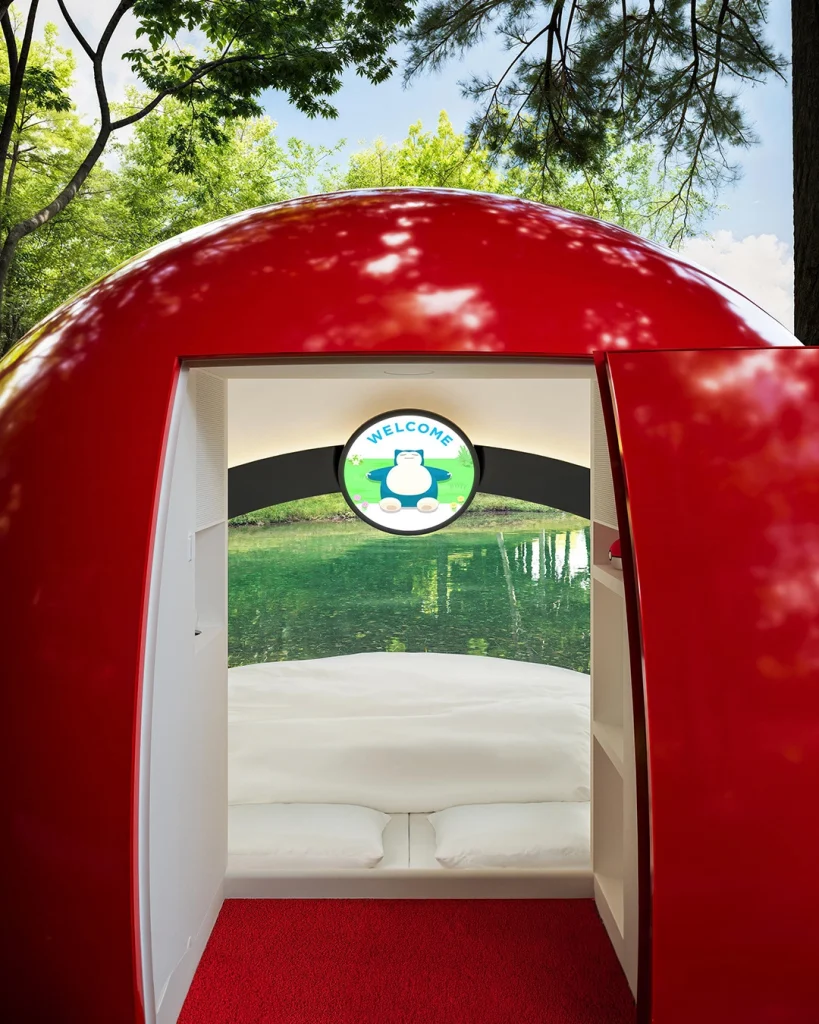
That arrangement preserves the object’s identity while making space for rest, orientation and a visual connection to the landscape. The bed is not added as furniture inside a themed room. It becomes the spatial centre of the project, echoing the interior logic of a Pokémon resting place.
For designers, that distinction is useful. Strong themed architecture does not attach an image to a building. It allows an image to organise circulation, openings, material transitions, scale and atmosphere.
A Giant Poké Ball is a difficult architectural brief
Spherical architecture has always carried a tension between visual purity and practical space. A sphere has no obvious façade, roof or rear elevation. It meets the ground awkwardly. It compresses usable floor area near its perimeter. Its curved skin complicates waterproofing, insulation, cladding and interior fit-out.
Yet the same geometry has powerful experiential benefits. A sphere creates enclosure without corners, produces a strong sense of centrality and reads as a complete object in a landscape. In the Hokkaido pod, the half-open condition solves several of these challenges. It introduces an entrance, establishes a directional view and breaks the sphere’s perfect symmetry to make the interior habitable.
This is where computational design can offer real value. A digital model can coordinate the shell’s curvature, structural ribs, window geometry, panelisation, insulation zones and drainage strategies. A workflow in Rhino, Grasshopper or another parametric environment could test different openings against daylight, wind loads, panoramic views and material waste.
The outcome need not look algorithmic. The public sees a Poké Ball. Behind the surface, however, a successful build would depend on precise geometric coordination.
A pod shaped by sleep, not spectacle
The collaboration is connected to Pokémon Sleep, a wellness-oriented mobile game built around sleeping habits. That context changes the project’s tone.
Instead of creating an adrenaline-driven attraction, the design is positioned around retreat, rest and landscape. The large circular bed reportedly accommodates two people, while the main window frames the surrounding forest. Its immersive quality comes from stillness: the occupant lies within a familiar object, but the view returns them to Hokkaido’s natural setting.
That balance matters in experiential hospitality. The strongest projects do not trap guests inside a branded universe. They use narrative as a lens through which guests notice their surroundings differently.
Hokkaido is especially suited to that approach. Its wide landscapes, forests and seasonal extremes give the pod a sense of isolation and contrast. A spherical red-and-white object set against trees, snow or mist creates a cinematic frame without requiring a large building footprint.
Architecture as a shareable story
The Poké Ball-Themed Hotel arrives during a period when hospitality increasingly competes for attention as much as occupancy. Social media has raised the value of spaces that can be recognised in a single image. But recognisability alone is not enough. The most successful destination projects give visitors an experience that unfolds after the photograph.
Here, the project’s story is already doing much of the architectural work. The premise is instantly understood: sleep inside a Poké Ball. That clarity travels across languages, markets and media platforms. The design does not need a lengthy curatorial statement to explain itself.
For AEC studios, there is a wider lesson. Buildings now operate across physical and digital channels simultaneously. A project must work as an interior, a construction system, a landscape intervention, a photograph and a short video. This does not mean designing for social media first. It means recognising that spatial identity is part of a project’s commercial and cultural performance.
The Poké Ball pod achieves this through a compact visual system: one object, one colour code, one ritual of sleep and one landscape setting.
The micro-architecture opportunity
The project also belongs to a larger movement toward compact, high-character hospitality structures. Cabins, pods, floating suites and prefabricated retreats have become testing grounds for material innovation, off-site construction and low-impact siting.
A human-sized Poké Ball is a highly specific example, but its operational concept has broader relevance. A small, transportable or modular unit can activate remote locations with less construction than a conventional resort. It can focus investment on a memorable room rather than a large building with standardised spaces.
The unknowns remain significant. The final location, interior materials, structural system, cost and environmental strategy have yet to be disclosed. The full design announcement is scheduled for September 15. Until then, it would be premature to judge its construction quality or sustainability claims.

Still, the concept invites useful technical questions. How is the curved shell fabricated? Is it made through moulded composite sections, metal framing, timber ribs or segmented panels? How is ventilation managed in a compact spherical volume? How is condensation controlled in Hokkaido’s cold climate? Where are services, storage and the bathroom located without disrupting the central sleeping space?
These are not secondary details. They are the difference between a compelling render and an enduring piece of architecture.
Fiction becomes a spatial tool
There is a tendency in design culture to separate “serious” architecture from branded entertainment. That distinction is increasingly unhelpful. Fictional worlds often contain powerful spatial ideas: portals, capsules, thresholds, protective shells and alternate scales of inhabitation.
The Poké Ball has always held a strange architectural proposition. From the outside, it is small enough to carry. From the inside, it implies comfort, containment and a private world for its occupant. The hotel brings that paradox into physical form.
It plays with scale, memory and expectation. Guests know the object before they enter it. The architecture begins in collective imagination and ends in an embodied encounter.
For computational designers, this offers another important point. Digital tools can generate endless geometry, yet the most effective forms are often those with a clear cultural anchor. The point is not complexity. The point is resonance.
A small sphere with a large brief
The giant Poké Ball sleeping pod is an unusual hospitality project, yet its design agenda is surprisingly relevant to the wider architecture and AEC community. It combines a strict formal brief, a challenging curved enclosure, a landscape setting, a tightly scripted interior and a globally recognisable narrative.
Its final reveal will determine whether the project succeeds as more than a powerful image. If the construction, environmental controls and interior planning match the clarity of its concept, it could become a valuable example of how branded architecture can remain spatially convincing.
For now, the project offers a simple reminder: memorable architecture does not always begin with a complicated form. Sometimes it begins with a familiar object, scaled up with enough care to let someone step inside.